
Keeping your resume one page is bad advice when it means deleting the work that proves you can do the job. A director's budget ownership matters more than a tidy bottom margin.
One page is an outcome of prioritizing evidence, not a formatting target. Choose what the target role needs to see. Then choose the page count.
Who Actually Needs a One-Page Resume
Cutting proof to hit one page loses interviews. In a ResumeGo hiring simulation reported by CNBC, two-page resumes were selected 2.9 times as often for managerial candidates. Across 7,712 resumes reviewed by 482 recruiters, hiring managers, HR professionals, and executives, matched two-page versions were selected 2.3 times as often overall, with preferences of 1.4 times for entry-level candidates and 2.6 times for mid-level candidates.
Treat that as a warning against rigid rules. Recruiters picked the version with stronger evidence, not the shorter one.
Page count by career stage
Use these as editorial starting points, not experience-based limits.
| Career stage | Page count that fits | When a second page is justified |
|---|---|---|
| Students and recent graduates | One page | Only for substantial research, publications, or work that proves the role |
| Early career, 0 to 5 years | One page | When projects or results would otherwise be cut |
| Mid-level, 5 to 10 years | One page is the goal, two often wins | When the second page holds distinct, role-relevant evidence |
| Senior individual contributor or manager, 10 to 20 years | Two pages | When scope, team size, and results need room |
| Career changers, veterans, and returners | Judge by evidence, not page count | When transferable skills need context to be understood |
| PhD and postdoctoral candidates | Two or more pages | When research, publications, and grants require it |
A long career does not equal a long relevant history. Recent work often proves fit better than a full chronology. Keep the older assignment only when it holds your strongest result for this target.
Specialized applications need specialized preparation. If you are pursuing federal policing work, Eztrackr's federal law enforcement resume guidance offers a role-specific starting point. Follow the vacancy requirements instead of importing a general convention.
Decision test: If cutting a line removes proof the target role asks for, keep the line and reconsider the page count.
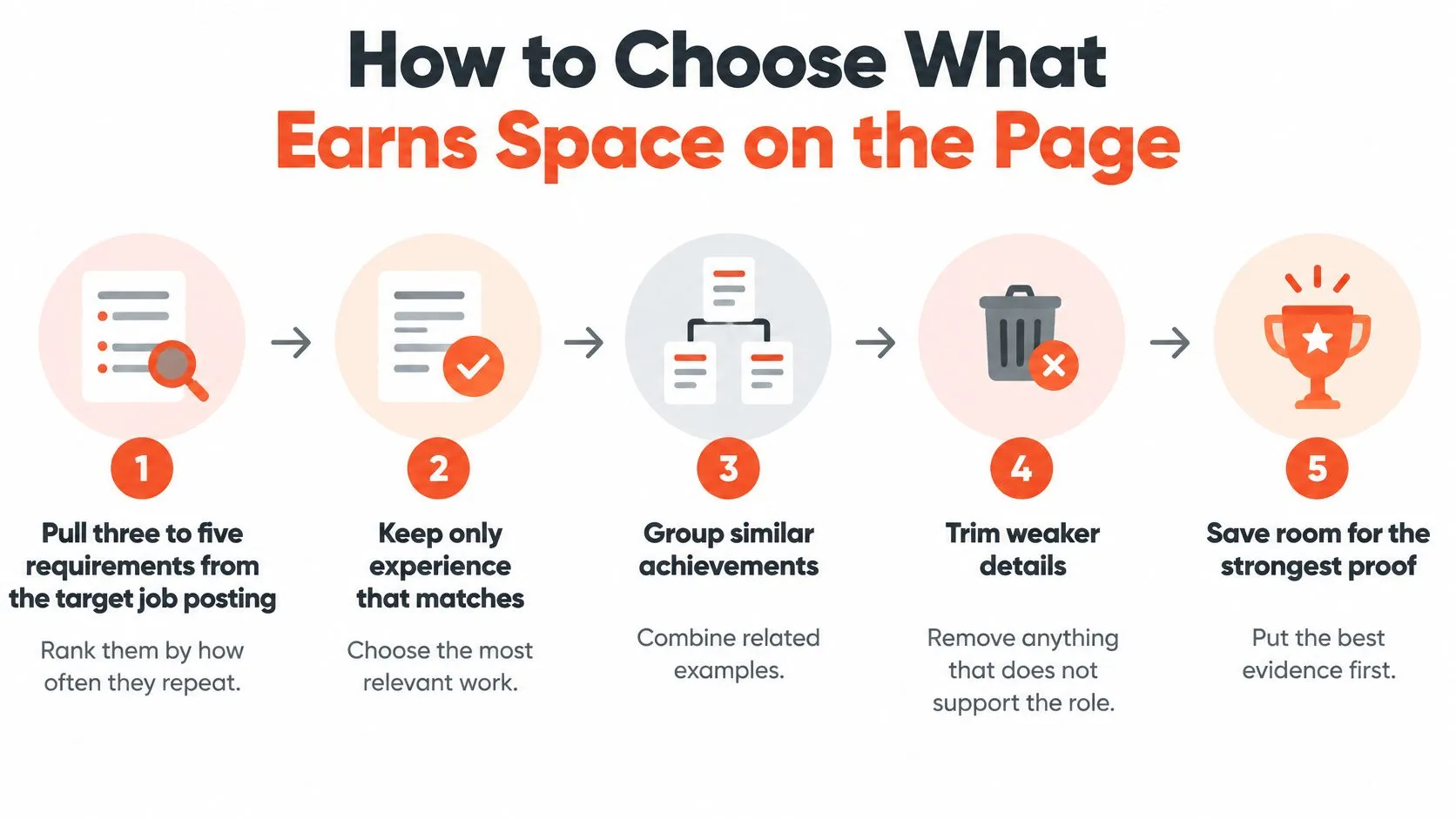
How to Choose What Earns Space on the Page
Start with the job posting, not your existing document. Otherwise, you'll spend your time polishing material that shouldn't survive the edit.
- Pull three to five requirements. Rank them by repetition, then check which requirements the employer explicitly calls essential.
- Keep experience that proves a requirement. Mark each relevant achievement with the requirement it supports. Unmatched content needs a strong reason to stay.
- Convert duties into outcomes. Capture the action, context, and measurable result. Leave an honest placeholder when you need to verify a figure.
- Rank bullets by relevance. Keep jobs in reverse chronology, but lead each role with the achievement most useful to this application.
- Compress wording before readability. Remove repetition, combine related examples, and replace vague phrases with specific verbs.
In the screening simulation summarized by Frontline Source Group, reviewers spent an average of 2 minutes 24 seconds on one-page finalist resumes, compared with 4 minutes 5 seconds on two-page finalists; its practical guidance also recommends two to four high-signal bullets per role.
Those averages aren't a countdown for your application. They reinforce a simpler point: reviewers need enough context to judge the work. Make the top third useful rather than spending it on an introduction about being motivated.
The selection process should look like deliberate sorting, not indiscriminate deletion.
Give each role a purpose
Put your target job title and a clear value line near the top. For a platform engineer, that might mean production reliability, data infrastructure, and reduced operational work. It shouldn't mean adaptable professional seeking new challenges.
Then decide which jobs deserve detail. The guide to how many jobs should be on a resume can help separate relevant history from a complete employment inventory.
A dense page can still conceal your qualifications. Squeezing text against the margins isn't prioritizing. It's postponing the decision about what matters.
Write Bullets That Prove the Work
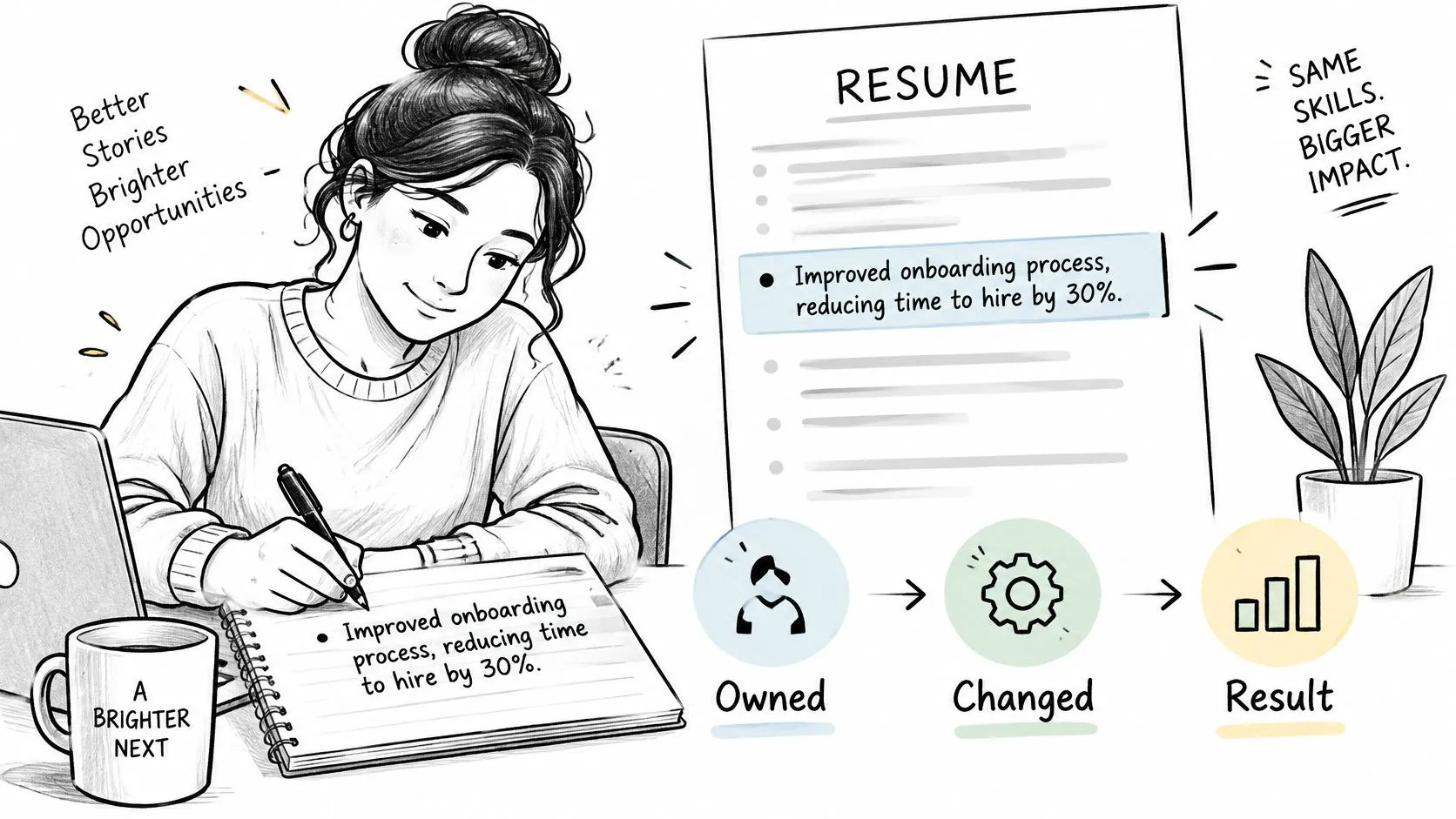
A useful bullet names what you owned, what you changed, and what happened next. The basic pattern is a strong verb, the scope, the tool or method, and the result.
Cornerstone University's resume guidance recommends action verbs and achievement-focused bullets rather than a list of responsibilities. The practical difference is visible in the wording.
Replace the duty with the contribution
Vendor management
- Before: Responsible for vendor management.
- After: Ran [number] vendor contracts worth [amount] a year and renegotiated [number] of them, cutting spend by [percent].
Data engineering
- Before: Worked on the data pipeline.
- After: Rebuilt the [system] pipeline in [tool], cutting failed nightly loads from [number] to [number] a month.
People operations
- Before: Helped with onboarding.
- After: Designed the [number]-week onboarding plan for [number] new hires, reducing time to first solo project from [number] to [number] weeks.
The brackets are questions for you, not permission to invent an impressive figure. Check contracts, dashboards, project records, or performance notes before replacing them.
This is the work behind a concise bullet.
Name results even without a metric
A bullet can work without a number: Replaced spreadsheet-based release approvals with a documented review process, giving engineering and compliance a shared audit trail. The result is concrete even though it isn't expressed as a percentage.
Use STAR as a thinking frame, not a paragraph template. Establish the situation and task, identify your action, and name the result. Keep the who, what, where, how, when, and why that a reviewer needs, then compress the answer.
At StoryCV, we ask what you owned, what you changed, and what happened next for each role. Those questions help distinguish your contribution from the team's general activity.
For more wording patterns, use these resume bullet point examples. If you're translating your experience for English-language applications in Morocco, Englify's CV advice for Moroccan professionals provides relevant context.
A bullet without a result is a duty. Duties go first on the cut list unless they're your only evidence of a required capability.
Layout Rules That Keep the Page Scannable
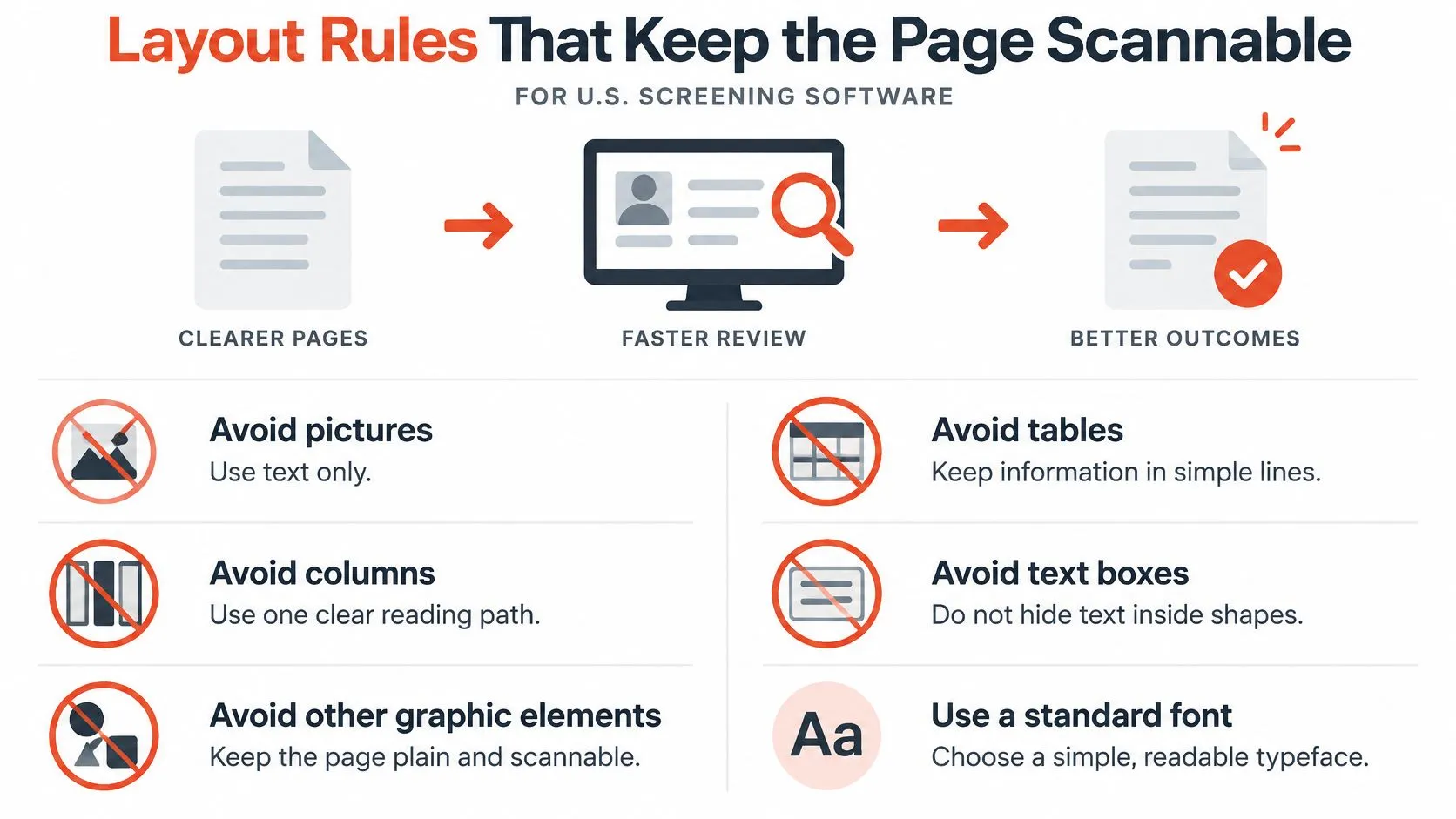
Use plain formatting before you experiment with decoration. The U.S. Social Security Administration's career guidance advises avoiding pictures, tables, columns, text boxes, and other graphic elements; it recommends standard fonts such as Calibri, Arial, Helvetica, Georgia, or Times New Roman, 10 to 12-point body text, and PDF or DOCX rather than GIF, PNG, or JPG.
Treat those as document-preparation recommendations, not a guarantee about a screening outcome. Follow the employer's file instructions when they're specified.
Keep the visual structure simple.
Run the human checklist
- Contact details: Put your name, email, phone, and location together at the top. Use a single line if it remains readable.
- Headline: Place the target title directly below your contact details.
- Experience: Use reverse chronology and a consistent employer, title, and date order.
- Bullets: Follow the selective bullet allocation established earlier, with the strongest evidence first.
- Labels: Use familiar headings such as Experience, Education, and Skills.
- Spacing: Leave visible separation between sections and roles.
Consistent indentation matters too. Use the bullet point formatting guide to check alignment and spacing rather than adjusting every bullet by hand.
Shrinking the font until everything fits passes the page-count test and fails the reader. View the document at normal zoom and scan for your current role, latest date, and strongest relevant skill. If you can't locate them quickly, reorder the page.
For a longer document, University of Pennsylvania Career Services recommends keeping the most important information on page one, adding your name and page number to subsequent pages, and using margins between 0.65 and 1 inch with sufficient white space.
What to Cut First and When to Stop
A cut is wrong when it removes proof and leaves a keyword behind. Delete repeated content first, especially tools and duties that appear under several jobs without showing a different contribution.
Then check every remaining line against the target role. Use this table as an editing policy, not a claim that qualifications expire after a particular anniversary.
Cut or keep each resume element
| Content | Cut when | Keep when |
|---|---|---|
| Objective statement | Always, replace with a headline naming the target role | Never |
| Roles older than 15 years | They don't prove a skill the target role needs | They prove a skill the target role needs |
| Duties without results | The bullet names a task but shows no outcome | The posting asks for the work and no other bullet covers it |
| Hobbies and interests | They have no link to the work | They show a skill the role uses |
| Graduation years | Graduation was more than 10 years ago | The posting asks for them |
| Lapsed certifications | They're expired and the posting doesn't require them | The posting names them as required |
| Tools in the skills list | No bullet shows you using them | The posting names them and a bullet shows you used them |
| References line | Always | Never |
Be careful with the certification exception. An expired credential doesn't establish current eligibility. If the posting requires it, clearly identify its lapsed status and any genuine renewal activity.
Northern Michigan University Career Services states that two pages are acceptable in most situations when the additional information is relevant to the applicant's skills and demonstrates qualification for the position.
Apply that rule to the difficult cuts. An older role might be the only place you managed a regulated operation. A project might establish technical depth that your current management title doesn't reveal.
Stop cutting when the next deletion would remove evidence needed to establish a requirement.
Don't preserve material merely because writing it took effort. But don't erase useful context to satisfy a convention either. A second page full of proof beats a single page that reads like a skills inventory.
Worked Examples for Three Experience Levels
These are hypothetical structures, not completed applications. Replace every bracket with accurate information, and retain only claims you can support.
Recent graduate targeting data analysis
[Name] | [Email] | [Phone] | [Location]
Junior Data Analyst
Economics graduate using SQL, Python, and Tableau to turn operational data into usable reporting.
Education
[Degree], [University] | [Graduation date]
Projects
- Sales analysis: Cleaned [dataset] in Python and built a Tableau dashboard that identified [verified sales pattern].
- Reporting automation: Wrote SQL queries for [project], replacing manual reconciliation with [documented result].
Experience
Data Analyst Intern, [Employer] | [Dates]
- Reporting: Standardized [report] definitions with finance, resolving [documented discrepancy].
Skills
SQL, Python, Tableau, Excel. Retain only tools you've used that match the posting.
Before: Worked on dashboards.
After: Built a Tableau dashboard that helped [audience] identify [verified pattern].
Mid-level engineer with seven years of experience
[Name] | [Email] | [Phone] | [Location]
Data Engineer
Builds reliable Python and SQL pipelines for finance reporting.
Senior Data Engineer, [Current employer] | [Dates]
- Reliability: Rebuilt [pipeline] in Airflow, reducing failed loads from [number] to [number].
- Performance: Tuned Snowflake models, cutting reporting runtime from [duration] to [duration].
- Ownership: Added data-quality checks across [number] sources, catching [error type] before publication.
Data Engineer, [Previous employer] | [Dates]
- Delivery: Built Python ingestion jobs for [number] feeds, replacing [manual process].
- Recovery: Documented pipeline recovery procedures, reducing restoration time from [duration] to [duration].
Analytics Engineer, [Earliest employer] | [Dates]
- Consistency: Created shared SQL models that reconciled [conflicting reports].
Education: [Degree], [Institution]
Skills: Python, SQL, Airflow, Snowflake
Before: Maintained data pipelines.
After: Rebuilt [pipeline] in Airflow, reducing failed loads from [number] to [number].
Director with fifteen years of experience
A second page may be justified here.
[Name] | [Email] | [Phone] | [Location]
Director of Operations
Leads [function] across [locations], managing [team size] and a [budget] operating budget.
Director of Operations, [Current employer] | [Dates]
- Cost: Renegotiated [supplier category], reducing annual spend by [amount].
- Delivery: Redesigned [workflow], improving on-time completion from [percent] to [percent].
- Leadership: Established manager reviews that resolved [documented operational problem].
Operations Manager, [Previous employer] | [Dates]
- Capacity: Replanned staffing across [sites], increasing throughput by [verified amount].
- Quality: Introduced [control], reducing [error type] from [number] to [number].
- Execution: Led [system rollout], replacing [legacy process] with [operational result].
Earlier experience
Regional Operations Lead, [Employer] | [Dates]
Supply Chain Analyst, [Employer] | [Dates]
Education: [Degree], [Institution]
Skills: [Relevant planning systems], supplier negotiation, operational forecasting
Before: Responsible for operations.
After: Led [function] across [locations], delivering [verified operational result].
Career changers use the same bullet rule. Name transferable skills in the summary so the reviewer can connect previous work to the target role.
Test One Role Against the One-Page Rule
Use your next application as the test. Don't rebuild your entire career history before you know which evidence the employer needs.
- Choose the target. Pick the role you're applying to next, not a broad category of jobs.
- Extract the requirements. Copy the posting's three to five most important requirements into a working note.
- Select the evidence. Match relevant experience, group related achievements, rank the strongest proof, and trim weaker details.
- Rewrite the leading bullets. Give each requirement a result-led example. Leave brackets wherever a figure needs checking.
- Fit and audit. Format the document, then inspect every cut. Restore anything that removed essential proof, even if that means keeping the second page.
The useful outcome isn't a particular length. It's a document you can defend line by line, with no invented precision and no important achievement hidden behind vague wording.
Start with a single role
StoryCV is a practical option if the hard part is describing the work. We interview you about each role, ask follow-up questions, and turn your answers into bullets. Typically, a full resume is completed in 1 to 1.5 hours.
Test the process on a single role before tackling the rest. Any number you don't know stays a placeholder until you verify it. You're not under-qualified. You're under-described.
Visit StoryCV to start free with two finished bullet points drawn from your own work. Use them to test what deserves space on your resume, then let the evidence determine whether you need another page.