The most popular advice about follow-up letters is wrong. A thank-you note isn't valuable because it proves you're polite. It's valuable when an internal advocate can forward it to the hiring panel and say, “This is why we should keep talking.”
Hiring decisions stall inside companies. A manager needs evidence for the panel. A recruiter needs a clear reason to reopen a candidate thread. Your follow-up letter should carry that evidence, not ask someone else to find it.
The right follow up letter format is short, specific, and useful without additional explanation. Include one new piece of information, connect it to the role, and make the next step easy to answer. That turns a routine message into a portable piece of proof.
The Letter Your Hiring Advocate Can Actually Forward
“Just checking in on my application” gives an advocate nothing to work with. It restates your interest, but it doesn't add evidence, context, or a sentence worth pasting into a panel discussion.
A stronger note gives the company something new. That might be a relevant result from a recent project, a considered response to a topic raised in the interview, a completed certification, or a concise portfolio example connected to the role. The point isn't to send more material. The point is to make your fit easier to repeat.
Forwardability test: If the person who liked you can't forward the message without rewriting it, the message isn't finished.
Your reader may be a recruiter, interviewer, or hiring manager. Your real audience is the person inside the company who needs a reason to mention you again. Write once for that advocate. The format becomes simpler because every sentence has a job.
A clean follow-up can reinforce the difference between what you did and what you changed. “Managed network infrastructure” describes responsibility. “Managed a 600-device Cisco network across 14 sites, maintaining 99.99% uptime” gives a decision-maker context, action, and outcome. The latter is much easier to carry into a hiring discussion.
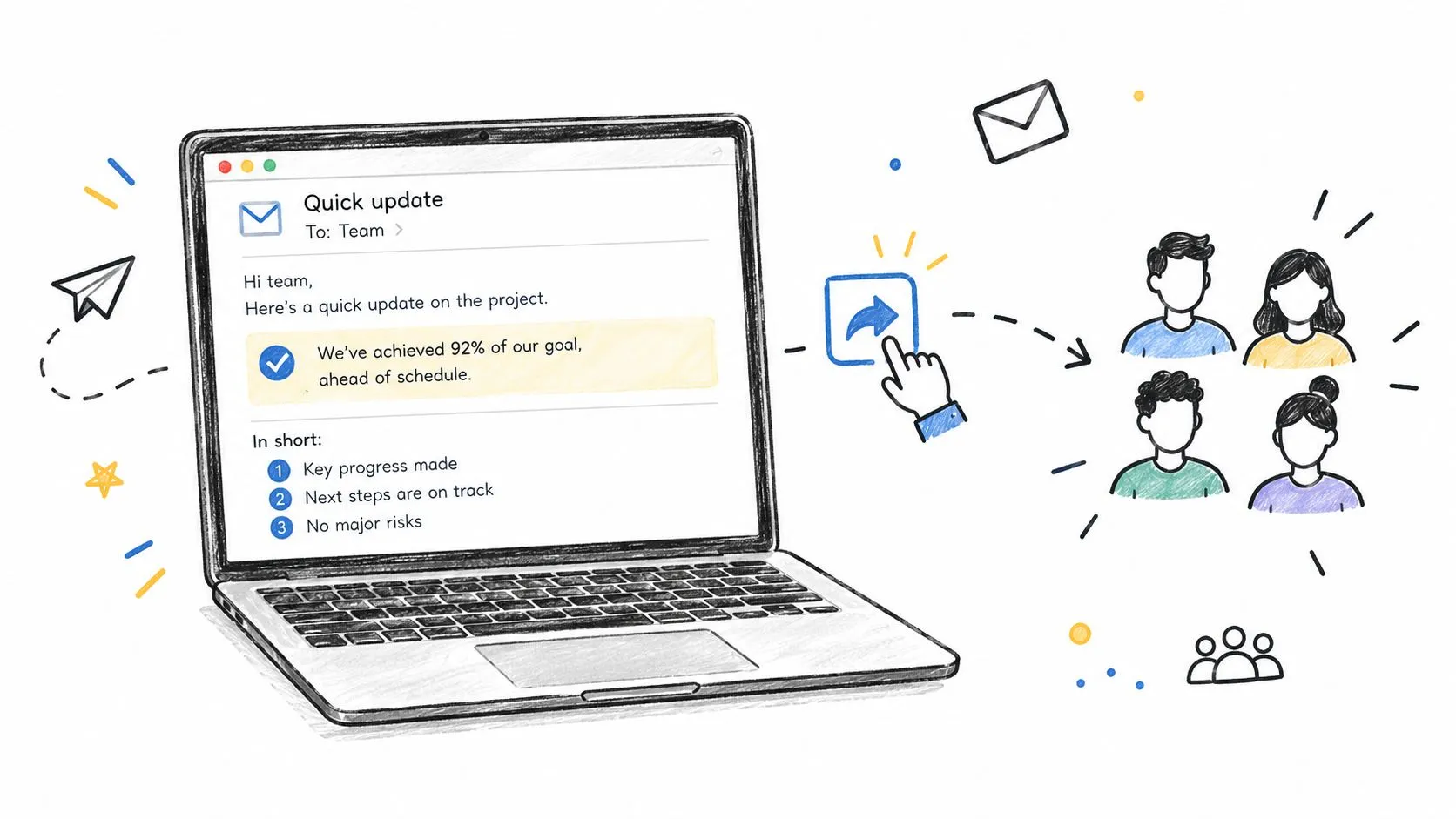
Use the same discipline in your application message. A concise job application email format gives the recipient a clear role, a relevant proof point, and a direct next step. Your follow-up should continue that thread, not restart it with a generic greeting.
Purdue OWL recommends standard business-letter conventions, including block, modified block, or semi-block layouts, 1-inch margins, and a professional font that matches your résumé. It also stresses that the letter should be short and customized to the role, which is exactly what a forwardable message requires. See the Purdue OWL follow-up letter guidance for the formal layout principles.
The Core Layout of a Follow Up Letter
A good follow-up should survive three environments: a recruiter's inbox, a forwarded thread, and a phone screen. Design for all three. Avoid anything that breaks when Outlook, Gmail, or a mobile client handles the message differently.
Start with recognition
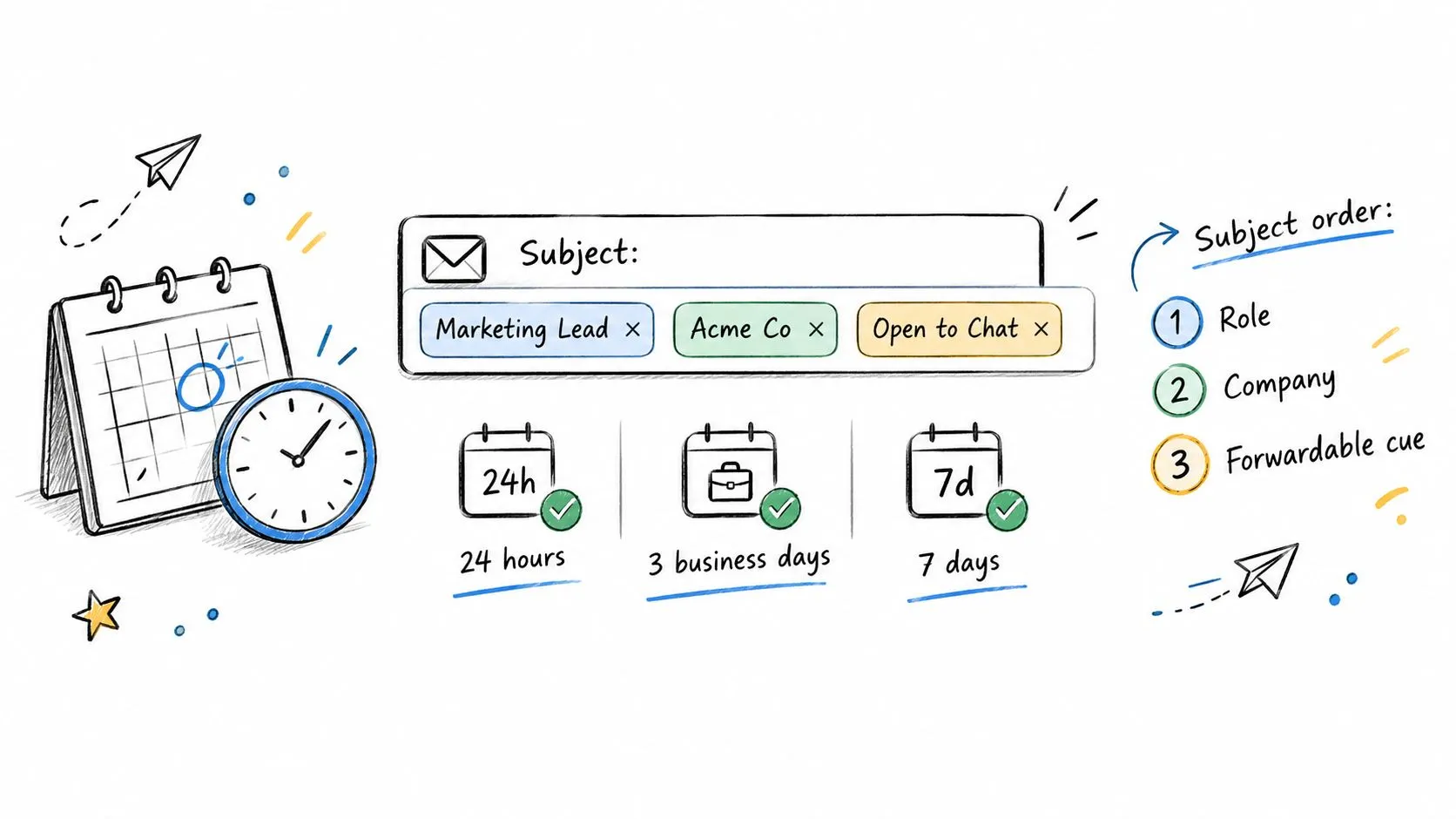
Your subject line should identify the role, company, and useful action. Don't hide the point behind “Checking in” or “Following up.” Use a phrase that helps the reader recognize the thread and understand why the message deserves attention.
Use a greeting that matches the recipient's introduction. If they gave you a first name, use it. “Hi Priya” feels like a continuation of a real conversation. “Dear Hiring Manager” sounds like you never met anyone.
Keep the body in four short blocks:
- Context: Name the role, company, and interaction or application date.
- New value: Add one relevant fact, example, insight, or result.
- Clear ask: Request one next step, preferably with a specific response window.
- Close: Use a professional sign-off and one phone number.
Set the total length between 120 and 180 words. That leaves enough room for evidence without creating a message your advocate has to summarize. Use plain text or one professional font, such as Calibri. Keep everything left-aligned, with one blank line between blocks.
Remove design risk
Don't use tables, logos, decorative images, or elaborate signatures. A PDF attachment can also disappear from a forwarded thread or create friction for a recruiter who only wants text they can paste into a tracker.
Your signature should be no taller than four lines:
Best,
Alex Carter
555-010-0198
alex.carter@example.com
The structure described in a practical sample cover letter for a job application also applies here: recognizable contact details, a personalized salutation, a focused body, a clear call to action, and a professional close. The follow-up is shorter, but it still needs those same signals of control.
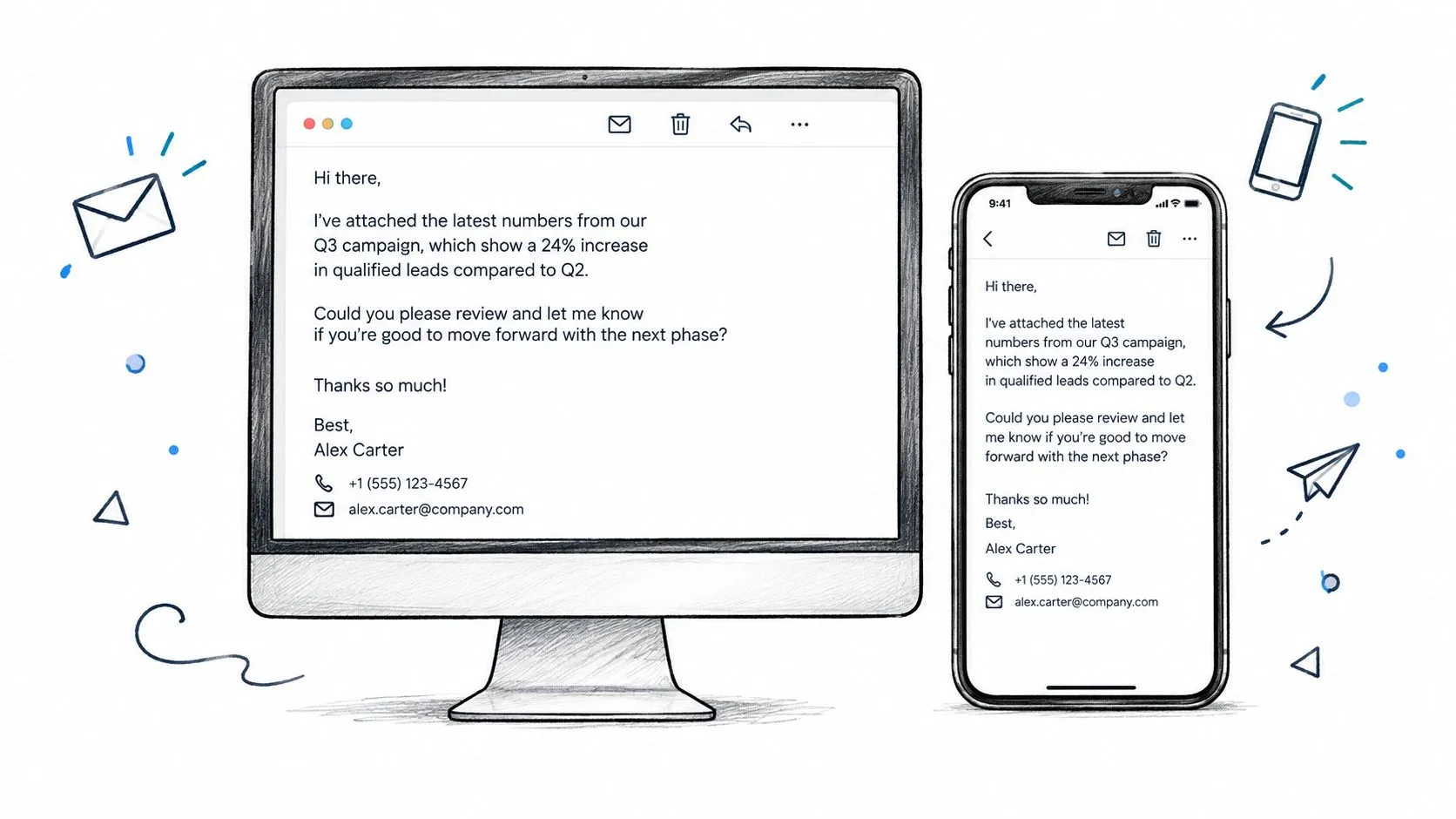
Think of formatting as removal, not decoration. Every extra element competes with the one line an advocate might forward. If the email looks clean when copied into a shared hiring document, you've made the right choices.
Timing and Subject Line That Earn the Open
Timing should match the event, not your anxiety. Send when the recipient is likely to recognize the context and act on it.
Indeed recommends sending an interview follow-up email within 24 hours in its interview follow-up email guidance. Other professional guidance recommends sending follow-up letters with a response request within 3–5 working days, depending on the situation. Use the window that fits the interaction, then stop improvising.
| Scenario | Send Window | Subject Line Pattern | Example Subject |
|---|---|---|---|
| Application with no contact | 7 to 10 business days after the closing date | Role, company, useful update | Senior PM at Lumen, one metric you asked about |
| Interview | Within 24 hours, then at the 7-day mark if needed | Company, role, interview callback | Lumen Senior PM, follow up to Tuesday's panel |
| Informational chat | Within 48 hours | Role or topic, useful takeaway | Product leadership, takeaway from our conversation |
| Recruiter screen | 3 business days, then 7 days before a second note | Application, role, proof point | Application Senior PM Lumen, relevant case study |
Subject lines should stay tight. Adobe recommends keeping them under 60 characters, while its guidance also presents a range of 40 to 60 characters and an upper limit of 10 words in its follow-up email subject line advice. The practical rule is simple: name the role first, the company second, and the forwardable cue last.
Skip “Just following up.” Lead with the information. “Senior PM at Lumen, one metric you asked about” gives the reader a reason to open. “Lumen Senior PM, follow up to Tuesday's panel” makes the thread recognizable. “Application Senior PM Lumen, attached case study” signals a concrete asset, although you should only attach it when the thread supports that choice.
For more subject-line options, use this job application subject line guidance as a reference, then replace generic language with the exact role and proof point.
Four Elements That Make the Letter Worth Reading
The best follow-up I've seen wasn't the warmest. It was the easiest to reuse.
A candidate had interviewed for an operations role. Instead of writing, “I wanted to check whether there were any updates,” she sent a note that connected the interview to a specific operating problem. She added one relevant result from her current role, asked for a short conversation, and included a compact summary her contact could share with the panel.
That message had four parts.
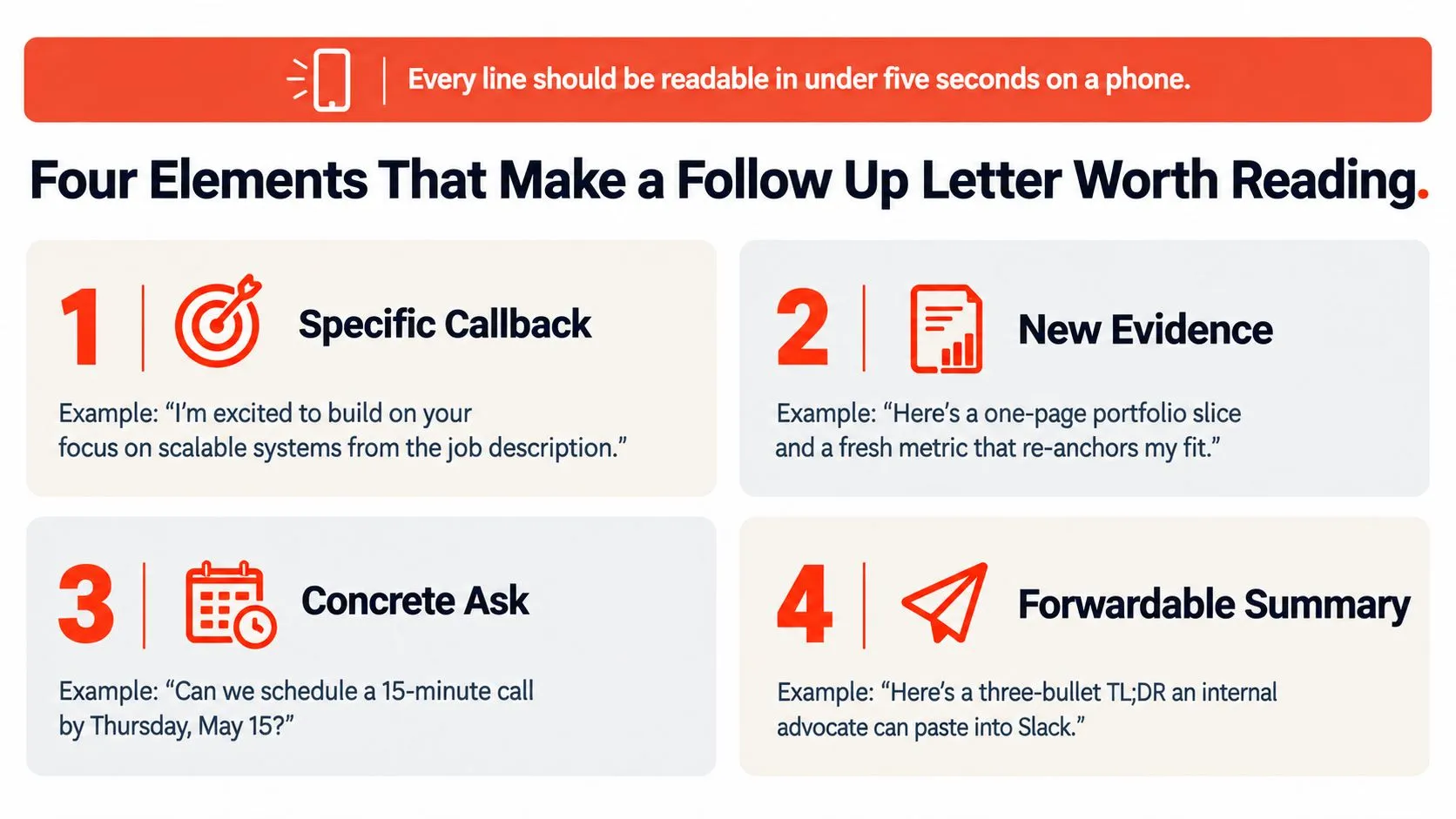
1. Specific callback
Start with something only a participant in the conversation would know.
“Our discussion about reducing handoff delays between implementation and support stayed with me.”
A job-description callback works too:
“You mentioned that the role needs someone to build repeatable reporting processes across regional teams.”
This proves you're continuing the conversation rather than sending a stored template.
2. New evidence
Add one piece of information the panel hasn't already seen. It could be a one-page portfolio slice, a recent project result, or a sharper explanation of work you discussed.
“Since we spoke, I pulled together a one-page example of how I redesigned an escalation workflow and clarified ownership across teams.”
Don't attach a random portfolio. Map the evidence to the role's day-two priorities.
3. Concrete ask
Open-ended questions create work. Ask for one action and give it a clear boundary.
“Would a 15-minute follow-up by Thursday be useful to discuss how I'd approach the first handoff review?”
That question is easier to answer than “Do you have any updates?”
4. Forwardable summary
Give the advocate a short block they can paste into Slack or a panel document:
- Relevant problem: Improved cross-team handoffs in a distributed operations environment.
- Evidence: Built a repeatable escalation workflow with clear ownership.
- Role connection: Can support the team's focus on consistent implementation and support processes.
Every line should scan in under five seconds on a phone. Phrases such as “just checking in” spend attention without creating anything useful. Remove them.
Four Ready to Customize Follow Up Templates
Use the closest template, then replace every bracketed variable. Don't copy one unchanged. The role, company, date, and proof point must match the original thread.
Recent graduate after an application
Subject: Marketing Coordinator, Creative Solutions, campaign project
Hi [First Name],
I applied for the Marketing Coordinator role at Creative Solutions and wanted to share one relevant project. In my [course or project], I built a launch plan for [specific product or audience], including channel messaging and a simple reporting framework. That work matches the role's focus on campaign coordination and clear performance updates. Would you be open to a brief conversation about the team's upcoming launch?
Best,
[Full Name]
[Phone Number]
Replace: [course or project] with a real assignment, internship, or student project. Match keywords from the original posting only when they describe work you completed.
Mid-level professional after a panel interview
Subject: Senior Operations Manager, Lumen, panel follow-up
Hi [Panelist First Name],
Thank you for the conversation on [day] about the Senior Operations Manager role at Lumen. Your point about improving handoffs between implementation and support stood out. I recently redesigned an escalation workflow across [relevant teams or regions], giving managers clearer ownership and faster visibility into blocked work. Would a 15-minute follow-up by Thursday help me share how I'd assess that process in the role?
Best,
[Full Name]
[Phone Number]
Replace: [relevant teams or regions] with the actual scope of your work. Mention the panelist who raised the topic, then make the note easy for that person to forward.
Career changer after networking
Subject: Operations at Northstar, transferable workflow experience
Hi [First Name],
Thanks for speaking with me about operations work at Northstar. I've been translating my experience in [previous industry] into the language your team uses around process ownership and customer handoffs. In my current role, I built a repeatable workflow for [specific process] and used it to coordinate [relevant stakeholders]. Could we continue the conversation with a short call next week?
Best,
[Full Name]
[Phone Number]
Replace: [previous industry] and [specific process] with the work you performed. Don't claim industry experience you don't have. Translate the responsibility into the target industry's language, then show the change you made.
Recruiter outreach to a passive candidate
Subject: Senior Product Manager, Lumen, growth platform result
Hi [Recruiter First Name],
I'm reaching out about senior product opportunities at Lumen. In my current role, I led [specific initiative] across [team or product scope], improving [measurable outcome] while coordinating [relevant functions]. The work aligns with your focus on [role or business priority], particularly the need for a product leader who can connect strategy to execution. Would you be open to a short conversation about the team's priorities?
Best,
[Full Name]
[Phone Number]
Replace: [measurable outcome] with a verified result from your work. Don't manufacture a number to sound senior. If you can't state a result, explain what changed, who benefited, or what decision became possible.
| Scenario | Subject Line Pattern | Opening Line | Core Proof Point | Ask |
|---|---|---|---|---|
| Recent graduate | Role, company, relevant project | “I applied for the [role] role at [company].” | Coursework, internship, or project tied to the posting | Brief conversation |
| Mid-level candidate | Role, company, panel callback | “Thank you for the conversation on [day].” | Relevant work connected to a panelist's concern | 15-minute follow-up |
| Career changer | Target function, company, transferable result | “Thanks for speaking with me about [function].” | Previous-industry work translated into target language | Short networking call |
| Recruiter outreach | Role, company, quantified achievement | “I'm reaching out about [role] opportunities.” | Verified outcome tied to the team's priority | Introductory conversation |
The templates are scaffolding, not a substitute for remembering your work. If you struggle to describe the proof point, start with the raw experience: what changed, who was affected, what did you decide, and what happened afterward? StoryCV can ask those questions and turn the answers into resume-ready bullets, which makes this kind of follow-up evidence easier to find and phrase.
Common Mistakes and How to Fix Them
Most ignored follow-ups fail before the recipient reaches the ask. They don't create a forwarding opportunity.
- Generic opener: “Just wanted to check in” communicates no new information. Replace it with a specific callback to the interview, job description, or application.
- Repeated pings: Multiple messages without new value make persistence feel intrusive. Keep follow-ups to two within a 14-day window, then stop unless the company gives you a different timeline.
- Unusable attachment: A
.pagesor.heicfile creates compatibility and review problems. Use a PDF when a document is requested, or paste the relevant text and include a portfolio link when appropriate. - Buried request: Long paragraphs force the recipient to hunt for your question. Put a three-bullet summary near the top, then make the ask visible.
- Wrong context: A message with the wrong role name, date, or interviewer name damages trust quickly. Check those details before sending.
A follow-up isn't a second résumé. It should add one useful fact, not repeat your entire career history. If the advocate has to explain why the message matters, you've made them do the job your letter was supposed to do.
Simple rule: Send something the internal advocate can forward as written, with no apology and no rewrite.
Send It Then Move On
A strong follow-up letter format has four beats:
- Lead with one useful fact.
- Keep the structure tight.
- Time the message to the situation.
- Customize it to the conversation.
Then log the send date, hiring contact, role, and expected reply window in a simple tracker. If that window passes, send one nudge that references the original message. Don't restart the thread with a fresh introduction.
A follow-up is not a waiting game. It's a useful artifact for the person inside the company who needs to make your case, and it's a learning loop for you. If nobody responds, you still learn which proof point felt strongest, which question was too vague, and which parts of your experience need sharper language next time.
Don't attach a portfolio unless the original thread requested one. Unsolicited files can trigger filters, create gatekeeper friction, or vanish when someone forwards the email. Paste the relevant evidence into the message or provide a clean link when it supports the role.
Your next move is practical. Draft the note, replace the variables, verify the role and names, send it, record the date, and start the next conversation instead of refreshing the inbox.
StoryCV helps you turn real work into clear resume-ready writing by asking focused questions about your responsibilities, context, actions, and outcomes. Use it to uncover the proof points your next follow-up needs, then visit StoryCV to tell your story in stronger words.