An inventory management resume doesn't get stronger because you add SAP, Excel, and cycle counting to a skills list. It gets stronger when you show the stock decision you made, the trade-off you managed, and what changed.
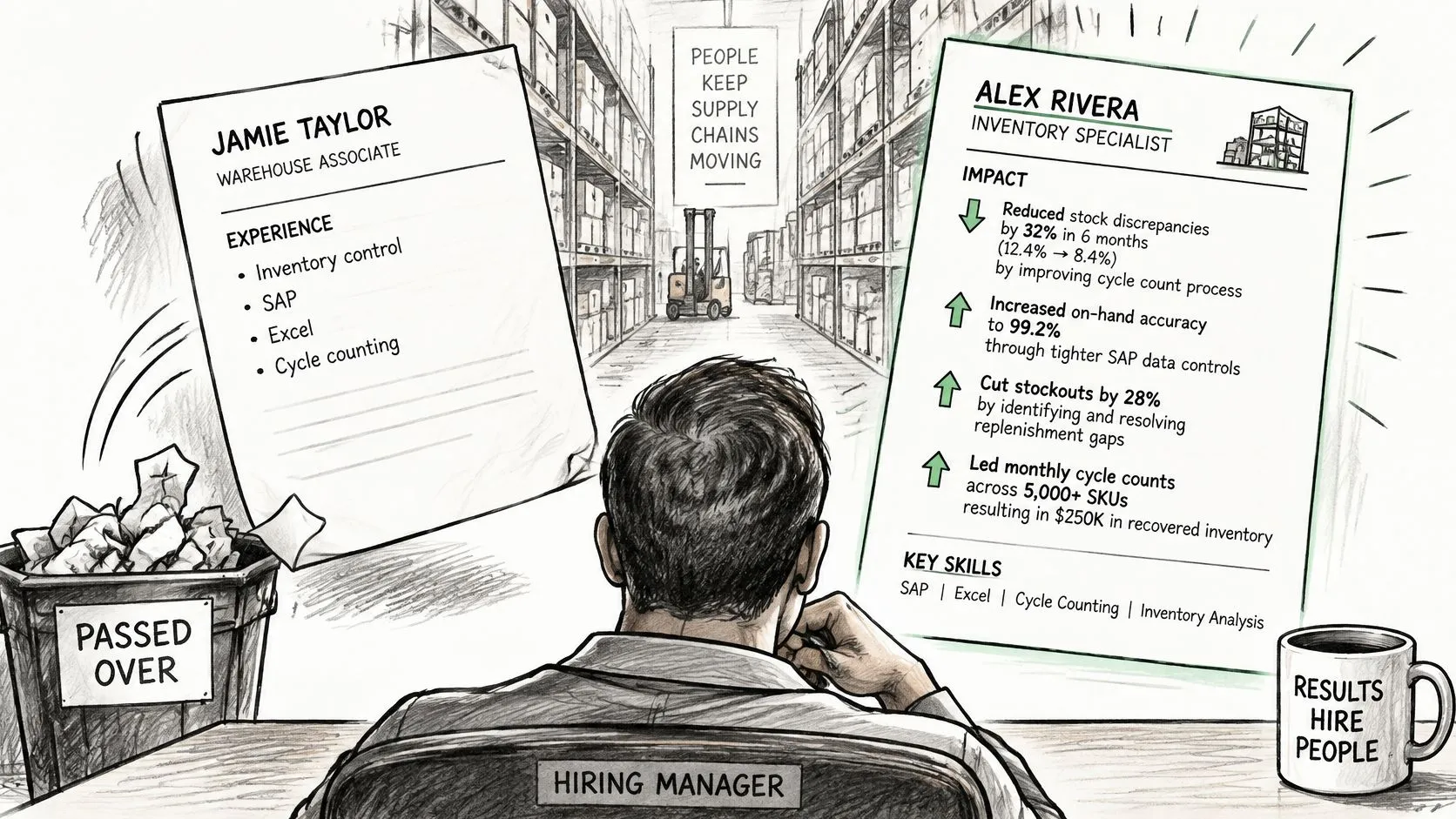
Two people from the same warehouse can use the same systems and do the same counts. One writes, “Responsible for inventory control, SAP, Excel, and cycle counting.” The other explains how a change to replenishment reduced excess stock without hurting availability. The first line gets them into consideration. The second gives a hiring manager a reason to keep reading.
Why an Inventory Management Resume Gets Skipped
Inventory work is a series of trade-offs. You balance service levels against cash tied up in stock, count accuracy against labor, and inventory turns against the risk of stockouts. A resume that says only “updated inventory records” reports the task but hides the judgment.
That judgment matters because inventory is part of logistics, not an isolated administrative function. The U.S. Bureau of Labor Statistics overview of logisticians describes work spanning purchasing, transportation, inventory, and warehousing. It projects U.S. logistician jobs will grow from 255,100 in 2025 to 300,000 in 2035, an 18% increase, with approximately 26,600 openings per year over that decade. The point isn't to claim that a growing field guarantees a job. It's that inventory work connects to a wider operating system, and your resume should show where your decisions affected it.
Tool names are the price of admission. Employers also need to see whether you improved stock integrity, reduced carrying costs, protected product availability, or helped orders move on time. A system name belongs beside the result it helped produce, not in a floating list that says nothing about your contribution.
The hard part often isn't the duty. It's remembering the SKU count, the before number, the change you made, and who felt the result. If you need help telling the human story around your work, this guide to show personality in your cover letter offers a useful companion. For the resume itself, start by recovering the facts behind one stock decision.
Inventory Management Resume Metrics and Bullets
| Metric | Weak line | Stronger bullet | What it proves |
|---|---|---|---|
| Inventory accuracy | Updated inventory records | Raised inventory accuracy from 94% to 99.2% across 18,000 SKUs by redesigning cycle counts | Stock integrity |
| Inventory turns | Managed inventory turns | Lifted turns from 4.0 to 5.5 by clearing slow movers without a fill-rate drop | Cash tied up in stock |
| Excess stock | Responsible for inventory reduction | Cut excess stock 20% by resetting reorder points on C items | The availability versus cash trade-off |
| Stockouts and fill rate | Ensured product availability | Held fill rate through a supplier delay by raising safety stock only on A items | Service under disruption |
| Order-processing errors | Processed warehouse orders | Cut order-processing errors 30% after fixing pick-location mismatches | Fulfillment quality |
| Obsolete and carrying cost | Controlled inventory costs | Reduced excess and obsolete inventory 22% through ABC review and write-off rules | Financial impact |
Treat the stronger bullets as models, not claims to borrow. Replace each number and detail with evidence you can explain. O*NET's inventory-management task list includes monitoring receiving, storage, shipping, and inventory integrity; calculating on-time delivery, order-fulfillment, and inventory-turn metrics; finding opportunities to reduce inventory; and reviewing procedures for efficiency and cost. Those duties point to the measures hiring managers can use to judge your work.
Take one line and unpack its logic:
“Cut excess stock 20% across 18,000 SKUs by resetting reorder points on C items, while fill rate held.”
Context: the inventory covered a defined scope. Action: excess stock went down. Mechanism: the candidate reset reorder points on C items. Outcome: the fill rate held, showing that the reduction didn't come at the cost of availability. A number without scope is empty. A tool name without a result is decoration.
Choose measures that match the problem you owned. Accuracy and cycle-count variance show whether records match physical stock. Turns and excess inventory make the cash side visible. Fill rate and stockouts show the service cost of keeping too little on hand. Order errors and obsolete stock expose failures that a general “managed inventory” claim conceals. For more ways to express results clearly, use these examples of metrics on a resume.
If you can picture the change but can't find the sentence, walk that one result through questions until the bullet is yours. Find my words.
Inventory Management Resume Block by Block
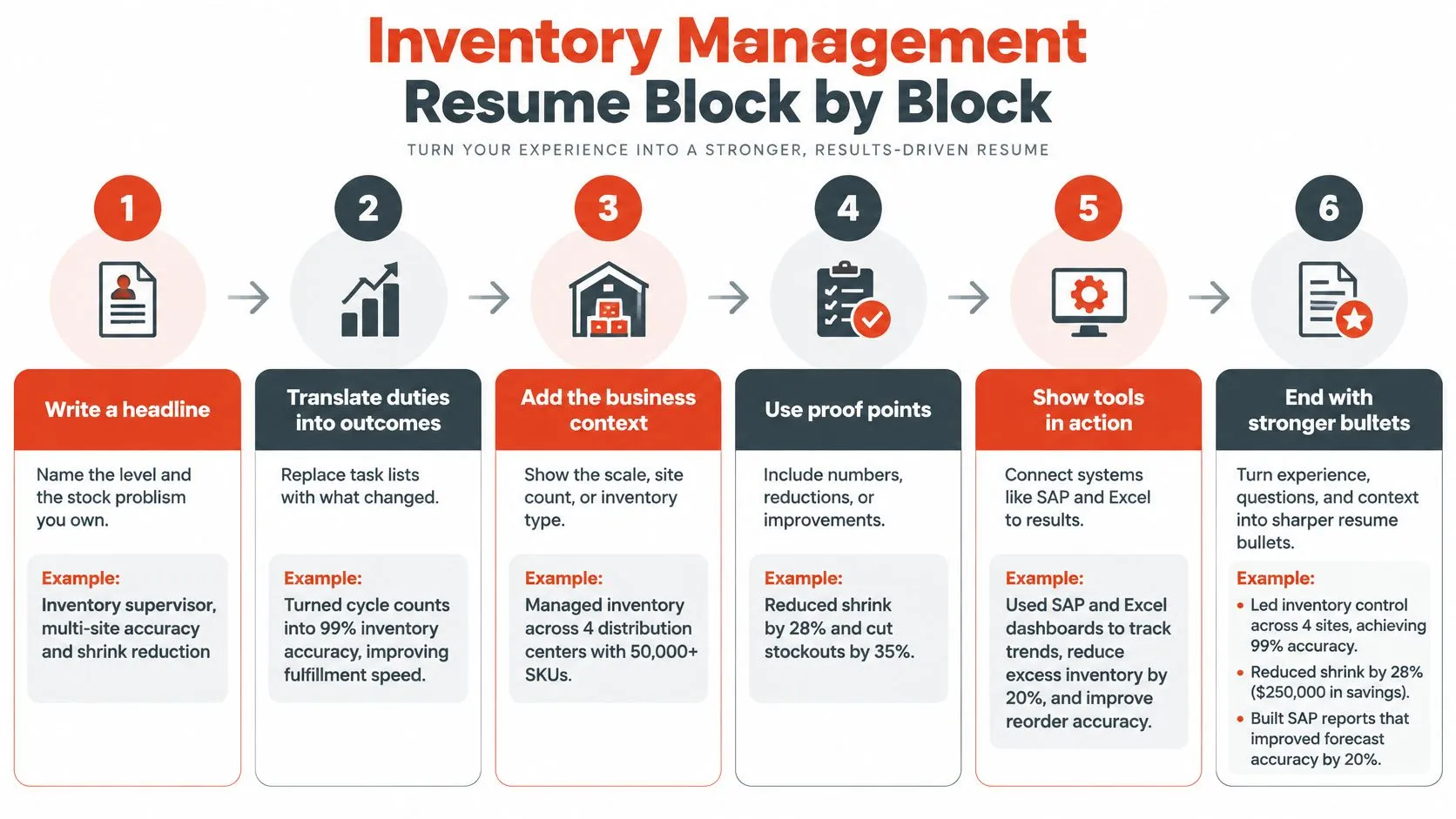
Build the content in the order a hiring manager needs it, not the order a resume template happens to offer.
-
Name the level and stock problem you own. Write a headline such as “Inventory Supervisor, Multi-Site Accuracy and Replenishment.” It signals what you handle more clearly than “Experienced professional.”
-
Write a three-line summary. Put scope first, such as sites, SKUs, or categories. Then state the trade-off you managed and one result. “Organized” and “detail-oriented” don't prove either.
-
Choose four to six bullets for each recent role. Rank them by business pain, not your daily calendar. Accuracy, turns, stockouts, and cost usually say more about your impact than receiving paperwork.
-
Ask three questions for every bullet. What did you own? What did you change? What happened next? A cycle-count bullet, for instance, should make clear whether you owned a zone, changed the count process, and reduced a discrepancy.
-
Name one mechanism when it explains the change. Use the detail that matters: ABC classification, revised reorder points, a cycle-count redesign, safety stock during a shortage, or a WMS or ERP change you led. Put SAP or Excel inside the bullet when it's relevant to the result.
-
Separate tool exposure from ownership. A short skills line can distinguish systems you used, trackers you built, and implementations you led. Don't claim to have run an ERP cutover because you scanned stock in a warehouse.
The profession also asks people to manage uncertainty, not just counts. ASCM's certification framework identifies demand variation, risk, and disruption as central to planning and inventory management. If you adjusted a forecast, changed safety stock during a shortage, or protected availability when a supplier slipped, show the decision and its operational result. Don't claim resilience in the abstract. Show what you changed.
StoryCV applies the same interview logic to work history: it asks what you owned, what you changed, and what happened next for each role. Use those answers to shape your professional experience section. Formatting comes after you have a headline, a summary, and proof.
Inventory Management Resume Proof by Career Stage
The same metric tells a different story depending on your level. Lead with the decisions you owned, not the decisions you hope to own next.
| Stage | Lead with | Example proof | Skip |
|---|---|---|---|
| Entry or floor | A count or zone you personally owned | Cut cycle-count variance on one aisle after fixing locations | A strategy you didn't set |
| Mid-level | A policy, tracker, or process you changed | Reset reorder points and raised accuracy 12% | A tool list with no result |
| Senior | Turns, service, and cost across sites | Cut obsolete stock 22% while protecting fill rate | Daily receiving tasks |
| Career change | Transferable evidence in inventory language | Reconciled serialized gear across two sites and closed record gaps | An ERP title you didn't own |
An entry-level warehouse candidate shouldn't claim network-wide inventory strategy if their responsibility was one aisle. A location fix or a reduction in mispicks can still show ownership. Be clear about the zone, count, or discrepancy you handled.
A supervisor or analyst can move up a level by showing a changed process. Say you rebuilt a replenishment tracker or reset reorder points. The resume should make the resulting change visible, not leave the hiring manager to guess what the spreadsheet did.
Senior candidates need to connect decisions across sites to both service and money. A bullet about obsolete stock matters more when it also shows how product availability was protected. If that evidence needs more room, use it. Don't pad the page with recurring duties.
A title isn't the only route into inventory work. The Indeed guide to inventory-manager resumes discusses translating adjacent experience: reconciling equipment can demonstrate inventory accuracy; scheduling materials can show planning; investigating discrepancies can show root-cause work; enforcing a count procedure can show compliance. For example, someone moving from equipment control could write: “Reconciled serialized gear across two sites, closed record gaps, and delivered a clean count to procurement.” That's inventory evidence without pretending the person held an inventory-manager title.
Be equally honest about systems. “Used Excel reports” means exposure. “Built a replenishment tracker” shows working ownership. “Led an ERP cutover” says you ran a substantial change. StoryCV is designed for people with complex paths, including career changers, military transitions, and people returning to the workforce. Translate the work, but don't inflate it.
Inventory Management Resume Length and ATS Formatting
Use one page when it tells the story cleanly. Use two when cutting material would hide your scope or results. Don't shrink meaningful evidence just to obey an arbitrary page rule.
A hiring simulation involving 482 recruiters, hiring managers, HR professionals, and executives assessed nearly 20,000 one- and two-page resumes. Of the 7,712 resumes reviewers selected, 5,375 were two pages. Reviewers were 2.6 times more likely to prefer two pages for mid-level roles and 2.9 times more likely for managerial roles, according to the Business Insider report on the resume-length simulation. That doesn't mean every inventory professional needs two pages. The second page earns its place when it adds real proof, such as broader facility scope, accuracy gains, stockout reductions, or cost improvements.
Keep the document focused. The NIH resume and CV guide recommends one or two pages and notes that a second page may be appropriate at roughly every seven years of experience. For an inventory manager, that space is for results and progression, not another paragraph of routine duties.
Cut the padding:
- Delete soft claims such as “organized,” “team player,” and “responsible for.” Replace them with evidence.
- Remove repeated skills. If SAP or cycle counting already appears in strong experience bullets, a long skills block adds little.
- Drop systems you can't explain. A scanner isn't proof of ERP expertise.
- Use standard headings. Keep sections such as Experience, Skills, and Education easy for people and parsers to recognize.
- Place keywords in context. Name a system in the bullet where you used it to make a change, rather than hiding it in a keyword paragraph.
For practical file and parsing choices, follow this guide to optimizing a resume for ATS. The aim is a readable file that says what you did without making a hiring manager hunt for the proof.
The parser needs the words. The hiring manager needs the trade-off.
Turn Your Inventory Work Into Resume Bullets
You already know the move: pick the trade-off, name the scope, include one mechanism, and use a number you can defend. The harder part is remembering which count, policy, or result was yours. A bullet should describe your work, not borrow a polished example that sounds plausible.
Start with the role where you made the sharpest stock decision. Write down what you owned, what you changed, and what happened next. If you don't remember the exact accuracy level or SKU count, mark it for follow-up instead of guessing. Your resume should only claim numbers you can explain in an interview.
StoryCV helps professionals turn real work into resume-ready bullet points through questions about what they did. Every number in the bullets comes from your own answers. It's free to start, including two finished bullet points, so you can test the process with one role before deciding what else to write.
Don't begin with the job title that sounds most impressive. Begin with the stock decision that best shows your judgment: the time you reduced excess without hurting fill rate, corrected recurring count errors, or protected availability through a supplier delay. Make that the first bullet on the page.
StoryCV helps you turn the inventory work you remember into clear bullets by asking what you owned, what you changed, and what happened next. Start with the role where you made the toughest stock decision, then Start my role with StoryCV.