Your ultrasound tech resume doesn't have a formatting problem. It has an evidence problem: “performed abdominal ultrasound exams” tells a hiring manager what the job involves, not how well you did it.
Most advice about ultrasound tech resume examples starts with margins and keyword matching. That can leave you with a tidy document that reads like a job description rewritten in the first person. Your credentials and specialties belong near the top. But the bullets need to show what you noticed, what you changed, and why it mattered.
Think about an unexpected finding you flagged. An exam you adapted when standard positioning wasn't possible. Images the interpreting physician could use without requesting another acquisition.
The test: Could another sonographer copy your bullet without changing anything? If so, it probably describes a duty rather than your skill.
The examples below are illustrative, not patient case histories or results to borrow. Use their reasoning. Replace the circumstances and outcomes with work you can truthfully explain.
1. Entry-Level Abdominal Ultrasound Tech Resume (0-2 Years)
You don't need years of independent scanning to show attentiveness. You do need to distinguish supervised clinical experience from work you performed independently.
Put your program, graduation date, clinical placements, and exact credential status where they're easy to find. Keep education separate from credentials, and don't turn an examination passed or scheduled into a registry you've earned. The ARDMS eligibility and examination overview explains why documented training and precise certification status matter.
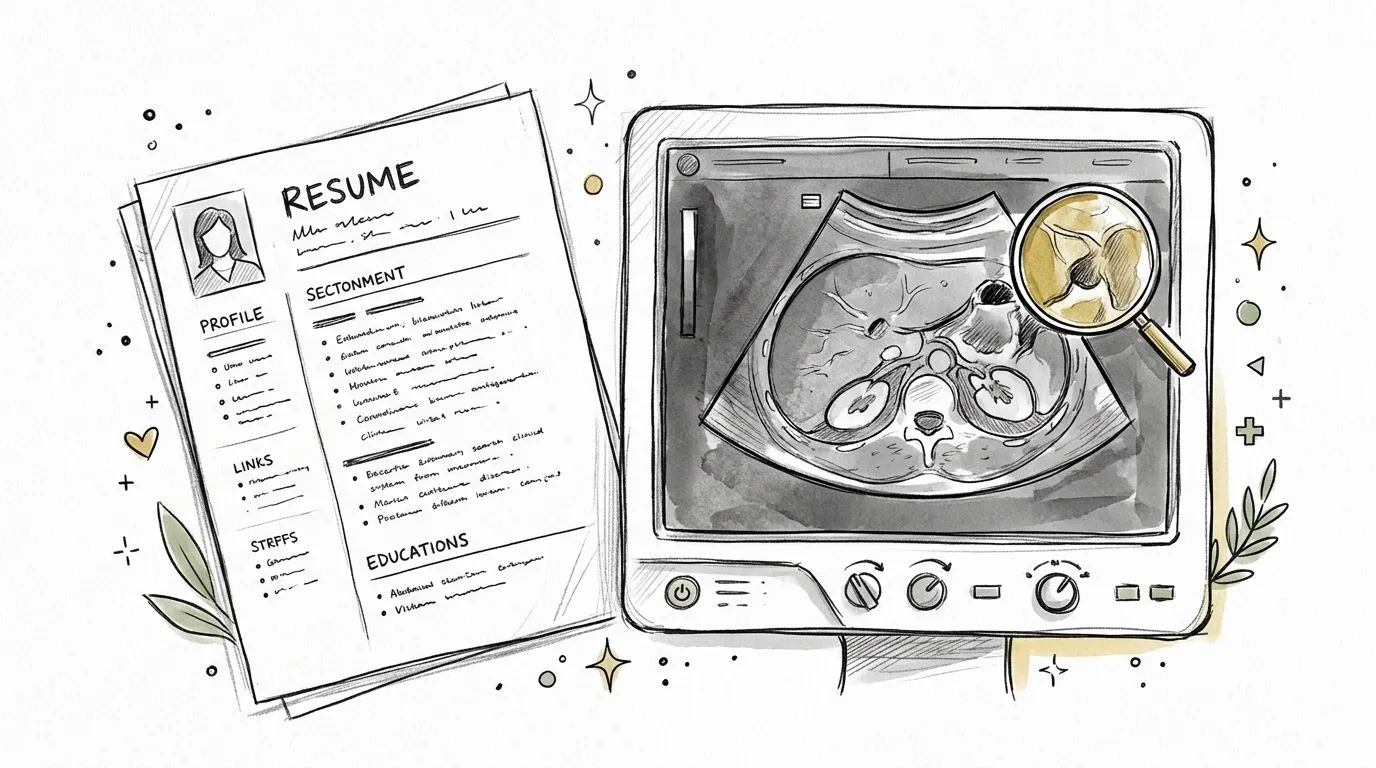
Show What You Noticed Under Supervision
Duty version
“Performed abdominal ultrasound exams and recorded findings.”
Judgment-based alternatives, illustrative
- Finding recognition: “Identified an atypical gallbladder finding during a supervised abdominal exam and documented additional images for the supervising sonographer and interpreting physician.”
- Patient adaptation: “Adjusted the scan sequence under supervision when breath-holding was unreliable, obtaining the required liver and kidney views.”
These bullets don't pretend you're the diagnosing physician. They show observation, adaptation, and appropriate communication.
Start with exams where you slowed down. What made you pause? What did you change, and what did your supervisor confirm?
Use entry-level resume objective examples to keep your opening focused on clinical readiness rather than enthusiasm alone. Your resume for ultrasound technician roles should make your actual scope clear, not inflate it.
2. OB/GYN Sonographer Resume for Mid-Level Roles (3-7 Years)
“Performed obstetric ultrasound exams” leaves out almost everything that distinguishes an experienced sonographer. The useful detail is how you completed a difficult examination while protecting patient comfort and diagnostic quality.
List your earned credentials and OB/GYN scope clearly. Then spend your experience section on decisions, not an inventory of examinations.

Replace Completion With Adaptation
Weak: “Performed obstetric ultrasound exams including dating, anatomy, and biometry.”
Stronger, illustrative: “Adapted positioning and acquisition sequence during a fetal anatomy survey when supine positioning wasn't tolerated, completing the required views during the visit.”
The stronger version explains the constraint and your response. It doesn't just claim you were flexible.
Another illustrative bullet could read: “Reviewed recurring image-quality feedback with the reading physician and adjusted acquisition technique to address requests for additional views.” Claim fewer repeat requests only if you observed and can substantiate that result.
An outcome doesn't need a percentage. It needs to be something that actually happened.
The BLS description of sonographer work and professional qualities identifies communication, attention to detail, patient care, and equipment operation as relevant capabilities. Show those capabilities inside the clinical work instead of listing them as unsupported adjectives.
For an ultrasound technologist resume, the adaptation is the evidence. Name the positioning, transducer choice, or acquisition sequence you changed. Keep the outcome within what you know.
3. Vascular Technologist Resume for Senior Roles (8+ Years)
At senior level, lead with the studies that required interpretation-aware scanning and sound escalation. A long list of carotid and peripheral studies doesn't explain why a department trusted you with difficult work.
Your vascular credential and registry status should be explicit. Use the exact designation you've earned, such as RVT, rather than treating cardiac and vascular credentials as interchangeable.
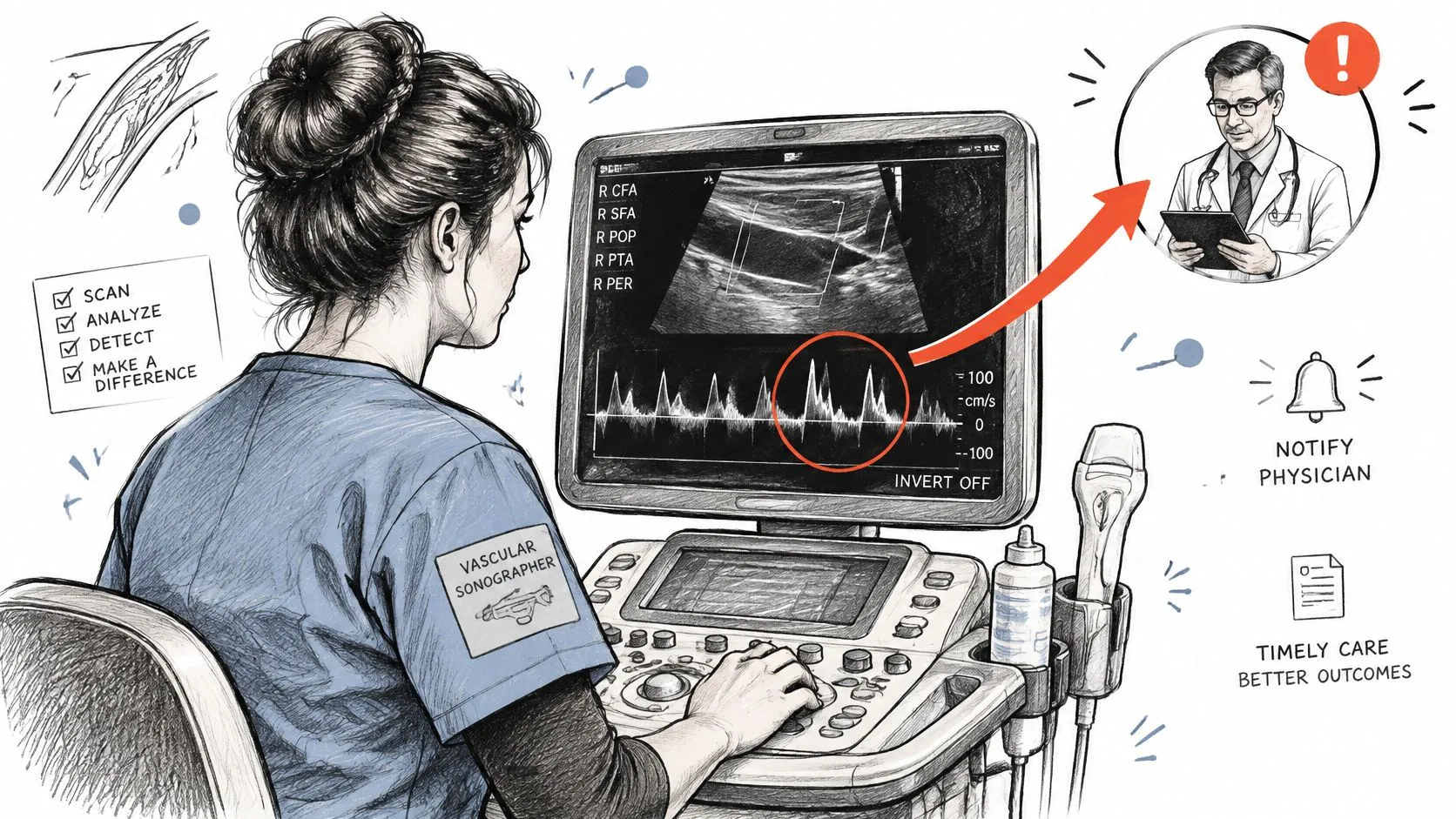
Make the Escalation Visible
Compare these illustrative versions:
- Duty: “Performed carotid and lower-extremity venous duplex studies.”
- Judgment: “Recognized a carotid flow pattern that differed from the referral indication and notified the interpreting physician before the patient left the department.”
- Technical adaptation: “Adjusted transducer approach during a technically difficult venous examination, documenting the required views and communicating examination limitations to the reader.”
The last example matters because recognizing a limitation is also judgment. Don't turn an incomplete or constrained examination into a claim of perfect diagnostic coverage.
Explain the action you took through the department's actual escalation process. Physician notification, additional documentation, and communication of limitations are clearer than “handled critical findings.”
Avoid claiming that you prevented a complication unless you have evidence for that outcome. Your defensible contribution may be that the physician received the finding promptly and had the images needed for review.
Senior ultrasound technician resume examples should show where experience changed your decisions. Longevity alone isn't the achievement.
4. Cardiac Sonographer Resume for Mid-Level Echo Roles
Weak: “Performed adult transthoracic echocardiograms using two-dimensional imaging, M-mode, and Doppler.”
That sentence establishes scope. It doesn't show what you did when the usual approach wasn't enough.
For an echo-focused ultrasound tech resume, put your earned RCS or RDCS credential, current status, and actual examination scope near the top. Keep the credentialing organization attached to the correct designation.
Write From the Cardiologist's Perspective
Consider these illustrative alternatives:
- Unexpected finding: “Recognized an unexpected valve finding during a limited echocardiogram and flagged the images for same-day cardiology review.”
- Difficult windows: “Changed acoustic windows during a technically difficult echocardiogram to capture the measurements requested by the interpreting cardiologist.”
The reader can now see both the problem and your response. If you remember the specific window or view, name it when it adds useful detail.
Don't attach “without a repeat visit” unless that was the observed result. Capturing the requested measurements is already a meaningful outcome.
Ask yourself what the cardiologist needed that the initial acquisition didn't provide. Then describe how you addressed that need, including any remaining limitations.
Ultrasound technologist resume examples become useful rather than decorative here. They help you move from technique named to technique chosen for a reason.
If you remember the study but can't explain its significance, StoryCV can help you work through the context, action, and outcome. Start with the difficult acquisition, not the polished sentence.
5. Lead Sonographer Resume for Supervisory Roles
A lead sonographer resume should show what you changed about other people's work, not just that you assigned it. “Supervised staff” doesn't explain whether image quality became more consistent or whether anyone learned a better approach.
Keep credentials visible. Then lead with quality ownership, protocol consistency, and coaching tied to actual scanning decisions.

Show the Problem You Traced
Duty version
“Supervised sonographers and managed department schedules.”
Leadership versions, illustrative
- Peer review: “Introduced peer image review after identifying inconsistent abdominal protocol coverage, then used review findings to guide staff coaching.”
- Root-cause work: “Investigated recurring repeat-image requests, identified inconsistent transducer settings, and standardized the acquisition approach across shifts.”
Neither bullet needs an invented team size or improvement percentage. Each names a problem, a decision, and a concrete change.
The next question is whether the change worked. Use documented quality findings or observed physician feedback when you have it. If you don't, describe the process you implemented without claiming a result you never checked.
Leadership evidence: Explain what you noticed, what you changed, and how you checked the work afterward.
The strongest leadership examples for a resume connect authority to a decision someone can examine. For a lead sonographer, that might mean reviewing follow-up images, coaching acquisition technique, or resolving inconsistent protocol use.
Don't let scheduling duties crowd out the clinical judgment that made you a credible lead.
6. Returning Sonographer Resume After a Career Break
A career break belongs on the resume. It doesn't need to become the resume's main subject.
Lead with your current credential status, then separate previous clinical experience from recent education or supervised practice. Don't imply you're current on equipment or protocols you haven't used recently.
Keep the Gap Short and the Evidence Specific
An illustrative gap line can be simple: “Career break for family care.” Add your actual dates, and list completed continuing education separately with its real subject and completion date.
For the clinical experience itself, compare:
- Duty: “Performed general abdominal and pelvic ultrasound exams.”
- Judgment, illustrative: “Recognized an unexpected finding during a routine pelvic examination and followed departmental procedures for same-day physician notification.”
- Current preparation: Describe completed refresher education or supervised practice precisely, without presenting study as independent scanning experience.
Use consistent dates on a resume so the reader can understand the sequence without guessing.
A clinical skills update for nurses concerns a different profession. Don't present nursing refresher education as sonography preparation or a substitute for role-specific requirements.
Your previous judgment is worth describing, but current readiness still needs current evidence. Keep both visible rather than claiming that experience makes a skills update unnecessary.
Start with an exam you still remember clearly. Write what you noticed, whom you told, and what you documented. Leave out patient-identifying details, including age range, gender, and distinctive circumstances.
7. Imaging-Center Multi-Modality Sonographer Resume
An imaging-center resume needs range without reading like an equipment inventory. Group abdominal, pelvic, thyroid, vascular, and other genuine specialties together, then use your bullets to explain how you handled variation.
Choose examples that show you protected image quality when patient needs, preparation, or scheduling complicated the examination. Keeping pace isn't an achievement if you leave out whether the study was usable.
Show How You Protected Quality
Duty: “Performed abdominal, pelvic, thyroid, and vascular ultrasound exams.”
Judgment-based alternatives, illustrative:
- Preparation mismatch: “Recognized a mismatch between examination preparation and the scheduled study, confirmed the appropriate next step through departmental procedures, and documented the revised plan.”
- Positioning constraint: “Adapted positioning and transducer approach during a thyroid examination when neck extension wasn't tolerated, capturing the required nodule measurements.”
Don't claim that changing the sequence solves every preparation issue. State what you checked and who authorized any change when that was necessary.
A Parkland sonographer posting illustrates why exact education, registration, and specialty qualifications deserve clear placement. Keep those screening details separate from the bullets that demonstrate your work.
For imaging-center applications, put the most relevant judgment example first. For hospital roles, reorder the same honest evidence around the vacancy's clinical scope.
Useful resume examples for ultrasound technician positions don't give you a universal script. They show how to choose evidence for a particular department without pretending you've done work you haven't.
7 Ultrasound Tech Resume Examples: Side-by-Side Comparison
Treat each resume example as a judgment test, not a template. The duty bullet shows what the sonographer did. The judgment bullet shows what they noticed, decided, or communicated. Use the comparison below to choose evidence that fits the specialty and role, then write only claims you can support.
| Resume example | Duty bullet | Stronger judgment evidence |
|---|---|---|
| Entry-level abdominal ultrasound tech | “Performed abdominal ultrasound exams.” | Describe a specific exam where you adapted your approach to a positioning or preparation constraint, and state what you documented. |
| Mid-level OB/GYN sonographer | “Performed OB/GYN scans and maintained image quality.” | Show how you adjusted technique when the usual views were difficult to obtain, then name the views or measurements you captured. |
| Senior vascular technologist | “Performed vascular studies and reported findings.” | Explain what prompted you to escalate a concern, whom you notified, and how you documented the communication. |
| Mid-level cardiac sonographer | “Performed echocardiograms and recorded measurements.” | Give an example of adapting views or flagging an unexpected observation for physician review. |
| Lead sonographer | “Trained staff and supported department quality.” | Specify the action you took, such as reviewing a protocol or coaching a colleague, and describe the observable result without claiming unverified improvements. |
| Returning sonographer after a career break | “Completed ultrasound exams before taking a career break.” | Pair a concise description of prior work with current registry status or continuing education. Use a past example that shows sound judgment. |
| Imaging-center multi-modality sonographer | “Performed exams across several modalities.” | Choose one example that shows how you handled competing exam demands while following the appropriate procedures and documenting the work. |
The stronger column gives each candidate a distinct decision to explain. Keep the example specialty-specific: an OB/GYN technique adjustment does not prove vascular escalation skill, and a leadership claim needs evidence beyond a list of duties.
Use the table to select a bullet, not copy one word for word. Replace the example with an event you can describe accurately, including the action you took and what followed. If you cannot name the decision or support the outcome, keep the claim narrower.
Turn What You Noticed Into What Gets You Hired
A duty says you held the probe. A judgment bullet explains what you noticed and how you responded.
Keep the credentials and modality specialties. They're necessary context, but they aren't a substitute for evidence. Your experience section should let a lead sonographer or interpreting physician understand the decisions behind your images.
Start with work you can recall and defend:
- An examination you adapted: What prevented the usual approach, and what did you change?
- A finding you flagged: What caught your attention, and how did you communicate it?
- A quality problem you addressed: What wasn't consistent, and how did you check the correction?
Write each answer as responsibility, context, action, outcome. Then cut the responsibility when the job title already makes it obvious.
Be strict about outcomes. “Documented additional views for physician review” is better than an unsupported claim that you improved diagnostic accuracy. A specific action you can explain is stronger than a dramatic result you can't substantiate.
Keep patient details out entirely. “A routine exam that revealed an unexpected finding” gives enough context to discuss attentiveness without including an age range, gender, date, or distinctive personal circumstance.
The best ultrasound tech resume examples aren't impressive because of their layout. They're useful because you can see a professional making a decision. Build your resume around those decisions, and the writing will sound like your work rather than everyone else's job description.
StoryCV is an Online Resume Writer that asks about the work you did and turns your answers into resume-ready bullets. Bring an exam you adapted, a finding you escalated, or an image-quality problem you resolved to StoryCV, and write your next role around evidence instead of duties.