Most advice about soft skills is too polite to be useful. If a resume says “team player,” I learn almost nothing, and neither does a hiring manager.
What gets you hired is not the label, it's the proof. Employers are treating transferable skills as core hiring criteria, not decorative extras, with 74% of employers in a City of London workplace guide prioritizing them at or above technical skills and the Cleveland Fed finding communication in over one-third of all U.S. job ads. The market has already moved. The resume still needs to catch up.
Why Soft Transferable Skills Decide the Hire
A lot of professionals think they have a skills problem. They usually have a translation problem.
Hiring managers do not reject strong people because they lack effort or personality. They reject them because the resume reads like a list of hobbies with better typography. A candidate can have real communication, adaptability, and problem solving skills, but if those skills never show up as outcomes, the page gives a recruiter nothing solid to trust. Employer guidance from the City of London transferable skills guide shows why this matters, and the Cleveland Fed found communication in over one-third of all job ads, followed by customer service (26.9%) and management (23.0%). That is hiring math, not wishful thinking.
Stop Treating Soft Skills Like Personality Traits
“Good communicator” is a label. “Reworked a messy status update into a weekly format that cut back-and-forth between sales and operations” is evidence. One gets skimmed. The other can be believed.
The market has been moving this way for years. A Forbes analysis citing Pew Research data reported that positions requiring strong soft skills such as interpersonal ability, management, and communication increased by 83% over the past three decades. The point is simple. Employers keep rewarding people who can move across functions, explain decisions, and keep work from breaking when priorities shift. Read the broader trend in the Forbes discussion of transferable skills growth.
Practical rule: if a skill can't survive outside your current title, it is not transferable enough to lead your resume with.
That is the test. Most resumes fail it because they name the trait and skip the proof. A stronger resume does the opposite. It shows where the skill showed up, what it changed, and why a skeptical reader should believe it. Use this guide on soft skills versus hard skills to keep the distinction clear before you turn those strengths into resume bullets and interview stories.
What Soft Transferable Skills Are
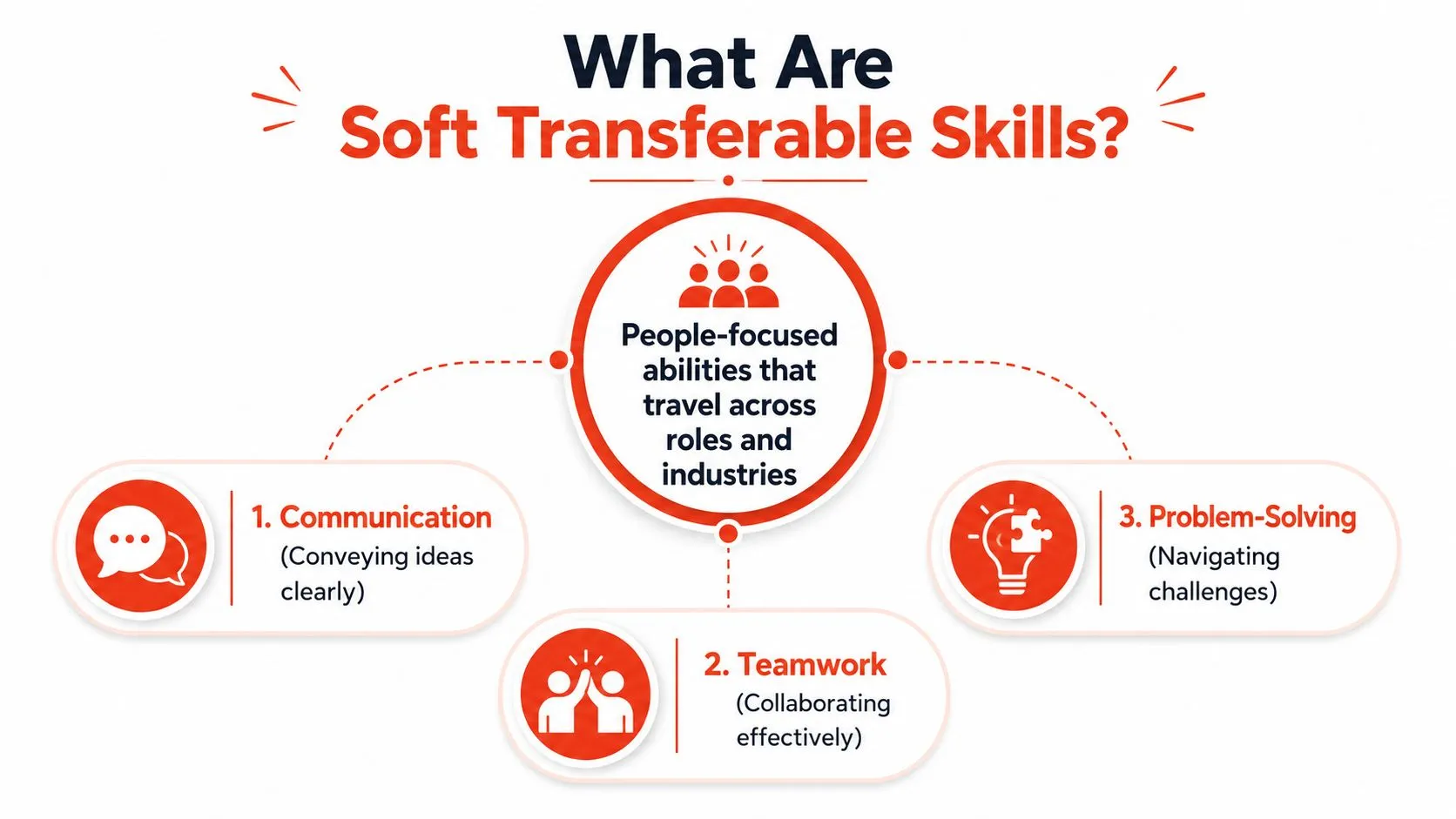
Soft transferable skills are people-focused abilities that carry across roles, industries, and career stages. They are not tied to one machine, platform, or certification. They are the human operating system that helps technical work hold up in real settings.
Hard skills work like instruments. Soft transferable skills are how you use them with other people in the room.
The clean distinction
A hard skill might be SQL, Excel modeling, bookkeeping, or forklift operation. A soft transferable skill shows up in how you use those tools, for example, explaining an issue clearly, handling disagreement, prioritizing under pressure, or keeping a team aligned. The U.S. Department of Labor groups core competencies such as professionalism/work ethic, oral and written communication, teamwork and collaboration, and critical thinking/problem-solving as core work-readiness abilities in its soft skills guidance.
That framing cuts through the mush. Communication, leadership, teamwork, adaptability, and professionalism are repeatable behaviors. They show up in meetings, handoffs, conflict, decisions, and deadlines.
What counts and what doesn't
A skill counts if it travels. It does not count if it only belongs to one narrow tool.
- Counts: calming a tense client call, leading a handoff between teams, turning chaos into a plan, surfacing risks early.
- Doesn't count: saying you are “nice,” “hardworking,” or “a people person” with no example behind it.
Here is the test. If someone changed your industry tomorrow, would the skill still help? If yes, it is transferable. If not, it belongs in the hard-skills lane.
If you want a sharper comparison between the two, the cleanest version is in soft skills vs. hard skills. That distinction is the whole game here.
The Skills Employers Care About Most
The market doesn't care about your favorite soft skills. It cares about the ones that keep work moving.
The Cleveland Fed analysis is useful because it strips away the fluff. Communication showed up in over one-third of all job ads nationally. Then came customer service (26.9%), management (23.0%), and sales, operations, and leadership at roughly 15% each. That pattern tells you what employers screen for, not what career advice blogs like to repeat. The source is the 2025 occupational mobility analysis from the Cleveland Fed, which the City of London guide cites alongside its own employer ranking.
Group the skills by how they show up
Communication is not just “writing well.” It is handling ambiguity, translating technical detail for non-experts, and reducing rework. In real work, that might mean rewriting a client update so finance, product, and leadership all understand the same decision.
Customer service is broader than support. It includes patience, boundary-setting, and the ability to keep a difficult conversation productive. A project manager, analyst, or ops lead can all show this when they absorb complaints without losing the thread.
Management and leadership are not reserved for people with direct reports. They show up when you coordinate priorities, make tradeoffs visible, and keep a project from drifting. If you have ever stepped in to clarify roles or resolve a bottleneck, that is leadership in motion.
Sales, operations, and collaboration often overlap with persuasion and alignment. A strong collaborator does not just attend meetings. They move decisions forward, bring the right people in, and close the loop.
If you cannot point to the meeting, the handoff, the conflict, or the result, the skill is probably still abstract.
One week of work, not one heroic story
Look at your last normal week. Where did you:
1. explain something to a stakeholder,
2. rescue a delay,
3. coordinate across functions,
4. calm a rough interaction,
5. keep the work organized when priorities changed?
That is your evidence pool. Not theory. Not personality. Actual work.
How to Find Your Own Soft Transferable Skills
You don't need to invent skills. You need to mine them properly.
The best method I've seen is brutally simple, and it works because it forces specificity. Ask Process, Collaboration, Skills, and Results. Tufts lays out that four-part approach in its transferable-skills guide, along with the reminder that these abilities can come from volunteering, clubs, personal projects, part-time work, workshops, training events, active learning, and reflection in the Tufts transferable-skills guide.
Use the four prompts, then stop overthinking
Write each answer in plain language.
- Process: What did I do? Start with the workflow, not the title.
- Collaboration: Who did I work with? Name the people or groups.
- Skills: What human ability did I use? Pick the key one, like negotiation, calming tension, or prioritization.
- Results: What changed because I was involved? Give the outcome, even if it's qualitative.
That's enough to pull a usable skill out of almost any experience. A retail shift can reveal conflict management. Parenting can reveal prioritization and resilience. Military service can reveal structure, coordination, and composure under pressure. Volunteering can show stakeholder communication just as clearly as paid work can.
For career changers and returners, this is the point
Non-linear experience is not weak experience. It just gets written badly.
If you've been out of the workforce, stop apologizing for it. Use the same method on care work, community roles, coursework, or side projects. A person who organized a neighborhood fundraiser, managed a school pickup schedule, or ran a volunteer rota has already practiced planning, communication, and follow-through. Those are not filler skills. They're the things employers keep paying for.
Here's the move: build a short list of five to seven skills, then attach one proof point to each. Not a polished paragraph. Just raw material you can use later.
Useful filter: if two different experiences point to the same skill, it's probably a real strength. If one experience does all the work, be careful.
Writing These Skills on Your Resume Without Sounding Generic
Weak bullets name the skill. Strong bullets show the effect.
Most resumes waste the strongest part of the story by leading with a vague adjective. “Strong communicator.” “Collaborative team player.” “Proactive leader.” That's not writing, it's labeling. Recruiters don't need more labels. They need a sentence that proves you can do the job.
Rewrite the sentence, not just the adjective
Use this structure:
Action + audience or stakeholder + what changed + result
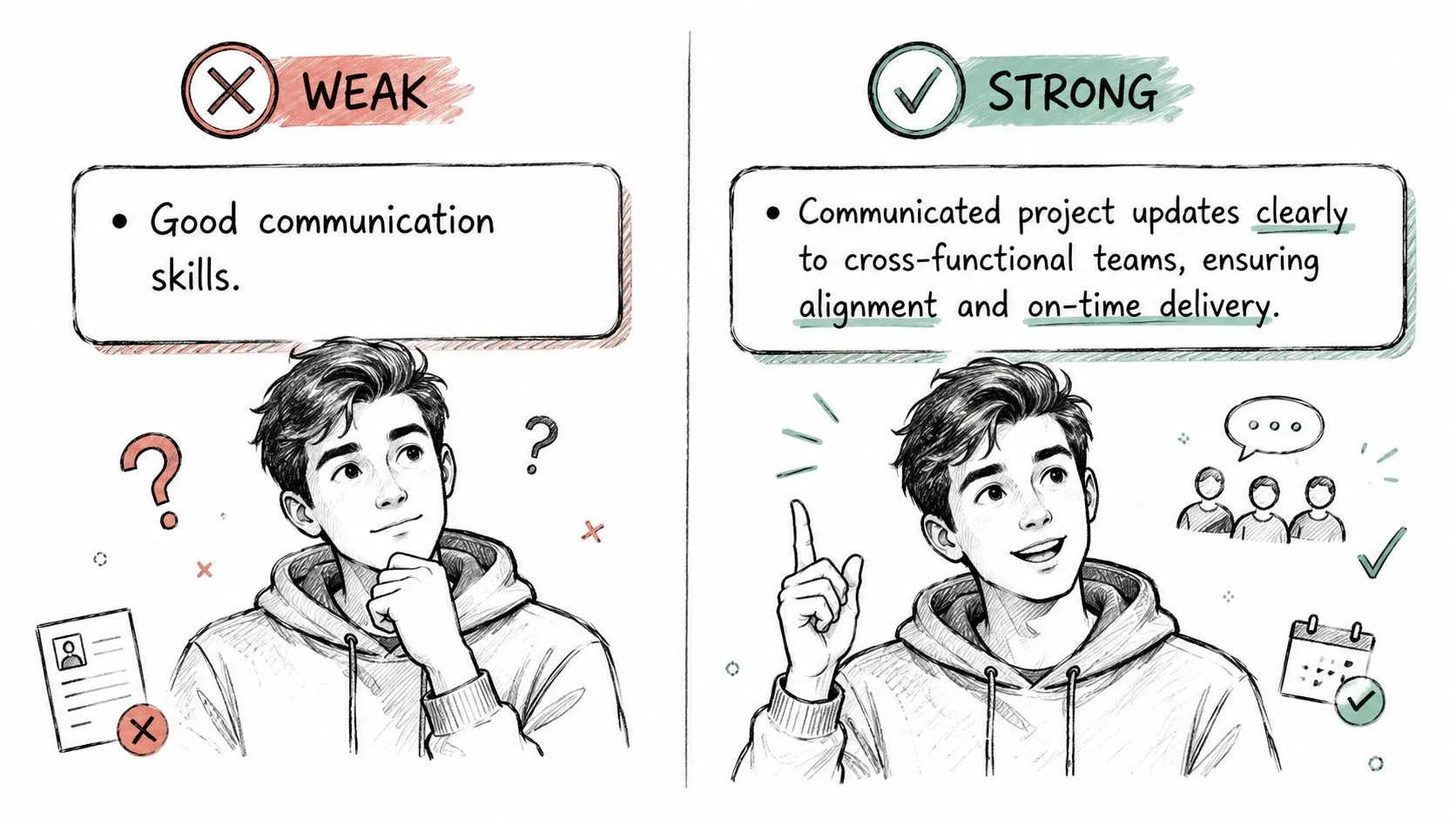
A weak bullet says, “Excellent communication skills used to support cross-functional projects.”
A stronger one says, “Redesigned weekly project updates for sales and operations, cutting confusion around handoffs and keeping launches on schedule.”
Same skill. Different proof. The second version gives a reader a person, a context, an action, and an outcome. That's what survives scrutiny.
Here are three more blunt rewrites:
-
Weak: Team player with leadership experience.
Strong: Coordinated input from product, sales, and support to resolve launch blockers before release. -
Weak: Good problem solver.
Strong: Identified repeated errors in a reporting workflow and tightened the review process before month-end close. -
Weak: Strong communication and ownership.
Strong: Took over client status updates after a handoff gap, rebuilt the update rhythm, and reduced back-and-forth between stakeholders.
The phrase show, don't tell gets repeated everywhere, but many people still tell. The fix is not more adjectives. It's more context.
Run every bullet through a hard check
Before you keep a line, ask:
1. Does it name a real stakeholder?
2. Does it show action, not attitude?
3. Does it make the skill visible through a result?
4. Would a stranger believe it without knowing me?
If the answer is no, rewrite it.
For a cleaner skills-section structure, the most useful reference is how StoryCV approaches the resume skills section. Use whatever system you like, but keep the same rule. Skills belong in evidence, not decoration.
Saying the Same Thing Out Loud in Interviews
A strong interview answer is your resume bullet with context and a pulse.
Candidates freeze because they treat the interview like a different exam. It is the same proof, spoken out loud and tested in real time. If the bullet already carries evidence, the story is mostly built.
Use STAR without making it sound canned
Keep it tight:
- Situation: What was going on?
- Task: What were you responsible for?
- Action: What did you do?
- Result: What changed?
That is the structure. The point is to make the details specific enough that the answer sounds lived-in, not rehearsed. A useful resource on speak confidently at work can help with delivery, but the content has to carry the weight first. Confidence cannot rescue a vague answer.
A short example that works
Question: “Tell me about a time you handled a difficult stakeholder.”
Answer: “In my last role, two teams were sending conflicting updates to clients, and it was creating confusion. I owned the weekly status message, rewrote it so both teams were working from the same format, and started flagging open risks earlier. After that, we had fewer follow-up questions and smoother handoffs.”
That answer works because it names the friction, the action, and the result. It does not beg for applause. It proves the person can handle coordination and communication under pressure.
If you need a cleaner framework for that exact question, the most useful companion is how to answer tell me about yourself, because the logic is the same. Start with the point, then back it up with evidence.
Keep it human
Do not memorize a speech. Memorize the facts.
- The stakeholder
- The friction
- Your move
- The outcome
That is enough. Anything more and you start sounding like a seminar.
What to Do With This by Friday
Rewrite three weak bullets today. Cut words like “passionate,” “hardworking,” and “team player” unless the sentence proves them.
Pick one story for each of your top three soft transferable skills. One for communication. One for collaboration. One for problem solving or leadership.
Stress-test every line against a real job description. If the wording doesn't match how employers describe the work, revise it.
Use the same evidence in your resume and your interviews. Different format. Same story.
Stop treating your resume like a personality test. It's a record of proof, and if the proof is good, the language gets easier.
StoryCV turns messy experience into clear resume language without making you fight a template. If your soft transferable skills are real but your bullets still read flat, StoryCV helps you turn that experience into writing a hiring manager can trust.