Most advice about common resume errors is shallow. It obsesses over typos, fonts, and whether your margins are too wide.
Those things matter. They are not the main reason strong professionals get ignored.
The problem is simpler and harsher. Most resumes read like job descriptions written by tired employees. They document tasks. They don't make a case. They tell me what you were around, not what changed because you were there.
A recruiter is not trying to admire your completeness. They're trying to decide whether you can solve a problem. If your resume doesn't answer that quickly, it loses.
Your Resume Is Not the Problem
Your experience probably isn't the issue. The way you've packaged it is.
Mid-career and senior candidates usually have enough substance. They've led projects, fixed messy processes, handled hard stakeholders, and kept teams moving. Then they turn all of that into bullets like "Responsible for operations oversight" or "Managed cross-functional initiatives." That language kills momentum.
Most common resume errors are not cosmetic
Yes, basic errors still hurt. But if your resume is clean and still not converting, you're dealing with a positioning problem.
A weak resume usually fails in one of these ways:
- It lists responsibilities: You describe the role, not your contribution.
- It sounds interchangeable: Another candidate could copy half your bullets and no one would notice.
- It hides judgment: You mention activity, but not decisions, tradeoffs, or outcomes.
- It lacks a through-line: The reader can't tell what you're known for.
Your resume should read like evidence, not admin.
That's the mistake most "common resume errors" articles miss. They treat the resume like a formatting exercise. It isn't. It's an argument for hire.
What hiring teams actually look for
Hiring teams scan for pattern recognition. They want to see signs of impact, credibility, and fit. Fast.
A stronger resume doesn't try to say everything. It selects proof. It shows where you stepped in, what you handled, and what improved. That creates a narrative. Not a dramatic one. A useful one.
Use your resume to answer four questions:
| Question | Weak resume answer | Strong resume answer |
|---|---|---|
| What did this person do? | Vague duties | Clear scope |
| How did they do it? | Generic buzzwords | Specific actions |
| What changed? | No visible result | Measurable or concrete outcome |
| Why them? | Hard to tell | Distinct strengths emerge |
If your resume doesn't do that, the document isn't broken. The story is.
Stop Listing Duties and Start Showing Impact
This is the biggest fix. If you do only one thing, do this.
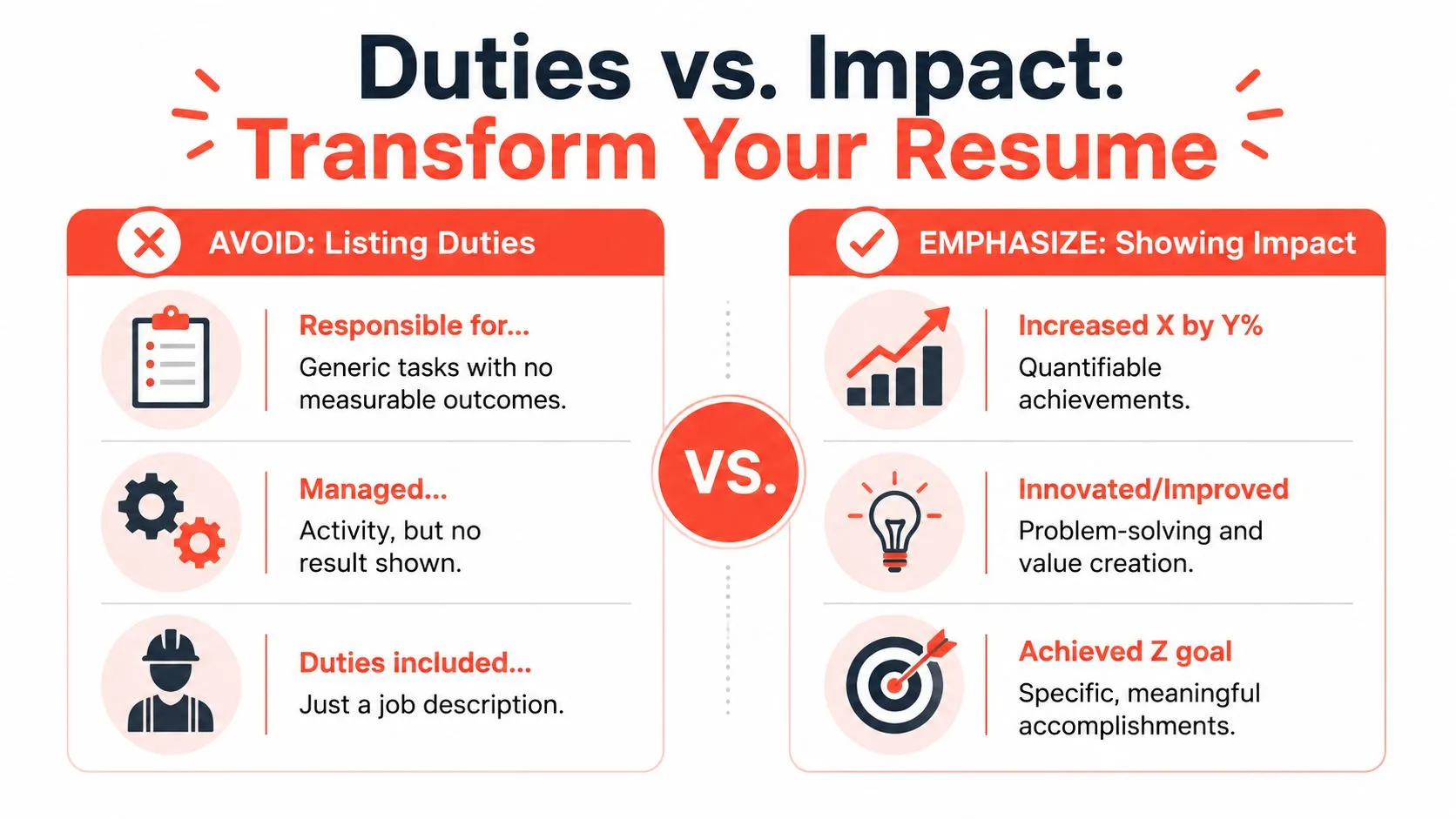
A duty tells me what your employer expected. An impact statement tells me what you delivered. Those are not the same thing.
Expert guidance recommends using an Action Verb + Task + Result/Impact structure, and examples like "Cut customer wait times by 30%" make the achievement easier for employers to evaluate, as shown in CCI Training's resume mistakes guide.
Bad bullets sound employed, not effective
Look at the difference.
| Weak bullet | Better bullet |
|---|---|
| Responsible for customer support | Resolved high-volume customer issues and improved response consistency across the team |
| Managed reporting process | Built a recurring reporting workflow that gave leadership faster visibility into pipeline risks |
| Worked with cross-functional teams | Coordinated product, sales, and operations stakeholders to launch a new process with fewer handoff issues |
| Oversaw onboarding | Redesigned onboarding materials so new hires could ramp with less confusion and fewer repeated questions |
The left side says you had a job. The right side says you made the job better.
Use the formula without sounding robotic
The formula is simple:
- Start with a sharp verb: Led, built, improved, launched, negotiated, redesigned.
- Name the task clearly: What did you do?
- Finish with the result: What changed? Faster process, better retention, fewer escalations, cleaner reporting, stronger adoption.
If you have numbers, use them. If you don't, use concrete consequences. Better still if the result helps a business, team, or customer.
Practical rule: If a bullet could appear on the job description, it doesn't belong on your resume.
Here are a few rewrites.
-
Instead of: "Responsible for managing vendor relationships"
Write: "Managed key vendor relationships to improve coordination, reduce delays, and keep projects on schedule" -
Instead of: "Handled team scheduling"
Write: "Organized team scheduling across shifting priorities to maintain coverage during peak demand" -
Instead of: "Supported CRM updates"
Write: "Cleaned and maintained CRM records so sales and operations could work from more reliable data"
If you're in a technical field, this gets even more important. Domain-heavy resumes often drown in tools and tasks. Trackside Careers' F1 resume tips are a useful example of how to make technical experience readable without flattening the substance.
A good rewrite doesn't inflate your work. It clarifies it. If you need help turning vague bullets into stronger achievement statements, this guide on how to write achievements in a resume is worth reading.
Later in the process, someone will ask, "What has this person done?" Your bullets should answer before the interview starts.
A short walkthrough helps if you're stuck:
You Are Writing for a Human Not a Robot
ATS anxiety has broken a lot of resumes.
People paste half the job description into their summary, repeat the same skills block three times, and call it optimization. Then they wonder why the document feels dead. Because it is.
Keywords matter, but only if they still sound true
You should use the language of the role. That's basic matching. But copying phrases without context makes you sound generic.
The better move is selective alignment. Pull out the terms that match your work, then embed them inside real accomplishments and real scope. That gives the ATS something to parse and the human something to believe.
AARP's guidance gets the balance right. Their advice on resume mistakes notes that the challenge is balancing ATS optimization with human readability, and that resumes built only for keyword matching often become generic and fail to differentiate the candidate's story.
Write for two readers at once
Your resume has two jobs:
- Pass structured screening: Use standard headings, clear job titles, and role-relevant terms.
- Win human attention: Show judgment, impact, and credibility.
That's why keyword stuffing is one of the most common resume errors. It treats the resume like a search query instead of a business document.
Try this instead:
| If the job ad says | Don't write | Write |
|---|---|---|
| Stakeholder management | Stakeholder management, stakeholder management, stakeholder management | Partnered with finance, product, and operations leaders to align priorities and remove delivery blockers |
| Process improvement | Process improvement specialist with process improvement experience | Redesigned team workflows to reduce friction, improve handoffs, and make reporting easier to trust |
| Data analysis | Data analysis, dashboards, reporting, analytics | Built reporting and analysis that helped leaders spot risks earlier and act faster |
If a hiring manager reads your resume and thinks "this was written to game software," you've already lost ground.
Keep the structure plain. Keep the language natural. If you're trying to understand how automated filters read resumes without turning yours into sludge, this explainer on AI resume screening covers the mechanics well.
The test is simple. If you removed the job ad from the equation, would your resume still sound like a credible professional wrote it? If not, you've overdone the optimization.
Small Errors That Send a Big Negative Signal
Let's deal with the obvious mistakes. Not because they're the main event, but because they send ugly signals fast.
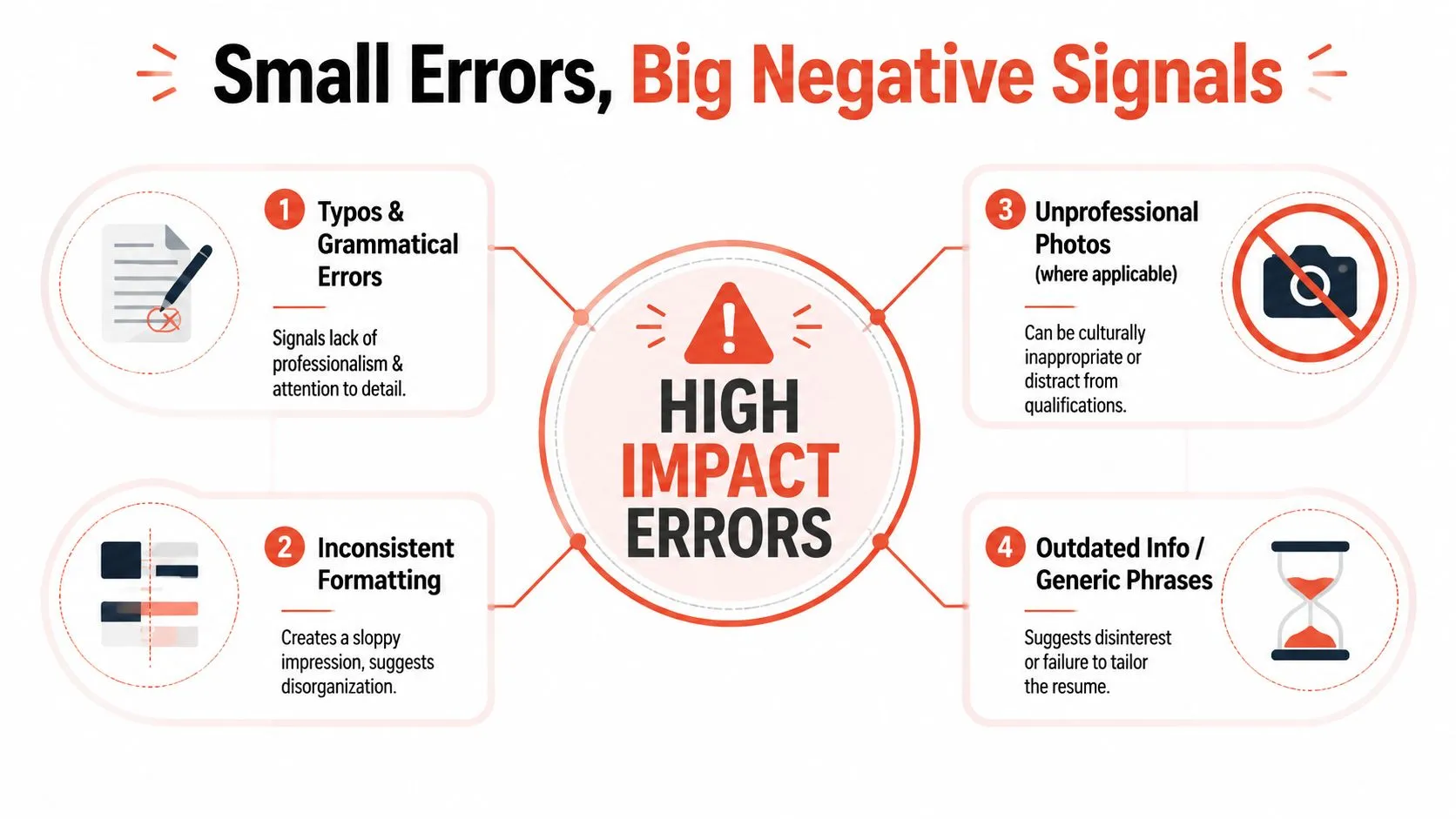
A peer-reviewed study found that resumes with five spelling errors had an 18.5 percentage-point lower interview probability than error-free resumes, according to the published study on resume spelling errors and interview chances. Separate resume-statistics reporting says 58% of resumes or cover letters are rejected for typos, and 88% are rejected for including a photo, based on TeamStage's roundup of resume statistics.
Why tiny mistakes get interpreted as big flaws
Recruiters don't see a typo and think, "Minor typo."
They think: rushed, careless, generic, not reviewed, maybe worse in actual work. Fair or not, that's how screening works. A resume is a proxy for judgment.
Three errors are especially damaging:
- Typos and spelling mistakes: They suggest weak attention to detail.
- Inconsistent formatting: Mixed dates, uneven spacing, and shifting bullet styles make the document feel unstable.
- Photos where they don't belong: In many markets, they distract from qualifications and can look unprofessional.
Clean formatting isn't aesthetic polish. It's competence made visible.
Cut anything that weakens the signal
A lot of resumes aren't just messy. They're noisy.
Drop the extras that don't help your case now:
- Old filler roles: Keep older experience lean if it no longer supports your target direction.
- Generic phrases: "Hard-working professional" tells me nothing.
- Unclear dates: Exact dates matter. Missing them can trigger doubt and rejection.
- Personal fluff: Hobbies, photos, and unnecessary personal details often make the document worse.
If your date formatting is sloppy or inconsistent, fix that next. This guide on dates on a resume is a practical place to start.
You don't need a perfect resume. You need a resume that doesn't create avoidable doubt.
Your Practical Resume Audit Checklist
Many job seekers edit resumes passively. They skim, tweak a word, change a font, and call it done. That's not an audit.
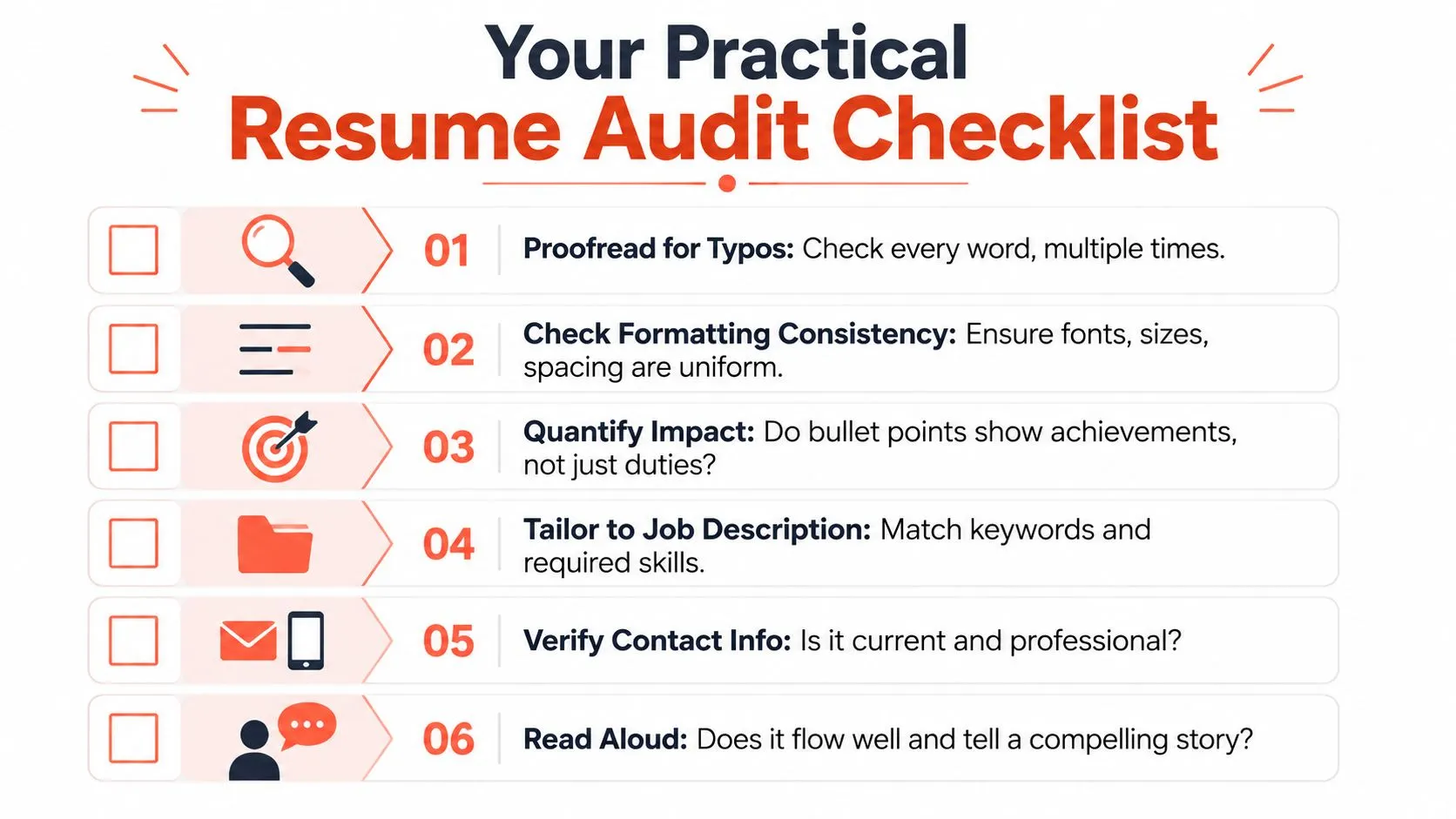
Use this list like a hard filter.
Run this check before you send anything
- Read the summary first: Does it sound like a clear professional pitch, or a fog machine full of buzzwords?
- Scan every bullet: Is it a duty, or does it show contribution, change, or result?
- Check relevance: Does each section support the role you want now?
- Test the first screen: Can someone understand your value in a quick skim?
- Look for repetition: Are you saying the same skill in five different ways because you don't have a stronger point?
- Verify the basics: Contact details, dates, titles, company names, and formatting all need to be clean.
Use the ten-second test
Open your resume. Look at it for ten seconds. Then answer these questions without rereading.
- What kind of professional is this person?
- What are they strongest at?
- What proof did I notice first?
If you can't answer those quickly, the resume is still muddy.
Read it aloud. Awkward phrasing exposes itself immediately.
The best audit question is brutal and useful: Would a busy hiring manager remember anything from this page an hour later? If the answer is no, keep rewriting.
Move from Fixing Errors to Telling Your Story
A clean resume clears the floor. It does not win the interview.
Hiring managers remember a point of view. They remember a candidate who is obviously good at something specific, in a specific context, with proof that holds up. This is the ultimate purpose of a resume. It is not a formatting exercise. It is an argument for hire.
Strong resumes feel coherent

Strong resumes have internal logic. The summary sets the position. The experience backs it up. The bullets prove it. The skills support the same direction. Nothing feels random, inflated, or copied from a job description.
This is the mistake weak resume advice misses. It obsesses over surface errors and ignores the bigger failure: the document never tells a convincing story. A candidate might have solid experience and still look forgettable because the resume reads like a storage bin of tasks. A digital resume writer like StoryCV helps by using a guided interview to turn raw experience into a clearer narrative draft instead of forcing you to fill blank boxes.
Stop polishing isolated lines and start shaping what the page says about you as a professional.
Ask yourself:
- What do I want to be known for?
- Which examples prove that fast?
- What conclusion should a hiring manager reach after one page?
If your resume answers those clearly, you have done more than remove errors. You have built a case.
If your resume has solid experience but still reads flat, StoryCV is a practical way to turn that experience into a sharper, more believable narrative. It works like a digital resume writer, using guided prompts to help you articulate impact, clarify positioning, and produce a draft that reads like a professional wrote it.