Forget the polite advice. If you're choosing between Claude and ChatGPT for resume writing, the answer is simple. Claude is usually safer on facts. ChatGPT is usually better when the task is messy, multi-step, and prompt-heavy.
That sounds like a clean winner. It isn't. Both tools start writing too early, and that's where resumes go sideways. The better question is not which one writes prettier sentences, but which one helps you avoid inventing a story you can't defend in an interview.
| What matters in resume writing | Claude | ChatGPT |
|---|---|---|
| Tone | More restrained, less flashy | More energetic, sometimes more generic |
| Handling vague prompts | More conservative with missing details | Better at multi-instruction prompts |
| Risk of made-up details | Usually lower | Usually higher unless tightly constrained |
| Best use | First draft, long context, accuracy | Brainstorming, cleanup, formatting, prompt chaining |
| Real limitation | Can feel a little stiff | Can sound polished while drifting off fact |
The Honest Difference Between Claude and ChatGPT
Yes, there are real differences. And yes, they matter. Claude is usually more conservative with metrics, better at holding long context together, and less likely to casually invent a number when you ask it to improve a bullet. ChatGPT is often stronger when the prompt is crowded, because it handles multiple instructions in one pass better, which makes it useful for alignment, keyword integration, formatting, and voice consistency at the same time. The comparison is fair.
But the gap between the two tools is still smaller than the gap between either tool and you knowing what your work was worth. That's the part people dodge. A resume bullet is a judgment call before it's a sentence. What changed. What you owned. What trade-off you made. What the result meant.
Neither tool knows that about you. So both can produce fluent nonsense if you feed them vague input.
That's why a lot of people get excited about the output and miss the underlying problem. If you want a useful outside view on that broader workflow, the comparison around ChatGPT for data enrichment is worth skimming, because the same trap shows up there, too. The model can only work with what you give it. If the input is thin, the result is polished guesswork.
For a deeper tool-vs-tool framing, the StoryCV vs ChatGPT comparison gets at the same issue from a different angle. The tool matters. The thinking matters more.
Practical rule: If your prompt doesn't contain the facts, no model can rescue the resume.
What Each Tool Actually Writes When You Ask
Give both tools a vague prompt and you'll see the difference fast. Ask, “Rewrite this bullet to sound stronger.” That's the kind of prompt people often use when they're tired and trying to move quickly. It also exposes how each model fills in blanks.
Claude usually tightens the sentence, keeps the structure cleaner, and avoids wandering too far from the source material. ChatGPT often sounds smoother on the first pass, but it's also more likely to sneak in a claim that wasn't there. That's the trade. Better surface polish, higher chance of drift.
Same prompt, two different defaults
Original bullet: Helped improve onboarding for new customers and worked with the product team on rollout.
Claude-style rewrite: Improved onboarding for new customers by coordinating rollout with the product team and clarifying setup steps.
ChatGPT-style rewrite: Optimized customer onboarding by partnering with product on rollout execution and improving the new-user experience.
Neither version is terrible. Claude stays closer to the source. ChatGPT sounds a little more polished. But both are still making a weak bullet sound more certain than the facts deserve. That's the underlying pattern.
When the input is vague, ChatGPT is more prone to cliché. Words like “efficient,” “optimized,” and “enhanced” show up fast. Claude is usually less flashy, but it can still flatten nuance into a tidy line that sounds right and proves little. If you've ever pasted a real bullet into a chatbot and gotten back something that felt generic, that's why. The model is writing before it understands.
For a closer look at how people misuse one of the tools in resume workflows, the ChatGPT for resume writing guide is a useful companion read. It makes the same point in a more execution-focused way.
Bottom line: A clean sentence is not the same thing as a credible resume bullet.
Pasting in the Job Description and Saying Improve My Resume
Here's how the workflow typically goes. You paste in the job description. You paste in your bullet. You ask for an improved version. Then you hope the model does the hard part for you.
Claude usually does a better job of preserving chronology and long-context detail. It's more likely to keep the logic of your career intact while nudging the language toward the job description. ChatGPT is often stronger at matching tone, compressing language, and weaving keywords into a tighter format. That's useful. It's not enough.
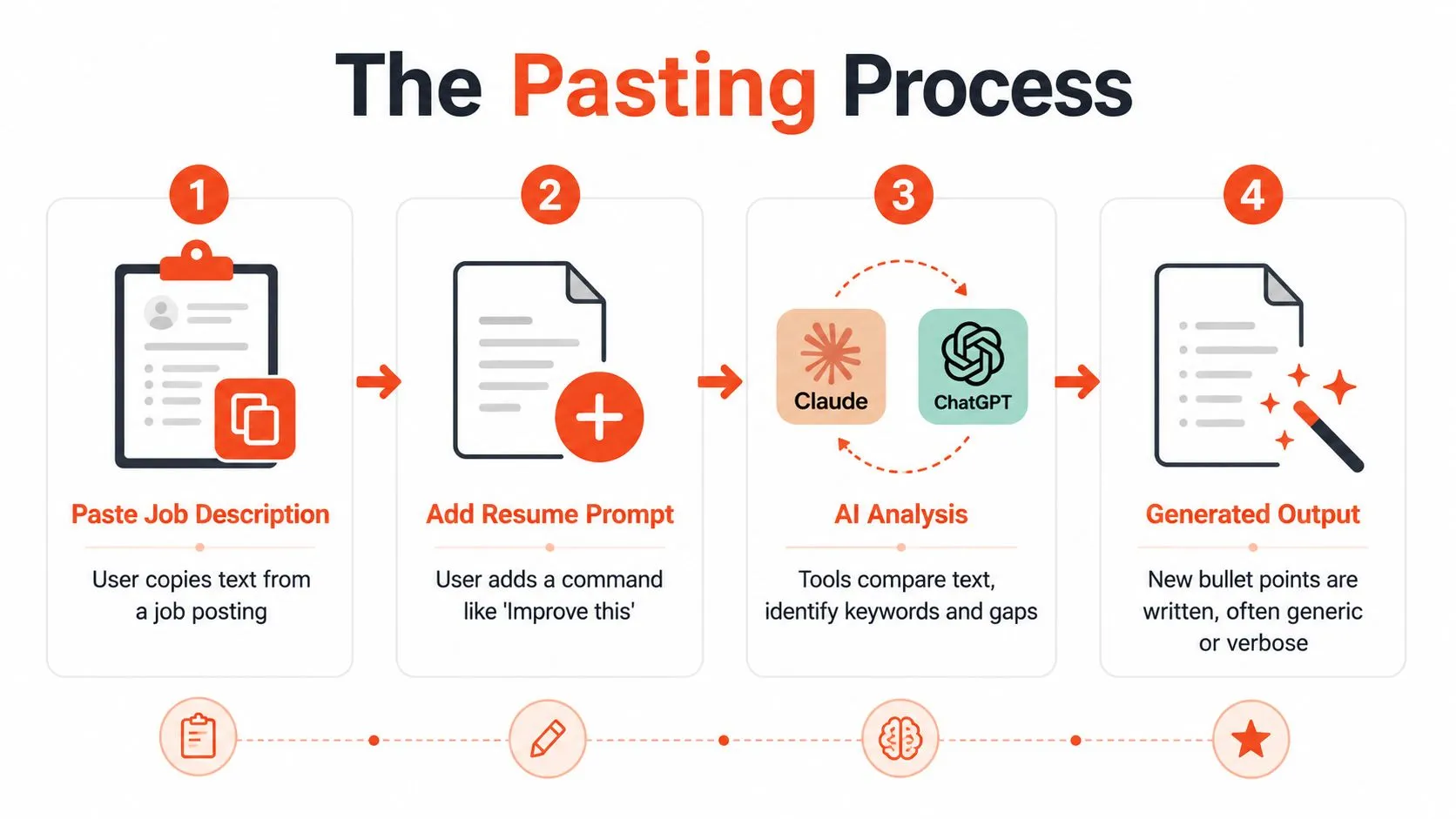
The danger is the same in both tools. They can invent scope, scale, or a metric that sounds plausible but never existed in your original input. That's the resume killer. Not weak prose. Unsupported claims.
Alignment is easy. Accuracy is the test
Claude tends to be more conservative when the job description is specific. It will usually mirror the language of the posting without pushing as hard into fantasy. ChatGPT is more aggressive about compressing everything into a cleaner, more recruiter-friendly read. That can be helpful. It can also erase the line between what you did and what the posting asks for.
That's why you can't skip fact-checking. If a tool adds a number, a scope claim, or a stronger result than you gave it, it's on you to catch that before the resume goes out. Read every line like someone who might have to explain it live.
For a broader look at screening logic and why these details matter, the AI resume screening guide makes a useful companion to this problem.
Reproducible Prompts You Can Paste In
Don't ask for “better” resume writing. That's too vague. Ask for the missing thinking first, then let the model draft.
- Extract impact from a vague bullet: “Turn this bullet into one that shows impact. Do not add numbers I didn't give you. If the result is unclear, ask me a question.”
- Align a summary to a job description: “Rewrite my summary for this job description. Keep my real experience only. Do not invent tools, metrics, or scope.”
- Tighten a summary that runs long: “Cut this summary by 25 percent. Keep the strongest facts. Remove filler and repeat ideas.”
- Audit the final draft for unsupported claims: “Review this resume draft and flag every statement that needs proof, every metric that looks invented, and every skill that is implied but not stated.”
Why these prompts work
They force the model to slow down. That matters because the default behavior of both tools is to write first and question later. If you tell them not to invent metrics, ask them to ask you when the evidence is missing, and make them surface unsupported claims, you get something far closer to usable draft material.
I'd still trust the output more if it sounded slightly boring and stayed honest.
That's the better trade. You can always sharpen a flat sentence. You can't unmake a fake accomplishment after a recruiter spots it.
A Simple Rubric for Judging Any Output
Stop asking which model “wins” on resume writing. Use a rubric that survives model changes.
- Claim versus claim with evidence. If a line sounds impressive but you can't point to the source of the claim, it's not ready.
- Tone versus voice. Tone can be adjusted. Voice should still sound like you.
- Keywording versus stuffing. Good tailoring shows relevance. Bad tailoring reads like a keyword dump.
- Structure versus template. A real resume has logic. A template has boxes.
The line that matters: If the sentence is stronger than the truth, it's the wrong sentence.
That's the kind of check you can apply after any rewrite, whether it came from Claude, ChatGPT, or a human.
The Gap Both Tools Miss
Claude and ChatGPT start writing right away. That is the problem.
A resume bullet starts as a thinking problem. What changed? What did you own? What did you trade off? Why did it matter? If you cannot answer those questions cleanly, no model can turn thin context into a strong bullet. It will only give you polished copy built on missing facts.

That is why the third option matters. It is a different category. These tools interview you before they write, the way a good human resume writer starts with a conversation instead of a blank template. StoryCV fits that category.
If you want a practical angle on the interview side of the job search, the guide to securing job interviews is a solid companion. For a look at how to beat AI screening with better inputs, see Beat AI resume screening. The point is the same. Better inputs change the output.
Claude and ChatGPT are writing tools. StoryCV is a thinking-first resume writer.
That is the divide that matters. Better words are useful. Better thinking gets you hired.
Which Tool Fits Which Kind of Job Seeker
If you've never used either tool, start with Claude. It's the safer default for resume drafting because it's less likely to invent details you'll regret later.
If you've already tried ChatGPT freehand and got generic output, that's not you failing. That's the model doing what it does with vague prompts. Tighten the inputs, or move to a workflow that asks you better questions first.
If you just need to clean up a summary, fix tense, or strip out formatting mess, either tool is fine. That's mechanical work. The free tier is usually enough for that kind of cleanup.
If you're applying seriously and the resume has to carry real weight, stop treating the model like the source of truth. Use it as a drafting layer, not a judgment layer.
That's the difference between better words and better thinking. One sounds polished. The other gets interviews.
If you want a resume that starts with your real experience instead of generic prompts, use StoryCV. It interviews you first, then turns that conversation into clear resume copy that fits the role without stuffing in fake metrics. Start there if you're done wrestling chatbots and want a faster way to write something you can defend.