Most resumes do not need a slick little objective. They need a sharper first impression, or no intro at all. If your experience already makes sense on its own, wasting the top of the page on “seeking a challenging position” is just bad editing.
Do You Even Need a Resume Objective
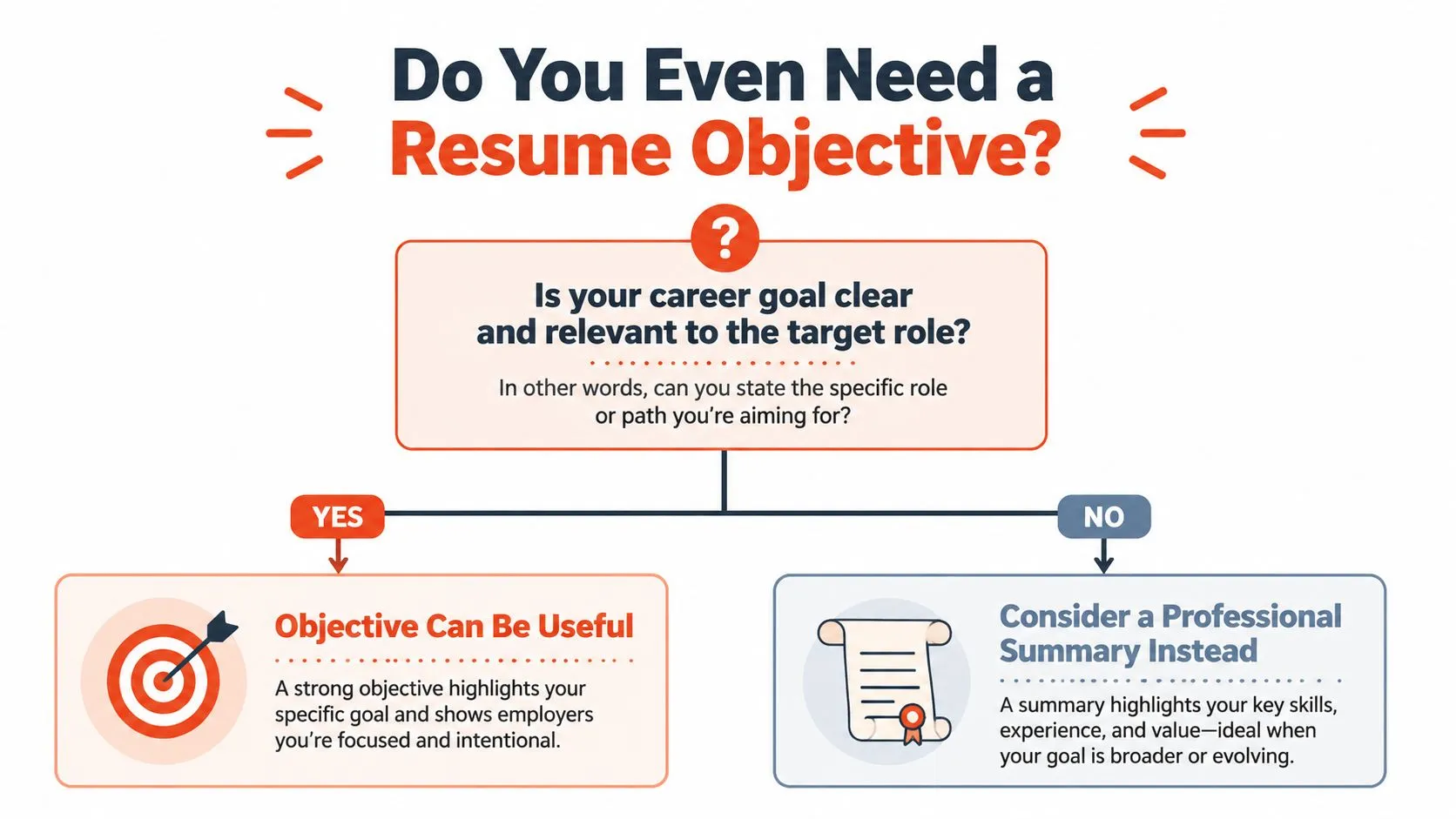
Popular advice gets this backwards. It starts with what to write, when the fundamental question is whether the section should exist at all. For a lot of mid-level and senior candidates, the answer is no, because the top of the page is too valuable to spend on a sentence that repeats what the rest of the resume already says.
Practical rule: If your title, progression, and recent results already point straight at the role, skip the objective. Let the work speak.
That said, the objective still earns its place for people who need to translate context fast. Students, career changers, returners, and military veterans often need a line that explains direction before the hiring manager gets to the rest of the page. Resume guidance from Purdue OWL treats the objective as an “at a glance” picture of your career interests, and it belongs directly below contact details, not buried later in the document (Purdue OWL resume workshop).
The easiest decision rule is simple. If you have clear, relevant experience and measurable outcomes, a summary or no intro tends to work better. If your background is non-linear, thin, or still being translated, an objective can do real work by signaling fit quickly. That logic lines up with modern resume guidance for transitional candidates, who need a compact statement of direction more than a long story about the past (Resume.io on resume objectives).
A clean example of that use case is a student or career changer. If you want a role in a new field, the objective helps the reader connect the dots before they decide the resume is off track. If you need a tighter starting point, this guide for nursing students shows how that works in a specific early-career context.
The Three-Part Structure That Actually Works
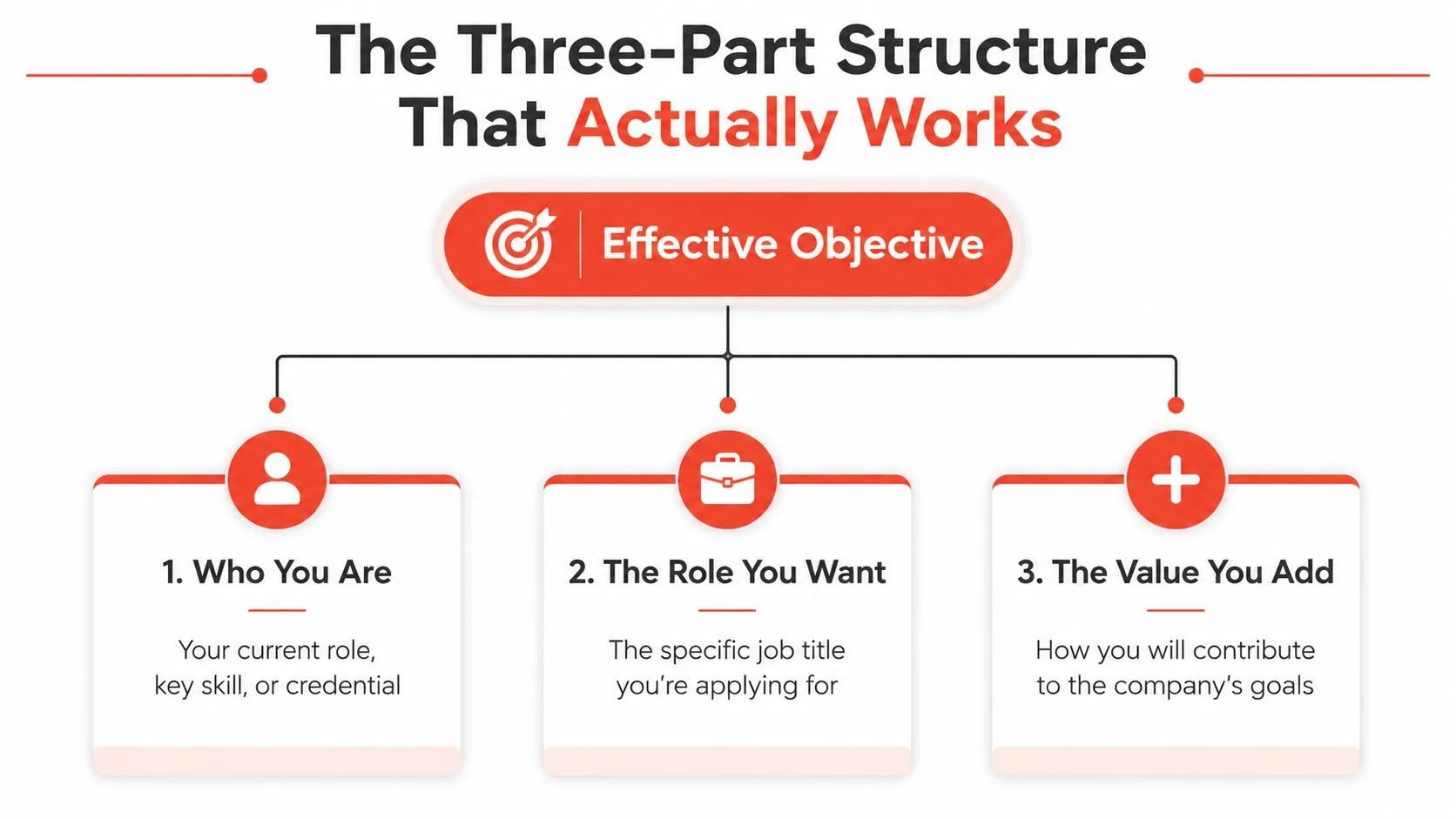
A good objective is not creative writing. It is a tiny, targeted pitch. The structure is the same almost every time, who you are, the role you want, and what value you add. That three-part formula shows up across major resume guidance for a reason, because it forces you to write for the employer instead of writing about yourself.
Start with identity, not ambition
Lead with a real professional label. Recent marketing graduate, operations manager, teacher transitioning into training, software engineer with team leadership experience. That opening tells the reader what bucket you belong in before you ask them to care.
Avoid vague identity words like “motivated professional” or “hardworking individual.” Those phrases say nothing. They're filler dressed up as polish.
Name the target role clearly
Then say the job title you want. Not the department. Not the vibe. The actual role. Marketing assistant, corporate trainer, operations lead, engineering manager. The hiring manager should know exactly what you're applying for without decoding it.
Add value, not personal wish lists
Finish with what you bring. The strongest objectives lean on a relevant skill, a credential, or a measurable achievement when you have one. That makes the statement easier to trust, and it keeps you out of the “I want to grow” trap that recruiters skim right past.
A workable final version looks like this:
Recent marketing graduate with hands-on social media experience seeking a marketing assistant role where strong content creation and analytics skills can support campaign performance.
That's it. Short. Specific. Readable in seconds.
Keep it to 1 to 3 lines, 2 to 3 sentences, or roughly 30 to 60 words. Career guidance from Indeed and other resume sources repeatedly lands in that range because recruiters scan fast and objectives are supposed to compress, not sprawl (Indeed resume objective examples, LockedIn AI objective guidance).
For more examples that stay tight and practical, see professional summary examples for a resume. The lesson is the same even when the label changes, lead with signal, not noise.
Objective Versus Summary Versus No Intro
These three choices are not the same thing, and they solve different problems. An objective points forward. A summary points back. No intro means the first role, project, or credential does the talking.
Use a summary when your experience already carries the page. Clear progression, recognizable titles, and results make the case fast, so a summary gives you room to highlight impact instead of intentions. If you want help tightening that format, improve your professional summary before you decide the top of the page needs an objective at all.
Use an objective when the resume needs context. That includes a career change, a return after a break, or the jump from school into work. The objective gives the reader a straight answer about direction before they start filling in blanks. Career guidance for transitional candidates keeps returning to that kind of concise, customized pitch, and MyPerfectResume statistics page reflects that focus on fit over vague personal branding.
Use this rule of thumb
- Experienced professional with measurable wins: skip the objective, use a summary, or skip the intro if the experience section already does the job.
- Mid-level professional changing functions: use an objective if you need to connect past work to the target role.
- Student, recent graduate, returner, or veteran translating experience: use an objective because it frames potential fast.
- Candidate with a clearly aligned career path: choose the format that uses the least space, not the one that sounds more official.
A generic objective is worse than none. If the line could sit at the top of any resume in any industry, cut it. Keep only the version that says who you are, what you want, and why this job fits.
For a tighter comparison of summary style and tone, the practical examples in StoryCV's summary article are worth skimming before you decide what belongs at the top of your page.
Before and After Rewrites for Real Candidates
Weak objectives all have the same disease. They talk in safe, broad language and hide the actual fit signal. Strong objectives do the opposite. They name the role, trim the fluff, and use a detail that proves the person isn't guessing.
Recent graduate aiming for a first marketing role
Weak version. “Recent graduate seeking an opportunity in marketing to gain experience and grow professionally.”
Tight version. “Recent marketing graduate with content and analytics coursework seeking a marketing assistant role to support campaign coordination and digital reporting.”
The edit is obvious. “Opportunity” and “grow professionally” got cut because they say nothing. The stronger version names the background, the role, and the contribution. It sounds like someone who knows where they fit, not someone tossing a resume into the void.
Teacher moving into corporate training
Weak version. “Experienced teacher looking to transition into a training position where I can use my skills.”
Tight version. “Teacher transitioning into corporate training, bringing presentation, facilitation, and curriculum design skills to a learning and development role.”
This one works because it translates teaching into business language. “Use my skills” is mush. “Presentation, facilitation, and curriculum design” is useful. The objective also signals a real transition, which is exactly when the section does its best work.
Mid-level operations manager moving into tech
Weak version. “Operations professional seeking a role in a technology company with room to contribute and learn.”
Tight version. “Operations manager with cross-functional workflow experience seeking an operations role in a tech environment to improve process efficiency and team coordination.”
The weak version asks for “room to contribute and learn,” which is about the candidate. The better version flips that into employer value and uses a role-specific phrase that fits a tech operations opening.
Software engineer stepping into a lead role
Weak version. “Software engineer looking for a lead role to grow my career and take on more responsibility.”
Tight version. “Software engineer with team collaboration and project delivery experience seeking a lead engineer role to guide development work and support stronger delivery outcomes.”
That rewrite adds leadership intent without pretending the person has already been a manager. It's credible. It gives the hiring manager a reason to keep reading.
Strong objectives are a fit signal for transition candidates. If the rest of the resume can't yet explain the direction, the objective should do that job fast.
A useful way to self-edit is to ask what got cut. If your draft still contains “challenging,” “dynamic,” “motivated,” or “seeking growth,” you haven't edited hard enough. Those words are safe because they're empty.
Tailoring Your Objective to One Job Posting
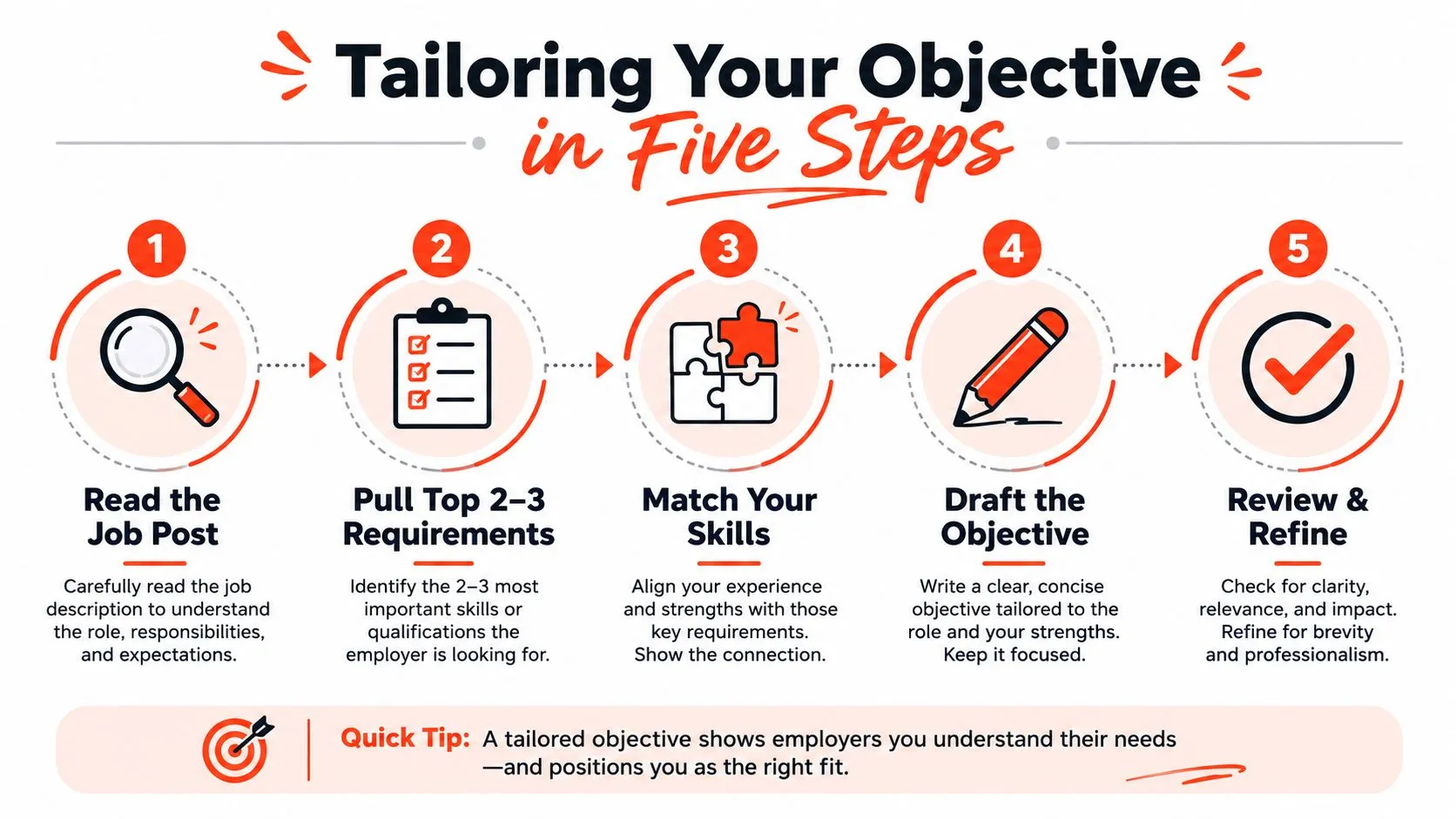
Tailoring is not optional. A one-size objective looks lazy the second a hiring manager reads it. The fix is fast. Read the posting, pull the top 2 to 3 requirements, and turn them into a short value statement that mirrors the employer's language without parroting it.
Use the job post as your filter
Start with the role title and the repeated skills. If a posting keeps mentioning cross-functional coordination, data reporting, and client communication, those are probably the words that matter. Pick the ones you match. Don't cram in every keyword just because it exists.
Then build a sentence around them:
Professional identity + target role + matched skill or credential + employer value
That structure keeps the objective from sounding like a keyword dump. It also helps with ATS relevance without making the line unreadable. ATS software is not impressed by stuffing. Humans aren't either.
Don't overfit the wording
A generic objective sounds like a copy-paste of the job ad. That's not customization. That's camouflage. Keep the language close enough to signal alignment, but natural enough that a person can read it without wincing.
For example, if the posting says “support onboarding and internal training,” don't repeat the whole phrase twice. Say you bring facilitation and documentation skills to a training role. Clean. Direct. Human.
The main mistake is leading with what you want. “Looking to join a fast-growing company” is not a value proposition. It's a preference. The employer does not care about your company taste. They care about whether you can do the work.
If you want a second pass on the wording, this resource on tailoring a resume to a job description gives a useful outside-the-box check for matching language without sounding robotic.
You can also use a tool like StoryCV to draft the opening more cleanly if you want guided wording rather than a blank page. It's an AI-powered resume writer that turns role context into resume language, which is exactly the kind of help this section benefits from.
Templates and Final Checks You Can Use Today
Templates are fine if they're tight. Long templates rot fast. Use these as a starting point, then replace the bracketed language with your actual role, skill, or result.
Student or recent graduate
Recent [degree] graduate with [relevant skill or coursework] seeking a [job title] role to contribute [value] in [area of work].
Career changer or returner
[Current background] transitioning into [target field], bringing [2 to 3 transferable skills] to a [job title] position focused on [employer outcome].
Mid-level professional
[Professional identity] with [relevant experience] seeking a [job title] role to apply [skill or credential] toward [business result].
Now run the cleanup list. If any of these show up, cut them.
- Vague openings: “Seeking an opportunity,” “hardworking professional,” and similar mush.
- First-person filler: Too many “I want” or “I hope” phrases.
- Restated work history: A mini bio that just repeats your resume.
- Missing role name: If the job title isn't there, the objective is too soft.
- No employer value: If the sentence stops at what you want, it's incomplete.
- No measurable anchor when you have one: Years, projects, or specific outputs make the line more believable.
Here's the test. If the objective disappears and the resume still makes perfect sense, delete it. If it helps the reader understand your direction fast, keep it tight and useful.
StoryCV is built for that kind of edit. It turns your background into a clearer narrative, which is exactly what a strong objective needs to do before the hiring manager ever reaches your experience section.
If you want help turning a messy career story into a clean objective and a stronger resume top line, visit StoryCV. It's built to help you write with judgment, not just fill space.