Let's get straight to the point. The old-school resume objective is dead. It's probably killing your chances of landing an interview before a hiring manager even reads your qualifications.
Every other nursing student writes, "Seeking a challenging registered nurse position to utilize my skills." It’s a complete waste of space. That sentence tells the recruiter what you want, not what you can do for them.
Why Your Objective Gets Ignored
You survived tough clinicals and even tougher exams. Your resume needs to show that grit and competence right from the first line. The problem with a traditional objective is that it's passive. It asks for an opportunity instead of demonstrating your value.
It's the most valuable real estate on your resume—the top one-third of the page. Wasting it on a generic, me-focused statement is a huge mistake. Recruiters spend just seconds on an initial scan. A weak opening gets your resume tossed in the 'no' pile.
The fix is simple: shift from a passive objective to an active, impact-focused professional summary. Instead of asking for a chance, you show you're ready to contribute from day one.
For a nursing student, this is everything. You have limited formal work experience. A strong summary frames your clinical hours as proof of your skills. It’s not about what you lack; it’s about what you’ve already done.
The Power of a Strong Summary
So, what’s the alternative? A professional summary. It’s a short, sharp, 3-4 line sales pitch at the top of your resume. It immediately answers the hiring manager's only real question: "Why should I hire you?"
For a nursing student, a great summary does three things instantly:
- It defines you. Are you a dedicated BSN candidate, a compassionate future RN, or a detail-oriented nursing student?
- It showcases key skills. Think patient assessment, EMR charting, care plan development, and patient advocacy.
- It proves your experience. It turns your clinical rotations into concrete achievements.
To see just how much of a difference this makes, let's look at a quick comparison. Notice how the focus shifts from a vague personal goal to a clear statement of value for the employer.
Objective vs Summary: A Quick Comparison
| Element | Weak Resume Objective (Avoid This) | Strong Resume Summary (Do This) |
|---|---|---|
| Focus | Self-focused (what I want) | Employer-focused (what I offer) |
| Content | Vague desires ("seeking a position") | Specific skills & achievements (managed 5-patient caseload) |
| Impact | Low (generic and passive) | High (confident and value-driven) |
| Example | "To obtain a registered nurse position at a respected hospital." | "Compassionate BSN candidate with 450+ clinical hours in Med-Surg and Pediatrics. Proficient in EMR charting and patient education, dedicated to delivering evidence-based care." |
The difference is night and day. One is a wish; the other is a promise backed by evidence.
And this isn't just about sounding better—it has a real, measurable impact on your job search.
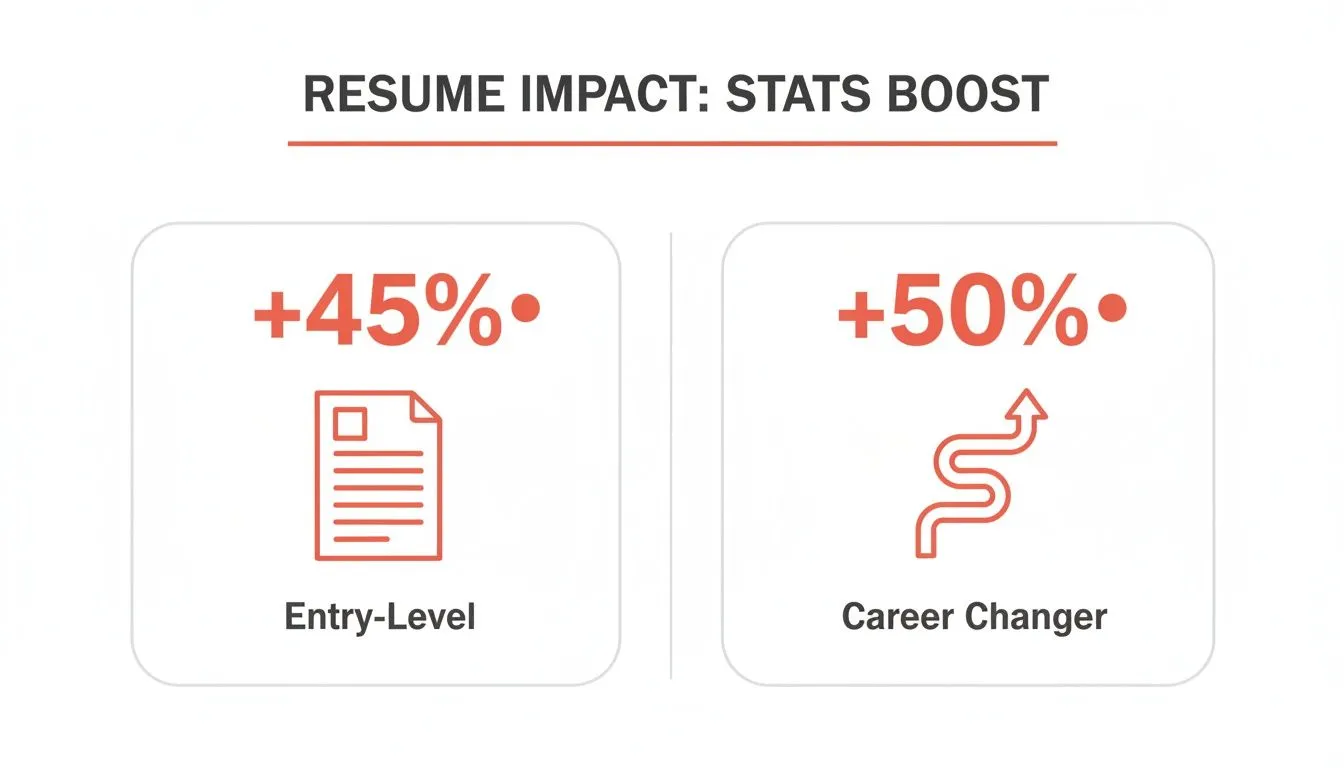
The data doesn’t lie. A strong opening statement can boost your chances of getting an interview by up to 45% for entry-level candidates like new nursing grads. For career changers, that number jumps to 50%. This isn't a minor edit; it’s a strategic move that puts you miles ahead of the competition.
The Three Ingredients of a Powerful Nursing Summary
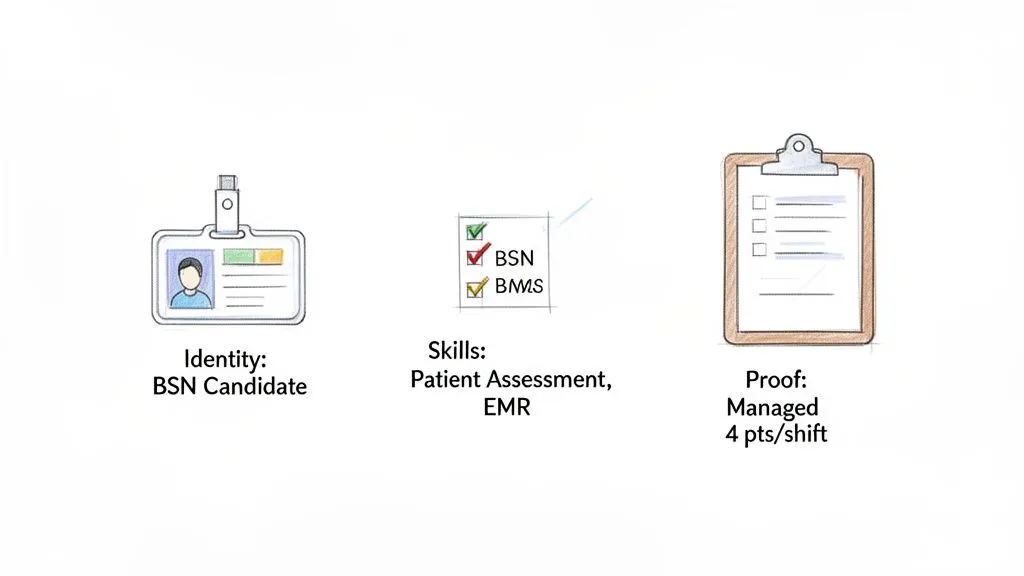
A great summary isn't complicated. It's focused. It gets straight to the point and shows a hiring manager you get what the job actually requires. Forget writing a generic, fluffy objective. Build a powerful summary using these three core ingredients.
1. Your Core Identity
Start with who you are right now. This is your professional headline. It needs to set the stage instantly.
Don't overthink it, but be specific and confident.
Compassionate BSN CandidateDetail-oriented Nursing StudentFuture RN with clinical experience in emergency services
This simple tag gives a recruiter immediate context. It’s clean, professional, and frames you as a serious candidate, not just another student with a dream.
2. Your Top 2-3 Skills
Next, name the skills that actually matter for the role. This isn't the place for a laundry list of buzzwords. You need to connect your skills to the real work of nursing. Hiring managers scan for specific competencies, not vague qualities.
Instead of just saying "good communication skills," mention something tangible. Focus on skills that solve real hospital problems, like improving patient safety or making a unit more efficient.
Your summary isn't a list; it's a short story. Weave your skills into a sentence that shows what you can do. This proves you understand the practical side of your training, not just the textbook version.
For example, pull out skills that recruiters are actively looking for:
* Patient assessment and triage
* EMR charting (Epic, Cerner)
* Care plan development and execution
* Wound care and medication administration
Combining your identity and skills, you might get: Compassionate BSN candidate skilled in patient assessment and EMR charting. See? You’re already building a much stronger case than a vague objective ever could.
3. Your Proof of Impact
This is where you make it real. Your clinical rotations are your proof. This is the most critical part of turning your student experience into professional evidence.
Scrub "assisted with patient care" from your vocabulary. It tells the recruiter nothing. You have to quantify your contributions to show the actual scope of your responsibilities.
Think about your shifts. How many patients were you responsible for? What specific tasks did you own from start to finish?
- Instead of: Helped nurses on the floor.
- Try: Managed care for up to 4 patients per shift in a fast-paced Med-Surg unit.
- Instead of: Observed in the ER.
- Try: Assisted in triage for a high-volume emergency department, conducting initial patient assessments.
Numbers cut through the noise. They give the hiring manager hard evidence of what you can handle. They prove you’re ready for the demands of a real clinical environment. This is how you show your value from the very first sentence.
Showcase Skills That Actually Matter in a Hospital
Let’s be honest. Hiring managers—and the software they use to filter resumes—don't care about vague qualities like “hardworking.” They’re scanning for specific skills that solve the real, daily problems of a busy clinical unit.
Your summary is the first and best place to prove you get it. This means cutting the fluff and focusing on competencies that keep a hospital running safely and efficiently. Show you’re ready to be a contributor, not just a student who needs their hand held.
Go Beyond the Textbook Skills
Anyone can write "strong communication skills" on a resume. It’s meaningless without clinical context. To stand out, use the specific language of healthcare.
Instead of generic terms, anchor your summary with high-impact skills every nurse manager is looking for:
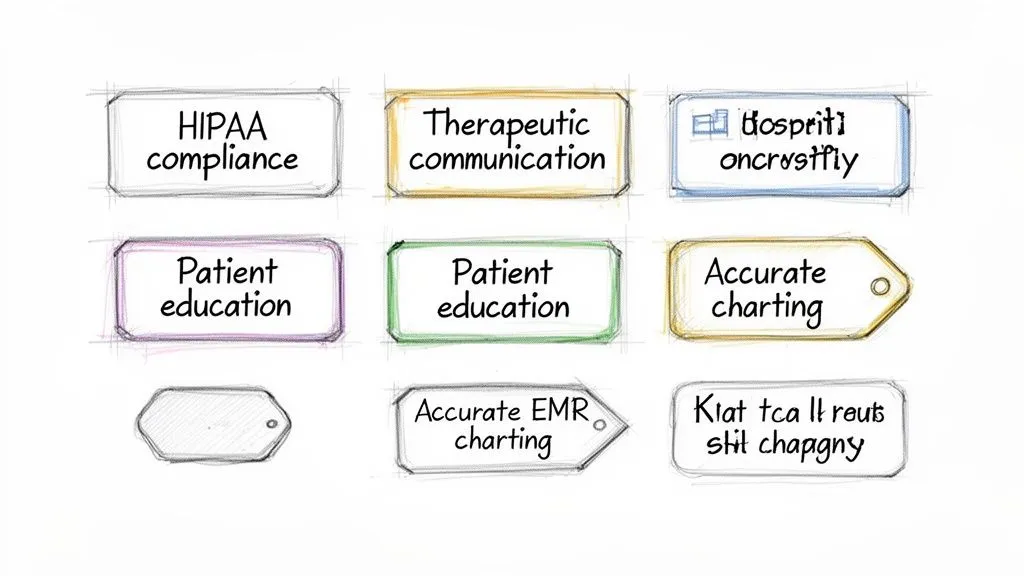
- EMR Charting: Mentioning proficiency in an EMR like Epic or Cerner is a huge green flag. It says you understand the administrative backbone of modern patient care and won’t need as much training.
- Patient and Family Education: This isn't just about being friendly. It’s a core nursing function that directly impacts patient compliance and lowers readmission rates.
- HIPAA Compliance: Showing you understand patient privacy demonstrates you respect the legal and ethical boundaries of the job. It’s a non-negotiable.
- Therapeutic Communication: This is the clinical term for building trust with patients, especially during difficult conversations. It signals a professional maturity beyond the classroom.
Adding these keywords to your summary does two things. First, it helps your resume sail past Applicant Tracking System (ATS) filters. More importantly, it tells a human reviewer that you speak their language. If you need more ideas, our guide on nursing student skills for your resume is a great place to start.
Your summary should read like a preview of a competent new colleague. It proves you understand the daily realities of patient safety, clear documentation, and effective communication in a busy unit.
Focus on What Hospitals Value Most
The skills that get you hired aren't a secret. An analysis of successful nursing student resumes from sites like Resume Worded shows a clear pattern. The most effective resumes consistently highlight communication skills, active listening, patient and family education, and privacy/confidentiality (HIPAA).
In fact, communication and listening skills appear on roughly 78% of these resumes, while privacy-related skills show up on about 72%. These aren't just buzzwords; they reflect the core priorities of modern healthcare—patient safety, satisfaction, and regulatory compliance.
This data confirms that a strong summary isn't about listing every procedure you’ve witnessed. It’s about strategically highlighting the competencies that signal you are a low-risk, high-potential new hire who is ready to contribute to a culture of safety and quality care.
Turn Clinical Experience Into Compelling Numbers
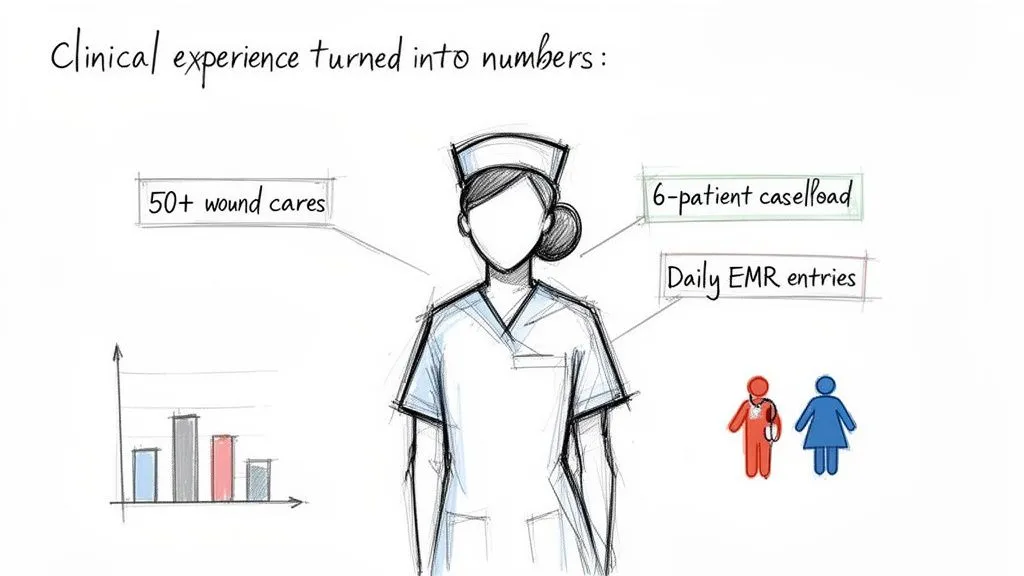
Let's get one thing straight: your clinical rotations are your work experience. Stop thinking of them as just a class you attended. Writing that you "assisted with procedures" is a waste of resume space. It tells a hiring manager nothing about what you can actually do.
The secret is turning your duties into data. Numbers are proof. They show you can handle real-world volume and responsibility, transforming your student experience into hard, professional evidence.
Start Quantifying Everything
Don't just list your rotations. Dig into what you actually did on each shift and find a number to attach to it. You have more data than you think.
Did you manage a group of patients? Don’t just mention it. Quantify it.
- Instead of: Responsible for patient care.
- Try: Managed daily charting and care plans for a 6-patient caseload.
Did you perform specific procedures? Count them up. It feels tedious, but it pays off.
- Instead of: Helped with wound care.
- Try: Performed 50+ wound care treatments, including dressing changes and irrigation.
This shift—from describing what you were told to do, to demonstrating what you achieved—is what separates a forgettable resume from an interview-worthy one. Metrics make your experience tangible.
Think like a manager. They don't care that you were present; they want to know what you accomplished. Numbers are the language of accomplishment.
How to Find Your Metrics
Your clinical logs and personal notes are a goldmine. Go back through them and look for totals, averages, and frequencies. Ask yourself these questions for each rotation:
- How many patients was I responsible for each day?
- How many IVs did I start? How many catheters did I insert or manage?
- Did my team hit a specific goal, like reducing wait times or improving a process?
- How many patients did I educate on discharge plans or new medications?
Even small numbers show a pattern of competence and hands-on ability. The data can be impressive—we've seen students document anywhere from 50 to 500+ patient interactions during their rotations. Some, by focusing on patient advocacy, have even contributed to a 20% increase in patient satisfaction scores. These numbers matter. They turn your education into concrete evidence.
Attaching numbers to your clinical experience is non-negotiable. It’s the clearest way to show a hiring manager you’re ready for the floor, not just the classroom. We cover this in more detail in our guide on using metrics in your resume. This is how you prove you can deliver results from day one.
Real-World Nursing Student Summary Examples
Theory is one thing. Seeing it in action is another. Forget generic templates that make every nursing student sound the same.
A powerful summary is specific. It reflects your unique experience and the value you bring. The goal isn't to copy these examples word-for-word. It's to see the simple formula at work: Who you are + what you can do + how you've already done it.
General BSN Student Example
This is your solid, all-around summary. It’s perfect when you're applying to Med-Surg floors, general hospital roles, or new grad residency programs. It shows you're competent, you've got the fundamentals down, and you're ready to go.
BSN candidate with 500+ clinical hours across Med-Surg and Telemetry units. Proficient in Epic EMR, patient assessment, and medication administration, with experience managing care for up to 5 patients per shift. Eager to apply strong clinical judgment and patient advocacy skills to the New Graduate Residency Program at City General Hospital.
Why it works:
* It immediately identifies you as a "BSN candidate."
* It lists specific, high-demand skills like Epic EMR and medication administration.
* It proves your experience with hard numbers: "500+ hours" and "5 patients per shift."
Pediatrics-Focused Student Example
If you’re aiming for a pediatric unit, your summary has to show you get the nuances of this population. It's not just about clinical skills—it's about connecting with kids and supporting families.
Compassionate nursing student with a dedicated clinical rotation in a pediatric acute care setting. Skilled in family-centered education and therapeutic communication with young patients. Experience includes assisting with 20+ pediatric immunizations and providing post-procedural comfort to children and families.
Why it works:
* Starting with "Compassionate nursing student" aligns you with the role's demands.
* It highlights key peds competencies like "family-centered education."
* "20+ immunizations" is a specific, measurable task that shows hands-on experience.
Emergency Department (ED) Focused Student Example
The ED is all about speed, accuracy, and staying cool under pressure. Your summary needs to mirror that high-stakes environment. Show them you can think on your feet.
Detail-oriented nursing student with 120+ clinical hours in a Level II Trauma Center. Proficient in rapid patient triage, vital sign monitoring, and assisting with emergency procedures. Proven ability to maintain composure and accuracy in a high-volume setting while charting in Cerner.
Why it works:
* "Detail-oriented" is a critical trait in the fast-paced, high-risk ED.
* It calls out ED-specific skills like "triage" and assisting with "emergency procedures."
* Naming the facility type ("Level II Trauma Center") and the specific EMR (Cerner) adds powerful context.
Putting together a resume with impressive numbers is just one piece of the puzzle. It’s crucial to understand the entire strategy behind landing your first nursing position. Your resume is the key that opens the first door.
Second-Career Student (From Teaching)
If you're a career changer, you have a secret weapon: transferable skills. Don't hide your past—frame it as a strength. A former teacher is already an expert in communication and education.
Former educator and current BSN candidate transitioning into nursing with a passion for patient advocacy. Draws on 10 years of experience in instructional design and communication to excel at patient and family education. Clinical experience includes developing and delivering discharge teaching plans for cardiac patients.
Why it works:
* It owns the career change and frames it as a positive, deliberate move.
* It brilliantly connects a past skill ("instructional design") to a core nursing duty ("patient education").
* It provides a concrete example of applying those skills in a clinical setting.
Answering Your Top Questions About Nursing Resume Summaries
The top of your resume is prime real estate, but it causes a lot of confusion. The advice you get online is often contradictory. Let's cut through the noise with some straight answers.
Objective or Summary?
Always a summary. An objective is about what you want—a job. A summary is about what you can offer—which is what gets you hired.
A hiring manager already knows you want the position; you applied. Your job is to prove you’re qualified for it in six seconds. A summary gets right to the point by leading with your skills and clinical impact, not your personal career goals.
What if I Have No Paid Healthcare Experience?
Don't sweat it. This is normal for nursing students. Your clinical rotations are your work experience, and you need to frame them that way.
Your summary isn't for listing duties. It's for showcasing achievements. Focus on the hard proof:
* The types of units you thrived in (e.g., ICU, Med-Surg, Pediatrics).
* The number of patients you managed per shift.
* Specific procedures you assisted with (e.g., "assisted with 50+ wound care treatments").
* Any EMR systems you’ve used, like Epic or Cerner.
Your clinical hours are your evidence of competence. Use them.
A summary isn’t about the jobs you've held; it's about the value you deliver. For a nursing student, that value is found in your hands-on clinical training, not a paycheck.
How Long Should It Be?
Short. Think 3-4 lines, maximum. A resume summary is not a mini-cover letter.
Its only job is to be a sharp, compelling preview that convinces the hiring manager to keep reading. Long, dense paragraphs get skipped instantly. Keep your sentences tight and focused on high-impact information. Brevity shows confidence.
Should I Change My Summary for Each Job?
Yes. Absolutely. This is non-negotiable.
Sending the same generic summary for a pediatric role and an emergency department position tells the hiring manager you haven't bothered to read their job description. Every unit has unique priorities.
Read the job ad carefully. If they emphasize "patient and family education," your summary needs to highlight your experience doing just that. If they’re a Level I Trauma Center, you better mention your ability to perform in high-pressure situations. Tailoring your summary is the single most effective way to show you are a serious candidate.
Stop staring at a blank page. StoryCV is your Digital Resume Writer. We don't hand you soul-crushing templates. We use an intelligent interview to pull out your real-world achievements and craft a powerful narrative that opens doors. Get editorial judgment at software speed. Try it now.