You survived clinicals. You mastered pharmacology. But your resume reads like a textbook index.
It lists what you've learned, not what you can do.
This isn't about finding the 'perfect' template. Templates are soul-crushing. This is about articulating your value.
Most nursing student resumes are a checklist. "Proficient in X." A waste of space. You're a developing clinician, not a machine filling out boxes. You need to show the 'what' (your skills) and the 'so what' (how you used them). This is the difference between a resume that gets filed and one that gets a call.
Hiring managers don't care that you “assisted with patient care.” They want to know you managed a 5-patient caseload, performed head-to-toe assessments, documented vitals in Epic, and educated a family on discharge instructions. Specificity is everything.
You need to translate your clinical experience into the language of professional value. For comprehensive guidance on creating a compelling application, these CNA resume writing tips offer valuable strategies applicable to any entry-level healthcare professional.
Let's cut the fluff. Here are the essential nursing student skills for your resume, with examples that get you noticed.
1. Clinical Assessment and Patient Care Documentation
This is the bedrock of safe nursing. Can you gather critical data and accurately record it? This isn't just charting; it's creating a legal record that ensures continuity of care. Hiring managers see this as non-negotiable proof of competence.
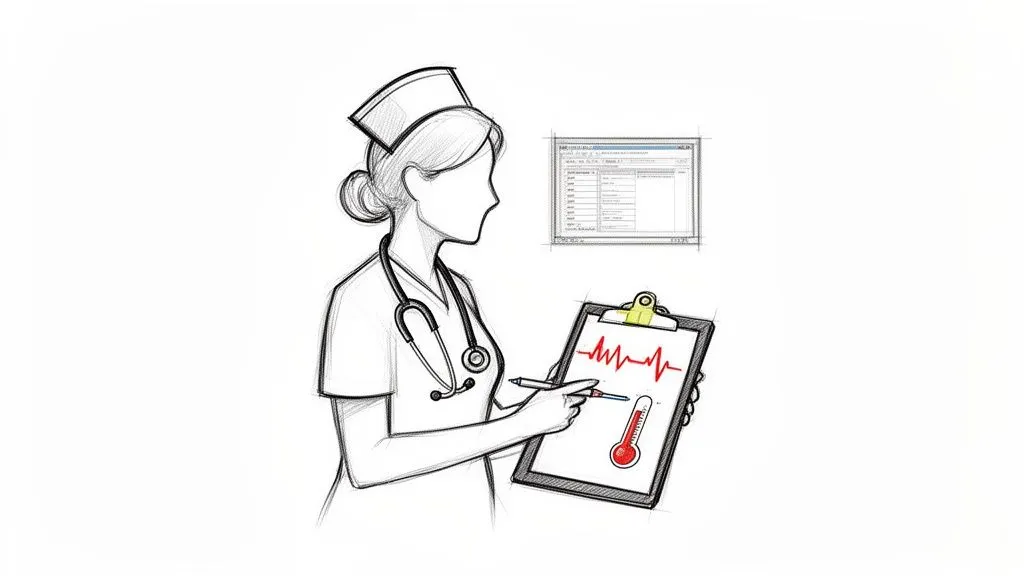
This skill shows you can use frameworks like ADPIE (Assessment, Diagnosis, Planning, Implementation, Evaluation). It proves you can make sharp clinical observations and communicate them clearly.
How to Showcase This Skill on Your Resume
Don't just say "conducted patient assessments." Use specific, quantifiable examples from your clinical rotations. Make your bullet points tell a story.
Resume Bullet Examples:
- For a Med-Surg Rotation: Conducted and documented comprehensive head-to-toe assessments for a caseload of 4-5 diverse patients per shift, identifying and escalating early signs of patient deterioration, resulting in timely intervention.
- For a Tech-Focused Role: Gained proficiency in Epic and Cerner EHR systems across two clinical placements, ensuring 100% accuracy in documenting vital signs, patient histories, and nursing interventions.
- For a Critical Care Internship: Performed focused neurological and cardiovascular assessments on ICU patients, meticulously documenting changes in condition that informed adjustments to care plans by the primary RN.
Actionable Tips
- Name the EHRs. Don't just say "EHR experience." Mention Epic, Cerner, Meditech, or Allscripts. This is a keyword for Applicant Tracking Systems (ATS).
- Connect assessment to action. Show how your assessment skills made a difference. Did you spot a medication side effect? Notice early signs of sepsis? Prevent a fall? Frame documentation as a key part of patient safety.
- Highlight specializations. Got certifications or focused training in specialized assessments (e.g., cardiac, neurological)? List them. It shows you've gone beyond the standard curriculum.
For more guidance on structuring these experiences, see these examples of a resume of a nursing student. Mastering the articulation of these foundational nursing student skills for your resume is crucial for landing your first role.
2. Medication Administration and Pharmacology Knowledge
This is a high-stakes skill. Accuracy is everything. It's more than handing out pills; it's understanding drug classifications, contraindications, side effects, and precise dosage calculations. Recruiters see this as a direct measure of your commitment to patient safety.
Competency here proves you can apply the "rights of medication administration" under pressure. It tells a hiring manager you are dependable and meticulous. Someone who can be trusted with one of nursing's most high-risk duties.
How to Showcase This Skill on Your Resume
Avoid the generic "administered medications." Give specifics about routes, technologies, and safety protocols you've used. Frame your experience around safety and accuracy.
Resume Bullet Examples:
- For a Geriatric or Long-Term Care Rotation: Safely administered medications to a caseload of 8-10 residents per shift via oral, subcutaneous, and IM routes, strictly adhering to double-check protocols for high-risk drugs like insulin and anticoagulants.
- For an Acute Care Internship: Gained proficiency in operating Alaris smart pump technology for IV infusions, managing titrations and ensuring correct dosage delivery for critical cardiac and pain medications.
- For a General Clinical Placement: Demonstrated a 100% accuracy rate in medication administration across a 12-week preceptorship, utilizing medication verification systems and conducting thorough patient education on new prescriptions.
Actionable Tips
- Specify routes and tech. State your experience with different administration routes (PO, IV, IM, SubQ) and specific tech like smart pumps or automated dispensing cabinets (e.g., Pyxis).
- Highlight safety. Emphasize your role in preventing errors. Use phrases like "maintained a zero-error record," "conducted meticulous medication reconciliation," or "adhered to high-alert medication protocols."
- Mention specialized knowledge. Experience with specific drug classes (chemo, psychotropics, anticoagulants) or controlled substances? Include it. It's a valuable detail.
Effectively describing these medication management skills is a crucial part of building a strong nursing student skills for resume section.
3. Patient Communication, Emotional Intelligence, and Compassion Fatigue Management
Technical skills matter, but nursing is a human profession. This is your ability to build trust, read unspoken needs, and manage the emotional toll of the work. Recruiters value this. It shows you can provide holistic care and survive a demanding career.
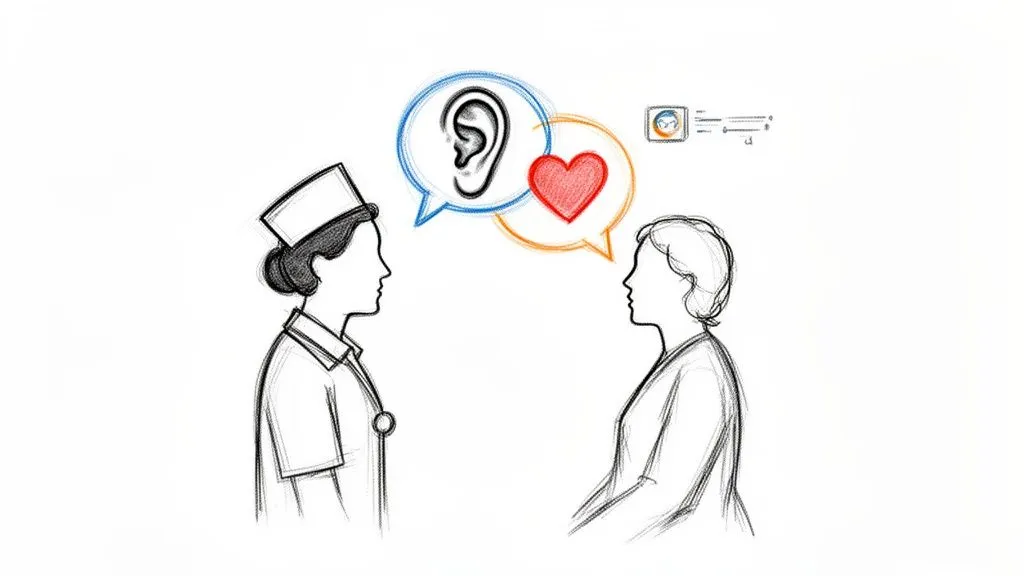
This proves you can navigate complex social dynamics—de-escalating anxious patients, providing culturally sensitive education, supporting grieving families. Recognizing and addressing compassion fatigue signals a high level of self-awareness. These are some of the most critical soft skills vs. hard skills a nursing student can showcase on a resume.
How to Showcase This Skill on Your Resume
Avoid vague phrases like "good communicator." Provide concrete examples where your interpersonal skills led to better patient outcomes.
Resume Bullet Examples:
- For a Pediatric Rotation: Built rapport with anxious pediatric patients and their families using age-appropriate communication techniques, resulting in increased cooperation during procedures and medication administration.
- For a Mental Health Placement: Employed therapeutic communication and de-escalation strategies to manage agitated patients, reducing the need for physical restraints by 15% during clinical hours and ensuring staff safety.
- For a Community Health Role: Provided culturally-sensitive patient education to a diverse, multilingual patient population, successfully explaining complex medication regimens to non-English-speaking clients through the use of certified interpreters.
- For a Geriatric Internship: Effectively communicated complex post-operative instructions to an elderly patient with hearing impairment, confirming understanding through the teach-back method and ensuring 100% adherence to the care plan.
Actionable Tips
- Use keywords. Use phrases like "therapeutic communication," "active listening," and "motivational interviewing" to show clinical application.
- Connect communication to outcomes. Did you improve medication adherence? Prevent a patient from leaving against medical advice? Show the result.
- Show your resilience. Acknowledge the emotional demands. "Developed self-awareness to recognize early signs of compassion fatigue, utilizing mentorship and debriefing to maintain professional resilience."
- Include family interaction. Mention instances where you provided clear updates or addressed concerns with empathy. Exploring strategies for critical incident stress debriefing can be invaluable.
4. Teamwork and Interdisciplinary Collaboration
Healthcare is a team sport. This is your ability to work with physicians, therapists, social workers, and other nurses. It involves clear communication and mutual respect. Hiring managers need to know you can integrate into their team and contribute to a safe environment.
This skill shows you understand that patient outcomes are a shared responsibility. It proves you can use tools like SBAR (Situation, Background, Assessment, Recommendation) to escalate concerns. It signals you're ready for the realities of clinical practice.
How to Showcase This Skill on Your Resume
Avoid "team player." Provide examples where your collaboration directly benefited a patient. Show how you acted as a vital communication link.
Resume Bullet Examples:
- For a Complex Care Rotation: Collaborated with physical therapy, social work, and the primary RN on comprehensive discharge plans for 3 post-stroke patients, ensuring all necessary resources and follow-up appointments were secured.
- For a Critical Care Internship: Utilized SBAR communication to effectively escalate a patient's declining respiratory status to the physician and respiratory therapist, leading to a rapid bedside intervention that prevented intubation.
- For a General Practice Placement: Participated in daily interdisciplinary team huddles, providing key nursing insights that helped tailor care plans and address psychosocial needs identified during patient interactions.
Actionable Tips
- Go beyond nursing. Focus on collaboration with other disciplines. Working with physicians, pharmacists, or physical therapists is more impactful than helping another student.
- Use communication frameworks. Explicitly mention using tools like SBAR or participating in "team huddles" or "bedside shift reports."
- Show the outcome. Did your communication prevent an error? Did it expedite a discharge? Connect your action to a positive result.
Including robust examples of teamwork is one of the most effective nursing student skills for your resume to demonstrate your readiness for a fast-paced, collaborative healthcare setting.
5. Time Management and Organizational Skills
A busy nursing floor is controlled chaos. This is your ability to prioritize, manage multiple patients, and stay calm under pressure. It’s about strategic thinking in a high-stakes environment. Hiring managers see this as a direct indicator of your ability to handle a real shift.
This skill proves you can juggle scheduled meds, immediate patient needs, documentation, and emergencies without compromising care. It shows you can think critically and adapt your plan on the fly.
How to Showcase This Skill on Your Resume
Avoid "good time management." Use concrete examples from your clinicals that paint a picture. Use numbers and specific outcomes.
Resume Bullet Examples:
- For a Med-Surg Rotation: Successfully managed and prioritized care for a caseload of 4-6 diverse patients per shift, consistently completing all medication administration and documentation within established timeframes.
- For a High-Acuity Placement: Maintained a calm and organized approach during a high-admission shift by creating a personalized shift plan, ensuring no critical tasks were missed and all patient needs were met.
- For a Leadership-Focused Role: Reorganized the unit's supply closet system during a clinical rotation, creating a labeling and inventory process that reduced search time for critical supplies by an estimated 15% for the nursing staff.
Actionable Tips
- Quantify your patient load. Always specify the number of patients you managed (e.g., "caseload of 5 patients"). Add context about the unit type (Med-Surg, Peds, ICU).
- Show prioritization in action. "When a patient's condition suddenly declined, effectively triaged care needs, delegated vital sign checks for a stable patient to a UAP, and focused on the acute situation."
- Mention your systems. Did you create a "brain sheet" or a checklist? Mentioning your personal tools for organization shows proactive problem-solving. These are the nursing student skills for a resume that demonstrate true readiness.
6. Critical Thinking and Clinical Reasoning
This is the cognitive engine of a great nurse. It’s connecting classroom knowledge to a real patient, analyzing data, and making sound decisions under pressure. Hiring managers value this. It shows you can think independently and act decisively to protect patients.

This skill proves you can move beyond simply following orders. You can anticipate complications, question assumptions, and solve problems. It tells a recruiter you are not just a task-doer but a proactive, analytical caregiver.
How to Showcase This Skill on Your Resume
Avoid "strong critical thinking skills." Present specific clinical scenarios where your analytical abilities led to a positive outcome. Illustrate your thought process.
Resume Bullet Examples:
- For a Med-Surg Rotation: Identified subtle signs of patient decompensation, including increased confusion and delayed capillary refill, before vital sign changes occurred, prompting early RRT activation and preventing ICU transfer.
- For a Pharmacology-Heavy Placement: Questioned a new medication order inconsistent with a patient's declining renal function, collaborated with the pharmacist, and prompted a prescriber review that prevented potential nephrotoxicity.
- For a Palliative Care Internship: Adapted a pain management plan for a patient not responding to standard interventions by researching alternative non-pharmacological methods and proposing a revised, multi-modal approach that improved patient-reported comfort by 40%.
Actionable Tips
- Describe your thought process. Use phrases like "analyzed trends," "investigated potential causes," or "differentiated between..." to show your reasoning.
- Highlight questioning. Show you're not afraid to speak up. Mentioning that you questioned an order demonstrates confidence and a commitment to patient safety.
- Connect to evidence-based practice. Mentioning you "applied research on catheter care protocols" adds significant weight to your skills.
Understanding how to frame these cognitive abilities is a core part of building a strong resume. You can explore how critical thinking fits into the bigger picture.
7. Infection Control and Safety Compliance
This skill is about unwavering commitment to a safe environment for patients and staff. It’s your knowledge of hand hygiene, PPE, and standard precautions. Hiring managers see this as non-negotiable. A single breach can have catastrophic consequences.
Demonstrating this proves you understand the "why" behind the protocols: preventing healthcare-associated infections (HAIs). It shows you are meticulous, responsible, and can be trusted to uphold the highest standards, even when no one is watching. This is one of the most critical nursing student skills for your resume because it speaks directly to your reliability.
How to Showcase This Skill on Your Resume
Avoid "knowledge of infection control." Provide concrete examples of you actively practicing safety during clinicals. Highlight your proactive approach to compliance.
Resume Bullet Examples:
- For an Isolation/COVID Unit Rotation: Maintained strict adherence to contact, droplet, and airborne precautions for a caseload of COVID-19 positive patients, ensuring zero cross-contamination incidents during clinical hours.
- For a Long-Term Care Placement: Proactively educated patients and families on fall prevention strategies, contributing to a 10% reduction in patient falls on the unit during a 6-week internship period.
- For a Surgical Internship: Implemented and monitored aseptic techniques during wound care and dressing changes for post-operative patients, ensuring proper sterilization protocols were followed to prevent surgical site infections.
Actionable Tips
- Frame it as a core value. "Maintained an unwavering commitment to infection control protocols to protect vulnerable patient populations."
- Be specific about pathogens. Mention experience with precautions for C. difficile, MRSA, or COVID-19. This shows real-world application.
- Highlight proactive safety measures. Did you identify a safety hazard? Report a near-miss? Showcasing your initiative demonstrates leadership potential.
- Mention certifications. If you have any (e.g., in hand hygiene or PPE), list them.
8. Adaptability and Learning Agility in Healthcare Transitions
Healthcare is in constant flux. New tech, new protocols, diverse patients. Adaptability isn't nice to have; it's a core survival skill. It's your ability to pivot between units, master new EHRs, and apply feedback. Hiring managers value this. It proves you can handle the unpredictable nature of clinical work.
This skill shows recruiters you're not rigid. It demonstrates you can embrace change, whether it's rotating from a fast-paced Med-Surg floor to a specialized pediatric unit or learning a new charting system mid-semester. This signals you'll be a low-risk, high-reward hire.
How to Showcase This Skill on Your Resume
Avoid "adaptable" or "quick learner." Give concrete examples of how you successfully navigated change during your nursing education.
Resume Bullet Examples:
- For Varied Clinical Rotations: Successfully completed clinical rotations across 4 diverse units (Med-Surg, Pediatrics, ICU, and Labor & Delivery), rapidly assimilating unit-specific protocols and patient care standards with positive preceptor feedback in each setting.
- For Technology Proficiency: Demonstrated learning agility by mastering the Epic EHR during a 12-week placement and quickly adapting to a Cerner system in a subsequent 8-week rotation, achieving full charting competency within the first week.
- For Patient Population Changes: Adjusted communication and care planning strategies when transitioning from an adult oncology unit to a pediatric rotation, actively seeking guidance to build rapport and provide age-appropriate, family-centered care.
Actionable Tips
- Frame rotations as adaptability. Don't just list them. Frame them as a story of your ability to adapt. Emphasize how you learned the unique workflows and patient needs of each environment.
- Connect feedback to growth. Show you're coachable. Mention how you sought and implemented feedback from preceptors to improve your practice. It proves you have a growth mindset.
- Highlight your curiosity. Your ability to ask insightful questions shows you're engaged and eager to learn. This is a key component of adaptability and a vital one of the many nursing student skills for a resume that managers look for.
8-Point Nursing Student Resume Skills Comparison
| Skill / Competency | Implementation Complexity 🔄 | Resource Requirements ⚡ | Expected Outcomes 📊 | Ideal Use Cases 💡 | Key Advantages ⭐ |
|---|---|---|---|---|---|
| 1. Clinical Assessment and Patient Care Documentation | Moderate | Low–Moderate | High | All clinical settings | Fundamental, transferable; improves documentation accuracy |
| 2. Medication Administration and Pharmacology Knowledge | High | Moderate–High | Very high | High-acuity units, specialty areas | Critical safety skill; quantifiable by certifications |
| 3. Patient Communication, Emotional Intelligence, and Compassion Fatigue Management | Moderate | Low | High | Patient-facing roles, palliative care, pediatrics | Differentiates candidates; builds trust and resilience |
| 4. Teamwork and Interdisciplinary Collaboration | Moderate | Low–Moderate | High | ICUs, ED, complex discharge planning | Enhances care coordination; reduces errors |
| 5. Time Management and Organizational Skills | Moderate | Low | High | Busy wards, med-surg, shift-based environments | Measurable efficiency gains; supports patient safety |
| 6. Critical Thinking and Clinical Reasoning | High | Moderate | Very high | High-acuity, complex clinical cases | Differentiates experienced clinicians; prevents adverse events |
| 7. Infection Control and Safety Compliance | Low | Low | High | All settings, isolation care, procedure areas | Non-negotiable for safety; measurable compliance impact |
| 8. Adaptability and Learning Agility in Healthcare Transitions | Moderate | Low–Moderate | High | Unit transfers, EHR rollouts, evolving protocols | Enables mobility, rapid skill uptake, long-term value |
Stop Listing. Start Telling.
Your nursing education wasn't about memorizing lists. It was about applying knowledge in dynamic, high-stakes situations. Your resume should reflect that.
Too many nursing students create a laundry list of skills, hoping a hiring manager connects the dots. Don't leave it to chance. The goal isn't to list your skills; it's to prove them through concise, powerful stories.
Each skill we covered is a prompt for a story. Instead of dropping "Patient Communication" as a keyword, you now have the tools to write a bullet point that shows how you de-escalated a family's anxiety.
Key Takeaways: From Keywords to Impact Stories
Remember this: your resume is a series of compelling arguments for why you are the best candidate. Each bullet point is a piece of evidence.
- Action Verbs are Your Foundation. "Assessed," "Administered," "Collaborated," "Educated." They signal your active role.
- Context is Everything. A fast-paced Med-Surg floor? A specialized oncology unit? Context gives your experience weight.
- Quantify Your Impact. Numbers cut through the noise. How many patients? By what percentage? How many EHR systems? Metrics are tangible proof.
- Tell the "How" and "Why." The best nursing student skills for a resume hint at your clinical reasoning. Instead of "Monitored vital signs," try "Monitored and interpreted vital signs, escalating a sudden drop in blood pressure to the charge nurse, leading to timely intervention for hypovolemia." This shows you don't just collect data; you understand it.
Your resume is an active sales pitch. The skills are the features, but the stories you tell are the benefits. You are not a student with "time management skills." You are a future nurse who successfully prioritized care for multiple patients during a hectic shift, ensuring all medications were delivered on time.
That's the difference between listing a skill and telling a story. It's the difference that gets you the interview.
Tired of trying to translate your clinical experience into powerful resume bullet points? StoryCV isn't a template library; it's a Digital Resume Writer. Our guided process pulls out your impact stories and frames them for you. Stop filling out boxes. Start telling your story. Get started with StoryCV.