Your resume is a list of duties. 'Answered calls.' 'Resolved tickets.' 'Provided support.' It’s honest. It’s also why you’re not getting hired for better roles.
Recruiters don’t care that you answered 100 tickets a day. They care if you made the company money, saved it time, or kept customers from leaving.
This is the gap for most mid-to-senior pros. You've done great work, but your resume sounds generic. It reads like a job description you copied, not a highlight reel of your achievements. Templates and resume builders just give you more boxes to fill with the same old duties.
That stops now. This isn't about fluff. It's about turning your responsibilities into metric-driven stories that command attention. We'll break down 10 types of resume bullet points for customer service with concrete examples. Time to stop documenting tasks and start articulating your value.
1. Quantified Customer Satisfaction Impact
Stop saying you "provided excellent customer service." It's a claim anyone can make. Hiring managers ignore it.
Lead with numbers that prove your impact on customer satisfaction. This is one of the most effective resume bullet points for customer service because it translates your work into business value. Metrics like Net Promoter Score (NPS), Customer Satisfaction (CSAT), and retention rates are the language of business. Use them.
How to Frame Your Impact
What changed because of your work? Did a key metric improve? By how much? Start your bullet point with that number.
- Before: Responsible for handling customer inquiries and improving satisfaction.
- After: Boosted Customer Satisfaction (CSAT) scores from 82% to 94% by implementing personalized follow-up protocols.
The Breakdown: The "After" example works. It specifies the metric (CSAT), shows the exact improvement (82% to 94%), and explains the action that caused it (personalized follow-ups). It tells a complete, compelling story.
More Examples of Quantified Impact
- Achieved a 91% first-contact resolution rate, reducing repeat calls by 23% and saving an estimated $40K annually in support costs.
- Maintained a 99.2% customer retention rate across a portfolio of 250+ enterprise accounts through proactive quarterly health checks.
To find these numbers, you may need to dig. If your company tracks performance data, ask for your stats. This approach turns vague duties into undeniable achievements.
2. Problem-Solving and Issue Resolution
Anyone can claim to be a “problem-solver.” Recruiters are tired of seeing it. Prove it. Detail a specific, challenging customer issue you resolved. These resume bullet points for customer service show you can think critically, turn complaints into solutions, and transform customer friction into loyalty.

Strong problem-solving narratives tell a story of turning chaos into order. They show you don’t just follow a script. You diagnose issues and create lasting fixes. To showcase your ability to overcome challenges, highlight specific instances where you applied strong creative problem-solving techniques.
How to Frame Your Impact
Identify a time you faced a tough customer problem. What was the issue, what was your specific action, and what was the business result? Quantify the outcome whenever possible.
- Before: Handled customer complaints and found solutions to their problems.
- After: Identified root cause of a 40% spike in refund requests by analyzing feedback patterns, then implemented a revised onboarding sequence that reduced returns to baseline within 6 weeks.
The Breakdown: The "After" example is powerful. It shows a clear narrative: problem (40% spike), action (analyzed feedback, revised onboarding), and result (returns reduced). It proves analytical thinking and direct business impact.
More Examples of Problem-Solving
- Developed a troubleshooting framework for complex product integration issues, reducing average resolution time from 3 days to just 4 hours and decreasing customer escalations by 65%.
- Created a workaround for a system limitation affecting 15% of the user base, enabling temporary functionality while engineering developed a permanent fix.
3. Customer Relationship Building and Retention
Great customer service builds loyalty. Your resume should show you are not just a problem-solver, but a relationship manager. These resume bullet points for customer service prove you can turn transactional interactions into long-term business value.

This means highlighting your ability to develop genuine connections, understand customer needs, and retain their business. It frames your work as a strategic asset, not just a support cost.
How to Frame Your Impact
Ground your relationship-building claims in business outcomes. How did your proactive approach affect retention rates or renewal numbers? Connect the human element to a hard metric.
- Before: Responsible for managing key accounts and building relationships.
- After: Built and maintained relationships with 180+ key accounts, achieving a 96% renewal rate through quarterly business reviews.
The Breakdown: The "After" example is powerful because it links an action (building relationships via quarterly reviews) to a high-value business outcome (96% renewal rate). It also provides scope (180+ accounts), making the achievement concrete.
More Examples of Relationship Impact
- Transformed five at-risk accounts representing $500K in annual revenue by implementing customized support plans and conducting monthly strategy sessions.
- Developed a 'customer advocate' program, turning satisfied customers into referral sources and generating 8 new enterprise deals.
To write bullet points like this, think about the long-term journey of your customers. Show hiring managers you understand that strong relationships are the foundation of a healthy business.
4. Process Improvement and Efficiency Gains
Top performers don't just follow the script; they rewrite it. Showcasing your ability to identify and fix broken processes proves you think like a business owner. These resume bullet points for customer service demonstrate a strategic mindset that makes you a far more valuable hire.
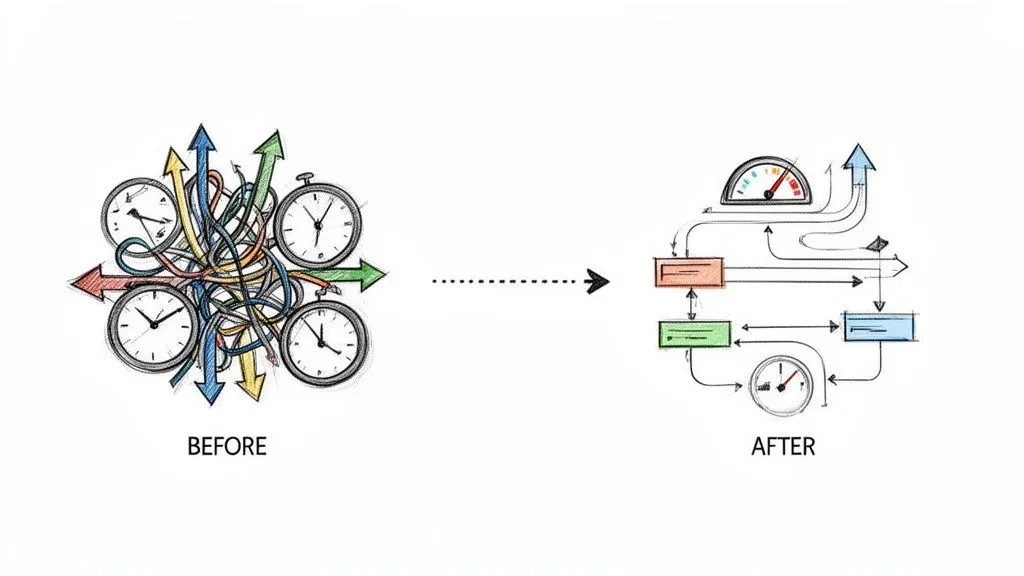
It’s about spotting the "why" behind recurring problems and implementing a real solution. This tells a hiring manager you’re proactive and can create scalable, long-term value.
How to Frame Your Impact
Think about a persistent team bottleneck. What did you do to fix it? Quantify the "before" and "after" to show a clear return on your initiative.
- Before: Created new email templates for the team.
- After: Analyzed customer inquiry patterns and redesigned email response templates, reducing average response time by 35% while maintaining quality.
The Breakdown: The "After" example connects an action (redesigning templates) to a business outcome (35% faster responses). It shows you identified a problem, diagnosed the cause, and delivered a measured improvement.
More Examples of Efficiency Gains
- Documented gaps in customer onboarding and created a video tutorial library, reducing related support tickets by 28% in the first quarter.
- Implemented ticketing system workflow optimizations that cut the average case resolution time from 8 days to 3 days, improving team capacity by 40%.
To find these stories, think about pain points you fixed. Did you create a guide, suggest a software tweak, or change a workflow? Frame it around the time, money, or effort it saved.
5. Multi-Channel Communication Excellence
Saying you "communicated with customers" is too vague. Modern support roles require you to be a chameleon, adapting your tone and approach across phone, email, chat, social media, and video. Showcasing your proficiency across these platforms proves you are versatile and effective.
This resume bullet point for customer service shows you can maintain a consistent brand voice and high standards, regardless of the channel. It signals you can handle the complexity of today's customer journey.
How to Frame Your Impact
Which channels did you master and what results did you deliver? Did you maintain a specific metric across all of them? Focus on how your versatility created value.
- Before: Handled customer inquiries on phone, email, and chat.
- After: Managed customer interactions across 5 channels (email, chat, phone, social media, in-app), maintaining a consistent <2-hour response time and a unified 92% satisfaction score.
The Breakdown: The "After" version is superior. It lists specific channels (5), provides a hard metric for response time (<2 hours), and ties it to a key performance indicator (92% satisfaction). It paints a picture of a well-rounded and reliable professional.
More Examples of Multi-Channel Excellence
- Specialized in social media customer service, resolving 40+ public inquiries daily while maintaining brand voice and de-escalating sensitive issues.
- Trained a team of 12 on best practices for email and chat, creating channel-specific templates that improved overall team satisfaction by 11%.
To make these points, think about your role. Were you a generalist or a specialist? If you trained others, that shows leadership. Highlighting your ability to adapt your skills and share them makes you a more valuable hire.
6. Technical Proficiency and Troubleshooting
Stop listing tools without context. Saying you "used Zendesk" is meaningless. Show how your technical skills directly solved customer problems, reduced team workload, or improved a business metric. These are powerful resume bullet points for customer service because they prove you are a problem-solver, not just a message-taker.
Demonstrating mastery of support software, product knowledge, and troubleshooting shows you can handle complexity and operate independently. This saves the company time and money.
How to Frame Your Impact
Identify a specific technical skill and connect it to a business outcome. Did your knowledge of a system reduce resolution times? Did you find a bug that improved the product?
- Before: Proficient in Salesforce and handled technical support questions.
- After: Mastered Salesforce Service Cloud, enabling rapid troubleshooting of 95% of technical issues without escalation and reducing average resolution time by 50%.
The Breakdown: The "After" example is effective. It names the platform (Salesforce Service Cloud), quantifies the outcome (95% of issues, 50% time reduction), and shows the business value (no escalation). It paints a picture of a self-sufficient, high-impact employee.
More Examples of Technical Proficiency
- Developed deep product expertise, authoring an internal knowledge base of 200+ troubleshooting articles that reduced new hire ramp-up time by 3 weeks.
- Used SQL queries to investigate root causes of complex customer issues, identifying 12 critical bugs for the engineering team to fix in Q3.
Document your technical wins. Note which tools you used to solve a specific, difficult problem. This approach frames you as a technical asset.
7. Training, Mentoring, and Team Leadership
Showing you can elevate your teammates is a powerful differentiator. It's a sign of leadership potential and a multiplier effect. Instead of just being a great individual contributor, you make the entire team better. These kinds of resume bullet points for customer service show you're ready for the next step.
Don't just say you "trained new hires." Show the outcome. Did you reduce their learning curve? Did they get promoted? Did their performance metrics improve? This proves your ability to build capability within a team.
How to Frame Your Impact
What was the direct result of your training or mentoring? Quantify the impact on the person, the team, or the business. Connect your action to a clear, measurable business outcome.
- Before: Trained new team members and mentored junior staff.
- After: Designed and delivered an onboarding program for 40+ new reps annually, reducing time-to-productivity from 8 weeks to 5 weeks.
The Breakdown: The "After" example is strong. It quantifies the scale (40+ reps), specifies the action (designed and delivered onboarding), and shows a clear business outcome (reduced time-to-productivity). It transforms a simple duty into a strategic achievement.
More Examples of Mentorship Impact
- Mentored 8 junior support specialists, coaching 5 to promotion readiness within 18 months through structured feedback and skill-building initiatives.
- Led a cross-functional project to develop a customer communication best practices guide, training the entire 25-person support team and resulting in a 9-point satisfaction increase.
Focus on the results of your guidance. Show how your knowledge transfer made the team more efficient or helped others advance. This frames you as a leader, not just a doer.
8. Customer Advocacy and Voice of Customer
Great customer service doesn't just solve problems; it prevents them. Showcasing your role as a customer advocate demonstrates strategic value. It proves you can translate customer feedback into business intelligence that drives product and process improvements.
Hiring managers want people who can represent the voice of the customer internally. This makes you a business partner, not just a support agent.
How to Frame Your Impact
Think about a time your insights from customer interactions led to a real change. Did you spot a recurring complaint? Did you champion a feature request? Connect your advocacy to a specific, measurable business outcome.
- Before: Relayed customer feedback to other departments.
- After: Analyzed customer feedback patterns and presented quarterly insights to the product team, influencing 5 feature priorities that cut feature-related support tickets by 23%.
The Breakdown: The "After" version is powerful because it shows the full cycle. It starts with the action (analyzed feedback), specifies the forum (quarterly insights), states the influence (influenced 5 priorities), and finishes with the business result (23% ticket reduction).
More Examples of Customer Advocacy
- Advocated for 8 process changes based on customer pain points, working cross-functionally with operations and engineering to implement improvements that increased customer satisfaction by 14%.
- Conducted monthly customer interviews, translating feedback into competitive insights that informed the go-to-market strategy for a new product line.
To build these resume bullet points for customer service, document the feedback loops you create. Show the chain from customer insight to company action to business impact. This proves you are a strategic asset.
9. Handling Difficult Situations and High-Stress Scenarios
Every customer service role has tough conversations. Don't just mention you can "handle difficult customers." Prove it. Show how you turn high-stress scenarios into positive outcomes. This demonstrates emotional intelligence, a skill that is impossible to automate.
These resume bullet points for customer service show you are a composed, professional problem-solver who can protect brand reputation and retain valuable accounts even when things go wrong.
How to Frame Your Impact
Think about a specific, challenging customer interaction. What was the root cause? What specific actions did you take to manage the situation and what was the business result? Focus on resolution and retention.
- Before: Dealt with angry customers and solved their problems.
- After: Managed resolution of a billing dispute involving a 12-month error on a customer's $50K contract, retaining the account through a diligent investigation and clear communication.
The Breakdown: The "After" example is powerful. It provides context (billing dispute, $50K contract), specifies the challenge (12-month error), and highlights the positive business outcome (retaining the account). It frames a negative situation as a professional success story.
More Examples of Handling High-Stress Scenarios
- Handled escalated situations representing 18% of support volume, achieving an 88% resolution rate without further escalation by practicing de-escalation techniques.
- Recovered three at-risk enterprise customers facing major service disruptions by providing real-time troubleshooting and hourly updates, retaining $180K in combined annual revenue.
Focus on the resolution, not just the conflict. Avoid dramatic language. The goal is to highlight your calm, professional response and the positive outcome you created for the company.
10. Industry Knowledge and Market Awareness
Anyone can follow a script. A great customer service pro understands the "why" behind a customer's problem. Demonstrating your deep knowledge of the industry, competitors, and market trends shows you are a strategic partner who provides context-aware solutions. This is one of the best resume bullet points for customer service roles in specialized fields like FinTech or SaaS.
This expertise proves you can hold substantive conversations, anticipate needs, and position your company's value effectively. It shows you understand the business, not just the support queue.
How to Frame Your Impact
Connect your knowledge directly to a customer or business outcome. How did your awareness of a regulation, competitor, or market trend change the way you helped a customer?
- Before: Aware of industry regulations and competitive products.
- After: Advised 30+ medical device customers on HIPAA best practices, reducing compliance-related support issues by 31%.
The Breakdown: The "After" version connects expertise (HIPAA) to a specific action (advising customers) and a measurable outcome (31% reduction in support issues). It tells a powerful story of value creation beyond simple ticket resolution.
More Examples of Market Awareness
- Maintained awareness of FinTech competitive offerings, enabling consultative conversations that supported 12 competitive wins against key rivals.
- Studied SaaS industry benchmarks, using the data to help enterprise accounts optimize product usage and achieve an 18% increase in feature adoption.
Think about times your expertise gave you an edge. Did you help a client navigate a complex compliance issue? Grounding your knowledge in specific actions turns a soft skill into a hard, quantifiable achievement.
Customer Service Resume Bullets: 10-Point Comparison
| Item | Implementation Complexity 🔄 | Resource Requirements ⚡ | Expected Outcomes 📊 | Ideal Use Cases | Key Advantages ⭐ | Tips 💡 |
|---|---|---|---|---|---|---|
| Quantified Customer Satisfaction Impact | Medium — requires data tracking and validation | Access to performance data, analytics tools, stakeholder sign-off | Measurable NPS/CSAT gains, retention, cost savings | Customer success, support, SaaS, hospitality | Direct business value; ATS-friendly with numbers | Show baseline → outcome; convert % to $ |
| Problem-Solving and Issue Resolution | Medium–High — needs diagnostic narrative and evidence | Time for root-cause analysis, cross-functional input | Faster resolutions, fewer refunds/escalations | Technical support, operations, customer advocacy | Highlights critical thinking and initiative | Quantify time/issue reductions; include obstacles |
| Customer Relationship Building and Retention | Medium — long-term, relationship-focused | Time, regular touchpoints, strategic reviews | Higher renewal rates, upsells, referrals | Account management, enterprise success, hospitality | Demonstrates emotional intelligence and LTV focus | Tie relationships to retention/ revenue metrics |
| Process Improvement and Efficiency Gains | High — involves redesign and change management | Data analysis, project coordination, tools/training | Time/cost savings, reduced tickets, capacity gains | Operations, support centers, onboarding teams | Positions role strategically; shows systems thinking | Provide before/after metrics; note cross-team impact |
| Multi-Channel Communication Excellence | Medium — requires channel adaptation and consistency | Familiarity with platforms, templates, training time | Consistent CX, faster response times, unified scores | Omnichannel support, community management, social teams | Versatility across platforms; easily verifiable skills | Report channel-specific metrics and progression |
| Technical Proficiency and Troubleshooting | Medium–High — technical depth plus communication | Technical tools, training, access to systems/logs | Fewer escalations, faster root-cause fixes, bug discovery | Technical support, CS engineering, product support | Differentiates candidates in technical domains | Balance jargon with business outcomes; list tools |
| Training, Mentoring, and Team Leadership | Medium — program design and coaching effort | Curriculum development time, evaluation metrics | Faster onboarding, higher retention, promoted mentees | Team leads, senior CS roles, operations managers | Signals leadership and multiplier impact | Quantify trainee outcomes and time-to-productivity |
| Customer Advocacy and Voice of Customer | High — requires influence and stakeholder alignment | Feedback channels, analytics, stakeholder engagement | Product/ process changes, reduced feature-related tickets | Product, strategy, customer-centric organizations | Elevates CS to strategic contributor | Document feedback → decision → impact chain |
| Handling Difficult Situations and High-Stress Scenarios | Medium — skillful framing and outcome focus | Training in de-escalation, documentation of cases | Retained accounts, lower escalation rates, resolved crises | Crisis management, high-value accounts, finance/healthcare | Demonstrates resilience and professional composure | Frame as learning outcomes; include resolution results |
| Industry Knowledge and Market Awareness | Medium — ongoing learning and contextualization | Research time, certifications, industry networks | More consultative conversations, competitive wins | Specialized/regulatory sectors (healthcare, fintech) | Shows business acumen and consultative value | Cite certifications and concrete customer examples |
Stop Documenting. Start Storytelling.
You've seen the examples. You get the formula: Action Verb + Quantifiable Result + Specific Context. But the real shift is a change in mindset.
Stop thinking of your resume as a logbook of duties. Start seeing it as a collection of your best career stories.
A generic resume says, “I answered customer calls.” A story-driven resume says, “I reduced call escalations by 15% by creating a new troubleshooting guide, saving the senior team 5 hours per week.” The first is a task. The second is an achievement. It shows you don't just solve problems; you prevent them.
From Task-Doer to Strategic Asset
We've broken down how to frame your contributions, from quantified customer satisfaction impact to multi-channel communication excellence. The core lesson is this: your daily work contains hidden metrics and impactful results. Your job is to find them and articulate them.
Consider these key takeaways:
* Metrics are everywhere: You don't need a fancy dashboard. Track tickets closed, time saved, processes improved, or positive feedback received.
* Context is king: Don't just state a number. Explain what it means. A 10% CSAT increase is good. Tying it to a specific initiative you led is powerful.
* Action verbs set the tone: Words like "resolved," "implemented," and "mentored" carry more weight than "responsible for." They show ownership.
Stop documenting what you were supposed to do. Start selling what you actually accomplished. You're not just a "Customer Service Representative." You are a problem-solver, a relationship-builder, and a strategic asset. To see this principle in action, check out these resume bullet point examples.
Crafting strong resume bullet points for customer service is your first, best chance to prove you're more than just another candidate. It’s how you get the hiring manager to stop skimming and start reading. Your career is a story of impact. It’s time you told it well.
Finding these stories in your daily work is the hard part. StoryCV is a digital resume writer built to do just that. It 'interviews' you with targeted questions to uncover the metrics and achievements you've overlooked, then helps you frame them with clarity and confidence. Stop filling out boxes and start telling your career story.