Your resume's only job is to turn your clinicals and class projects into proof. Proof you're ready for the floor. It has to show what you actually accomplished, not just the duties you were assigned.
Why Your Nursing Student Resume Gets Ignored
Staring at a blank page is the worst. But the problem isn't a lack of experience—it's that you’ve been taught to present it all wrong. Most nursing students make the same mistake.
They grab a generic template and fill it with weak, passive phrases. "Assisted with patient care." "Observed procedures." This tells a hiring manager nothing about what you can actually do. Your resume blends in with hundreds of others. It gets tossed.
This isn't about wording. It's about strategy.
The Real Reason You Need a Stronger Narrative
The demand for skilled nurses is exploding. The global nursing education market is on track to hit USD 49.4 billion by 2034. Why? A massive need for qualified people. The US is facing a critical nursing shortage. The World Health Organization predicts a global shortage of 4.5 million nurses by 2030. Your resume is your ticket to one of these roles—if it proves you're ready. You can read more about the growth of the nursing education market here.
Recruiters and scanning software (ATS) look for initiative and real skills. They don't care about attendance.
Your resume isn't a list of things you were present for. It's the story of the value you delivered, even as a student. It must show you didn't just shadow—you contributed.
From Passive Duties to Impactful Achievements
Stop listing duties. Start framing your experience as achievements. Translate what you did in clinicals into the language hiring managers and software understand. That means action verbs, specific numbers, and focusing on the outcome.
The shift is obvious.
| From Passive Duties to Impactful Achievements |
| :--- | :--- |
| Generic & Passive | Impact-Driven & Specific |
| Assisted nurses with daily patient care tasks. | Managed a daily caseload of 4-5 diverse patients, performing head-to-toe assessments and updating care plans in the EHR system. |
| Monitored patient vital signs. | Accurately recorded and tracked vital signs for a 15-bed Med-Surg unit, promptly reporting abnormal findings to the charge nurse. |
| Helped with patient education. | Educated 10+ post-operative patients and their families on wound care and medication management, improving patient compliance. |
One is a passive checklist. The other tells a story of competence.
This guide will help you build a nursing student resume that sells your potential and gets you noticed.
Building a Resume That Highlights Your Strengths
Your resume isn’t just a piece of paper. It argues for an interview. For nursing students, the standard chronological format is a trap. It forces you to lead with limited work history, burying your real assets—clinicals and skills—at the bottom.
Forget that broken model.
We’re using a hybrid approach that flips the script. It puts your most compelling qualifications front and center. This isn't about a soul-crushing template; it's about a logical flow that makes your strengths impossible to ignore. For other examples tailored for students with limited work history, you can explore our guide on student resumes. https://story.cv/blog/articles/student-resume-template-with-real-examples
The Strategic Order of Your Resume Sections
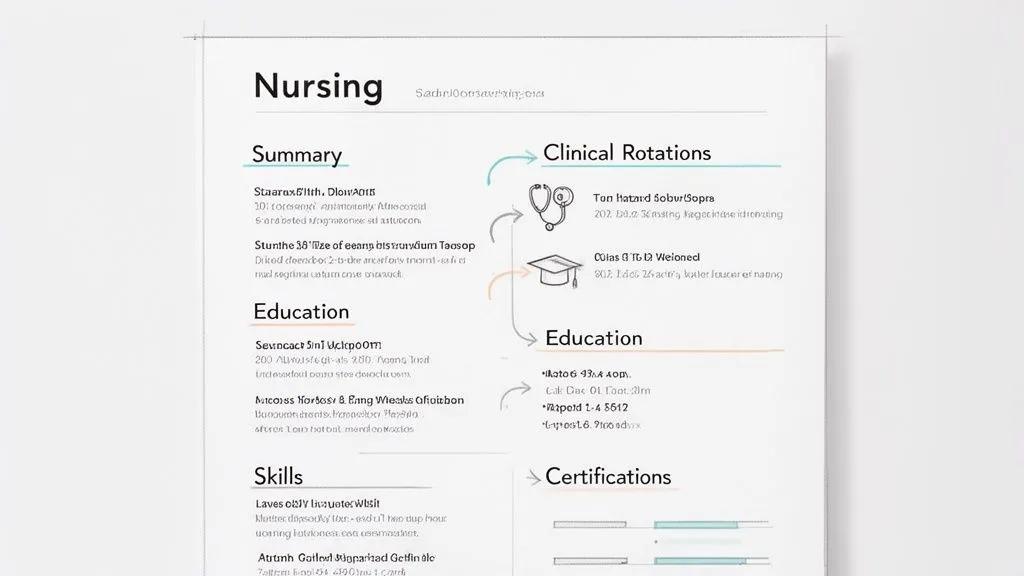
The sequence of your sections tells a story. This order proves you're a capable, hands-on candidate, not just a student.
- Contact Information & Professional Summary: Your name and details, then a sharp, three-sentence summary. Your elevator pitch.
- Clinical Rotations: This is your work experience. Treat it that way. Position it right after your summary and pack it with achievement-focused points.
- Education: Your degree, university, and expected graduation date. Clean and to the point.
- Skills: A curated list of your technical and interpersonal abilities. EHR systems, patient advocacy, IV insertion.
- Certifications & Licensure: BLS, ACLS, and NCLEX status. Non-negotiable proof. Make them impossible to miss.
This structure immediately highlights what matters in a resume of a nursing student. It shows practical experience before they even see your academics.
Don't let a bad structure hide your best work. The goal is to make it easy for a busy hiring manager to see your value in 10 seconds. This layout does that.
For students looking to showcase their dedication, understanding the symbolism behind things like nursing graduation stoles can offer another perspective on highlighting strengths from day one. By prioritizing clinicals, you reframe the conversation from "what I studied" to "what I've done." You’re not just a graduate; you’re a future colleague. That shift makes all the difference.
Turning Your Clinical Rotations Into Compelling Achievements
This is where your resume wins or loses. Your clinical rotations are your work experience. Full stop.
Too many students list them like a class schedule—hospital, unit, dates. Huge missed opportunity. Hiring managers don't need someone who just showed up. They need proof you contributed, learned on your feet, and can be trusted.
Turn your clinical hours into powerful, quantifiable achievements. With serious RN shortages projected and BSN enrollment climbing, your resume has to show you're ready to make an impact on day one. Read more on the trends shaping nursing careers from the American Association of Colleges of Nursing.
Adopt the PAR Framework
Use the PAR framework: Problem-Action-Result. It forces you to tell a complete story about your competence. It moves you from listing tasks to showing your impact.
- Problem: What was the patient need or clinical situation?
- Action: What specific nursing skill did you perform?
- Result: What was the positive outcome for the patient, unit, or team?
This isn't about inventing heroic stories. It’s about explaining the value behind your actions, even routine ones. It’s the difference between "I did this" and "I accomplished this."
Real-World Examples That Actually Work
Let's see this in practice. Notice the specific numbers and focus on the outcome.
Med-Surg Rotation
- Generic: Assisted with patient care on a busy Med-Surg floor.
- Achievement-Focused: Managed a daily caseload of 4-5 patients with diverse post-operative needs, performing comprehensive assessments and updating care plans in Cerner, leading to a 15% reduction in charting errors noted by my preceptor.
Pediatrics Rotation
- Generic: Helped administer medications to children.
- Achievement-Focused: Accurately calculated and administered oral and IV medications to pediatric patients aged 2-10, employing distraction techniques that reduced patient distress and procedure time by an average of 5 minutes.
ICU Rotation
- Generic: Monitored vitals for critical care patients.
- Achievement-Focused: Monitored and documented vital signs and ventilator settings for 2 ICU patients, promptly identifying and reporting a critical drop in oxygen saturation that led to immediate intervention.
Stop listing responsibilities. Start showcasing results. Frame every bullet point around the impact you made, no matter how small.
Your goal is to prove you can think critically and act decisively. You didn't just 'assist' with patient education; you educated 10+ diabetic patients on insulin administration, which improved their confidence scores on post-discharge surveys. You didn’t just 'help' with admissions; you completed intake documentation for 3-4 new patients per shift, ensuring a smooth handoff to the primary RN.
It’s not fluff. It’s concrete evidence. This is how you get an interview.
Writing a Professional Summary That Gets Read
The "Objective" statement is dead. It was all about what you wanted. A hiring manager has seconds to figure out what you can do for them. Wasting that prime real estate at the top of your resume is a huge mistake.
You need a sharp, confident Professional Summary. Your 15-second elevator pitch. Three punchy lines. No fluff, just facts. It's the first thing a recruiter reads, and it determines if they keep reading.
Your summary must answer three questions: Who are you professionally? What are your top 2-3 skills? And what’s your goal, framed to show how you'll benefit their team?
The Three-Line Formula
Crafting a summary that works isn't complicated. Stick to a simple formula.
- Line 1: Your Credential. Start with your professional title. "Compassionate and detail-oriented BSN candidate..."
- Line 2: Your Core Skills. Pull out two or three key skills relevant to the job. "...proficient in patient-centered care, EHR charting (Epic), and medication administration."
- Line 3: Your Aligned Goal. State what you're looking for, framed to show contribution. "...seeking to apply clinical knowledge to improve patient outcomes on a fast-paced Medical-Surgical unit."
This replaces a vague, me-focused objective with a clear statement of value. Want to explore this further? Our guide on how to describe yourself in a resume offers more strategies.
Examples for Different Units
A generic summary is a useless summary. Tailor it for each application. Here's how to adapt the formula for specific specialties.
Emergency Department Focus:
Driven BSN candidate with 120+ clinical hours in emergency and trauma settings. Proficient in rapid patient assessment, triage protocols, and IV insertion. Eager to contribute strong critical thinking and calm under pressure to a high-acuity Emergency Department team.
Labor & Delivery Focus:
Empathetic BSN candidate with a passion for maternal and infant health, demonstrated through focused clinical rotations in L&D and postpartum care. Skilled in fetal heart monitoring, patient education, and providing compassionate family support. Seeking an RN role to help ensure safe and positive birth experiences.
Oncology Focus:
Detail-oriented BSN candidate with specialized clinical experience in an inpatient oncology unit. Competent in chemotherapy safety protocols, central line care, and providing holistic support to immunocompromised patients. Aims to apply dedication and clinical skills to deliver exceptional care in an oncology setting.
These summaries are direct, specific, and laser-focused on what the student can bring. They prove you've thought about the role and are ready to contribute. That’s how you get a hiring manager to stop skimming and start reading.
Showcasing Your Skills and Certifications
This section isn't a junk drawer for every skill you've heard of. It’s hard proof. It shows you have the specific, non-negotiable qualifications for the job.
Get it right, and it closes the deal.
Your Education section should be clean. Degree (e.g., Bachelor of Science in Nursing), university, and expected graduation date. That's it. No lengthy coursework descriptions.
Certifications And Licensure Are Your Proof
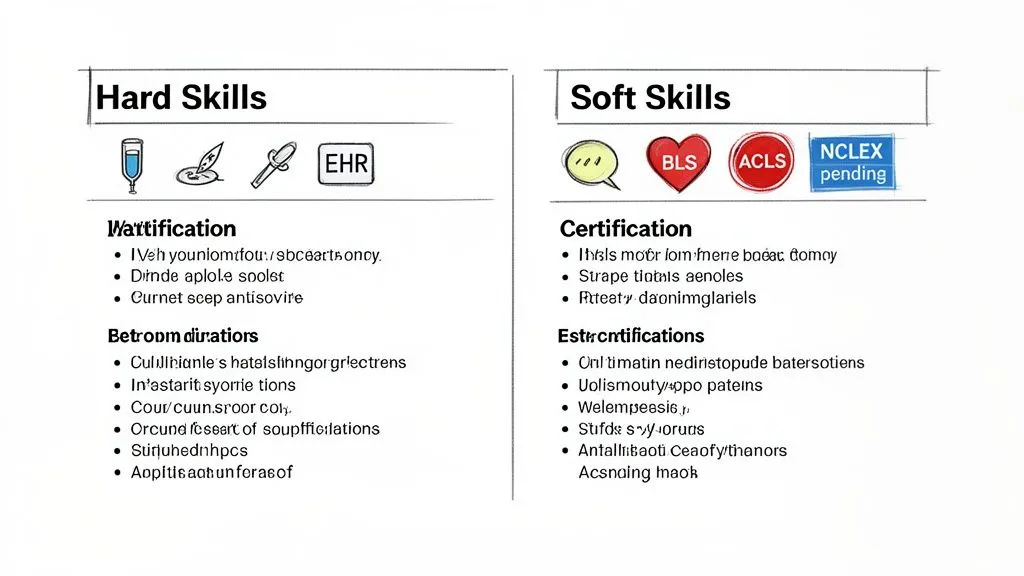
Your certifications are your credentials. They need to be front and center, easy to find. List them clearly with the issuing body and expiration date. Essentials like:
- BLS (Basic Life Support): American Heart Association, expires MM/YYYY
- ACLS (Advanced Cardiovascular Life Support): American Heart Association, expires MM/YYYY
What about your nursing license? Be direct. If you've passed the boards, list your RN License number and state. If you haven't taken it yet, state it clearly: "NCLEX-RN Examination scheduled for [Date]" or "Eligible to sit for NCLEX-RN." This transparency manages expectations.
Even anticipating your RN Nursing Graduation Stole signals commitment to the profession, a human touch that helps.
Don't make recruiters hunt for this. Your certifications and license status are deal-breakers. Put them in a dedicated section where they can be verified at a glance.
Curate Your Skills Section
This section needs to be a curated list, not a brain dump. Separate hard skills from soft skills. This creates clarity and makes your resume scannable.
Hard Skills (Technical & Clinical)
List specific, teachable abilities. Precision is key.
- EHR Systems: Proficient in Epic and Cerner
- Clinical Procedures: IV Insertion & Removal, Wound Care, Catheterization, Phlebotomy
- Medical Equipment: Ventilator Management, Infusion Pumps
Soft Skills (Interpersonal)
These skills show how you work. They bring your clinical expertise to life.
- Patient Communication & Education
- Critical Thinking & Problem-Solving
- Compassionate Care & Patient Advocacy
Organizing your skills this way paints a complete picture. It shows you have both the technical competence and the human touch to be an excellent nurse.
Tailoring Your Resume to Beat the Robots
Sending the same resume everywhere is a guaranteed way to get ignored. It’s lazy. The final, most crucial step isn't about writing—it's about strategy.
Most hospitals use Applicant Tracking Systems (ATS). These are simple sorting tools, not evil robots. They scan your resume for keywords from the job description to see if you’re a potential match.
Don't just stuff your resume with terms. That makes it unreadable for the human who actually hires you. The trick is to strategically mirror the employer's specific language.
How to Tailor Your Resume in Under 10 Minutes
This doesn't need to be a huge time-suck. Follow a simple process for each application.
- Find the Key Qualifiers: Open the job description. Pinpoint the top 3-5 requirements. Are they asking for experience with "pediatric patient education," proficiency in "Cerner EHR," or ability to thrive in a "fast-paced emergency setting"?
- Mirror Their Language: Weave those exact phrases into your summary and clinical experience. If the description says "patient advocacy," you use "patient advocacy"—not "supporting patients." The closer the match, the better.
- Keep the Format Clean: Forget fancy columns, graphics, or weird fonts. A simple, single-column format with clear headings is your best friend. It’s ATS-friendly and easy for a human to scan.
Your goal isn't just to beat the machine. It's to make a human hiring manager’s job easier. A tailored, clean resume shows you’re a professional who pays attention to detail—a critical skill in nursing.
A quick note on cover letters. Only write one if it's required or if you have a specific story that doesn't fit in your resume—like explaining a career change. If you do, keep it short, sharp, and focused on how you’ll solve their problems.
For a deeper dive, check out our guide on what makes a resume truly effective.
Burning Questions About Your Nursing Student Resume
Alright, straight to it. You've got questions. I've got no-nonsense answers.
How Long Should My Resume Be?
One page. Full stop.
As a student, you don't have the career history for a second page. A tight, single-page resume is more powerful and respects a hiring manager's time. Don't add fluff to fill space—it just waters down your real accomplishments.
Should I Include My GPA?
Only if it's a 3.5 or higher. If it's not, leave it off. It does more harm than good.
Your clinical skills and certifications say more about your potential than a number. You want the reader’s eyes on what you can do, not a grade that doesn't strengthen your case.
The rule is simple: if information doesn't make you look better, it's noise. A high GPA helps; an average one is a distraction.
What If I Have No Paid Healthcare Experience?
Your clinical rotations are your experience. Period.
Treat them exactly like a paid job. Frame each rotation—"Med-Surg," "Pediatrics," "Labor & Delivery"—with detailed, achievement-focused bullet points. Showcasing what you actually accomplished proves your competence more effectively than a generic part-time job ever could.
Stop wrestling with templates. Stop second-guessing every word. StoryCV is a digital resume writer. It uses a smart interview to pull out your unique clinical achievements and weaves them into a compelling story. Get your first draft free at https://story.cv.