Your resume keeps getting ignored. But it’s not your experience. It's how you talk about it.
Getting your resume bullet points format right isn't a grammar rule. It’s a strategic choice. It's what turns a list of duties into a story of achievements that gets you noticed.
Why Your Resume Bullet Points Are Being Ignored
Recruiters don’t read resumes. They scan them. Your work history is a wall of text they'll glance at for seconds, hunting for one thing: proof of value.
Most resumes fail this test. They're packed with passive bullet points like this:
- "Managed social media accounts."
- "Responsible for client communication."
- "Assisted with project management."
These lines are copied from a job description. They say what you were supposed to do, not what you did. It’s the difference between saying you were on the team and showing you helped win the game.
The Real Problem Is Vague Language
Vagueness is a resume killer. Simple as that.
A single corporate job can get 250 resumes. Blending in is the same as being invisible. Recruiters spend an average of 7.4 seconds scanning each one. If your bullet points don't immediately broadcast your value, you’ve already lost. You can find more data on resume effectiveness over at Resufit.
The issue isn't your experience. It's that you’re failing to answer the recruiter's one silent question: "So what?"
From Duties to Results
To cut through the noise, shift your mindset. Stop listing tasks. Start showcasing results. Every bullet point must be a mini-story of your success.
Don't just say you handled sales. Show how much you sold and what that meant for the business. This is the transformation that moves your resume from the "no" pile to the "interview" list.
We’ll show you exactly how. Your great work deserves to be seen.
The Action + Impact Formula For Your Bullets
Forget the complicated acronyms. STAR, XYZ—they’re bloated. They make you overthink. There’s a simpler, more powerful way: Action + Impact.
That’s it. A clean, two-step formula that tells a complete story.
- Action: What you did. Start with a strong verb. No more "responsible for."
- Impact: What happened because of your action. The result, the metric, the "so what?"
A recruiter's brain is hardwired to find this pattern. When they see a clear action followed by a measurable result, they instantly get it. It’s direct, confident, and impossible to ignore.
From Vague to Valuable
The difference is night and day. A duty-based bullet describes a task. An Action + Impact bullet proves an achievement. It shifts the focus from what you were assigned to what you delivered.
A resume filled with vague duties gets ignored.
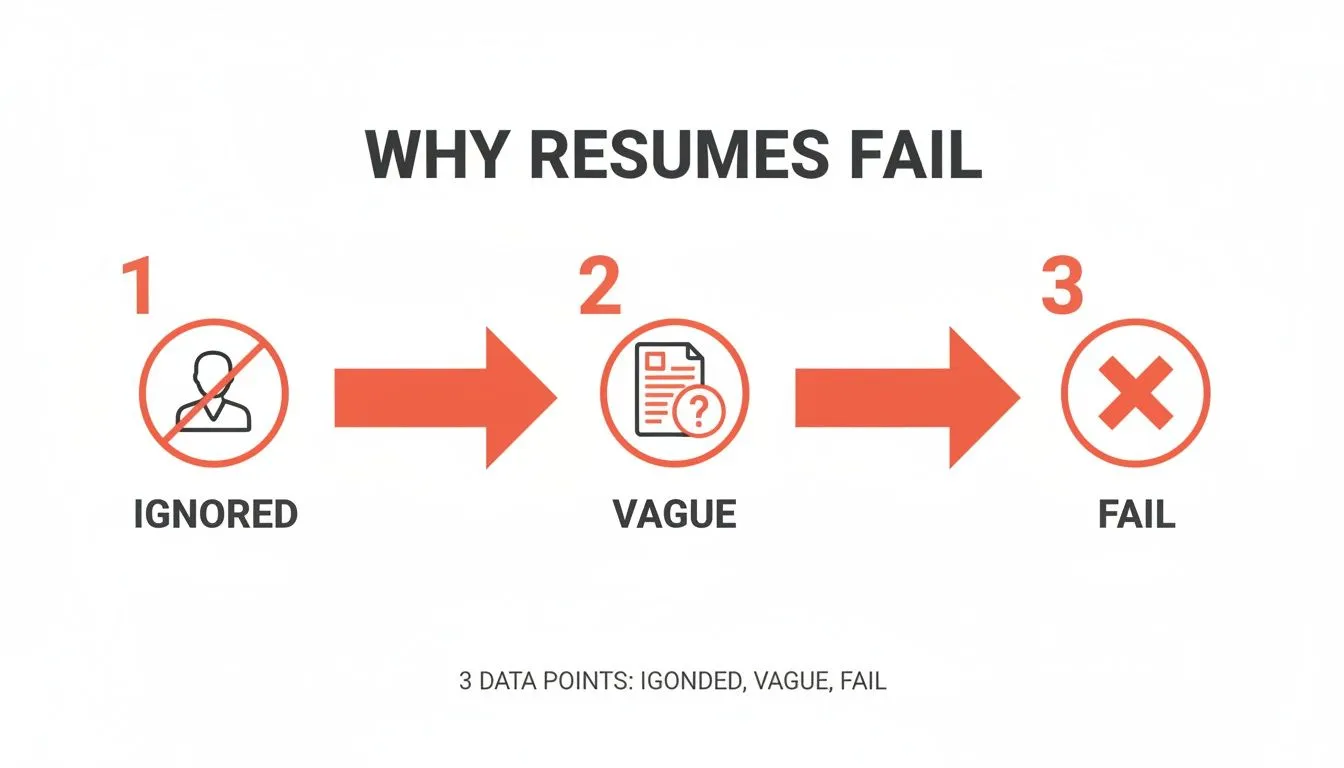
This image nails it. When your bullets are vague, they are ignored. This leads to rejection. Break this cycle by getting specific and focusing on results.
This one change reframes your entire professional story from passive to active.
Here are some real-world examples. Notice how the weak bullets just list tasks, while the strong ones showcase tangible achievements.
Before and After: Transforming Your Bullet Points
| Weak Bullet (The Task) | Strong Bullet (The Action + Impact) |
|---|---|
| Managed the social media accounts. | Grew organic Instagram following from 500 to 15,000 in 6 months by launching a targeted content series. |
| Responsible for creating new sales decks. | Developed a new sales deck that led to a 15% increase in client conversion rates in Q3. |
| Worked on improving the website's speed. | Reduced average page load time from 4.2s to 1.8s by compressing images and optimizing JavaScript. |
| Handled customer support tickets. | Maintained a 98% customer satisfaction score over 1,200+ support tickets. |
The "strong" versions don't just sound better—they provide cold, hard proof of your ability to make a difference. That’s what gets you interviews.
The Action Verb Is Your Hook
Your verb sets the tone. A weak verb creates a weak impression. A strong, specific verb grabs attention.
Instead of "managed" a project, did you launch it, overhaul it, or streamline it? Each word tells a more compelling story.
- Weak: "Handled the marketing budget."
- Strong: "Optimized the $500K marketing budget..."
The strong verb signals a higher level of contribution. You weren’t just a caretaker; you were a driver.
Your experience isn't the problem. The problem is you're writing a job description instead of an impact report. Start with a punchy verb and follow it up with a hard number. That's the game.
This simple formula—Action + Impact—is the foundation of every bullet point that gets results. It works for everyone. Stop listing duties. Start demonstrating your impact.
How to Format Resume Bullet Points for Both Scanners and People
Your resume has two audiences: software and a person. You have to win over both. Getting the resume bullet points format right is how you do it. This isn't about being boring; it's about being strategic.
The first gatekeeper is the Applicant Tracking System (ATS). It’s a bot that scans for keywords and structure. It can’t read fancy fonts, complex tables, or weird symbols. A human recruiter scans for clarity, impact, and a clean look. Mess up the format, and you fail one or both tests.
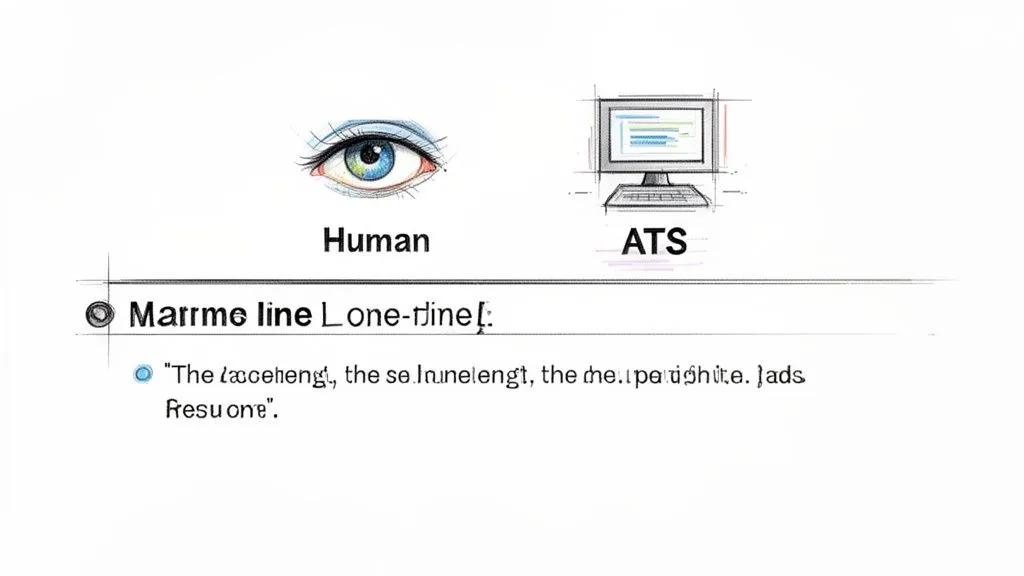
With ATS filtering most applications, formatting has become a science. Generic resume builders often get this wrong. Good resumes get rejected before a human ever sees them.
The winning formula is clear: Action Verb + Context + Quantifiable Result. Top career strategists agree, often framing it as: 'Accomplished X as measured by Y by doing Z'. You can discover more insights about resume points on Indeed.com.
The Simple Rules For Formatting
Let’s get tactical. Follow these rules for bullet points that satisfy bots and hiring managers.
- Bullet Symbols: Stick to basics. A solid circle (●) or a square (■) is all you need. Don’t use arrows, checkmarks, or custom icons. The ATS might misinterpret them.
- Punctuation: Be consistent. Use a period at the end of every bullet point, or use none at all. Pick one style and stick with it.
- Length: Keep it punchy. Aim for one to two lines per bullet. If it stretches to three lines, you’re including fluff. Edit it down.
Keep Your Tenses And Structure Consistent
Consistency is key. It shows attention to detail.
For your current role, use the present tense.
* Manage a team of five engineers to develop new product features.
* Optimize marketing spend to achieve a 10% lower CPA.
For all past roles, use the past tense.
* Managed a team of five engineers.
* Optimized marketing spend.
Parallelism is just as important. It means starting each bullet point with the same type of word—usually a strong action verb. This creates a clean, scannable rhythm.
Your resume’s format is its handshake. A weak, inconsistent format signals carelessness. A clean, simple format communicates confidence before they even read a single word.
A warning: avoid resume templates with columns or graphics. They look cool, but they confuse ATS scanners. The software reads left-to-right, top-to-bottom. Columns break that flow, and the ATS will jumble the information.
The best format is often the simplest one. A single column with clear headings and clean bullet points. For a deeper dive, check out our guide on advanced bullet point formatting.
A Practical Guide To Quantifying Your Achievements
"But I don’t have numbers." This is a myth. Every professional has quantifiable achievements. You just need to know where to look.
"Quantify" doesn't just mean a $1M sales deal. It means translating your work into a measurable outcome. Providing proof. Impact can be time saved, costs cut, or processes improved.
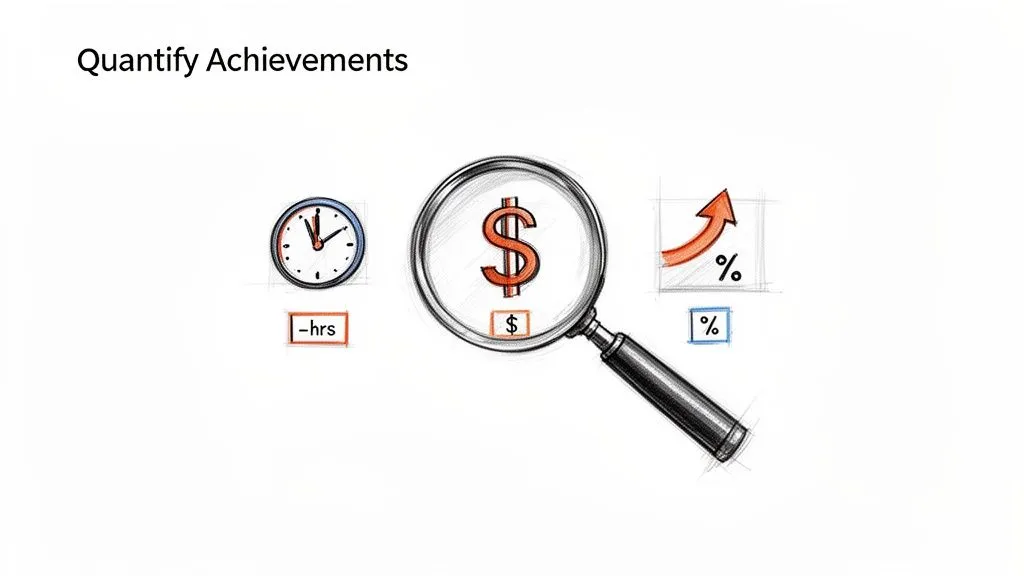
The key is to ask the right questions. Don't just think about what you did. Think about what changed because of it.
Finding Your Numbers
No matter your role, you have metrics. You just need to uncover them.
For Operations, HR, or Admin Roles
Your world is efficiency, process, and support. Your numbers are in the systems you manage.
- Time: How much time did you save a team? Did you slash meeting times by 25%?
- Volume: How many candidates did you screen each week? How many new hires did you onboard?
- Accuracy: Did you reduce data entry errors by 15%?
For Marketing or Creative Roles
Your impact is measured in attention and action.
- Engagement: By how much did you lift open rates or social followers?
- Growth: Did your content strategy drive a 40% jump in organic traffic?
- Efficiency: Did you drop the cost-per-lead by $5?
For Tech or Product Roles
Your code shapes the user experience and the bottom line. The data is everywhere.
- Performance: Did you crush API response times from 800ms to 200ms?
- Scale: Did you re-architect a system to handle 10x the user load?
- Adoption: Did your new feature get picked up by 30% of active users in the first month?
Every job creates a "before" and an "after." Your goal is to find the data that measures the distance between those two points. That data is your impact.
How to Format Resume Bullet Points With Numbers
Once you have your numbers, the resume bullet points format is simple. Weave the metric into your Action + Context + Result statement. Make it the hero.
Let's look at a few before-and-afters. The "before" is a passive duty. The "after" is a quantified achievement.
Before (Vague):
* Responsible for redesigning the onboarding process.
After (Quantified):
* Redesigned the employee onboarding process, cutting new hire ramp-up time by 3 weeks and boosting 90-day retention by 12%.
Before (Vague):
* Wrote blog posts for the company website.
After (Quantified):
* Authored and published 15+ long-form articles that now generate 40% of all monthly organic search traffic.
Before (Vague):
* Fixed bugs in the mobile app.
After (Quantified):
* Resolved a critical bug in the mobile checkout flow, slashing cart abandonment rates from 60% to 35% in the first week.
The quantified versions provide undeniable proof. Stop hiding behind vague job descriptions. Find your data and put it front and center. This is how to format resume bullet points that get you hired.
Real-World Bullet Point Examples You Can Adapt
Enough theory. The quickest way to get it is to see it. These examples are your blueprint.
Don't copy them. Borrow the structure. Notice how each one starts with a strong verb, adds a hard metric, and gives just enough context to make the achievement clear.
Tech Roles
For tech roles, show how your work made a difference—improving performance, boosting stability, or making the user experience better. Your code isn't just code; it's a solution.
Software Engineer:
* Overhauled a legacy monolithic backend into a microservices architecture, improving system scalability by 300% and slashing API latency from 500ms to 120ms.
* Built and deployed a new CI/CD pipeline using Jenkins and Docker, cutting deployment times by 70% and eliminating manual release errors.
* Mentored 3 junior engineers through bi-weekly code reviews and pairing sessions, accelerating their onboarding and improving team-wide code quality by 15% based on SonarQube metrics.
Product Manager:
* Launched a new mobile app feature by leading a cross-functional team of 8, resulting in a 25% increase in daily active users and $150K in new ARR within the first quarter.
* Conducted 30+ user interviews and A/B tests to validate a new pricing model that boosted average revenue per user (ARPU) by 18%.
Business Roles
In business, your impact connects to the bottom line—revenue, costs, and market share. Your bullet points need to tell that story with confidence.
For more ways to frame your wins, check out our deep dive on resume bullet points examples.
Marketing Manager:
* Directed a $250K paid social campaign across three platforms, achieving a 4x ROAS and lowering the cost-per-acquisition (CPA) by 22% compared to the previous year.
* Grew organic search traffic by 60% in 9 months by developing and executing a content strategy focused on high-intent keywords, which now drives 40% of all new leads.
Financial Analyst:
* Created a new financial forecasting model that improved budget accuracy from 85% to 98%, enabling more strategic capital allocation for key growth projects.
* Identified $500K in annual operational cost savings by analyzing vendor contracts and recommending consolidation opportunities.
These aren't job duties. They are specific, quantified stories of success. Each one answers the "so what?" question before a recruiter has to ask.
Operations Roles
Operations is about making things better, faster, and cheaper. Your bullet points should shout this from the rooftops.
Operations Manager:
* Streamlined warehouse inventory management by implementing a new barcode system, which reduced order fulfillment errors by 95% and improved on-time shipping to 99.8%.
* Negotiated new terms with 5 key suppliers, securing an average cost reduction of 12% and saving the company $1.2M annually.
Project Manager:
* Led the end-to-end delivery of a $2M enterprise software migration project, completing it 2 weeks ahead of schedule and 10% under budget.
Stop Filling Boxes And Start Telling Your Story
Resume builders have turned career storytelling into a mechanical, soul-crushing task. They give you a template and ask you to fill in the blanks. Your career is a narrative, not a data entry project.
Filling out boxes is for machines. Telling your story is for humans. Your great work deserves to be told, not just listed.
Let The Story Write The Resume
Most people get stuck here. They wrestle with the resume bullet points format instead of focusing on the story. But what if you didn't have to?
At StoryCV, we don’t give you empty boxes. We are a Digital Resume Writer. We guide you through a smart interview to uncover your narrative, like a human career coach. We help you find the context, challenges, and results that generic tools miss. You just answer questions about your work.
Your career is a series of stories. Each project, each challenge, and each success has a narrative. The best resumes don't just list achievements; they tell these stories.
This storytelling approach extends beyond your resume. As you build your narrative, you can apply the same principles when you optimise your professional profile on LinkedIn to create a consistent and powerful personal brand.
The result is a resume with perfectly formatted, high-impact bullet points. They sound like you because they are your stories, articulated with precision. You stop trying to sound like a resume and start sounding like the expert you are.
It’s time to let your story do the work.
Ready to stop filling boxes? StoryCV interviews you to discover your best work and writes the high-impact resume bullets for you. Start telling your story for free.