Most advice about “rewrite my resume” is bad because it starts with the wrong trigger.
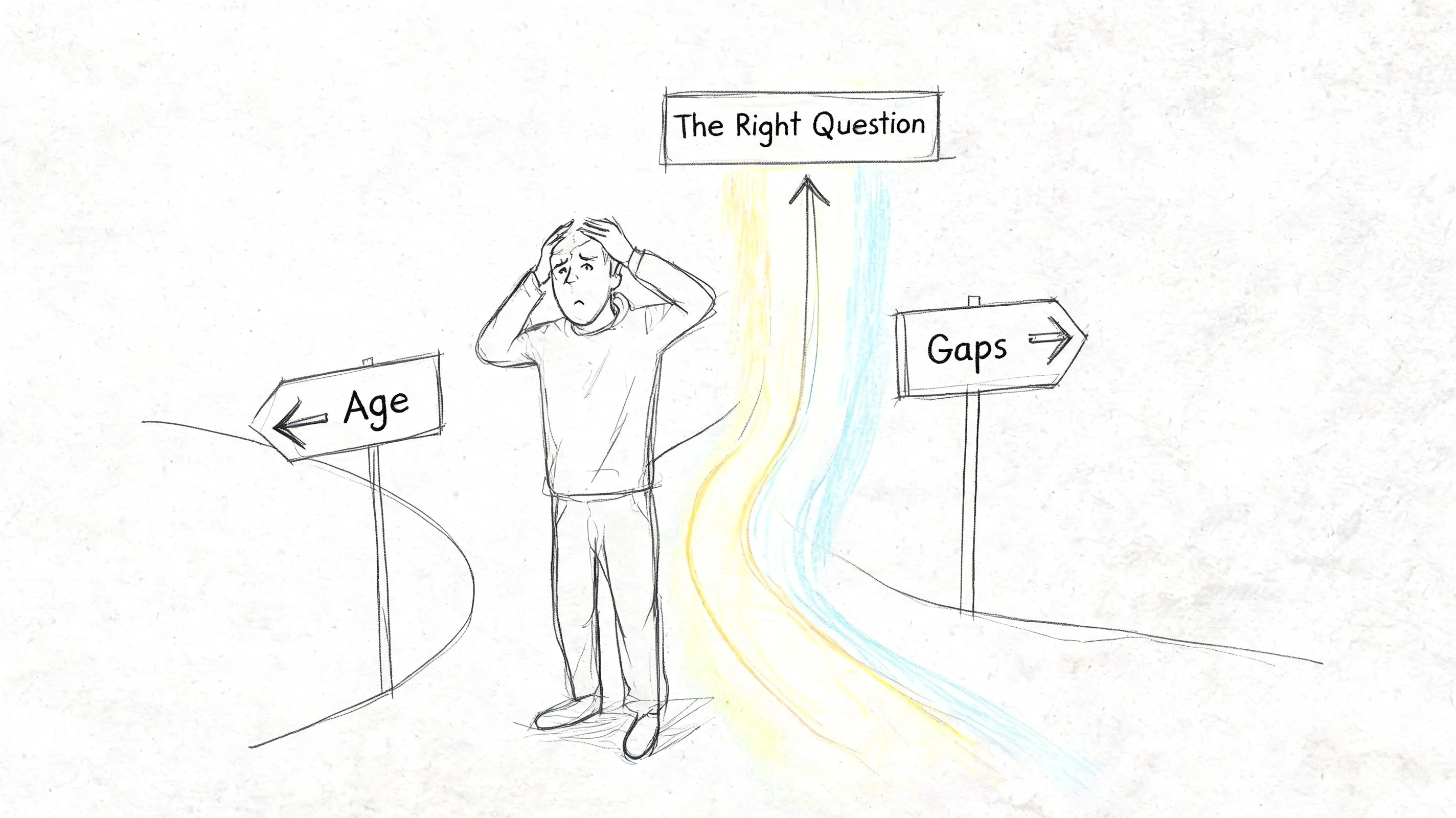
People say rewrite if it's old. Rewrite if you have a gap. Rewrite if a friend says it looks dated. None of that gets to the core issue. A resume isn't a museum piece. It's a sales document for the next job.
Ask one question instead: does this resume describe the role I want next, in the language the people hiring for that role use?
If yes, refine it. Tighten bullets. Cut junk. Tailor keywords. Done.
If no, rewrite it. From the ground up.
That's the difference. Not age. Not vibes. Not whether you changed the font last spring.
Rewrite vs Refine The Wrong Question to Ask
A lot of professionals waste weeks polishing the wrong resume.
They tweak spacing. They swap templates. They delete a gap, then put it back. They ask three friends for feedback and get four conflicting opinions. Meanwhile, the actual problem stays untouched: the document still argues for the wrong job.
Here's the cleaner diagnostic.
Refine if the story is already right
If you're applying for basically the same role at a different company, your existing content is probably usable. You may need sharper phrasing, better ordering, stronger keywords, and fewer generic claims.
That generic language matters more than people think. Executive resume experts note that phrases like “highly accomplished,” “experienced,” and “results-driven” show up so often that they create negative bias instead of differentiation. The same expert roundup also found that 35% of recruiters recommend covering 15 years of work history and 33% prefer 10 years, which is a good reminder to focus on relevant experience instead of dumping your whole career into one file, according to this executive resume expert analysis.
Rewrite if your resume is arguing at the wrong altitude
Say you're a marketing manager. Over the last two years, you've moved beyond campaign execution. You've shaped channel strategy, influenced budget decisions, worked with sales leadership, and decided what not to do.
But your bullets still say things like:
-
Executed campaigns across paid and organic channels
-
Managed social media calendar
-
Coordinated with design team
-
Tracked weekly performance reports
That resume is still pitching you as a tactical executor. No amount of rewording fixes that. You don't need prettier formatting. You need new content that shows strategy, judgment, tradeoffs, and business impact.
Practical rule: If your current bullets describe tasks, but your target role expects decisions, you're not editing. You're avoiding a rewrite.
One more opinionated take. If your resume hasn't been touched in years because you stayed employed, rewrite it. Old resumes freeze your voice in the version of you that got the last job. That version usually undersells the one doing the work now.
The 5-Minute Self-Interview to Find Your Story
Many can't rewrite their resume because they start by writing.
Bad move.
Start by interrogating your own work. Fast. No polishing. No formatting. Just raw material. You need stories, decisions, friction, and proof. If you can't pull that out, your resume will sound like every other AI-smoothed blob on the internet.
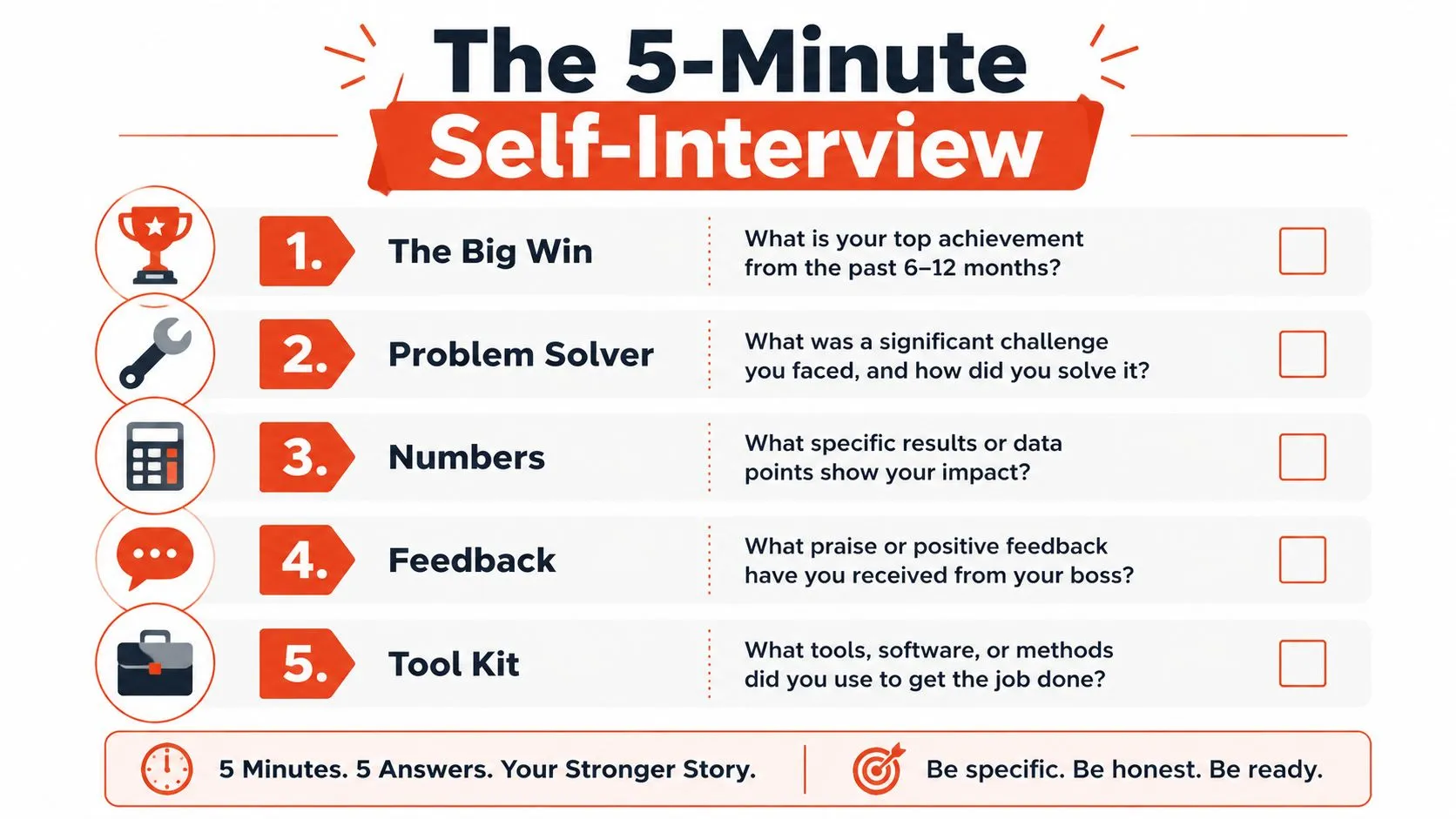
If you need help warming up your memory, this guide on career reflection before writing your resume is useful. Then do this:
Ask better questions
Set a timer for five minutes per role. Answer these in fragments if you have to.
-
What problem did I solve that wasn't technically my job?
This pulls out initiative. Hiring managers care about that more than your polished summary. -
Where did I make a decision with incomplete information?
That gets you past task lists and into judgment. -
What got better because I was there?
Think speed, clarity, quality, handoffs, customer friction, reporting, team confidence. -
What did my manager trust me with after I proved myself?
Expanded scope is a signal. It's often overlooked. -
What did I own end to end?
Not “helped with.” Owned. -
Where did I influence people without formal authority? Essential if you're moving toward management, strategy, or cross-functional roles.
-
Which tools, systems, or processes did I use well enough to change outcomes?
This keeps your resume grounded in real work instead of generic leadership talk.
Write down scraps, not perfect bullets
Don't force clean prose yet. Write notes like:
-
Sales team kept ignoring campaign leads
-
Built handoff doc with qualification rules
-
Weekly pipeline reviews improved
-
Boss started pulling me into planning meetings
That's enough. You can turn that into a bullet later.
Your best resume material usually lives in the stuff you almost didn't mention because it felt “normal” to you.
The point of this exercise is simple. Good resumes don't come from memory alone. They come from pressure-testing what changed because you did the work.
From Vague Duties to Measurable Impact
Most resumes die here.
People list responsibilities. Employers want evidence. Cultivated Culture found that only 48% of resumes include a LinkedIn profile link, only 26% include at least five measurable results, and 36% contain zero metrics, based on their analysis of over 125,000 resumes in this resume statistics breakdown. That tells you the bar is still embarrassingly low.

Use the WHO method
Keep it brutally simple:
| Part | What it means | What it sounds like |
|---|---|---|
| What | The thing you did | Led, built, redesigned, launched, consolidated |
| How | Your approach | By changing process, aligning teams, introducing a system, shifting priorities |
| Outcome | What improved | Faster delivery, better conversion, lower errors, clearer reporting, stronger adoption |
If you want a deeper walkthrough, read this piece on how to write achievements in a resume.
Before and after examples
Bad bullets usually describe motion. Better bullets describe value.
Before
Managed social media campaigns.
After
Led paid and organic social campaigns, shifted content toward demo-driven offers, and improved lead quality for the sales team.
Before
Responsible for reporting.
After
Built weekly performance reporting used by marketing and sales leaders to spot drop-offs, reallocate spend, and tighten campaign follow-up.
Before
Worked with cross-functional teams on product launch.
After
Coordinated launch planning across product, sales, and customer success, clarified ownership, and kept launch materials aligned with go-to-market priorities.
Notice what changed. The stronger versions don't just inflate verbs. They add context, method, and consequence.
Here's a useful walkthrough if you want to see someone teach this in plain English:
What to quantify when you don't have clean numbers
You do not need every bullet to include a giant metric. But you do need specificity. Use concrete scope when exact performance data isn't available.
Try these:
-
Team scope such as leading onboarding for a regional sales group
-
Process ownership such as owning monthly forecast prep
-
Decision scope such as setting priorities across competing requests
-
Operational complexity such as coordinating legal, finance, and product inputs
-
Cadence such as weekly reporting, quarterly planning, daily stakeholder updates
Reality check: Rewording a duty isn't enough. You need to show what changed, what improved, or what became possible because of your work.
That's the core of “rewrite my resume” when the old version is too small for the role you want.
Tailoring for Robots and Humans
ATS vs human is a fake debate.
A good resume serves both because both are looking for relevance. The robot scans for recognizable language. The human scans for fit, judgment, and proof. If you stuff keywords without meaning, both lose interest.
Hiring managers spend less than 10 seconds making qualification decisions, and 54% of recruiters automatically reject generic, uncustomized resumes, according to Teal's guidance on quantified resumes. So customize the thing properly.

Stuffing keywords vs matching the role
Here's the difference:
| Weak approach | Better approach |
|---|---|
| Copy the job description into your skills section | Use the employer's language to frame your actual work |
| Repeat the same buzzwords everywhere | Mirror priorities once, then prove them in bullets |
| Add every tool you've touched | Keep the tools that matter for this role |
| Write one universal resume | Adjust headline, summary, bullets, and skills for each target |
A project manager and a product manager may both work on a launch. They should not describe it the same way.
-
Project manager framing focuses on timelines, dependencies, risk, stakeholder coordination.
-
Product manager framing focuses on customer problem, prioritization, roadmap decisions, adoption.
Same work. Different lens.
For a practical method, use this guide on tailoring your resume to a job description.
If the job post says “cross-functional leadership” and your resume says “helped multiple teams,” you're making the reader do translation work. Don't.
Next Steps Rewriting at Speed
If your resume already makes the case for the next role, refine it and move on.
If it doesn't, stop pretending a few edits will save it. Rewrite it.
That doesn't mean starting from panic. It means rebuilding your story around the work you want more of. Better scope. Better language. Better evidence. The hard part isn't typing. It's extracting the right material from your own career.
That's also why generic AI rewrites fall flat. Teal points to an authenticity paradox around resume rewriting: over-reliance on AI creates homogenized resumes, and hiring teams report “AI-written resume fatigue,” as described in their resume rewriter discussion. The bullets sound polished, but interchangeable.
If you want speed, use tools for the parts tools are good at. Organizing history. Checking phrasing. Drafting versions. An online resume generator can help with layout and getting a basic draft into shape.
If you need help with the harder part, StoryCV is a digital resume writer that uses a guided interview to pull out context, decisions, and outcomes, then turns that into resume language. That's a different job from a template or a builder. It's for people who know they've done strong work but don't want to spend all weekend forcing it into bullet points.
The decision is still yours. Does your current resume describe the next role in the right language? If yes, refine. If no, rewrite.
If you want a faster way to turn real work into sharper resume content, try StoryCV. It helps you uncover the parts of your experience that usually get buried, then writes them clearly without turning your resume into generic AI sludge.