A principal can tell within seconds whether your educational assistant cover letter was written for the school or recycled from a childcare template. “Passionate about children” says nothing about how you support reading, record observations, manage routines, or work under a lead teacher. A strong letter makes one specific contribution easy to picture in the school's own classrooms.
The role is substantial, not obscure. The Bureau of Labor Statistics reported approximately 1,210,740 teacher-assistant jobs in educational services in 2025, while a broader occupational table counted 1,420,350 teaching assistants, excluding postsecondary roles, with an annual mean wage of $38,290. BLS also reported approximately 1,463,000 teacher-assistant jobs and projected about 176,200 openings per year from 2025 through 2035, despite little or no net employment growth. Replacement demand makes immediate fit more persuasive than vague enthusiasm.
Why Most Educational Assistant Letters Get Skipped
Most weak applications fail for one of two reasons. The letter repeats the job description without proving anything, or it leads with childcare language instead of classroom evidence.
A sentence such as “I am passionate about children and eager to support your school” might sound pleasant. It doesn't help a hiring principal rank you. Neither does “I am a hard worker,” “I am a team player,” or “I have excellent communication skills.” Those are labels. The reader needs to know what you did.
A hiring principal doesn't hire your personality adjectives. She hires the evidence behind them.
An educational assistant cover letter should answer a practical question: What will this person be able to handle in our building? The answer might involve leading a small reading group, adapting instructions for an individual learner, recording progress accurately, supervising transitions, supporting behavior routines, or communicating observations to the teacher.
That distinction matters because educational assistants do more than supervise children. Portland Public Schools' educational assistant job description includes small-group support in spelling, reading, and mathematics, distribution of instructional materials, student supervision, class and student records, educational-media equipment, and clerical work. Your letter should reflect the duties that appear in the vacancy, not a generic idea of classroom help.
Replace virtues with visible work
Weak:
“I'm patient, caring, and passionate about helping children succeed.”
Stronger:
“During small-group tutoring, I adapted reading instructions for learners who struggled to follow the original activity, recorded their progress, and shared observations with the supervising teacher.”
The stronger version still communicates patience and care. It does so indirectly, through actions a school can evaluate.
Customization matters. In an iHire survey of hiring professionals and recruiters, 65.3% said cover letters remained essential to recruitment, 76.5% said they always read one when a candidate included it, and 77.3% wanted applicants to customize letters for the specific position. The survey also found that 30.4% expected a cover letter even when the posting called it optional. Those figures aren't specific to educational assistants, but they support a clear conclusion: a customized letter earns more attention than a decorative attachment.
The One-Page Evidence Frame That Beats Generic Templates
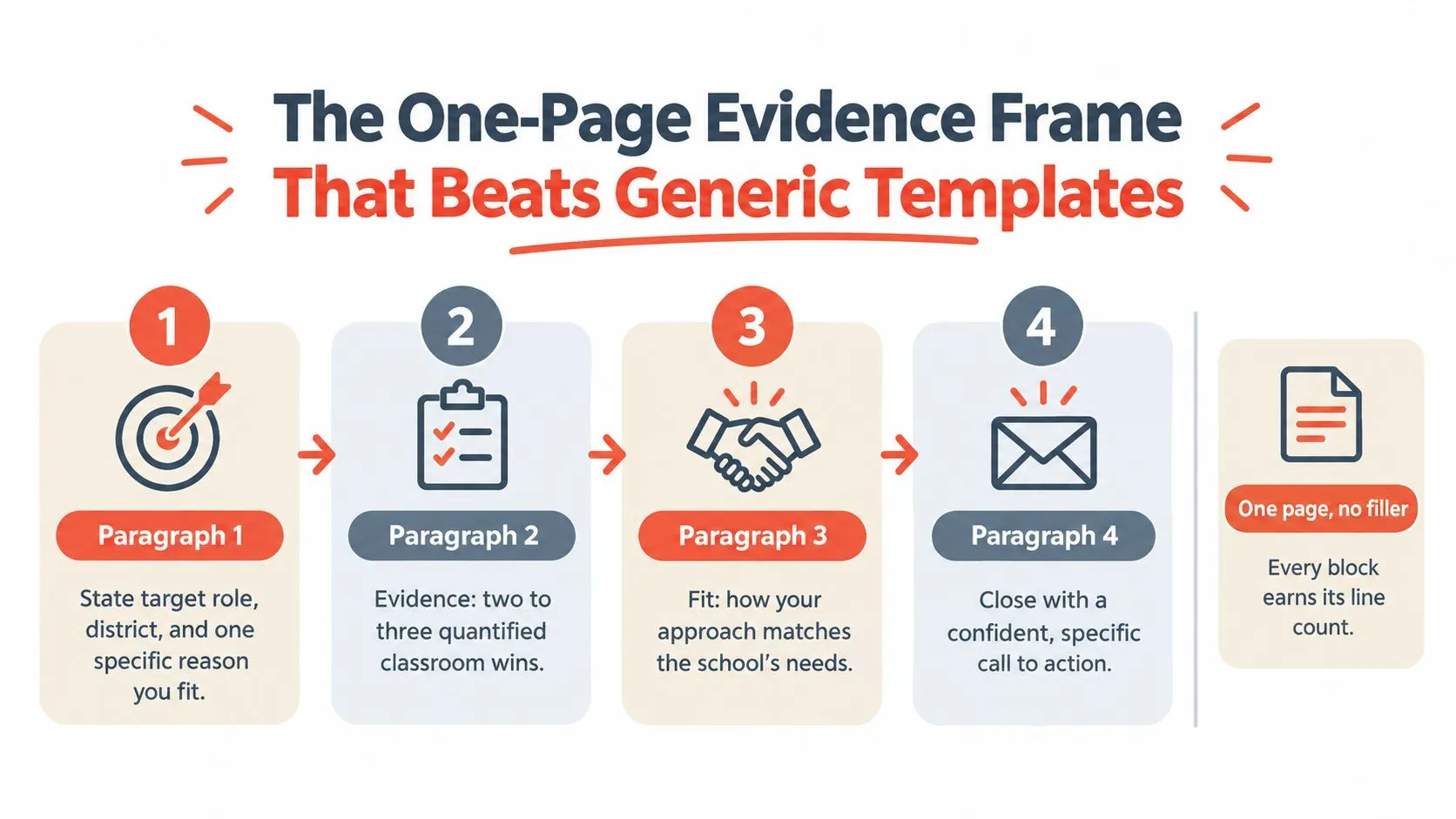
A principal opening a stack of applications needs to identify your fit quickly. Give the letter four paragraphs, each with one job. If a sentence does not prove that you can handle this posting, remove it.
Paragraph one names the target
Use the exact role title, school or district name, and one requirement from the vacancy. Keep the opening to roughly three to five lines.
“I'm applying for the Educational Assistant position at Northview Elementary. My experience supporting small-group literacy activities and documenting learner progress matches your need for classroom assistance across the primary grades.”
Delete “I am writing to apply for the position posted on your website.” It says nothing about the school, the role, or your value.
Paragraph two carries the proof
Use two evidence points. Build each around situation, task, action, result, then keep the paragraph to roughly six to eight lines.
“While supporting a mixed-ability reading group, I noticed that several learners lost track of multi-step instructions. I broke the activity into shorter prompts, checked understanding between tasks, and maintained a simple progress record for the teacher. The group completed the assigned work more consistently, and the teacher had clearer observations to use when planning follow-up support.”
A result does not need a dramatic statistic. Improved participation, cleaner records, smoother transitions, or steadier task completion can demonstrate value when someone can verify the outcome.
Paragraph three handles qualifications
Use roughly four to six lines for credentials, relevant coursework, practicum experience, certification status, or an equivalent pathway. Credential requirements vary, especially across inclusion-support roles, so match your explanation to the vacancy rather than apologizing for a nontraditional route.
For U.S. public-school roles, teacher assistants in Title I schools generally need two years of college coursework, an associate degree, or a qualifying assessment, according to the BLS teacher assistant occupational profile. Special-needs positions may involve skills testing, while some schools require CPR or first-aid certification.
State what you hold, what remains pending, and how your experience supports the listed duty. Tutoring can demonstrate instructional assistance. Caregiving can show routine management, observation, and communication. Youth programs can support supervision and behavior guidance. Make the connection explicit. Schools facing inclusion-staffing shortages need proof that you can contribute to the actual support plan, not another paragraph about being “passionate about children.”
Paragraph four closes with a specific next step
Use roughly three to five lines. Restate the strongest match, state your availability, and invite a conversation.
University of Maryland Career Center guidance recommends naming the organization and position and proving qualifications with evidence instead of repeating the résumé. CUNY career guidance recommends a roughly one-page letter with short paragraphs, examples, and careful proofreading.
Use this cover letter guide for a job application to check the document's basic organization. The working standard is one page, four purposeful paragraphs, no filler.
Use the video below as a visual reference for building a focused cover letter structure.
Mapping Your Proof to the Posting, Not Your Resume
Your résumé records your history. Your cover letter should interpret that history for one particular school.
Start with the posting, not your own document. Read it twice. On the first pass, mark every duty, required credential, student population, documentation task, and named system. A posting might mention PowerSchool, IEP Direct, reading platforms, progress monitoring, data entry, small-group instruction, or de-escalation. Those terms tell you what the school is trying to solve.
On the second pass, list a real moment from your experience beside each important requirement. Don't reject an example because it came from tutoring, caregiving, coaching, healthcare support, volunteering, or another setting. Reject it only if you can't explain the action and responsibility.
Use the posting's priority order
Don't paste résumé bullets in sequence. Mirror the vacancy's priorities so the reader sees the match immediately.
| Posting language | Evidence to find | What the letter should show |
|---|---|---|
| Small-group literacy support | Tutoring or guided reading | How you adapted instruction and checked understanding |
| Progress monitoring | Logs, assessments, or observations | How you recorded information and shared it accurately |
| Behavior support | Youth work, care, or classroom experience | How you maintained routines and collaborated during difficulty |
| Confidential records | Administrative or student-support work | How you protected information and followed procedures |
A Tier 2 reading intervention posting might ask for targeted literacy support, progress monitoring, and communication with classroom staff. A relevant paragraph could say:
“As a tutor, I supported learners who needed additional reading practice outside the main lesson. I broke texts into manageable tasks, recorded patterns in their errors, and shared those observations with the program coordinator so future sessions could target the same gaps.”
That example doesn't pretend tutoring is identical to school employment. It explains the transferable work plainly.
For more practice turning vacancy language into relevant application evidence, use this guide to tailor your resume to a job description. The same mapping habit strengthens your cover letter.
Three Sample Letters for Three Different Assistant Roles
A general classroom aide, a special education paraprofessional, and an intervention data assistant don't have the same job. Their letters shouldn't sound interchangeable.
| Element | General Classroom Aide | Special Education Para | Intervention/Data Assistant |
|---|---|---|---|
| Main school need | Reliable instructional and routine support | Consistent one-to-one care and documentation | Accurate intervention records and progress monitoring |
| Lead with | Small-group instruction and supervision | Individualized support, behavior routines, and collaboration | Data entry, assessment support, and learner progress |
| Useful language | Reading, mathematics, materials, records | IEP, confidentiality, individualized support, de-escalation | MTSS, intervention, assessment, documentation |
| Avoid | Generic childcare language | Claiming independent teaching authority | Describing the role only as clerical |
Sample one for a general classroom aide
Dear Principal [Name],
I'm applying for the Educational Assistant position at [School Name]. My experience supporting small-group reading activities, supervising transitions, and maintaining clear activity records matches your need for dependable classroom assistance across the grade level.
In my previous role with [program or employer], I supported learners during guided reading and mathematics activities. When students needed different explanations, I broke directions into smaller steps, checked their understanding, and shared observations with the lead instructor. I also prepared materials and helped maintain orderly routines so instructional time stayed focused.
I bring [relevant coursework, associate degree, assessment, or equivalent experience], along with a careful approach to student supervision and communication. I understand that an assistant supports the classroom teacher's plan and follows established procedures rather than working as an independent teacher.
I'd welcome a brief conversation about how I could support small-group instruction, student routines, and record keeping at [School Name]. I'm available [availability] and would be glad to discuss the position.
Sincerely,
[Name]
The childcare-style version fails because it doesn't prove classroom readiness. This version names the work a principal can assign on the first day.
Sample two for a special education paraprofessional
Dear Principal [Name],
I'm applying for the Special Education Educational Assistant position at [School Name]. My experience providing individualized support, maintaining predictable routines, and documenting learner observations aligns with your need for consistent assistance under the direction of special education staff.
While supporting [student, learner, or program], I helped an individual learner complete academic tasks by adapting explanations and following the established support plan. I recorded observations after each activity and communicated relevant changes to the supervising adult. During moments of frustration, I used the agreed routine, reduced competing demands, and sought assistance when the situation required staff intervention.
My background includes [IEP exposure, relevant coursework, behavior-support training, CPR or first-aid certification, or pending credential]. I understand the importance of confidentiality and accurate follow-through when supporting a student with individual needs. I would bring patience through consistency, not through improvised promises.
I'd welcome the opportunity to discuss how my experience could support your special education team and contribute to safe, structured learning. I'm available [availability] for a conversation.
Sincerely,
[Name]
A special education letter must not imply that the assistant diagnoses, designs independent programs, or replaces qualified staff. The St. Helens School District description emphasizes individual and small-group instructional support alongside record keeping for students with special needs. Lead with that operational reality.
Sample three for an intervention and data assistant
Dear Principal [Name],
I'm applying for the Intervention and Data Assistant position at [School Name]. My experience organizing learner records, supporting targeted instruction, and communicating progress information matches your need for accurate MTSS support.
In [previous setting], I helped deliver focused academic practice and maintained records of participation, completed tasks, and observed learning needs. I entered information consistently, checked entries for errors, and summarized relevant patterns for the staff member responsible for planning next steps. I also worked directly with learners, which helped me connect the data with what students were experiencing during instruction.
I bring [assessment system, spreadsheet experience, reading platform, relevant coursework, or equivalent documentation experience]. I'm comfortable handling confidential information, following established procedures, and staying calm when student needs compete for attention.
I'd appreciate a brief conversation about how I could support intervention records, progress monitoring, and student-facing academic assistance at [School Name]. I'm available [availability].
Sincerely,
[Name]
The Brighton Public Schools job description shows why intervention letters need more than caregiving language. Such roles can include push-in and pull-out support, literacy or mathematics interventions, assessment support, data entry, confidentiality, and emotionally charged situations.
If you need a practical exercise for turning experience into application language, this worksheet for job-seeking skills can help you gather evidence before drafting. For another sample-based comparison, review these executive assistant cover letter samples, then keep the same evidence discipline for education roles.
Writing a Targeted Opening and a Credible Closing
The first sentence should identify the school's need and your relevant proof. It shouldn't announce that you found a vacancy.
Generic opening:
“I am writing to apply for the Educational Assistant position posted on your website.”
Targeted opening:
“At [District Name], your primary classrooms need support with small-group literacy and student routines. My experience adapting reading activities and recording learner progress gives me a practical match for this role.”
If you have a verifiable result, add it. Don't manufacture one. “I supported a small reading group and maintained progress records for the lead instructor” is stronger than an unsupported claim about transforming outcomes.
The closing should make a reasonable request. It shouldn't beg, oversell, or repeat your entire letter.
Generic closing:
“Thank you for your time and consideration. I look forward to hearing from you.”
Credible closing:
“My experience with structured small-group support and accurate student observations would help me contribute to your classroom routines. I'm available for a brief phone conversation next week and would welcome the chance to discuss the position.”
Confident language names what you can contribute. Arrogant language claims you're the solution before the school has met you. Avoid “I would be a great fit,” “I am the perfect candidate,” and “I know I can make a huge difference.” Show the fit instead.
For readers who also need to sharpen short professional writing, these suggestions for clear LinkedIn posts offer useful editing principles. Apply the same test here: remove any sentence that could belong to another applicant.
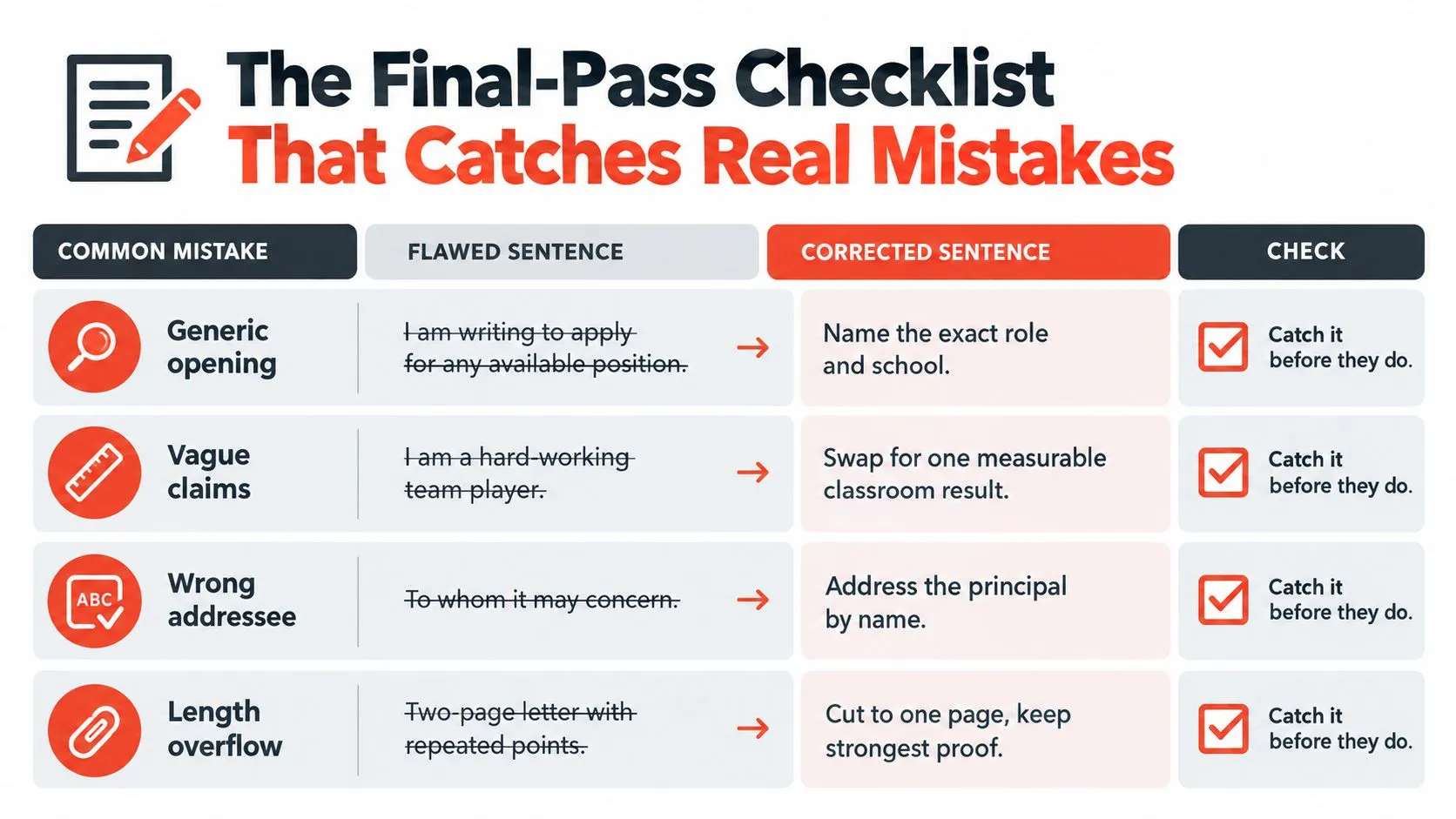
The Final-Pass Checklist That Catches Real Mistakes
A final review should expose the reason a principal would skip your letter. Read each sentence, identify its risk, and replace general language with proof tied to the vacancy.
Flawed: “I am writing to apply for any available position at your school.”
Fix: Name the exact educational assistant role, school, grade band, and student group.Flawed: “I am a hard-working team player with excellent communication skills.”
Fix: Describe a classroom action, such as sharing learner observations with the lead teacher after a small-group activity.Flawed: “I have experience working with children.”
Fix: State the setting, responsibility, student need, and observable result.
Run these checks in order:
- Check the target. Confirm the school name, role title, grade level, student population, and posting reference.
- Check the proof. Replace résumé repetition with a situation, action, and outcome.
- Check the match. Use the posting's language naturally. Do not dump keywords into a final skills list.
- Check the credentials. State your degree, coursework, assessment experience, certification, CPR or first-aid status, or equivalent experience accurately. Requirements vary by district, so never imply a credential you do not hold.
- Check the staffing need. If the posting concerns inclusion support, connect your evidence to accommodations, student routines, observation records, or collaboration with special education staff. Childcare language alone will not address an inclusion-staffing shortage.
- Check the details. Remove the wrong school year, outdated posting date, incorrect addressee, or mismatched attachment filename.
- Check the claims. Every performance number must match your résumé or records. Unsupported statistics weaken trust.
- Check the close. Ask for a specific next step and confirm your availability.
The University of Kentucky's cover-letter guidance reinforces the need to name the position, research the employer, and state the value you offer. Keep the letter to one page. Adobe's cover-letter guidance places the usual length between half a page and one page.
Turn Your Classroom Work Into Words That Travel
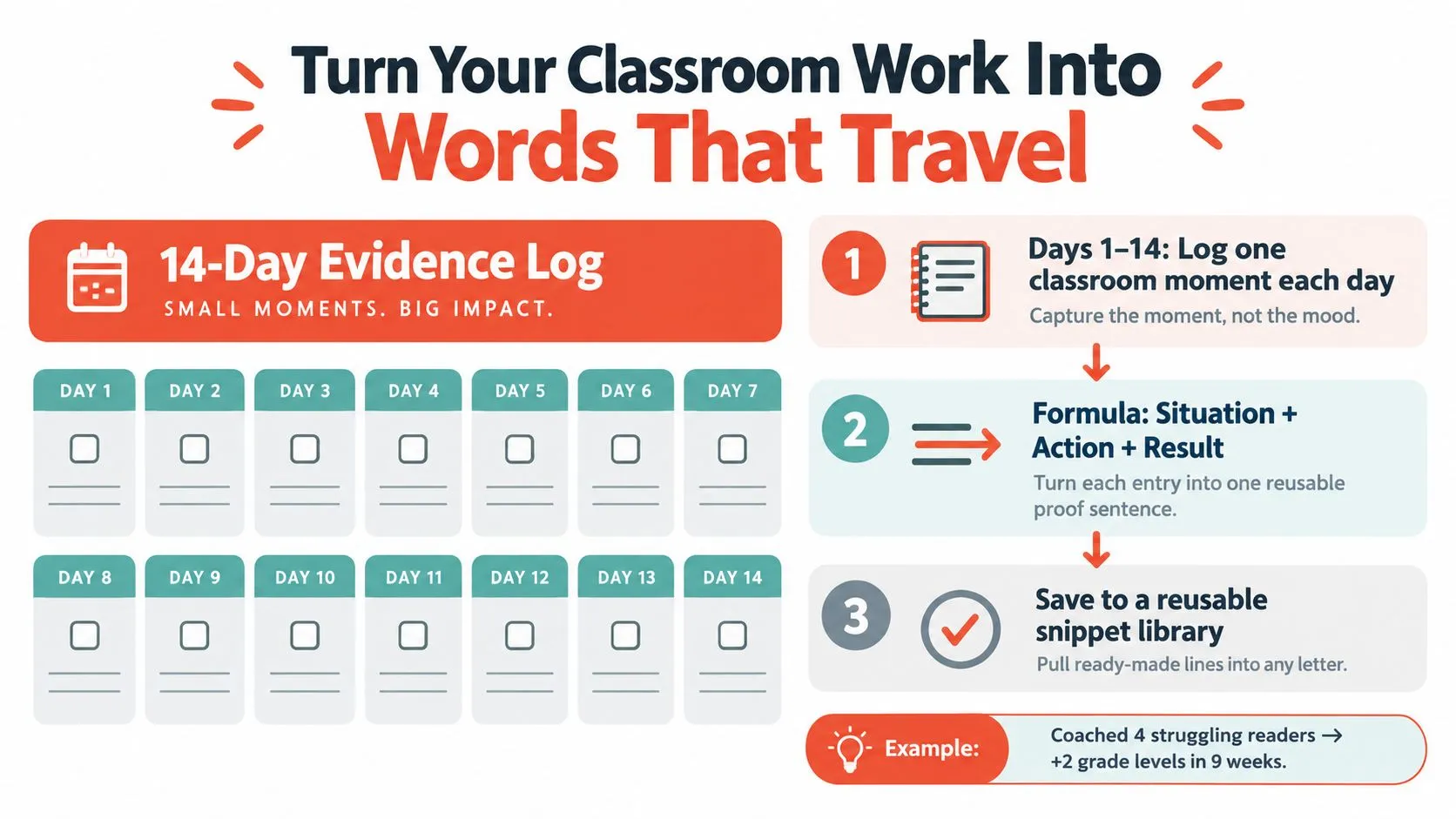
Don't wait until an application is due to remember your strongest classroom moments. Keep an evidence log for 14 days, with one entry per day.
Record:
- Date and setting: Where the work happened.
- Role and students affected: Identify the support you provided without exposing confidential information.
- What you did: Record the action, not the mood.
- Observable result: Note participation, completed work, smoother routines, clearer records, or another verifiable outcome.
- Posting language: Add the noun phrase that matches a vacancy, such as small-group instruction, behavior support, progress monitoring, or family communication.
One behavior-chart entry can support different letters when you change the duty alignment, not the underlying fact. For a general classroom role, emphasize consistent routines and participation. For a special education role, emphasize following the individual support plan and communicating observations. For an intervention role, emphasize documentation and progress monitoring.
Responsibility is not proof. Context, action, and outcome are proof.
Turn each log entry into one reusable sentence:
“When [situation], I [action], which [observable result].”
Then save the sentence in a personal snippet library. Your next educational assistant cover letter should draw from real work, not from a template's adjectives.
Open your last two assistant job descriptions, underline the noun phrases, and rewrite your evidence-log entries to match them before sending the next application. StoryCV asks about the work you did and turns your answers into resume-ready writing, which can help you find the specific classroom evidence hidden behind general responsibilities. Visit StoryCV to talk through your experience and start putting your strongest role into clear words.