A solid cover letter for your job application is the single best way to give your resume a voice and pull you out of the slush pile. It's a short, strategic document that connects your unique skills and personality directly to what a company actually needs, proving you’ve done your homework.
Think of it as the story that convinces a hiring manager to even bother reading your resume in the first place.
Why a Great Cover Letter Still Opens Doors
In a job market flooded with applications—many slapped together by AI—the idea that cover letters are obsolete is a dangerous myth. They've actually become more critical than ever. A well-written cover letter is your first real chance to move beyond sterile bullet points and tell a compelling story about why you are the right person for the job.
This isn't just about repeating your resume; it's about adding much-needed context. It’s your space to:
-
Show genuine excitement for the company and its mission.
-
Connect your past wins directly to the problems mentioned in the job description.
-
Explain career gaps or pivots in a positive, forward-looking way.
-
Showcase your writing skills and professional tone before they ever speak to you.
The Data Proves Its Value
The comeback of the cover letter isn't just a hunch; it's backed by hard numbers. Cover letters have seen a huge resurgence, with 83% of hiring managers admitting they read them even when they're optional. A staggering 45% review them before even glancing at the resume.
This shift is all about finding a real human connection in the hiring process. Candidates who submit a tailored cover letter are 1.9 times more likely to land an interview, which dramatically boosts their chances. You can dig into the full research on the cover letter's comeback to see just how much it matters.
This infographic breaks down why a strong cover letter for a job application makes such a tangible difference.
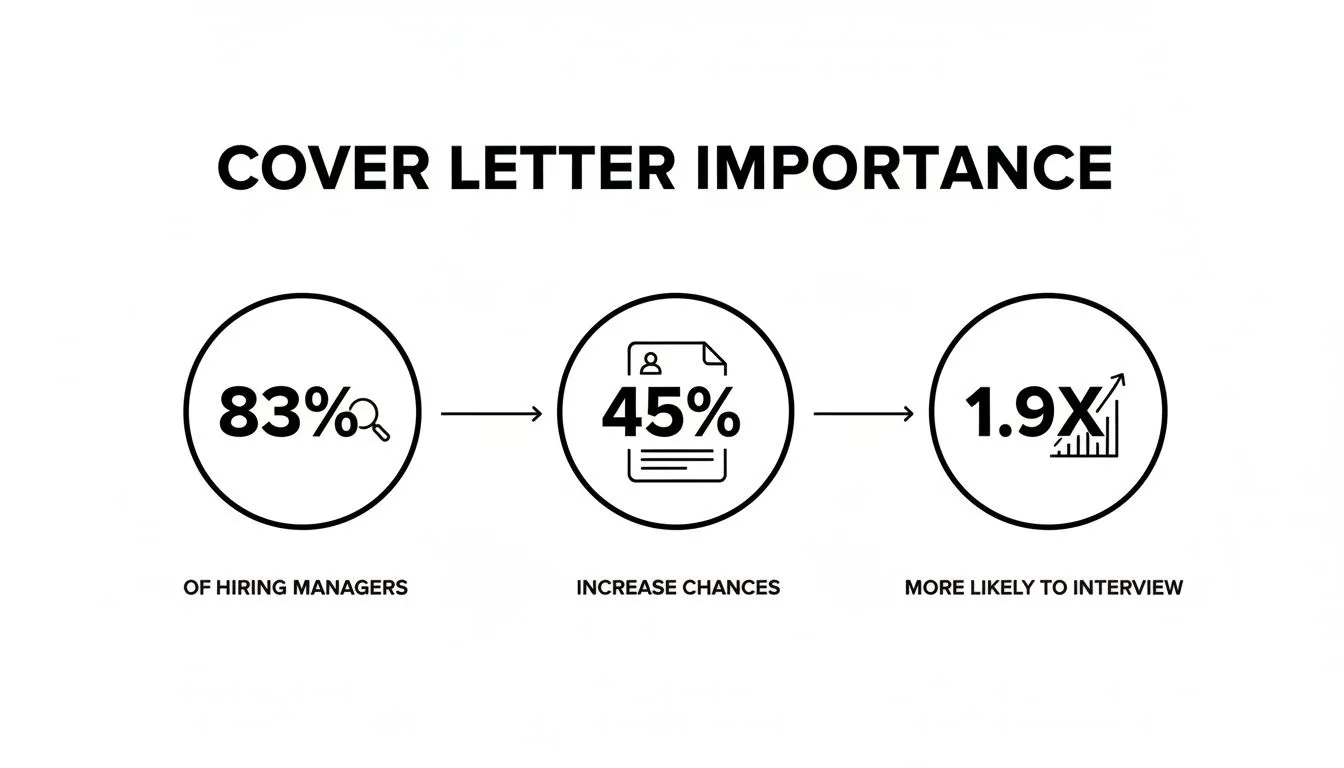
The numbers don't lie. A thoughtful cover letter isn’t just an optional extra—it’s a powerful tool that recruiters actively use to filter and prioritize who they talk to.
A resume shows what you've done. A cover letter shows who you are. It’s the bridge between your experience and the employer's specific needs, turning a list of qualifications into a compelling pitch.
Skipping this step means you're missing a golden opportunity to control your own story and make a memorable first impression. A generic or nonexistent cover letter screams low effort, but a personalized one shows you're a serious, invested applicant.
Honestly? It's the ultimate tie-breaker between two equally qualified candidates.
Key Elements of a Modern Cover Letter
Every great cover letter, regardless of the role or industry, is built on a few core components. Here’s a quick breakdown of what you need to include to make sure your letter hits all the right notes.
| Component | Purpose | Key Takeaway |
|---|---|---|
| Contact Information | To make it easy for them to reach you. | Include your name, email, phone, and LinkedIn. Match it to your resume header. |
| Personalized Salutation | To show you've done your research. | Address the hiring manager by name. "Dear Hiring Manager" is a last resort. |
| Strong Opening Hook | To grab attention immediately. | Start with a compelling achievement or a direct connection to the company's mission. |
| Body Paragraphs | To connect your skills to their needs. | Tell a story. Show how your experience solves their specific problems. |
| Clear Call to Action | To guide the next steps. | Confidently state your interest in an interview and express enthusiasm for the role. |
| Professional Closing | To end on a polished note. | Use a standard closing like "Sincerely" or "Best regards," followed by your name. |
Nailing these elements transforms your cover letter from a simple formality into a strategic tool that gets you noticed for all the right reasons.
Building the Framework for an Unforgettable Cover Letter
A great cover letter isn’t about slavishly following a template; it's about building a strategic framework. When you understand the basic anatomy of a persuasive letter, you can craft a story that flows logically, grabs a hiring manager’s attention, and holds it from the first sentence to the last.
This structure gives you guardrails without killing your authentic voice. It makes sure every single word has a purpose.
Before we get into the storytelling part, let's nail the non-negotiable basics that signal you’re a pro.
Start with a Clean and Professional Header
Your header is the very first thing a recruiter sees. It needs to be clean, professional, and—this is key—identical to the header on your resume. That consistency creates a polished, cohesive application package from the jump.
Make sure you include these four things:
-
Your Full Name: Big and bold.
-
Your Phone Number: A mobile number you actually answer.
-
Your Professional Email Address: Keep it simple, like firstname.lastname@email.com.
-
LinkedIn Profile URL: A customized URL looks much sharper than the default one with random numbers.
Next, add the date and the recipient’s info. Try your best to find the hiring manager's name and title. A quick search on LinkedIn or the company’s "About Us" page usually does the trick and makes your letter feel far more personal.
Choose a Modern Salutation
How you start your cover letter for job application sets the entire tone. The days of "To Whom It May Concern" are over. Honestly, that greeting just signals you didn’t do your homework.
If you found a name, use it. "Dear [Ms./Mr./Mx. Last Name]" is classic and always a safe bet.
If you can't find a name after a solid search, don't sweat it. Just use a modern, targeted alternative:
-
"Dear Hiring Manager"
-
"Dear [Department] Team" (e.g., "Dear Marketing Team")
-
"Dear [Job Title] Search Committee"
These are professional and show you’re talking to a specific audience, not just blasting your letter into the void.
The Three-Act Structure of a Winning Letter
Think of your cover letter like a short, persuasive story with a clear beginning, middle, and end. This three-act structure makes your narrative easy to follow and builds momentum perfectly.
Act 1: The Hook
Your opening paragraph is your one shot to grab their attention. Don't waste it with stale lines like, "I am writing to apply for the position of..." They already know that.
Instead, lead with a punchy statement that immediately shows your value or passion for the work. If you're a student with a killer project, you might lead with that. Learning how to frame that experience is everything when you're starting out, and you can find great advice in our post on building a compelling student resume template with real examples.
Pro Tip: Your opening should make the hiring manager think, "Okay, this person is different. I want to read more." It’s your elevator pitch in written form.
Act 2: The Body
This is the heart of your letter, usually one or two paragraphs. This is where you connect your most relevant experiences directly to the problems the company needs to solve, which they’ve conveniently laid out in the job description.
Don't just list your duties. Tell a quick story about a time you solved a similar problem or got a relevant result. Use numbers whenever you can to prove your impact.
-
Weak: "I was responsible for social media management."
-
Strong: "At my last job, I grew our Instagram following by 35% in six months by launching a new content strategy focused on user-generated videos, which directly addresses the need for community engagement you mentioned in the job post."
See the difference? The second one proves your skill instead of just claiming it.
Act 3: The Confident Close
Your final paragraph is where you wrap up your pitch and point the hiring manager toward the next step. Reiterate your excitement for the role and mention something specific about the company's mission or a project that gets you fired up.
End with a clear, confident call to action. Ditch the passive "I look forward to hearing from you" and try something more proactive, like, "I am eager to discuss how my experience in data analysis can help your team's upcoming product launch."
Finally, use a professional closing like "Sincerely," or "Best regards," followed by your typed full name. Nail this simple structure, and you'll have a repeatable blueprint for a memorable and persuasive cover letter, every time.
From Generic to Genuine: How to Tailor Your Message
Sending the same cover letter everywhere is like using a master key from a cheap motel—it’s not going to open any important doors. If you do only one thing to get more callbacks, this is it: customize your letter. This isn't just about swapping out the company name. It's about showing you've done your homework and understand exactly what they need.
A tailored message proves you're a serious candidate. It changes your cover letter from a simple formality into a direct pitch that speaks right to the hiring manager.
Decode the Job Description Like a Pro
That job description isn't just a list of tasks; it's a treasure map. It’s telling you precisely what the company is struggling with and the skills they believe will fix their problems. Your job is to read it not once, but three times.
-
First Read (The Skim): Get the big picture. What’s the core mission of this role? Is it about driving growth, fixing broken processes, or building something new from scratch?
-
Second Read (The Highlight): Go through with a digital highlighter and mark every skill, tool, or qualification they mention. Pay close attention to words that show up more than once—those are their biggest priorities.
-
Third Read (The "Why"): Now, read between the lines. If they’re asking for "strong project management skills for cross-functional initiatives," the real problem is likely disorganized projects and teams that don't talk to each other. Your goal is to pinpoint these hidden pain points.
Once you’ve done this, you'll have a shortlist of what truly matters to them. This list is your blueprint.
Frame Your Experience as the Solution
Now, take that list of priorities and connect your own experience to each one. The trick is to go beyond just saying you have a skill. You need to prove it with a quick story or a number.
Don't just say you have the key; show them a time you used it to unlock a similar door.
A tailored cover letter doesn't just list your skills; it connects them directly to the employer's needs. Instead of saying, "I have strong communication skills," you say, "I used those skills to get our sales and marketing teams aligned, which boosted lead quality by 25%."
This small shift changes everything. It moves the focus from your past to their future. You’re answering the one question every hiring manager has: “How is this person going to make my job easier?”
This kind of framing is critical. Data shows 49% of hiring managers say a great cover letter can rescue an otherwise weak resume, and a staggering 94% admit that cover letters influence their final decision. For a deeper dive, you can check out these cover letter statistics.
Tailoring Your Cover Letter for Different Industries
The tone you use, the stories you tell, and the proof you offer should change depending on the industry. A creative agency isn't looking for the same things as a buttoned-up financial firm. Adjusting your approach shows you get their world.
A quick way to think about this is to see how your tone and focus might shift across different sectors.
Tailoring Your Cover Letter for Different Industries
| Industry | Tone & Style | Content Focus | Example Snippet |
| :--- | :--- | :--- |
| Tech & Startups | Direct, innovative, and results-focused. More casual and confident. | Focus on metrics, scalability, and problem-solving. Highlight specific projects and your impact on growth. | "When I saw you were looking to scale your user onboarding process, it reminded me of when I redesigned our flow at Company X, cutting user drop-off by 18% in the first month." |
| Corporate & Business | Professional, formal, and structured. Emphasizes reliability and alignment with company values. | Showcase process improvements, risk management, and your ability to work within established systems. | "My experience in managing multi-million dollar budgets and ensuring regulatory compliance aligns directly with the responsibilities outlined for this Senior Analyst position." |
| Creative & Marketing | Energetic, engaging, and brand-aware. Shows personality and a creative spark. | Tell a story. Focus on campaign success, audience engagement, and your unique creative vision. | "I've been an admirer of your brand's bold voice for years, and I believe my work in launching the 'Project Spark' campaign, which boosted engagement by 40%, would fit right in." |
When you adapt your language and focus like this, you show you're not just qualified—you're a good cultural fit. This level of detail makes your cover letter for job application feel personal and urgent.
The goal is simple: write something so specific to the role that it would be useless for any other application. That's when you know you've nailed it.
Navigating ATS and Formatting for Readability
You can write the most compelling cover letter for a job application in the world, but it’s completely useless if a human never sees it. Before a hiring manager gets a chance to be wowed by your story, your application must first get past the digital gatekeeper—the Applicant Tracking System, or ATS. This is the software that scans, sorts, and filters the vast majority of applications before they ever get a fair shake.
Your mission is twofold: satisfy the robot, then engage the human. It sounds complicated, but it’s really just about keeping your document clean and simple. Overly creative formats with columns, funky text boxes, or embedded graphics are notorious for confusing an ATS. When the software can't parse your letter, it gets misinterpreted or, worse, tossed into the digital trash heap.
Formatting That Pleases Both Robots and Recruiters
The best format is clean, professional, and dead simple to read. Forget flashy design; your only goal here is readability. A recruiter might spend just six seconds on their first scan, so make their job as easy as possible.
Here are a few simple rules to live by:
-
Fonts: Stick to the classics. Think Calibri, Arial, Helvetica, or Georgia. They’re easy on the eyes for both people and software. Keep the font size between 10 and 12 points.
-
Margins: Give your text some breathing room. Keep margins between 0.5 and 1 inch on all sides. This creates clean white space and prevents the page from feeling cluttered.
-
Layout: A standard, single-column layout is your best friend. Avoid tables, columns, or text boxes, which can scramble your information when the ATS tries to read it.
Your goal is a document that's effortlessly scannable. If a hiring manager has to squint, zoom in, or decode a weird font, you've already lost them. Clarity is everything.
Ultimately, your format should be so clean it becomes invisible, letting your actual words take center stage.
Weaving in Keywords Without Sounding Robotic
The ATS is programmed to hunt for specific keywords and phrases pulled straight from the job description. Your job is to mirror that language naturally within your cover letter. This isn't about stuffing your paragraphs with every buzzword you can find—that’s a surefire way to make your letter unreadable to the human who eventually sees it.
Instead, comb through the job description and pull out the key skills, qualifications, and responsibilities. Look for terms related to:
-
Specific software or tools (e.g., "Salesforce," "Python," "Adobe Creative Suite")
-
Hard skills or methodologies (e.g., "data analysis," "agile development," "SEO")
-
Soft skills they mention (e.g., "cross-functional collaboration," "project management")
Once you have your list, weave these exact phrases into the stories of your achievements. For example, instead of saying, “I worked with different teams,” you could write, “My role required deep cross-functional collaboration with both engineering and marketing.” This approach ticks the box for the ATS while giving the human reader meaningful context. To learn more about how these systems operate, check out our guide on how the ATS filter works.
Choosing the Right File Format
When it's time to save your masterpiece, you really have two choices: PDF or a Word document (.docx). For years, PDF has been the gold standard, and for good reason. It locks in your formatting, ensuring your letter looks exactly how you designed it on any device.
However, some older, clunkier ATS platforms can still struggle with PDFs. The best rule of thumb? Always check the application instructions. If they don’t specify a file type, a PDF is almost always your safest bet. If they explicitly request a .docx file, give them exactly that.
The trend in hiring is toward short, focused letters. One survey found that while 88% of job seekers think cover letters are important, a telling 66% of them prefer letters to be half a page or less. This lines up perfectly with how recruiters behave, as 42% admit to just skimming applications. This just hammers home the need for a clean, scannable format that gets straight to the point.
Don't Sabotage Your Application With These Common Mistakes
You’ve done the hard part. You’ve written your story and connected it to the job. It feels like you’re ready to hit send, but this is where one small, unforced error can undo everything.
Before you submit, you have to do one last scan for the blunders that sink an otherwise great cover letter for job application. These aren’t just typos; they’re strategic mistakes that signal a lack of effort. Catching them is the final gut check to make sure your application lands with the impact it deserves.
The Buzzword Trap
One of the fastest ways to sound generic is to stuff your letter with clichés. Phrases like "team player," "results-driven," or "go-getter" are so overused they've become completely meaningless. They’re filler, and they don’t prove a thing.
Instead of just claiming you have a skill, give a real example that shows it in action.
-
Before: "I am a results-driven professional with strong problem-solving skills."
-
After: "When our team faced a critical software bug before a product launch, I dug into the code, found the root cause, and worked with two developers to ship a patch in under three hours. The release went off without a hitch."
The second version proves your skills without ever needing the buzzwords. It’s a specific, memorable story that’s far more convincing.
Clichés are the enemy of authenticity. They make you sound like everyone else. Your goal is to stand out, and the best way to do that is by sharing a real, specific story of your impact.
Just Regurgitating Your Resume
Your cover letter and resume are a team, but they have different jobs. Your resume lists what you did. Your cover letter explains how you did it and why it matters for this specific role. The most common mistake is just turning your resume’s bullet points into sentences.
This wastes a golden opportunity to add personality, context, and a direct link to the company’s goals. The hiring manager already has your resume—don't make them read it twice.
-
Weak: "In my last role, I was responsible for managing social media accounts and creating content."
-
Strong: "I noticed your company is looking to grow its TikTok presence. At my last job, I spearheaded a video content strategy that boosted our engagement on that platform by 45% in a single quarter. I’m excited by the chance to bring that same creative energy to your team."
The strong version connects your past wins directly to their future needs. It makes you look like an immediate asset.
Ignoring the Company
Another huge red flag for recruiters is a letter that feels like it could have been sent to anyone. If you can swap out the company name and the letter still makes sense, you’ve missed the entire point. You need to show that you're applying for this job, not just any job.
This is where your research pays off. Mention something specific that drew you to them.
-
A recent project they launched that you admire.
-
A company value that genuinely resonates with you.
-
A recent news article or award they received.
Even a single, thoughtful sentence can make a world of difference. For instance: "I was particularly impressed by your recent commitment to sustainable packaging, as it aligns with my own professional focus on eco-friendly supply chain solutions." This simple touch proves you’ve done your homework and are genuinely invested, transforming your application from a generic submission into a thoughtful pitch.
Frequently Asked Questions About Cover Letters
Even with the perfect structure, a few nagging questions always seem to pop up right before you hit "send." These little details can feel like a big deal, but getting them right is the final layer of polish that makes your application stand out.
Let's clear up some of the most common hang-ups so you can submit your cover letter for job application with total confidence. A small, avoidable mistake shouldn't undermine all your hard work.
How Long Should a Cover Letter Be?
Keep it tight. The sweet spot for a modern cover letter is between 250 and 400 words. In practice, that’s about three or four short paragraphs that fit neatly on one page without looking like a wall of text.
A hiring manager needs to get your whole message in less than a minute. Your goal is to be punchy and powerful, not to write your life story. Show them you respect their time by sticking to the most relevant points for the job at hand.
Your cover letter is a highlight reel, not the full feature film. Get straight to the point, prove your value, and make it easy for them to say "yes" to an interview.
This word count forces you to be ruthless. Every single sentence has to earn its place by proving you're the right person for the role.
Is It Okay to Use AI to Write My Cover Letter?
Using AI as a brainstorming buddy or an editing assistant is a smart move. It's great for getting past writer's block, suggesting different phrasings, or tightening up a clunky sentence. But whatever you do, don't just copy and paste the output.
Recruiters are getting incredibly good at spotting the flat, impersonal tone of AI-generated text. A letter written entirely by a bot lacks the authentic passion and personal stories that make a candidate memorable. It can't fake genuine enthusiasm.
If you use AI, you must do a heavy edit to:
-
Inject your own voice and personality.
-
Weave in specific, quantifiable achievements.
-
Make sure the tone matches the company culture.
Think of AI as a collaborator, not a ghostwriter. It’s a tool to help you think, not a replacement for your own story.
What If I Don't Know the Hiring Manager's Name?
This is a classic problem, but the answer is pretty simple. First, do some digging. A quick search on LinkedIn or the company's "About Us" page will often turn up the name of the department head or the person who posted the job.
If a reasonable search comes up empty, don't resort to stuffy, outdated greetings like "To Whom It May Concern." It immediately signals you didn't put in the effort.
Instead, use a modern, professional alternative. It shows you're addressing a specific audience, even without a name:
-
"Dear Hiring Manager"
-
"Dear Marketing Team"
-
"Dear [Job Title] Search Committee"
Choosing one of these options is perfectly acceptable and shows professionalism without faking it. It is a simple, clean solution. If you consistently find yourself stuck on how to frame your value, exploring what a resume writer does can shed light on the art of professional storytelling.
Ready to stop wrestling with words and start telling your career story? StoryCV uses a smart, interview-based approach to uncover your real impact and craft a compelling resume draft in minutes. Move beyond generic templates and create a document that opens doors. Try it for free at https://story.cv.