“Provided excellent customer service” appears on nearly every retail resume. Recruiters skip it because it gives them nothing to compare.
Your store already measures your work through units per transaction, conversion rate, average basket, loyalty sign-ups, shrink, mystery shop scores, and NPS. Ask your supervisor for your last quarter's figures while you still have access. Don't wait for an exit interview.
The difference is simple. Handled returns describes a task. Reduced the return queue by improving intake and routing describes a change. A strong retail resume summary connects what you did to what moved.
That evidence also fits the broader rule for retail resumes: pair an action with a metric, comparison point, timeframe, and business mechanism, as shown in these retail resume examples. Target the language to the vacancy, but don't stuff your summary with keywords. An analysis of 1,786 retail vacancies found customer service in 63% of postings, communication in 62%, sales in 35%, teamwork in 24%, and problem-solving in 21%. Retail skills research supports leading with customer-facing impact, then proving it.
Below are eight summary types. Each includes a weak line, a stronger line, an ATS version, and a human version. Use only figures you can verify.
If the numbers are buried in your memory, StoryCV gives you a useful next step. It asks about the work you did, then turns your answers into resume-ready writing. Try StoryCV.
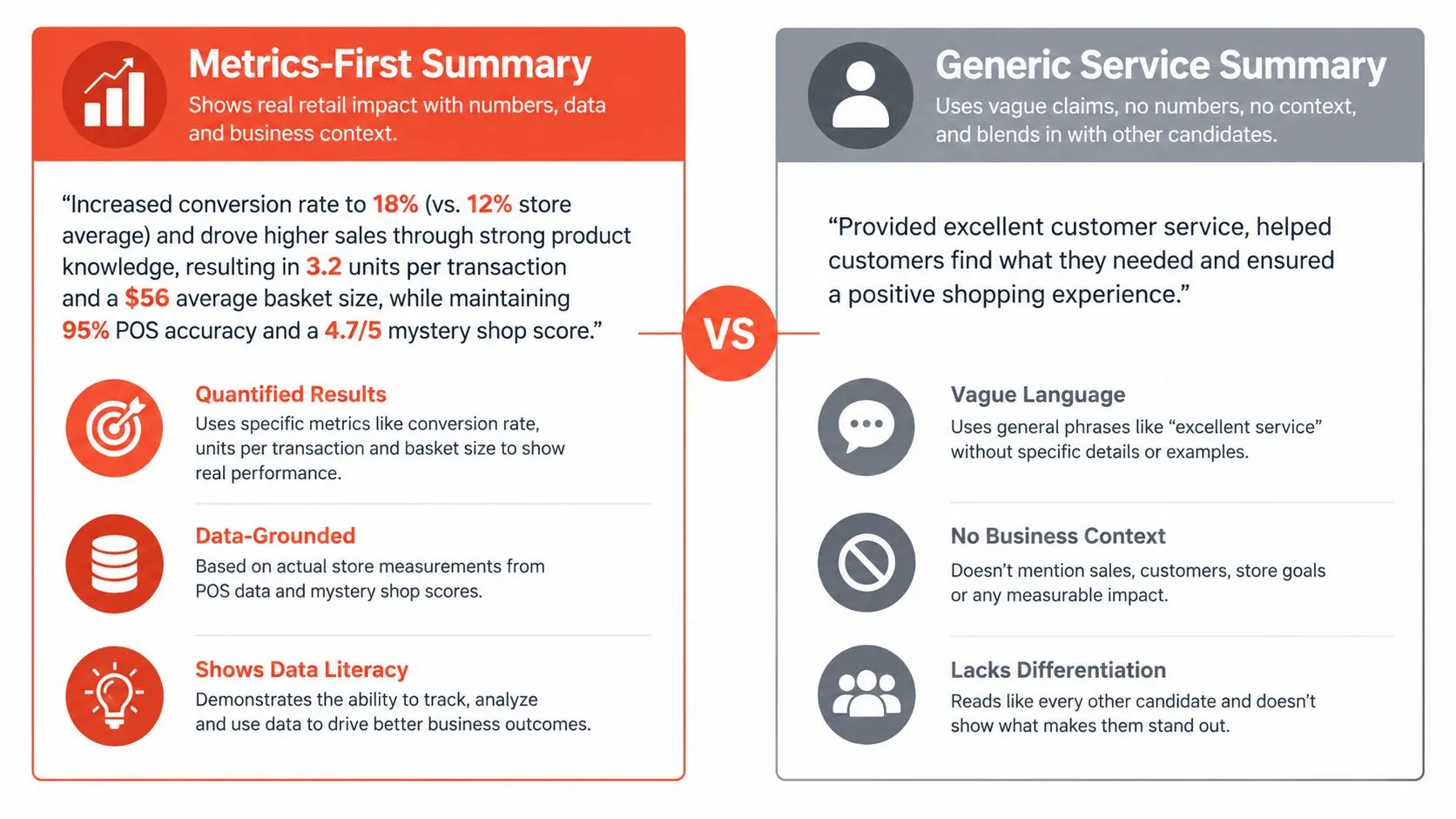
1. The Metrics-First Summary
Lead with the number that best explains your commercial value. Retail is measured in movement, not enthusiasm.
A metrics-first summary works well for sales associates, department leads, and store managers. Use the figures your POS system or manager already tracks. Ask for your last full quarter and request the store or team baseline too. A number without context still leaves the reader guessing.
Practical rule: Put your strongest metric in the summary. Keep the next one or two for your experience bullets.
Here's the difference:
- Weak: Provided excellent customer service and supported sales.
- Stronger: Increased average transaction value to $47, $3 above the team baseline, through relevant add-on recommendations.
For an ATS, use direct terminology:
ATS variant: Retail sales associate with an 18% conversion rate versus a 12% store average in Q3, skilled in product discovery, consultative selling, and loyalty enrollment.
For a human reviewer, make the mechanism easier to follow:
Human variant: Retail sales associate who turns customer questions into useful purchases. In Q3, I reached an 18% conversion rate, compared with a 12% store average, by asking better product-discovery questions.
Request these figures before you leave:
- Conversion rate: Ask how often your interactions became purchases.
- Basket metrics: Request average basket, units per transaction, or average transaction value.
- Loyalty results: Ask for your enrollment total and the relevant store or district comparison.
- Quality measures: Request mystery shop scores or NPS if your store tracks them.
- Loss measures: Ask about shrink only if your role gave you meaningful responsibility for cash, stock, or loss prevention.
You can also write: Enrolled 210 loyalty members in six months, ranking highest in a district of 24 stores. Don't inflate the result. Retail hiring managers understand that store type, traffic, seasonality, and department all affect the baseline.
2. The Operational Competency Summary
A resume that says “used POS” is weaker than one that explains what the system helped you control. Name the platform only when you used it, then connect it to inventory accuracy, replenishment, receiving, scheduling, shrink control, or fulfillment. That evidence positions you for store operations, supply chain, fulfillment, or management roles.
Lead with the operating problem, the change you made, and the result. Keep the claim defensible.
- Weak: Managed inventory and supported daily store operations.
- Stronger: Maintained 98.2% inventory accuracy across 2,400 SKUs by tightening cycle-count procedures and resolving stock exceptions.
If your work covered a larger environment, you might write: Managed inventory accuracy protocols across 8,000+ SKUs, maintaining 98.2% cycle-count accuracy. Use that wording only when you can explain the scope and measurement.
An ATS version should match the target posting:
ATS variant: Retail operations professional experienced in inventory control, cycle counts, replenishment, POS workflows, scheduling coordination, receiving, shrink control, and exception management.
A hiring manager also needs to see your judgment:
Human variant: I keep the store dependable behind the scenes. I maintained 98.2% inventory accuracy across 2,400 SKUs by tracing recurring count errors and fixing the process that caused them.
Use operational language tied to specific work:
- Audit: State what you checked and how often.
- Streamline: Identify the delay, handoff, or duplicate step you removed.
- Coordinate: Name the teams, shifts, or systems involved.
- Maintain: Connect accuracy to stock availability, fulfillment, or customer experience.
- Resolve exceptions: Show how you handled cases outside the standard process.
Request measurable evidence before leaving the store. Managers may be able to confirm inventory accuracy, cycle-count results, replenishment performance, receiving volume, shrink responsibility, or fulfillment outcomes. These figures give an operational summary the same credibility that conversion, basket size, loyalty sign-ups, mystery shop scores, and NPS give a sales-focused summary.
Use the platform as proof of control, not as a software list. The system matters because it helped you find errors, protect stock, improve handoffs, or keep orders moving.

A short visual explainer can help you map the process from stock movement to customer delivery:
3. The Specialized Department Summary
General retail language hides specialist value. If you worked in jewelry, cosmetics, electronics, grocery, or pharmacy, name the department and the responsibility.
Specialist departments often combine product knowledge, trust, compliance, and commercial judgment. That makes your experience more useful than a generic “retail professional” label. It also gives a new employer a reason to believe you can handle a category with real risk or technical detail.
- Weak: Experienced retail associate with strong product knowledge.
- Stronger: Electronics specialist who managed forecasting, vendor coordination, and inventory for 250+ active SKUs.
For ATS matching, use the category and systems:
ATS variant: Electronics department professional with experience in P&L ownership, vendor relationships, sales forecasting, inventory management, product education, and customer consultation.
For a person, make the trust element visible:
Human variant: I helped customers make expensive electronics decisions without overwhelming them. I combined product education with forecasting and inventory control across 250+ active SKUs.
Department-specific evidence can include:
- Commercial scope: Ask your manager for department sales or margin contribution if it's available.
- Risk control: Mention jewelry loss prevention, pharmacy accuracy, fresh-food dating, or other standards you personally owned.
- Credentials: Include relevant beauty, electronics, nutrition, or cosmetics-safety training.
- Customer behavior: Show how product education, recommendations, or follow-up influenced the department's work.
Don't frame the summary around loyalty to a previous retailer. Frame it around transferable category skill. A cosmetics specialist can emphasize consultation and product matching. A pharmacy candidate can emphasize accuracy and refill support. An electronics candidate can emphasize needs discovery, product comparison, and inventory decisions.
When the resume needs a stronger structure for this type of experience, use these retail resume templates as a content reference, not as a substitute for evidence.
4. The Sales Driver Summary
A sales summary must show that you owned the result. “Helped customers find products” doesn't prove personal selling performance.
This approach fits commission environments, luxury retail, high-consideration products, and departments where add-ons materially affect the transaction. Start with your personal sales total, rank, margin mix, add-on rate, or repeat-customer revenue. Your manager or sales dashboard may already contain the answer.
Here's a clean split:
- Weak: Assisted customers and exceeded sales goals.
- Stronger: Ranked third in personal sales across a 24-store district, generating $245,000 in annual revenue with a 32% margin mix.
The ATS version should make the selling method searchable:
ATS variant: Retail sales professional skilled in consultative selling, product bundling, warranty upselling, customer follow-up, and add-on conversion.
The human version should explain why the number happened:
Human variant: I built trust before recommending extras. That approach produced a 64% protection-plan add-on rate, compared with a 41% team average.
Ask for the data that separates revenue from technique:
- Personal sales: Request your total and the measurement period.
- Peer rank: Include the size of the comparison group, such as top three across 24 stores.
- Product mix: Margin or category mix may explain your value better than revenue alone.
- Repeat customers: Ask how many customers returned and how much revenue came from them.
- Method: Name consultative selling, bundling, warranty upselling, or follow-up only when you used it.
You can write: Built a customer base of 180 repeat customers, generating 28% of personal monthly revenue through relationship maintenance and post-purchase follow-up. That line works because it connects relationship behavior to revenue.
For help turning sales work into sharper bullets, see these resume bullet points for sales. Keep the summary focused on one commercial story. Don't cram every target, product, and award into the opening paragraph.

5. The Team Leadership Summary
You don't need a supervisor title to prove leadership. If managers trusted you to onboard, coach, or model standards, document it.
Retail leadership is visible in repeated behavior. You may have run floor huddles, taught till procedures, trained visual standards, or helped new hires become productive. Replace “mentored teammates” with the skill taught, the number of people involved, and the observable result.
Weak: Mentored new employees and supported team performance.
Stronger: Onboarded 23 new hires over two years, with mentees reaching productivity benchmarks two weeks faster than the store average.
The ATS version should surface leadership terms:
ATS variant: Retail team lead experienced in onboarding, product training, floor coaching, visual merchandising standards, daily huddles, and performance support.
The human version should sound like a person who took responsibility:
Human variant: Managers relied on me to make new associates useful quickly. I onboarded 23 hires over two years, and my mentees reached productivity benchmarks two weeks faster than the store average.
Ask your manager a direct question before you leave: Did you rely on me to train or model behavior for others? Request confirmation in writing if possible. It can help you remember the scope and defend the claim in an interview.
Strong leadership evidence might look like this:
- Training volume: Trained 18 associates on visual merchandising standards.
- Quality outcome: 16 of those 18 associates scored “exceeds standards” on their first visual audit.
- Store outcome: Led floor huddles that contributed to an 8-point increase in customer satisfaction after introducing a product-knowledge format.
Avoid claiming that every team result came from you. State your role accurately. “Introduced the teaching format” is credible. “Drove all customer satisfaction” is not.
6. The Problem-Solver Summary
Problem-solving summaries begin with the mess. They don't begin with “responsible for.”
Retail gives you recurring problems every week: unclear policies, slow processing, aging clearance, reconciliation errors, stock exceptions, and customer frustration. The useful story has four parts: context, diagnosis, action, outcome.
- Weak: Resolved customer issues and improved store processes.
- Stronger: Found that unclear fitting-room policies caused 22% of customer complaints, redesigned the workflow, and reduced complaints by 31% in eight weeks.
That sentence works because the problem comes first. The reader can see what you noticed, why it mattered, and how the intervention changed the result.
ATS variant: Retail problem solver experienced in root-cause analysis, complaint resolution, process improvement, shrink reduction, workflow redesign, and compliance correction.
Human variant: I look for the repeat problem behind the individual complaint. After finding that unclear fitting-room policies caused 22% of complaints, I redesigned the workflow and reduced complaints by 31% in eight weeks.
Use a simple interview with yourself:
- Observation: What kept going wrong?
- Scale: How often did it happen, and who felt the impact?
- Diagnosis: Why did the issue occur?
- Action: What did you change?
- Result: What improved, and did the fix last?
A clearance example could read: Found that 40% of clearance inventory was aging past its markdown date, built an aging report, and recovered $12,000 in seasonal margin through weekly markdown reviews.
A cash-control example could read: Spotted rush-hour till reconciliation errors, proposed a two-till peak-period system, and improved accuracy from 94% to 99.2%.
Don't hide behind technical language. “Implemented an automated aging report” matters only when the reader understands the retail problem it solved. State the business mechanism in plain English.
7. The Customer Retention Summary
Retention is different from transaction volume. A crowded store doesn't prove that customers chose to return to you.
Use this summary for specialty retail, salon services, wellness, beauty, and loyalty-led environments. Ask your manager whether the business tracks repeat visits, enrollment, regular-customer lists, or customer spend. You may have more evidence available than you think.
- Weak: Built strong relationships and encouraged loyalty enrollment.
- Stronger: Built a loyalty customer base of 340 regulars with a 68% repeat-visit rate, with members spending 2.3 times more annually than non-members.
The ATS version should include the language hiring systems and managers expect:
ATS variant: Customer retention specialist experienced in loyalty enrollment, repeat-visit growth, personalized recommendations, post-visit follow-up, and customer relationship management.
The human version should show the behavior behind the retention:
Human variant: Customers returned because I remembered what they bought, what they disliked, and what they needed next. I built a base of 340 regulars with a 68% repeat-visit rate.
Ask for comparisons, not just totals. A high enrollment rate means more when you know the store average. One useful line is: Achieved a 45% new-customer loyalty enrollment rate versus a 28% store average by personalizing sign-up conversations to customer needs.
You can also connect retention to service design:
- Follow-up: Increased beauty-service repeat purchases from 52% to 71% through post-visit messages and personalized recommendations.
- Customer value: Compare annual spend between regulars and new customers if the business provides that data.
- Relationship method: Explain how you remembered preferences, recommended products, or followed up after a purchase.
Keep privacy in mind. Don't place customer names, personal contact details, or confidential account information on a resume. Describe the pattern and your action.
For stronger language around service work, use these resume bullet points for customer service. You're not claiming that friendliness created retention. You're showing which repeatable behavior helped customers come back.
You can also learn how to improve retail customer loyalty by connecting satisfaction signals to repeat behavior rather than listing “customer-focused” as an unsupported trait.
8. The Compliance and Quality Summary
Accuracy is a commercial skill. In pharmacy, food, financial services, and luxury retail, one preventable error can matter more than a polished sales claim.
Use this summary when you maintained records, passed audits, managed temperature or labeling checks, controlled medication fulfillment, or trained colleagues on standards. Ask your manager for actual audit results before you write the line.
Weak: Detail-oriented retail professional who follows company policies.
Stronger: Maintained 99.8% accuracy in pharmacy order fulfillment across 18 months, with zero medication errors or audit findings.
The ATS variant should name the relevant standard:
ATS variant: Retail compliance professional experienced in pharmacy fulfillment, mystery shop audits, temperature checks, date rotation, labeling, quality control, and regulated operating procedures.
The human version should make trust concrete:
Human variant: I protected customers by treating accuracy as part of service. Across 18 months, I maintained 99.8% pharmacy order-fulfillment accuracy with zero medication errors or audit findings.
Quality evidence can come from several places:
- Audit history: State the standard, score, and consecutive passes.
- Error control: Describe an error-free period only when records support it.
- Training: Explain how many associates you trained and how they performed.
- Department controls: Mention temperature checks, date rotation, labeling, or other duties you owned.
- Business impact: Connect compliance to customer trust, operational safety, or reduced liability without exaggerating causation.
A mystery-shop example could read: Passed 14 consecutive mystery-shop audits at an exceeds-standards level and trained eight associates, all of whom passed their first audit.
A fresh-food example could read: Managed deli compliance for temperature checks, date rotation, and labeling, achieving full compliance in monthly audits.
Don't list HIPAA, FDA guidelines, or another framework unless it applied to your work. Compliance language only helps when you can explain the standard, your responsibility, and the evidence.
8-Point Retail Resume Summary Comparison
| Approach | Implementation Complexity 🔄 | Resource Requirements ⚡ | Expected Outcomes ⭐📊 | Ideal Use Cases 💡 | Key Advantages ⭐ |
|---|---|---|---|---|---|
| The Metrics-First Summary | Medium 🔄, retrieve & contextualize POS/store metrics | Moderate ⚡, POS access, manager data, basic data literacy | High ⭐📊, clear, measurable impact (conversion, AOV, loyalty) | Retail roles with tracked KPIs; operator/management-facing resumes | Data-driven credibility; ATS/searchable |
| The Operational Competency Summary | Medium–High 🔄, quantify processes & system changes | Moderate ⚡, process logs, inventory/scheduling systems, time to implement | High ⭐📊, improved efficiency, accuracy, reduced labor/shrink | Operations, supply chain, assistant manager, stores with shrink issues | Positions candidate for ops/management; systemic thinking |
| The Specialized Department Summary | Medium 🔄, requires deep product & departmental metrics | Moderate ⚡, P&L or sales data, certifications, vendor contacts | High ⭐📊, strong category ownership (sales, margin, compliance) | Department supervisor, category manager, specialty retail (jewelry, pharmacy) | Signals specialty expertise; easier verification by managers |
| The Sales Driver Summary | Medium 🔄, gather individual sales/rank and context | Moderate ⚡, personal sales totals, rank, product-mix metrics | High ⭐📊, direct revenue signal (personal revenue, add-on rates) | Commission roles, luxury retail, sales management tracks | Clearly demonstrates revenue contribution; verifiable |
| The Team Leadership Summary | Medium 🔄, document repeatable coaching & team outcomes | Low–Moderate ⚡, training counts, retention/performance deltas, manager confirmation | Medium–High ⭐📊, improved team productivity, retention, CSAT lift | Supervisor, trainer, aspiring managers | Shows leadership potential without formal title |
| The Problem-Solver Summary | Medium 🔄, state problem → diagnosis → solution → result | Low–Moderate ⚡, observational data, before/after metrics, small initiatives | High ⭐📊, measurable fixes (time saved, errors reduced, revenue recovered) | Any retail role; strong for ops/management pipeline | Demonstrates ownership, initiative, practical impact |
| The Customer Retention Summary | Medium–High 🔄, requires longitudinal tracking & context | High ⚡, CRM/loyalty data, follow-up systems, analytics | High ⭐📊, increased repeat rate, LTV, loyalty enrollments | Specialty retail, services, CRM or community roles | Aligns with LTV strategy; strategic business impact |
| The Compliance and Quality Summary | Medium 🔄, collect audit records & standards conformance | Moderate ⚡, audit/inspection reports, compliance frameworks | High ⭐📊, reduced risk, high audit scores, error-rate reduction | Pharmacy, food service, regulated retail, quality assurance | Trustworthiness for sensitive duties; audit-verifiable |
Start Your Retail Resume Summary With Last Quarter's Numbers
Pick the summary type that fits the job you want next, not the one you wrote last time.
A store-operations application needs a different opening from a luxury-sales application. A pharmacy role needs different proof from an entry-level sales-associate role. Choose the business problem you want to solve, then select the metric that proves you've handled something similar.
Ask your supervisor for last quarter's figures before you leave, or this week if you're still on the floor. Request the number, the comparison point, and the period it covers. Ask whether it came from the POS system, a back-office report, a mystery shop, a loyalty dashboard, or a manager's review.
Then write two versions around your strongest number:
ATS line: Achieved [metric] against [baseline] by [what you changed], using [truthful target-role keyword].
Human line: I improved [business result] from [baseline] to [metric] by changing [specific behavior or process].
Treat that pattern as a starting point, not a box to fill. The summary still needs judgment. Remove metrics that don't support the job. Keep the strongest one near the front. Use your experience bullets to add the second layer of proof.
Your retail resume summary should make three things obvious:
- What you did: Name the action.
- What changed: State the measurable result.
- Why it matters: Connect the result to sales, service, accuracy, retention, or operations.
If the evidence is scattered across old schedules, dashboards, and conversations with managers, StoryCV can help you talk through the work you did and shape those details into a resume-ready summary. Don't start with a template. Start with the facts you can defend.
Write my first role with StoryCV, then build the summary around the numbers your store already recorded.
StoryCV interviews you about the work you did and turns real context, decisions, and outcomes into clear resume writing. Visit StoryCV to turn your retail metrics into a focused summary instead of another generic service claim.