The most popular advice about AI resume writing is also the least useful: paste in the job description and ask for a finished resume. That gives you polished language, not a credible account of what you did.
AI help with resume writing works when it improves the evidence you already have. It can organize scattered memories, sharpen weak bullets, and align your experience with a role. It can't decide which career story is true, strategically important, or worth defending in an interview. That judgment still belongs to you, or to a guided process that makes you do the thinking before the prose appears.
Why Most AI Resume Drafts Feel Fake
Generic AI resumes sound competent because they use competent language. They still feel empty. A hiring manager sees familiar verbs, familiar buzzwords, and a document that could have been produced for almost anyone in the same function.
The usual process is simple. A candidate pastes a job advertisement into ChatGPT, adds a few lines about their background, asks it to “write a resume,” and submits whatever comes back. The structure looks fine. The grammar is clean. The content often fails because the model never learned the candidate's actual evidence, decisions, constraints, or trade-offs.
It fills those gaps with averages.
The three signs of synthetic filler
- Vague impact claims: “Drove strategic improvements” says nothing about what changed, how you contributed, or how anyone could verify it.
- Buzzword clusters: “Cross-functional, data-driven, results-oriented” can describe almost any professional and therefore describes no one well.
- Interchangeable bullets: If the bullet could sit on five other resumes in the same function without looking out of place, it isn't doing enough work.
A resume bullet should reveal a decision and its consequence. “Supported a product launch” is a task fragment. “Coordinated launch dependencies across product, sales, and support, keeping the release aligned with the planned date” gives the reader scope and ownership without inventing a metric.
The central mistake: asking AI to write before giving it something specific to write about.
That's why these signs of an AI-generated resume matter. The problem isn't that a sentence sounds polished. The problem is that polish is hiding missing evidence.
AI helps most when it captures your story first and drafts second. A guided interview can force useful questions: What broke? What did you change? Who depended on your decision? What improved afterward? Generic prompting skips that work and produces plausible text on weak material.
What AI Actually Does Well on a Resume
AI is excellent at the chores people postpone. It can take scattered notes, rough timelines, and half-remembered projects and turn them into readable material. That doesn't make the result true automatically. It makes the raw material easier to inspect.
The first win is structuring chaos. Give AI notes such as “worked on Q3 launch, sales had concerns, fixed handoff process, launch stayed on track,” and it can shape the idea into a clearer bullet:
“Led a cross-functional rollout of the Q3 product launch, resolving sales and delivery dependencies to keep the release on schedule.”
That version is still only as accurate as the notes behind it. The tool improved the structure. You must supply the scope and outcome.
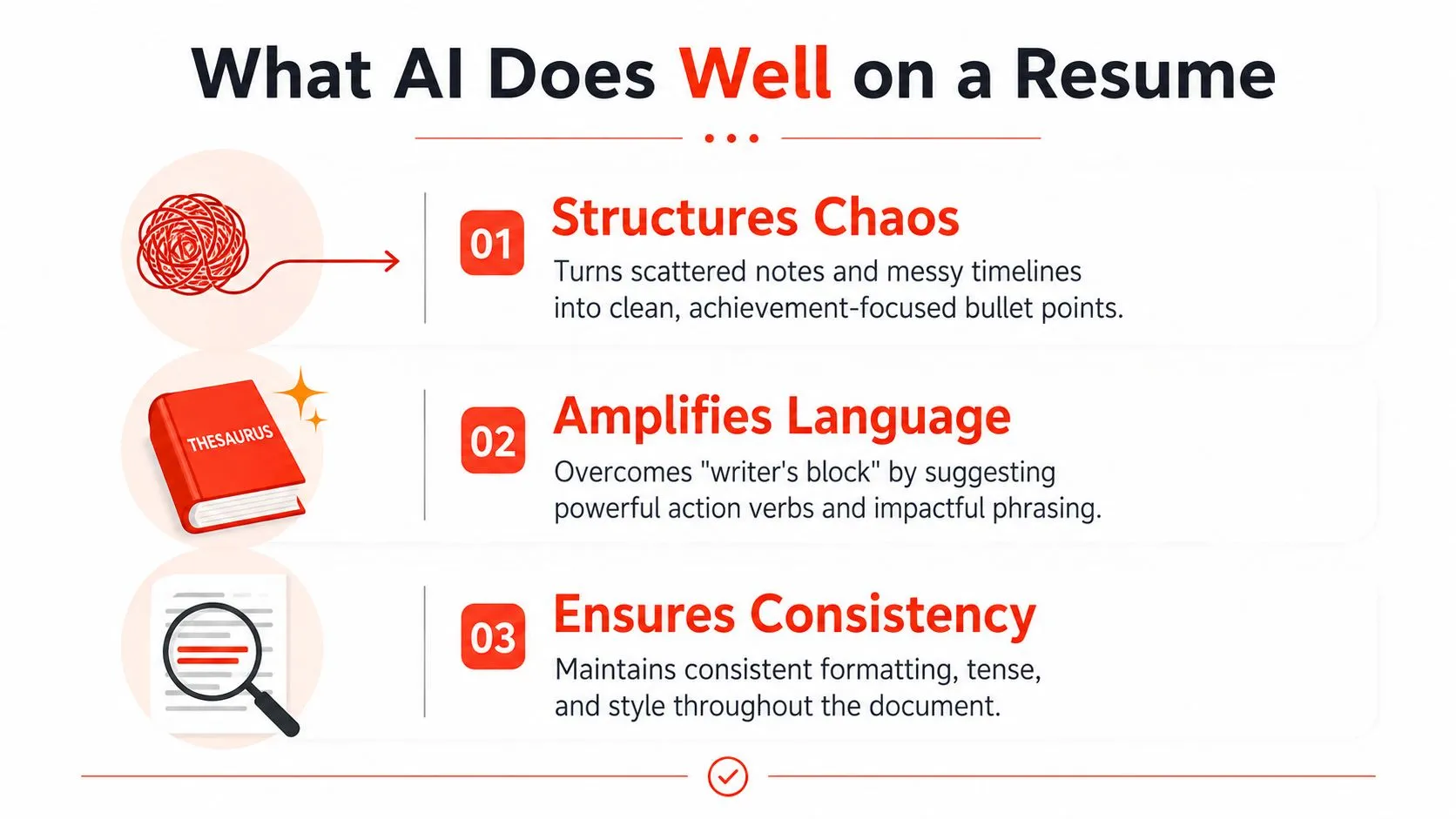
Three useful jobs for a resume assistant
Amplifying language is the second. If your draft says “helped improve reporting,” AI can suggest more precise alternatives such as “redesigned weekly reporting” or “automated recurring reporting,” but only if those verbs match what you did. Strong verbs clarify ownership. They shouldn't inflate it.
The third is consistency. AI can normalize tense, remove first-person pronouns, shorten bloated summaries, and flag inconsistent headings. It can also compare the language in your resume with a job description and identify terms that match your experience. That's useful for ATS readability, where structure and explicit role language matter.
A 2026 ATS benchmarking study reported formatting issues in 62% of submissions, an average job-specific match score of 58 out of 100, and parsing failures affecting nearly one in four resumes. The same study identified two-column layouts as the most common formatting error, appearing in 38% of submissions and associated with a 31% parsing-failure rate. The ATS resume study supports a boring conclusion: use a single column, standard headings, and explicit skills before worrying about visual flair.
AI is valuable here because it reduces mechanical friction. It isn't valuable because it magically knows your career.
Guided Interview Beats Generic Prompts
Generic prompting asks the model to guess. A guided interview asks you to remember. That difference determines whether the final resume sounds like a person or like a competent composite of other resumes.
| Factor | Generic Prompt | Guided Interview with StoryCV | Human Writer |
|---|---|---|---|
| Effort | Low at first, high during corrections | Moderate, focused on answering questions | Moderate to high |
| Cost | Usually low or included in an AI subscription | Accessible software pricing | Higher professional fee |
| Voice preservation | Weak unless you revise heavily | Stronger when answers supply personal language | Strong, with skilled editing |
| ATS fit | Depends on the prompt and formatting | Built into structured drafting | Depends on the writer |
| Truthfulness risk | High when evidence is thin | Lower when generation is limited to supplied facts | Lower, but raw material still matters |
| Turnaround | Fast | Fast | Slower |
A guided workflow makes the candidate surface metrics, decisions, stakeholders, constraints, and outcomes before any bullet gets written. That solves the input problem behind generic drafts. The model has something real to organize.
For example, a guided question might ask why you changed a process, who resisted it, and what happened afterward. Your answer could reveal that you replaced a manual handoff, reduced rework, and gave another team clearer ownership. A generic prompt might reduce the same experience to “optimized cross-functional workflows.”
The trade-off is simple
Human writers still have an edge when the work requires strategic positioning. They can notice a career thread you missed, challenge a weak claim, and decide which achievement should lead the document. They also need accurate raw material from you. A writer can't responsibly invent the missing story either.
For mid-to-senior professionals, guided AI captures much of a writer's drafting value at a fraction of the cost. Generic prompting captures only a small portion because it skips discovery. Those are editorial judgments, not measured performance claims, but the practical difference is obvious when you compare the input each approach receives.
The recommendation is direct. If you have clear evidence and only need cleanup, use a general AI assistant. If you struggle to explain your impact, use a guided interview. If your positioning is delicate, add a human review.
A Practical AI Resume Workflow You Can Run Today
Your resume should begin as an evidence file, not a formatted document. Record every role, project, outcome, stakeholder, difficult decision, and useful piece of feedback you can recall. Rough notes are fine. Incomplete thoughts are useful. AI can organize your story, but it cannot supply a truthful one.
Use a short interview before asking for bullets. Ask yourself what changed, why you acted, who was affected, what resisted the change, and what happened afterward. These questions often reveal the details generic prompts erase, such as replacing a manual handoff, reducing rework, or giving another team clearer ownership.
Then work through four passes:
- Capture facts. List roles, projects, tools, timelines, outcomes, and people affected by your work. Skip polished wording.
- Shape the evidence. Ask AI to turn each verified item into a bullet using action, scope, and outcome. Require a placeholder when evidence lacks a metric. Never allow it to create a number.
- Match the role. Use relevant phrases from the job description only when they accurately describe your experience. Keep the underlying achievements unchanged.
- Check your voice. Read each sentence aloud. Keep wording you would use in an interview, and remove polished language that no longer sounds like you. This guide to using AI for resume writing without losing your voice makes the same point: personal evidence comes first, editing comes last.
A focused prompt is enough: “Rewrite these verified notes into concise resume bullets. Preserve every fact. Do not add metrics, tools, seniority, or responsibilities. Use action, scope, and outcome only where the evidence supports it.”
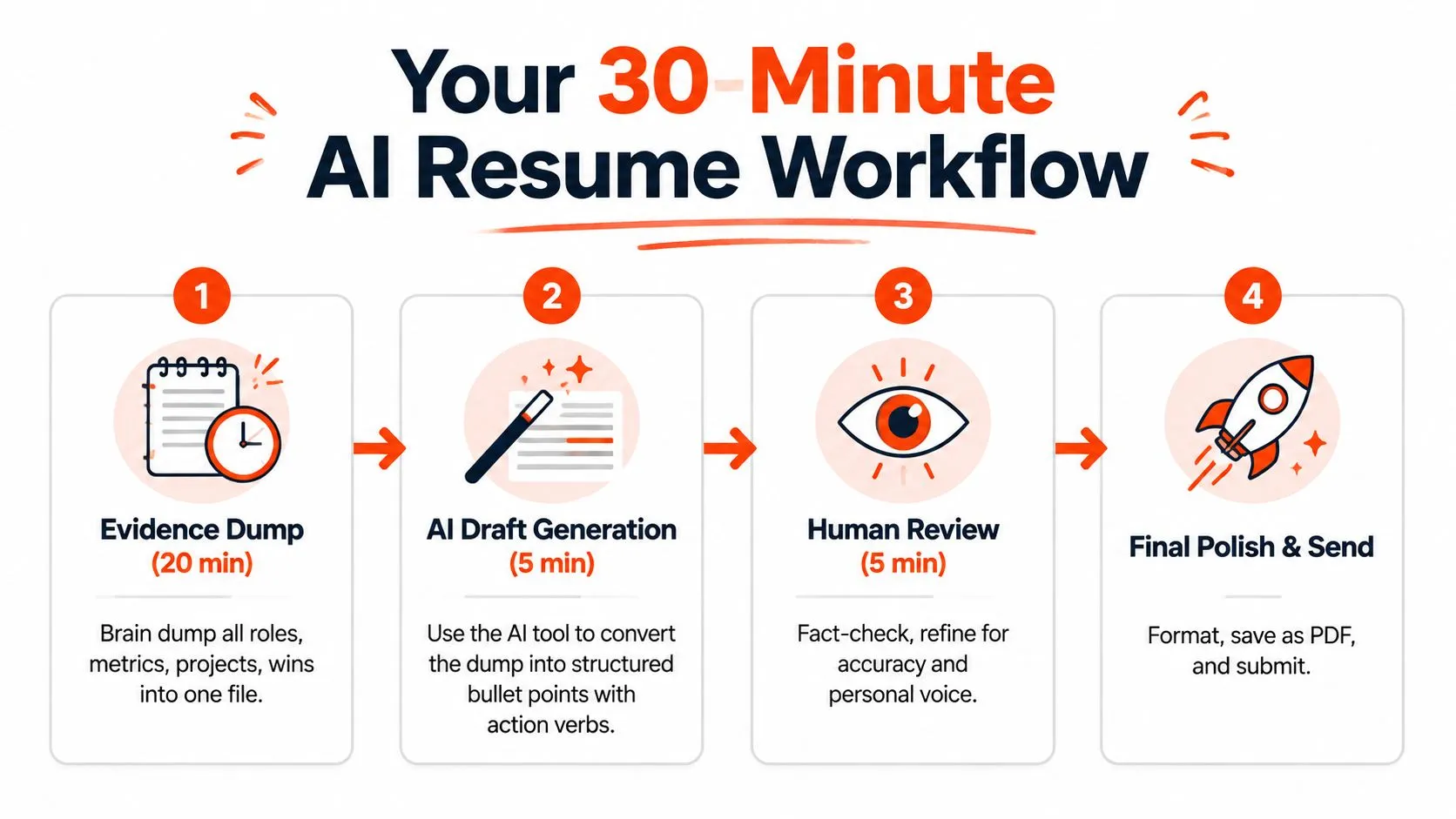
Review the draft with the same care as the source notes. A guide to humanizing job application drafts can help restore specific wording and a personal rhythm when the output sounds generic.
The Hard Limits of AI Resume Help
AI can produce a false statement in perfect grammar. Treat that as a serious risk. A sentence is not safe because it sounds reasonable.
The clearest failure is hallucinated metrics. Give a model “improved performance,” and it may supply a percentage, revenue figure, team size, or timeline that never existed. An interviewer can ask about those details. You will have to explain them.
AI also works from whatever context you provide, including context that is no longer current. It may use an old title, outdated tooling language, or vocabulary that does not fit your field. The result reads smoothly while suggesting that your experience is out of date.
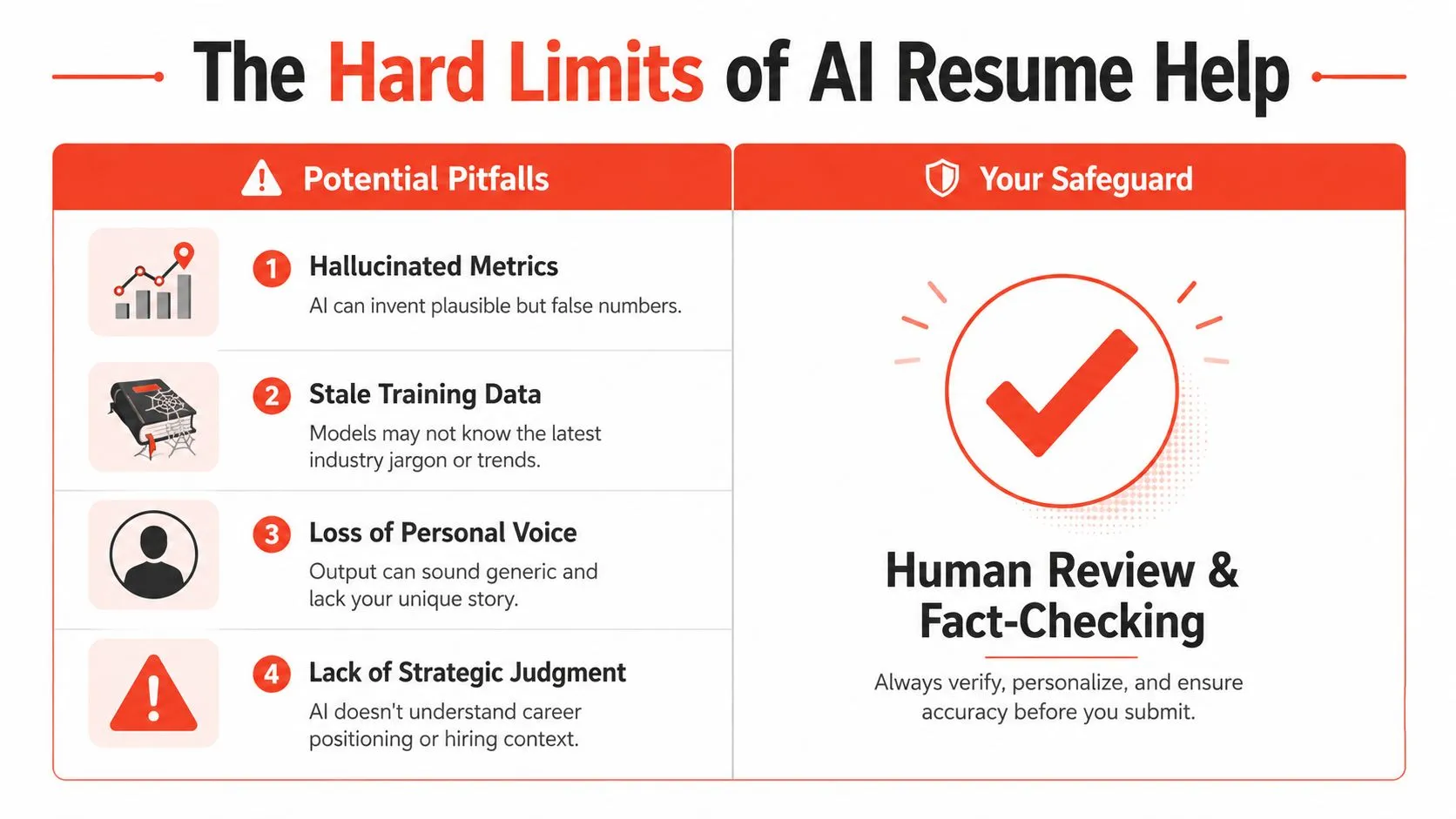
Before you paste anything into a resume tool, control four risks:
- Privacy exposure: Client names, proprietary projects, internal systems, and employment details can disclose sensitive information when entered into third-party services. Remove identifying details unless you understand how the service handles your data.
- Inflated impact: “Helped launch” can become “spearheaded transformation.” The wording is stronger, but the claim is different.
- Loss of voice: Generic phrasing removes the small choices that make your experience believable. A polished resume can still sound empty.
- Missing judgment: AI cannot decide whether a project presents you as a strategic owner, a dependable operator, or someone working below the target role's level.
A truthfulness-constrained approach sets a better standard. A 2026 paper describes a guidance engine that may advise against applying, a generator restricted to rephrasing verified experience, and a narrative generator barred from adding facts absent from the resume. The paper on truthfulness-constrained generative AI offers a useful direction for resume tools: preserve evidence first, then improve structure and wording.
Safety rule: if AI adds a detail you did not provide, mark it as a draft error. Do not treat it as a helpful suggestion.
When You Still Need a Human in the Loop
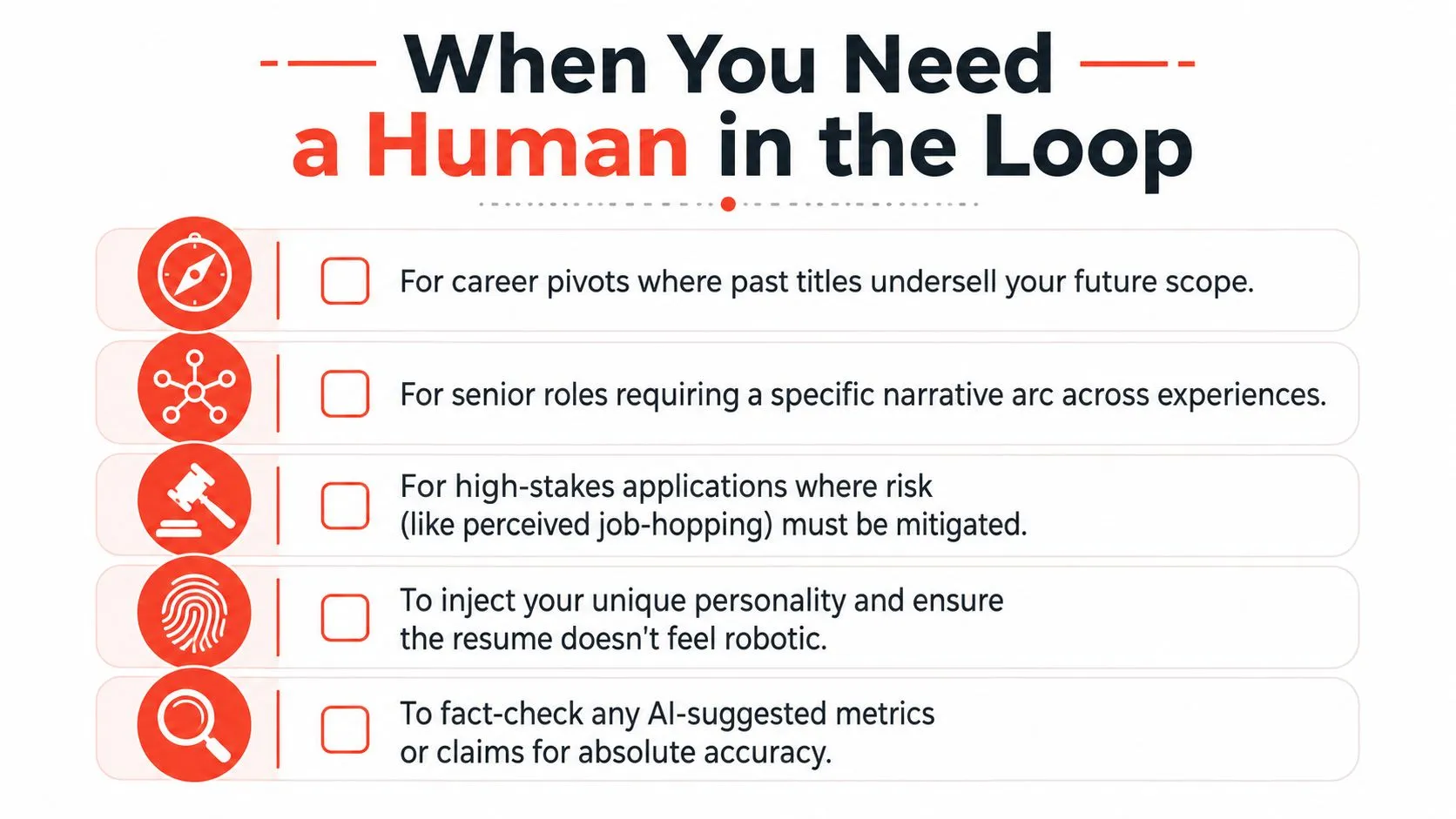
AI can organize evidence and sharpen phrasing. A human decides what the evidence means for the role you want. That judgment matters most when your career story has a turn, a gap, or several competing themes.
Consider a senior pivot. Your past title may sound smaller than the position you are targeting, even though your work shows the needed judgment. AI can clarify the title context and reorder bullets. A human can connect the evidence without making you sound as if you held a job you never did.
Executive resumes have a related problem. Years of work need one clear thread. Strategy, operating judgment, transformation, talent decisions, and commercial outcomes cannot all receive equal emphasis. AI can summarize each role, but a reviewer must choose the leadership theme that should lead.
Ask for human review when:
- Your career is changing direction: A reviewer can translate transferable evidence while keeping the transition honest.
- You are presenting executive experience: Human judgment can shape a through-line instead of leaving disconnected achievement lists.
- You have a layoff or career break: Sensitive context needs deliberate framing. Omitting it may raise questions, while overexplaining can distract from your qualifications.
- Your seniority is unclear: An experienced reviewer can catch language that makes substantial work sound junior or modest work sound inflated.
- The application matters greatly: A second reader can test whether each claim will hold up in behavioral questions.
A human review also makes sense when the resume must persuade someone who does not already understand your field. Industry shorthand, unusual scope, and indirect impact can look vague to a generalist reviewer. AI may smooth those phrases without fixing the underlying interpretation.
Treat the resume as a positioning document, not a formatting task. This comparison of AI resume writers and human writers helps clarify where software can stop and editorial judgment should begin.
Use AI to recover details, structure your story, and produce a draft. Use a human to test the story's direction, credibility, and voice before you submit it.
Pick the Right Level of AI Help for Your Career
The right choice depends less on your comfort with technology than on the complexity of your story. A simple career can tolerate more automation. A complicated one needs better questioning.
Choose your default
Early-career generalists usually need structure first. Use AI to turn projects, internships, coursework, and part-time work into concise bullets. Your minimum workflow is a factual evidence dump, a constrained draft, and a human proofread. Watch for inflated ownership, invented outcomes, and skills you only encountered briefly.
Mid-career professionals targeting a specific role gain more from guided interviews. You've probably forgotten useful details because they became routine. The right workflow draws out decisions, scale, results, and collaboration, then tailors the language to the target role. Your warning sign is a resume full of responsibilities but short on consequences.
Senior leaders and career changers should pair AI drafting with human review. You need narrative positioning, not just keyword alignment. The red flags are a document that lists every role at equal weight, explains no strategic thread, or makes a transition sound like a collection of unrelated tasks.
Resume length should follow experience rather than a rigid ATS superstition. This resume-length guidance recommends one page for professionals with under ten years of experience, two pages for roughly ten to twenty years, and three pages only for senior executives or academics with extensive publications. ATS software parses content. It doesn't impose a universal page limit.
Your interview preparation should use the same evidence. Build each story around Situation, Task, Action, and Result, then practice it aloud using the STAR interview framework. For “tell me about yourself,” give a professional snapshot that explains why you're in front of that interviewer, not an autobiography. This narrative approach to interviewing gets that distinction right.
The rule is simple: if the resume reads like everyone else's, the AI is doing too much. Your document should sound cleaner after editing, not less like you.
StoryCV is an online resume writer that interviews you about your roles, decisions, context, and outcomes, then turns those answers into clear resume drafts. Start with one fully written role for free, and visit StoryCV when you want AI speed without handing your career story over to generic prompts.