
The popular advice is wrong: a sports trainer resume shouldn't read like a standard fitness resume with a longer certification list. A hiring manager needs to see how you assess risk, respond under pressure, support rehabilitation, and make sound return-to-play decisions.
That distinction matters because athletic training sits close to healthcare, while many candidates describe it like general coaching. Your resume must show what you changed, not only what you were responsible for. The same injury assessment experience can sound like emergency care to a team, patient progression to a clinic, or client safety to a gym.
Stop Writing a Generic Fitness Resume
A generic fitness resume focuses on routines. It says you led workouts, demonstrated exercises, motivated athletes, and maintained equipment. Those duties may be true, but they don't explain your judgment.
Managing a gym floor is different from managing athlete health during competition. A sports trainer may assess an acute injury, activate an emergency response, communicate with a physician, document treatment, and help determine whether an athlete can safely return. Those decisions carry more weight than a list of exercises.
The profession is also more specialized than many candidates assume. Athletic trainers held about 35,200 jobs in 2025, and employment is projected to grow 13% from 2025 to 2035, faster than the average for all occupations, according to the U.S. Bureau of Labor Statistics overview of athletic trainers. More opportunity doesn't make a vague resume useful. It makes role-specific credibility more important.
What recruiters need to find
Your opening profile should establish the setting, scope, and type of care you provide. Then your experience should prove it through specific work.
Include evidence of:
- Injury assessment: Acute evaluation, screening, triage, and clinical decision-making.
- Rehabilitation: Recovery protocols, therapeutic modalities, exercise progression, and patient or athlete education.
- Emergency response: Event coverage, first aid, CPR, AED use, and escalation procedures.
- Collaboration: Communication with physicians, coaches, administrators, athletes, and families.
- Documentation: Treatment notes, medical records, compliance, and follow-up.
A sports trainer resume that only says “provided fitness support” forces the recruiter to guess. Don't make them guess. Use the language of the role you want, then attach it to a real decision, action, or outcome from your work.
The Anatomy of a High-Impact Sports Trainer Resume
Lead with experience. A reverse-chronological format puts your most recent and relevant work where recruiters look first. Guidance for athletic trainer resumes also recommends this structure, with a concise summary followed by employment history, skills, and education, as outlined in this athletic trainer resume guide.
Use this order:
- Header: Name, location, phone, email, and relevant credentials.
- Professional summary: Your setting, clinical scope, athlete population, and strongest area of impact.
- Professional experience: Recent roles first, with focused bullets that show decisions and results.
- Skills: Technical and operational skills matched to the target posting.
- Certifications: Current credentials with issuing organizations and status.
- Education: Degree, institution, and relevant coursework when it strengthens your fit.
Don't put a large skills block above your work history just because it looks polished. A list of “sports medicine, rehabilitation, CPR, and exercise physiology” is useful for screening, but it doesn't replace evidence. The recruiter needs to know where you applied those skills and what happened next.
Write the summary like a clinical snapshot
A strong summary might read:
Athletic trainer with experience supporting team-based care, injury assessment, rehabilitation, emergency response, and return-to-play coordination. Partners with coaches, physicians, and administrators to protect athlete health while maintaining accurate treatment documentation.
That works because it defines the professional, not the personality. Avoid empty language such as “passionate fitness expert” unless the role specifically calls for it.
For each position, use focused bullets rather than a diary of daily tasks. Three to five strong bullets per role is a useful standard from the cited resume guidance. Give each bullet a clear subject, action, and consequence.
Use headings such as Professional Experience, Certifications, and Clinical Skills. Avoid playful labels like “Training Toolbox” or “My Fitness Journey.” A serious sports CV should make its structure obvious to both an applicant tracking system and a human reader.
Tailoring Skills for Different Settings
Your experience doesn't change when you move from a team to a clinic. The employer's definition of value does.
Take injury assessment. On a professional team resume, it can demonstrate rapid evaluation, emergency response, communication with coaching staff, and support for return-to-play decisions. In a rehabilitation clinic, the same experience should emphasize treatment planning, patient education, progress documentation, and coordination with medical professionals. In a commercial gym, it may show safe exercise modification, client assessment, referral judgment, and injury prevention.
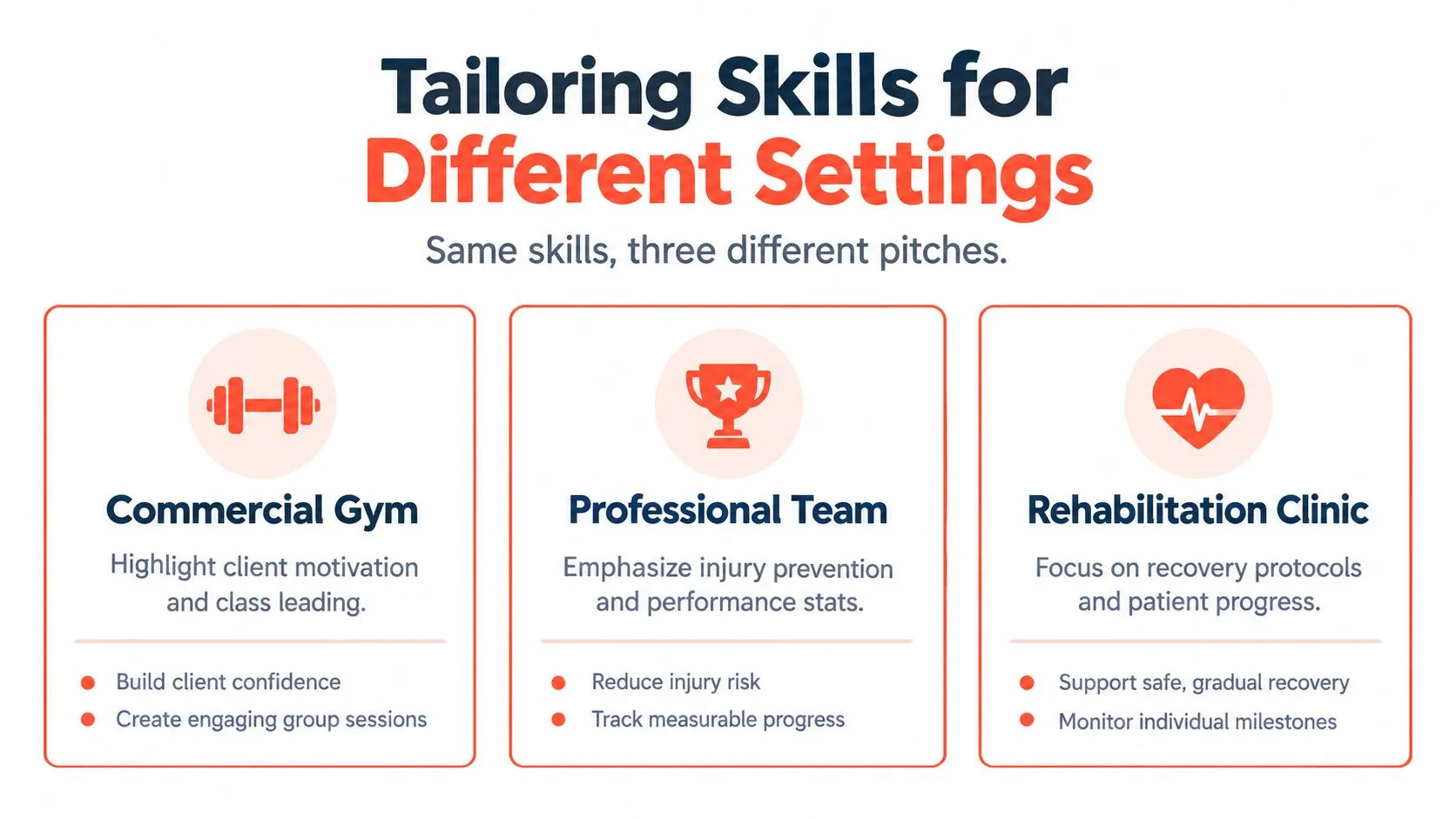
One responsibility, three translations
| Setting | Lead with | Example framing |
|---|---|---|
| Commercial gym | Client safety and program delivery | Assessed movement limitations and modified strength programs to support safe training progression |
| Professional team | Injury prevention and performance support | Evaluated injuries during training and competition, coordinated follow-up care, and supported return-to-play decisions |
| Rehabilitation clinic | Recovery and documentation | Guided rehabilitation exercises, educated patients on recovery protocols, and maintained treatment records |
A sports coach resume should foreground athlete development, practice planning, communication, and performance support. A sports director resume needs broader evidence, including staff coordination, program operations, compliance, scheduling, and stakeholder management. A sports management resume should connect sports knowledge to delivery, administration, client relationships, and commercial responsibilities.
Don't create a different identity for every application. Create a stable evidence base, then change the emphasis. Your athletic resume example might use “event coverage” for a team role, “patient flow and documentation” for a clinic role, and “program delivery” for a performance center.
For a practical framework on matching language to each posting, use this guide to tailoring your resume to a job description.
The following video can help you think about the difference between duties and role-specific value before you edit your experience.
Turning Duties into Measurable Achievements
“Managed injury prevention programs” is a responsibility. It tells the reader what sat on your desk. It doesn't tell them what improved because you did the work.
Start with the basic chain:
Responsibility → context → action → outcome
The outcome may be numerical, but it doesn't have to be invented or forced. Use records you can verify, such as the number of athletes supported, events covered, treatment plans coordinated, staff trained, or cases documented. If you don't have a reliable figure, describe the operational result precisely.
Before and after
Weak
- Assisted with athlete rehabilitation.
- Provided injury assessment.
- Worked with coaches and doctors.
- Maintained medical records.
Stronger
- Guided athletes through progressive rehabilitation exercises and communicated status updates to support coordinated care.
- Assessed acute injuries during training and competition, escalated concerns appropriately, and documented follow-up requirements.
- Partnered with physicians and coaches to align treatment decisions with athlete health and participation needs.
- Maintained accurate treatment records to support continuity of care and compliance.
The stronger bullets don't pretend that every result can be reduced to a percentage. They show what you did, in what setting, and why it mattered.
If you have verified figures, use them naturally. For example, “Covered [verified number] competitive events,” “trained [verified number] staff members in CPR and first aid,” or “supported [verified number] return-to-play cases.” Replace the brackets with your own records before submitting. Never borrow a result from a generic sports resume example and present it as yours.
Make the consequence visible
Weak bullets often hide the important part in a job description. “Coordinated treatment plans” becomes more useful when you explain that coordination improved communication between the trainer, physician, coach, and athlete.
The same principle applies to a sports coach resume example. “Designed conditioning sessions” is less persuasive than “Designed sport-specific conditioning sessions that aligned with training demands and athlete availability.” The second sentence shows judgment, even without a fabricated performance statistic.
Use strong verbs such as assessed, coordinated, documented, rehabilitated, educated, implemented, monitored, and escalated. Remove soft openings like “responsible for” and “helped with.”
For more editing patterns, use this resource on writing achievements in a resume.
Required Credentials and Keywords
Put the credentials that establish qualification where they can be seen quickly. For athletic training roles, recognized signals include ATC, CSCS, and CPR/AED, as noted in this athletic trainer certification guidance.
Use a dedicated section:
Certifications
- ATC, issuing organization, current status
- CSCS, issuing organization, current status
- CPR/AED, issuing organization, current status
- First aid, if relevant to the role
Then reflect the most important credential in the summary when it supports your positioning. Don't scatter acronyms through every bullet. That looks like keyword stuffing and makes the document harder to read.
Build a targeted skills section
Match exact language from the job posting when it accurately describes your experience. Useful clusters include:
- Clinical: Athletic training, injury assessment, sports medicine, rehabilitation, therapeutic modalities.
- Performance: Program design, strength training, exercise physiology, athlete assessment, performance testing.
- Safety: Injury prevention, emergency response, CPR/AED, first aid, exercise modifications.
- Communication: Patient education, treatment coordination, coach collaboration, medical documentation.
- Business and service: Client assessment, nutrition guidance, program delivery, client retention.
These clusters align with commonly cited screening terms for sports and fitness roles, including certification acronyms, program design, strength training, client assessment, nutrition guidance, and CPR/AED, as described in this sports and fitness resume keyword guide.
Keep the design simple. Use standard headings, readable text, consistent dates, and a file format requested by the employer. ATS compatibility comes from clear content and accurate terminology, not decorative graphics.
For a clean way to present credentials without turning the page into an acronym wall, review this guide to putting certifications on a resume.
Cross-Functional and Operational Skills
A trainer who can treat an injury but can't coordinate care, travel, records, or compliance creates work for everyone else. Show that you can operate beyond the gym floor.
Job descriptions commonly include coordination with physicians, coaches, and administrators, along with event coverage, travel, CPR and first-aid instruction, medical record maintenance, and compliance with NCAA and NATA rules and ethics, according to this sports athletic trainer role overview.
Use the target setting to choose the emphasis:
- Club-side roles: Program delivery, member communication, scheduling, retention, and facility coordination.
- Professional teams: Travel logistics, event coverage, physician communication, compliance, and performance support.
- Clinical roles: Patient education, documentation, rehabilitation progression, referrals, and multidisciplinary coordination.
This wider framing reflects where the field is moving. A 2026 NATA workforce study reports that 24% of athletic trainers intend to work in a different setting within five years, with intended interest rising from current levels in clinics, hospitals, and professional sports. The figures appear in NATA's workforce coverage.
Sports-service employers also need people who can coordinate programs, support clients, manage administration, and contribute to delivery. For a broader look at professional communication and operational positioning, Telomyx offers a relevant resource.
Your resume should make the move between settings easy to understand. A team-side trainer can look credible in a clinic, but only if the resume translates event coverage into clinical coordination, emergency response into patient safety, and athlete communication into education and documentation.
You know the work. StoryCV helps you talk through that work and turn the details into resume-ready bullets that show context, action, and impact. Visit StoryCV to write your sports trainer experience in language that fits the role you want next.