Changing careers? Your old resume is a liability.
It’s a history book. A list of duties from a job you don't want anymore. It forces a recruiter to connect the dots. They won’t. They don’t have time.
You need to translate your past into their future. Show them why your non-linear path is a strength. This guide shows you how. No fluff.
Your Resume Is a Bridge, Not a History Book
Recruiters spend seven seconds on your resume. Seven.
They’re not reading your life story. They’re looking for one thing: "Can this person solve my problem right now?" A list of duties from your old industry screams "No." It makes them do the work. They'll just move on.
Your career change resume isn't a record of what you did. It's a strategic argument for what you can do next.
Shift Your Mindset
The biggest mistake is thinking your experience doesn't count. It does. You just need to translate it.
A teacher who managed a classroom of 30 kids wasn't just "teaching." They were a project manager, a stakeholder communicator, and a resource allocator. A retail manager didn't just "run a store." They were a P&L owner, a team builder, and a customer experience expert.
See the shift?
* Stop thinking like an employee listing tasks.
* Start thinking like a consultant showing value.
Traditional vs. Career Change Resume
| Element | Traditional Resume (What you did) | Career Change Resume (What you can do) |
|---|---|---|
| Focus | Past duties and responsibilities. | Future potential and transferable skills. |
| Language | Passive, task-oriented ("Responsible for...") | Active, results-oriented ("Increased sales by...") |
| Goal | Show a linear progression up a ladder. | Build a logical bridge to a new field. |
| Audience | Recruiter understands your industry jargon. | Recruiter needs clear, translated value. |
You're moving from documenting history to building a business case for your hire. It’s a simple, powerful shift.
The Modern Career Isn't Linear
Changing careers is the new normal. The average worker changes jobs about 12 times. Job tenure is at a two-decade low. Pivoting is how smart professionals grow their skills and salary.
A powerful resume opens the door. But it works best when you also build a professional online presence that tells the same story.
This guide shows you exactly how to build that bridge.
Stop Applying and Start Targeting
Sending a generic resume is like shouting into a void. It's lazy and ineffective. It's why you're getting ghosted.
You can't write a compelling resume if you don't know who you're talking to. The "spray and pray" method is dead.
1. Define Your Target Role
Get specific. "I want to work in tech" is a wish, not a target. You need a job title. "Product Manager." "UX Designer." "Customer Success Manager." Pick one. For now.
This single decision provides a lens for your entire history. It dictates what to include, what to cut, and what to highlight.
For professionals over 40, this is critical. It often takes them twice as long to find a new role. Why? Resumes that cling to old job descriptions instead of reframing experience for what's next.
2. Dissect the Job Description
Find 3-5 job descriptions for your target title. From companies you admire. Dissect them. You're looking for patterns.
- Core Skills: What technical skills (SQL, Figma) and soft skills (stakeholder management, cross-functional collaboration) show up every time?
- Keywords: Do they say "manage projects" or "drive initiatives"? Do they talk about "customers" or "users"? Learn their language.
- Outcomes: What problems will this person solve? Look for "increase user engagement," "reduce churn," or "streamline processes."
This isn't keyword stuffing. It's deep listening. You’re learning to speak the hiring manager’s language. For a deeper dive, read our guide on tailoring your resume to the job description.
3. Create Your Skills Map
Now, build the bridge. A skills map connects your past experiences to the job's requirements.
Two columns. On one side, list the top 5-7 requirements from the job descriptions. On the other, write a specific time you demonstrated that skill, even in a different context.
A skills map forces you to find the evidence. It turns vague "transferable skills" into concrete proof.
Example: Teacher to Project Manager
| Project Manager Requirement | Teacher's Translated Experience (Evidence) |
|---|---|
| Stakeholder Management | Coordinated with 30+ parents, 4 fellow teachers, and 2 administrators quarterly to align on student development plans and ensure consistent support. |
| Resource Allocation | Managed a $2,500 annual classroom budget, allocating funds for supplies and technology to maximize educational ROI. |
| Timeline & Milestone Tracking | Executed a 9-month curriculum, tracking student progress against weekly milestones to ensure 95% of students met year-end goals. |
| Cross-Functional Communication | Led weekly team meetings with grade-level teachers to standardize curriculum delivery, improving departmental efficiency by 15%. |
See? It’s not a stretch. It’s a translation. This prep work is what gets you a response.
Translate Your Experience—Don't Just List It
Now you have a target. Time for the real work.
Your old experience is valuable, but it's speaking a foreign language. Your job is to translate it. Listing old duties is lazy. Translating achievements is strategic.
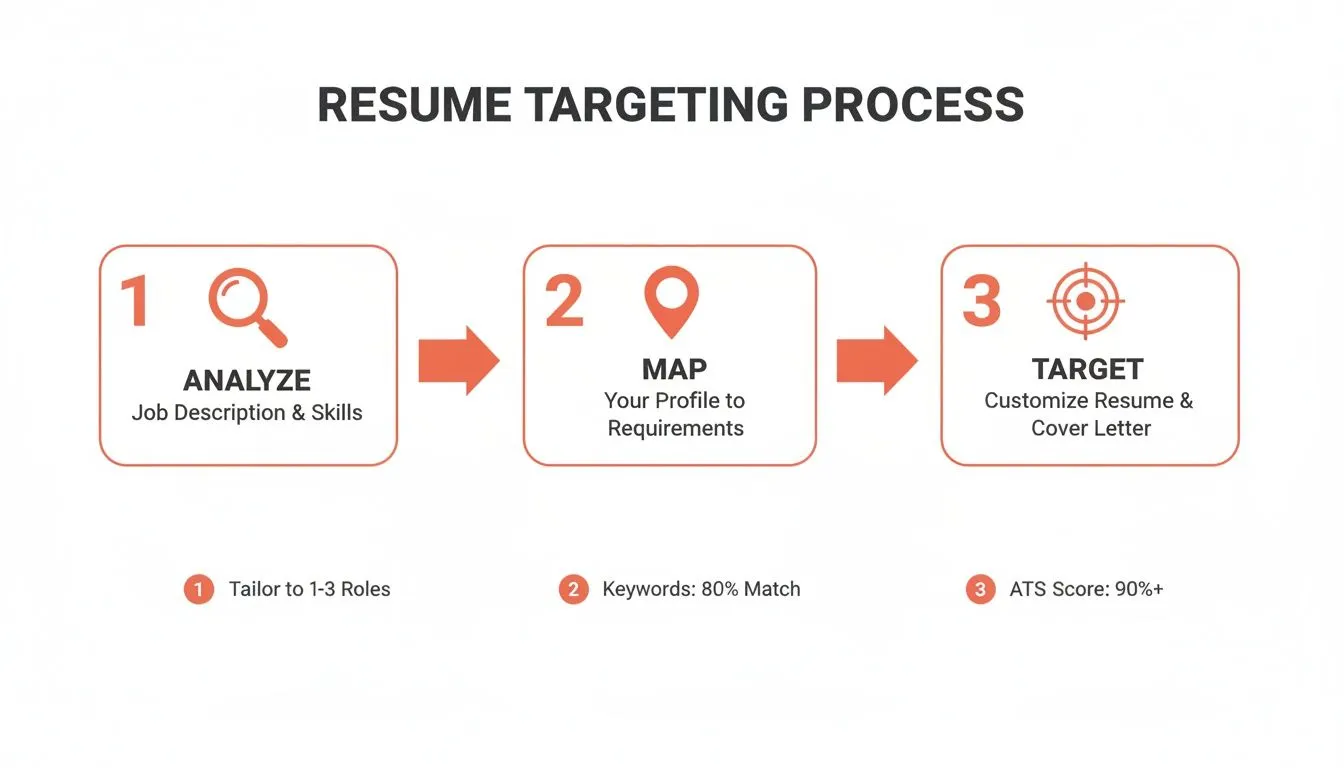
This analyze-map-target flow turns your resume from a backward-looking document into a forward-looking argument.
Your Professional Summary Is Your Pitch
The "Objective" section is dead. It was about what you wanted. A Professional Summary is the opposite. It’s a 2-3 sentence pitch telling the employer what they get.
This is the most valuable real estate on the page. It's your first and best chance to frame your story. Don't start with your old title. Start with the one you want.
- Weak: "Experienced Marketing Manager with 8 years in campaign management, seeking an opportunity in product management."
- Strong: "Product Manager with 8 years of experience leading cross-functional teams to launch user-centric initiatives. Proven ability to translate customer feedback into actionable roadmaps, driving a 15% increase in user engagement."
The first is a historical fact. The second is a confident claim to a new identity, backed by a quantified result.
Spotlight Transferable Skills
Below your summary, add a Skills section. This isn't a junk drawer for every tool you've ever used. It's a spotlight on the top 3-5 transferable skills you found in the job descriptions.
Don't just list them. Add a bullet point of proof for each.
A marketer pivoting to product management could write:
* Product Roadmapping: Translated user survey data from 5,000+ customers into a 6-month content roadmap, leading to a 20% uplift in trial conversions.
* Stakeholder Communication: Presented quarterly business reviews to C-level executives and aligned marketing, sales, and engineering on campaign goals.
* Data Analysis: Used Google Analytics and SQL to analyze campaign performance, identifying a key drop-off point that boosted lead capture by 10% when fixed.
You’re not just claiming skills; you're proving them with results.
Reframe Your Job Experience
This is where the magic happens. Every bullet point must focus on impact, not activity.
First, consider reframing your job title. Don't lie. Add context. A "Lead Teacher" who created new lesson plans could become "Lead Teacher (Curriculum & Training Lead)." It's honest and helps connect the dots.
Next, rewrite every bullet point using this formula:
Action Verb + Quantifiable Result + Context = Impact
Forget "responsible for." Show what you achieved. Every bullet should tell a mini-story of value creation. Mastering how to write achievements in your resume is a non-negotiable skill.
Before and After Bullet Points
Here's how to translate a generic duty into a compelling achievement.
| Original Role & Bullet (Before) | Target Role & Translated Bullet (After) |
|---|---|
| Role: Retail Store Manager Bullet: Responsible for managing daily store operations and staff scheduling. Target: Operations Manager |
Translated Bullet: Streamlined store operations by implementing a new inventory management system, reducing stock discrepancies by 30% and saving 15 staff hours per week. |
| Role: Journalist Bullet: Wrote articles on technology trends for a daily newspaper. Target: Content Marketer |
Translated Bullet: Authored 50+ data-driven articles on technology trends, generating an average of 20,000 monthly page views and increasing organic search traffic by 40% YoY. |
| Role: Executive Assistant Bullet: Managed travel and calendars for three senior executives. Target: Project Coordinator |
Translated Bullet: Coordinated complex international travel for 3 C-suite executives, ensuring 100% on-time project kick-offs across 4 global time zones. |
Each "after" example uses a strong action verb, a specific number, and connects the achievement to the target role's needs. This is how you show the value you'll create for them.
Your Two Audiences: The Robot and The Human
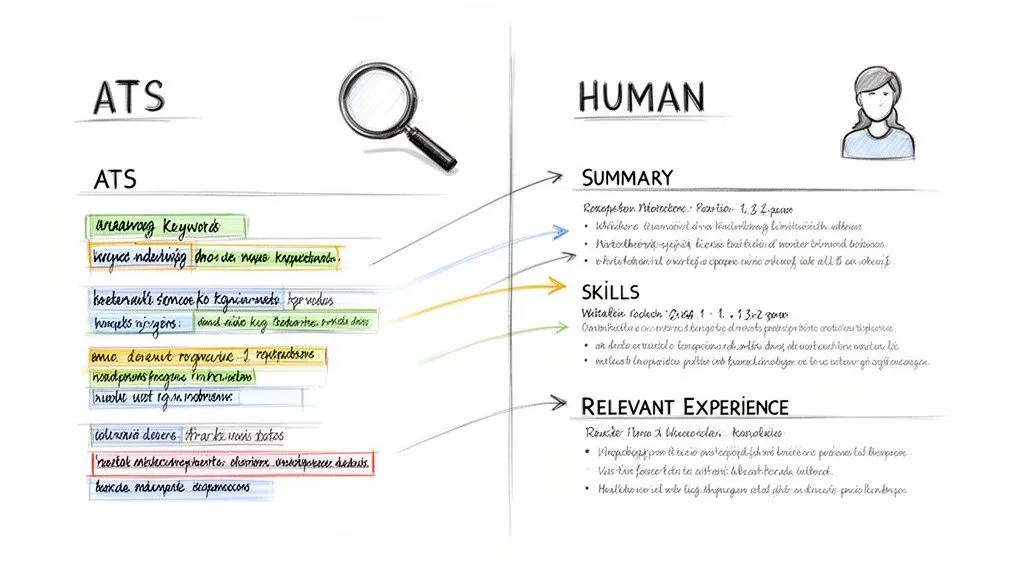
Before a person sees your resume, it must pass the Applicant Tracking System (ATS). Then it has to impress a human in six seconds.
Most people fail here. They either keyword-stuff for the robot, creating an unreadable mess, or they ignore the ATS and get rejected instantly.
The secret isn't a flashy template. Templates are soul-crushing. Fancy columns, graphics, and weird fonts break the ATS and annoy recruiters. Simple wins.
Adopt the Hybrid Resume Format
Forget the chronological resume. It leads with your least relevant experience. Functional resumes are even worse—recruiters see them as a red flag.
The answer is the hybrid format. It’s the best of both.
It opens with your skills and qualifications, then follows with a streamlined work history. It puts your transferable skills front and center.
For a career changer, the hybrid format is a strategic necessity. It lets you control the narrative from line one.
The Unbeatable Resume Structure
This simple outline is ATS-friendly and scannable.
1. Professional Summary: Your 2-3 sentence pitch. Claim your new identity.
2. Skills Section: A targeted list of skills, each with a quantified proof point.
3. Relevant Experience: Your detailed work history for roles that support your pivot.
4. Additional Experience: Group older or less relevant roles here. Just job title, company, dates. No bullets.
5. Education & Certifications: Degree, university, and relevant certifications.
This flow is intentional. It guides the reader from your future pitch to your proven abilities. It’s a story, not just a list. To see this in practice, check out these best product manager resume template options.
Keep It Simple and Beat the Bots
83% of companies will use AI for resume screening by 2026. Non-linear paths often get auto-rejected. A clean, simple format is your best defense.
- Standard Fonts: Use Calibri, Arial, or Georgia.
- No Columns or Tables: ATS bots read left to right. Columns scramble your resume.
- Natural Keywords: Weave language from the job description into your summary and bullets. If they say "stakeholder management," use that phrase.
- Standard Headings: Use "Professional Experience" and "Skills." Don't get cute with "My Career Journey."
Your goal is a document so clean that a robot and a hurried human can both understand it instantly.
Your Cover Note Is Your Secret Weapon
Anyone who says cover letters are dead is wrong. Or they've never changed careers.
For a career changer, the resume tells the what. The cover note explains the why. It’s your chance to connect the dots. Ignoring it is a huge mistake.
This isn't an essay. It’s a short, sharp, three-paragraph email that addresses the elephant in the room: your career pivot.
A great cover note disarms skepticism. It shows self-awareness, turning your non-traditional background from a red flag into a strength.
The Three-Paragraph Strike
Forget formal cover letters. Your goal is a brief, confident message. More like a sharp email to a peer.
- Paragraph 1: The Hook. State the role and why you’re excited about this company. Be specific. Mention a product or mission statement.
- Paragraph 2: The Bridge. Acknowledge your career change. Explain why you're pivoting. Then, connect one or two key achievements from your past to the new role's core needs.
- Paragraph 3: The Close. State the value you will bring. Reiterate your enthusiasm and end with a clear call to action.
This structure anticipates the recruiter's primary question ("Why is this person applying?") and answers it immediately.
Make It Human
The tone is everything. Be professional, not robotic. Write like you talk.
Strong Opening Lines:
* "I've been following [Company Name]'s work on [Specific Project], and I was thrilled to see the opening for a Product Manager."
* "As a long-time user of [Product Name], the UX Designer role on your team feels like a perfect fit for my skills."
The "Bridge" in Action (Paragraph 2):
An event manager applying for a project manager role:
"My transition from event management to project management is driven by a passion for bringing complex projects to life. For example, I recently managed a $150K conference budget, coordinated 30+ vendors, and delivered the event 10% under budget—skills I’m confident will translate directly to your client onboarding process."
Confident Closing Lines:
* "I am confident my experience in [Your Skill] can help your team achieve [Their Goal]. I'm eager to discuss how I can contribute."
* "Thank you for your time. I look forward to discussing this opportunity with you."
Show them your career change is a deliberate, strategic move. For more guidance, see this sample cover letter for a job application. Don't skip the cover note.
A Few Lingering Questions
Pivoting is a big deal. Small details feel huge. Let's clear them up.
What about "irrelevant" jobs?
Include them, but be strategic. An unexplained gap is a red flag.
Create two sections: "Relevant Experience" at the top, and "Additional Experience" below. For older or less relevant jobs, just list the company, title, and dates. No bullets. This keeps your work history honest while focusing the recruiter on what matters now.
How far back should my resume go?
10-15 years. What you did recently carries more weight. The goal is relevance, not an autobiography.
If you have a game-changing achievement from 20 years ago that perfectly aligns with your target role, make an exception. But the bulk of your resume should be recent impact.
Your resume is a marketing document, not a legal record. It sells your future potential.
Can I change my job title?
Reframe it, don't fake it. Inventing a title is a lie.
What you can do is add context. If your title was "Store Manager" but you trained people across five locations, you could list it as "Store Manager (Regional Training Lead)". This is clarification, not dishonesty. It helps translate your value for recruiters and the ATS.
Do I need an objective section?
No. Objectives are dead. They’re about what you want.
Use a "Professional Summary" instead. It's your 2-3 sentence pitch at the top. It's forward-looking and declares the value you're ready to bring to their team. It frames your entire story from the first second.
Stuck translating your experience? StoryCV is a Digital Resume Writer that interviews you to uncover your real impact. We help you build a compelling narrative, not just a list of tasks. Start your next chapter for free at https://story.cv.