Most marketing director CV advice trains you to look busier, not more senior. It pushes you to add metrics, stack up channels, and turn a marketing manager resume into a longer document. Hiring teams at director level do not reward volume. They reward judgment.
A strong marketing director CV shows that you can allocate budget, set priorities, lead other marketers, and connect marketing decisions to revenue, growth, and margin. If your evidence still centers on campaign execution, platform ownership, and channel delivery, you are arguing for the wrong job.
That mistake is common.
Candidates who are ready for director roles often undersell themselves by writing like senior specialists. They describe what they launched, managed, and delivered. They skip the harder proof. What they decided, what they stopped, where they shifted spend, how they built teams, and how their choices changed business performance. If you need to show title progression cleanly, use this guide on how to show a promotion on a resume.
Your CV needs to read like the record of someone trusted to make commercial calls, not just execute marketing plans.
Your Marketing Director CV Is Not a Promotion
A marketing director CV is not a celebration of your last title change. It's an argument that you can be trusted with a meaningful part of the business.
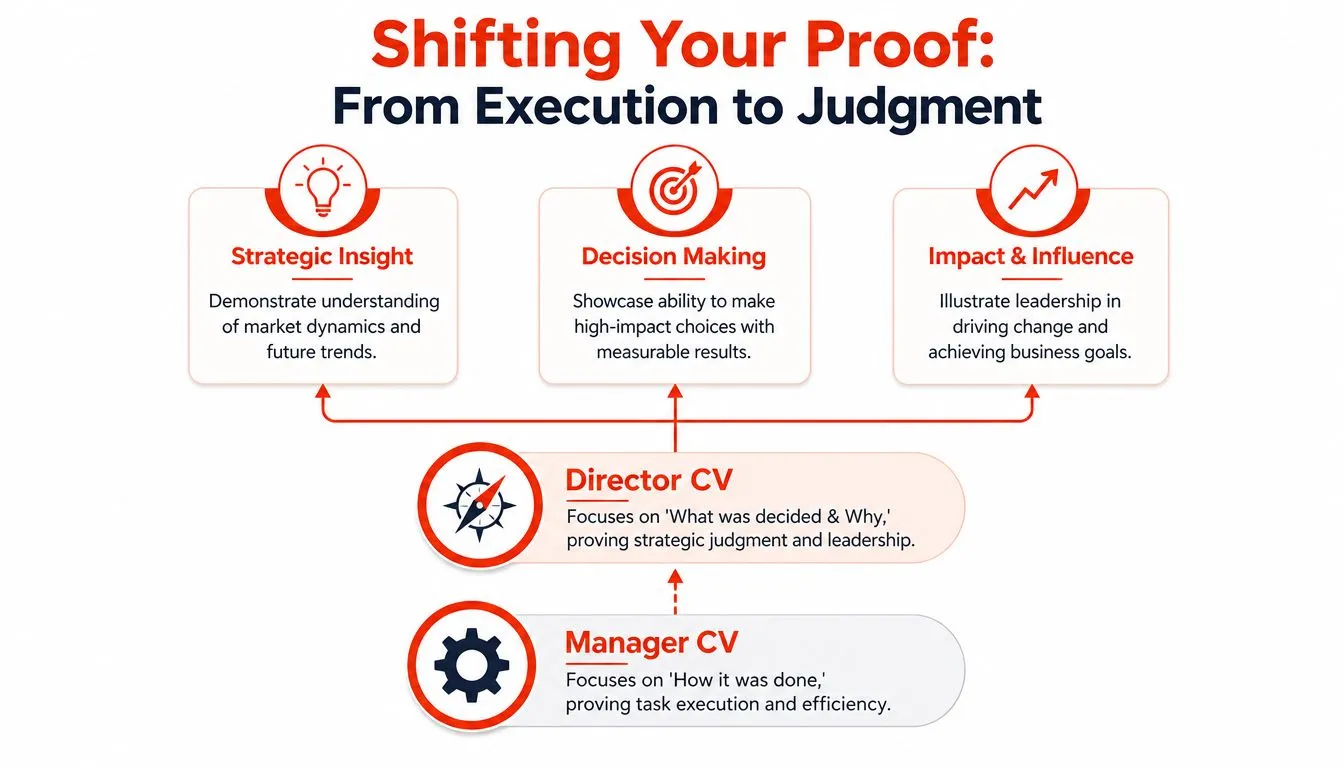
That means the document has to change when the job changes. A manager CV proves you can deliver. A director CV proves you can decide. Those aren't the same thing.
Hiring committees don't scan director applications looking for someone who did more email, more paid social, or more content over more years. They look for signs that you chose where resources went, what not to do, and how marketing served the wider business. If your bullets are still channel-first, you're telling them you think the role is still about execution.
“It looks experienced” is not the same as “this person can lead.”
A lot of candidates confuse scale with seniority. More bullets. More tools. More platforms. More campaigns. None of that proves judgment. It just proves activity.
What actually changes
The shift is simple, but not easy:
- From output to ownership. Stop listing what you produced. Show what you owned.
- From channels to choices. “Ran SEO” matters less than “moved investment toward organic because paid efficiency was weakening.”
- From personal effort to team outcome. Director hiring is about whether your leadership changed results across people, process, and spend.
If you need to show a title progression cleanly, use this guide on how to show a promotion on a resume. But don't confuse displaying a promotion with proving director-level capability. The first is formatting. The second is evidence.
The mistake that kills most applications
The most common failure in a marketing director resume is padding out the same kind of tactical bullets used at manager level, just under a more senior title.
That signals more time in seat, not more strategic weight. And that's exactly what a hiring panel notices.
Shift Your Proof from Execution to Judgment
A manager runs the play. A director chooses the playbook.
That's the cleanest way to think about your marketing director CV. The evidence has to move up a level. Not “I launched.” More “I decided, because, and here's what changed.”
The three kinds of proof that matter
At director level, three things carry weight.
-
Budget judgment
Don't say you managed a budget. Say how you allocated it. Show the trade-off. What got more investment, what got cut back, and why. -
Team design
“Led a team” is weak. Explain how you structured the team around the business need. Did you shift roles toward lifecycle, product marketing, field marketing, or content operations? Show the logic. -
Strategic prioritization
This is the heart of director-level writing. What did you choose to prioritize across brand, demand, product, sales alignment, market expansion, or retention? That's what signals leadership.
Quantify without faking certainty
A lot of marketing work at director level sits in shared attribution. Revenue may involve sales, product, finance, and customer success. That doesn't mean you should duck metrics. It means you should stop pretending you personally caused everything.
ResumeBuilder's guidance on marketing director resumes gets this right. Existing advice often misses how to quantify strategic influence when direct revenue attribution is ambiguous. The better approach is to use the PAR framework and lean on proxy metrics when they're more credible, such as improved lead-to-close velocity by 30 days, instead of forcing a revenue claim you can't defend.
Practical rule: weak attribution makes strong candidates look careless.
That same principle matters when you talk about modern leadership. If a job spec asks for AI strategy, don't list tools like you're applying for a specialist role. Explain the operating decision. Did you introduce AI-assisted content workflows, tighter forecasting habits, or better reporting discipline? For a sense of what companies now probe in specialist hiring, WorkSignal's roundup of top questions for hiring SEO specialists is useful. The subtext matters. Employers aren't only asking what tools people know. They're asking how they think.
What credible director evidence sounds like
Here's the difference in tone:
- Weak: Managed paid and organic marketing channels across multiple campaigns.
- Better: Rebalanced acquisition investment across paid and organic channels after efficiency declined, aligning spend with the company's commercial priorities.
- Best: Reframed channel mix around pipeline quality and sales capacity, shifting budget and team focus to the programs most likely to support the company's next stage of growth.
Notice what changed. The point isn't more words. It's better evidence.
Rewrite Bullets from Tasks to Decisions
Most bullets fail because they start too low. They begin with the task instead of the decision.
That's fixable. And the fix is mechanical. The work experience section should use the PAR formula with up to 6 bullet points per role, and resumes without specific metrics see a 70% lower success rate in ATS screening, according to Zety's marketing director resume guidance.
Use this formula
Write each bullet in this order:
Decision + business rationale + result
Not every bullet needs a number. But every bullet should reveal a judgment call.
If the bullet could appear on a specialist CV with almost no edits, it probably belongs below director level.
Manager vs Director Bullet Points
| Manager-Level Bullet (Focus on Action) | Director-Level Reframe (Focus on Judgment) |
|---|---|
| Launched SEO content campaigns and worked with writers to improve rankings. | Shifted content investment toward high-intent organic topics to support a more sustainable acquisition mix, aligning editorial effort with commercial search demand. |
| Managed paid media campaigns across search and social. | Reallocated spend across paid channels based on efficiency trends and business priorities, improving budget discipline and clarifying where paid should support pipeline versus awareness. |
| Worked with sales to improve lead quality. | Reset marketing and sales handoff criteria to prioritize conversion quality over raw volume, improving trust in pipeline reporting. |
| Led the email calendar and campaign execution. | Reframed lifecycle marketing around stage-specific buyer needs, using nurture strategy to improve progression instead of maximizing send volume. |
| Managed the team delivering campaign assets. | Structured team effort around strategic priorities, separating urgent campaign delivery from longer-horizon growth initiatives so execution didn't crowd out planning. |
The underlying work is similar. The framing is not.
A worked example
Here's a clean before-and-after.
Manager-level bullet
- Built and launched a multi-channel product campaign across email, paid social, webinars, and landing pages.
Director-level reframe
- Prioritized launch investment across channels based on buyer intent and sales readiness, concentrating resources on the programs most likely to support adoption and cross-functional execution.
The second version does three things the first one doesn't.
- It shows a choice
- It gives a reason
- It implies commercial judgment
That's the standard.
If you want help tightening language at the sentence level, this guide on how to write resume bullet points is worth reading. But the true upgrade isn't wordsmithing. It's changing what the bullet proves.
Structure the CV to Tell a Leadership Story
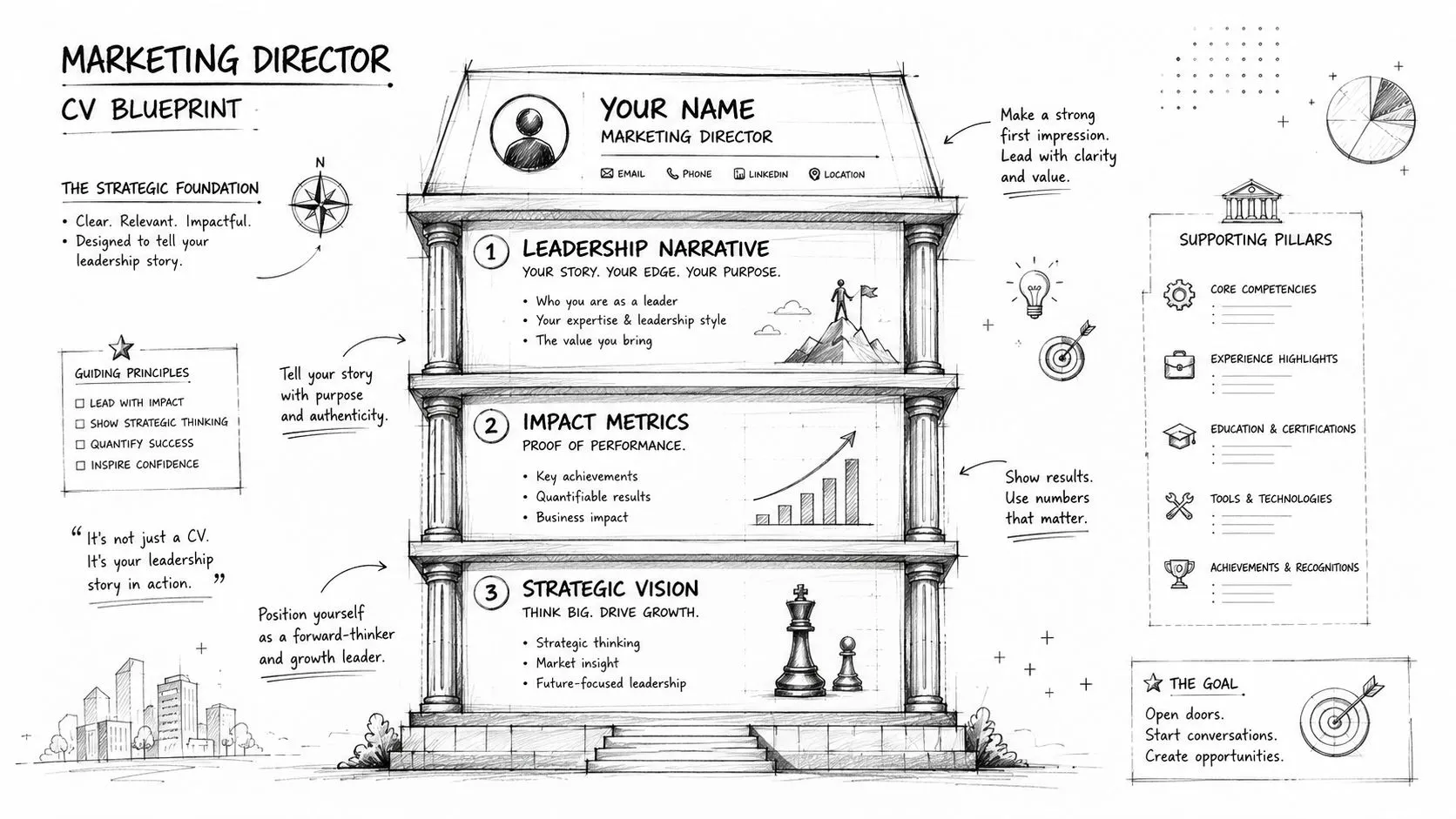
A good marketing director CV reads like an executive brief. Fast to scan. Hard to misunderstand. Built around leadership, not inventory.
That starts at the top. A marketing director resume should include a Professional Summary first, followed immediately by Core Competencies, as noted in Enhancv's marketing director resume example. That order matters because senior hiring is top-loaded. People decide quickly whether the rest is worth reading.
Write the summary like a brief, not a bio
Your summary should answer three questions right away:
- What kind of marketing leader are you
- What business problems do you tend to solve
- What scope are you ready for now
Skip adjectives like “dynamic,” “results-driven,” and “original.” They're filler. Use real operating language instead.
Example:
Marketing leader focused on growth, go-to-market alignment, and commercial clarity across brand, demand, and product marketing. Strongest in roles where marketing has to support business transition, sharper prioritization, and better use of budget across teams.
That says more than a pile of clichés.
Build a competencies section that sounds senior
Don't write “marketing expert.” Don't write “excellent communication.” Don't write generic lists that could belong to anyone.
Use competencies that reveal director-level scope, such as:
- Go-to-market strategy
- Budget allocation
- Team design
- Pipeline planning
- Positioning and messaging
- Marketing operations
- Cross-functional leadership
- Data analysis
- Strategic planning
If you include tools like Google Analytics, HubSpot, CRM systems, SEO/SEM platforms, or marketing automation software, place them in context. Senior candidates still need technical credibility. They just shouldn't let the tools lead the story.
Keep the document tight
Senior marketers can use up to two pages, while recruiters spend only 5 to 6 seconds on average reviewing each resume, according to Resume.io's marketing director examples. That's why structure matters more than volume.
Use a single-column format, reverse chronology, and readable type. Save the visual cleverness for your portfolio, if you have one.
For examples of resumes that feel like a coherent story rather than a keyword dump, look at these narrative resume examples.
An Annotated Marketing Director CV Sample
Here is the mistake that sinks a lot of first-time director applications. The CV reads like a strong Marketing Manager CV with a better title. Hiring teams notice it immediately.
A useful sample shows the difference faster than another checklist. Read this one as a model of scope, judgment, and leadership proof. Do not copy the wording. Copy the standard.
Sample marketing director CV
Alex Morgan
Marketing Leader
City, Country | email@address.com | portfolio link
Professional Summary
Marketing leader with experience across demand generation, content, product marketing, and cross-functional planning. Strongest when the role requires prioritization, sales alignment, and clearer use of team and budget resources. Stepping into director scope through repeated ownership of strategy, trade-offs, and operating cadence.
Core Competencies
Go-to-market strategy • Budget allocation • Team leadership • Positioning • Demand generation • Lifecycle marketing • Marketing operations • CRM and automation • Analytics • Cross-functional collaboration
Experience
Senior Marketing Manager
Company Name | Dates
-
Reprioritized marketing activity around the company's highest-value commercial goals, shifting team focus away from low-value requests and toward the programs with the clearest business case.
-
Worked across sales, product, and leadership to tighten the definition of qualified pipeline and align campaign planning to actual sales capacity.
Annotation: Strong director-level bullets often sit between functions because that is where business trade-offs get made. -
Introduced a more disciplined planning cadence for launches and always-on programs, improving clarity on ownership, timing, and decision rights.
Annotation: Operational leadership matters because directors turn strategy into a working system. -
Used reporting from Google Analytics, HubSpot, and CRM workflows to identify where buyer progression slowed, then redirected attention toward the stages creating friction.
Annotation: Tools support the point. Judgment is the point. -
Supported executive planning with clearer performance narratives and proxy metrics where attribution was shared across teams.
Annotation: Senior marketers need to explain messy performance transparently, without hiding behind weak reporting or inflating impact. -
Framed marketing performance in commercial terms instead of activity terms.
Annotation: Add a real metric in your own CV if you have one. Revenue influence, budget efficiency, retention impact, or pipeline quality all work better than channel outputs.
Marketing Manager
Company Name | Dates
- Built and executed multi-channel campaigns across email, content, webinars, and paid distribution.
- Partnered with sales on campaign follow-up and messaging feedback.
- Managed agency coordination, campaign calendars, and reporting.
- Improved landing page, nurture, and campaign consistency across launches.
Education
Degree Name, University Name
Certifications
Relevant certification | Relevant certification
Notice where the weight sits. The senior role gets more space, and the bullets show choices, alignment, prioritization, and operating control. The earlier role is shorter because it proves foundation, not leadership readiness.
That is how you signal progression. You are not trying to show that you have done more marketing work over time. You are proving that the level of decision-making changed.
Hard proof strengthens a senior CV when it is real and specific. Use metrics tied to commercial outcomes, budget ownership, team leadership, or business milestones. If you cannot prove a number cleanly, do not force one. A precise description of a decision and its business effect is stronger than a vague percentage no one believes.
A short video can help if you want another take on executive-level resume thinking.
If you do not have the director title yet, write the scope you already own. Titles lag behind reality all the time. Hiring managers care more about budget responsibility, cross-functional influence, and team leadership than whether your company updated the org chart.
A director-level CV needs to answer one question clearly. Can this person make sound marketing decisions for the business, not just deliver more campaigns?
StoryCV is an Online Resume Writer built for people whose work is stronger than their wording. It uses editorial judgment at software speed to turn real experience into a clear, credible narrative, without forcing you into lifeless templates. If your marketing director CV still sounds like task history, StoryCV helps you rewrite it as evidence of judgment, ownership, and leadership.