Most executive assistant cover letters fail before the second sentence. Letters that don't front-load a quantified outcome face a more than 90% rejection rate in the initial 5-second scan, according to MyPerfectResume's executive assistant cover letter guidance. That sounds harsh. It's also believable if you've ever hired for this role.
An executive doesn't need another polite note. They need evidence that you can think clearly, protect their time, handle sensitive information, and write without supervision. A good cover letter for executive assistant roles does that immediately. A bad one sounds nice and says nothing.
Your Cover Letter Is the First Interview Question
Stop treating the cover letter like an introduction. For an executive assistant, it's a work sample.
When I read one, I'm not asking, “Are you interested in the role?” Of course you are. I'm asking, “Can you operate at executive altitude without hand-holding?” That's why weak openings get ignored. “I'm excited to apply” tells me nothing. “I supported a founder through rapid scheduling changes, board prep, and confidential communications” tells me more. If you can add a real metric, even better.
The first line should answer one question: What have you already done that proves you belong here?
What hiring teams are really scanning for
An executive assistant isn't judged on warmth alone. The letter has to signal three things fast:
- Judgment means you know what matters, what can wait, and what needs escalation.
- Discretion means people can trust you with calendars, conversations, documents, and messy internal dynamics.
- Polish means your writing is clean, calm, and precise.
A cover letter for executive assistant roles isn't a courtesy. It's a test of how you think on paper.
If your first paragraph reads like a generic intro, you've already missed the point. Don't open with your desire. Open with your proof.
The fastest way to sound junior
Here's the language that drags strong candidates down:
| Weak opening | Why it fails |
|---|---|
| “I am writing to apply for the Executive Assistant role.” | Pure formality. No value. |
| “I'm highly organized and detail-oriented.” | Every applicant says this. |
| “I have excellent communication skills.” | Unproven claim. |
| “I'd love the opportunity to support your team.” | Focused on your interest, not their need. |
A better opening is specific, relevant, and calm. Not dramatic. Not inflated. Just useful.
For example:
“In my last role, I coordinated high-stakes executive scheduling, drafted client-facing communications, and protected leadership time by catching conflicts before they reached the calendar.”
That works because it sounds like someone who understands the actual job.
Use This Three-Paragraph Structure
Templates make people sound interchangeable. Use a simple structure instead. Three paragraphs is enough for most executive assistant applications, and it forces you to keep only what matters.
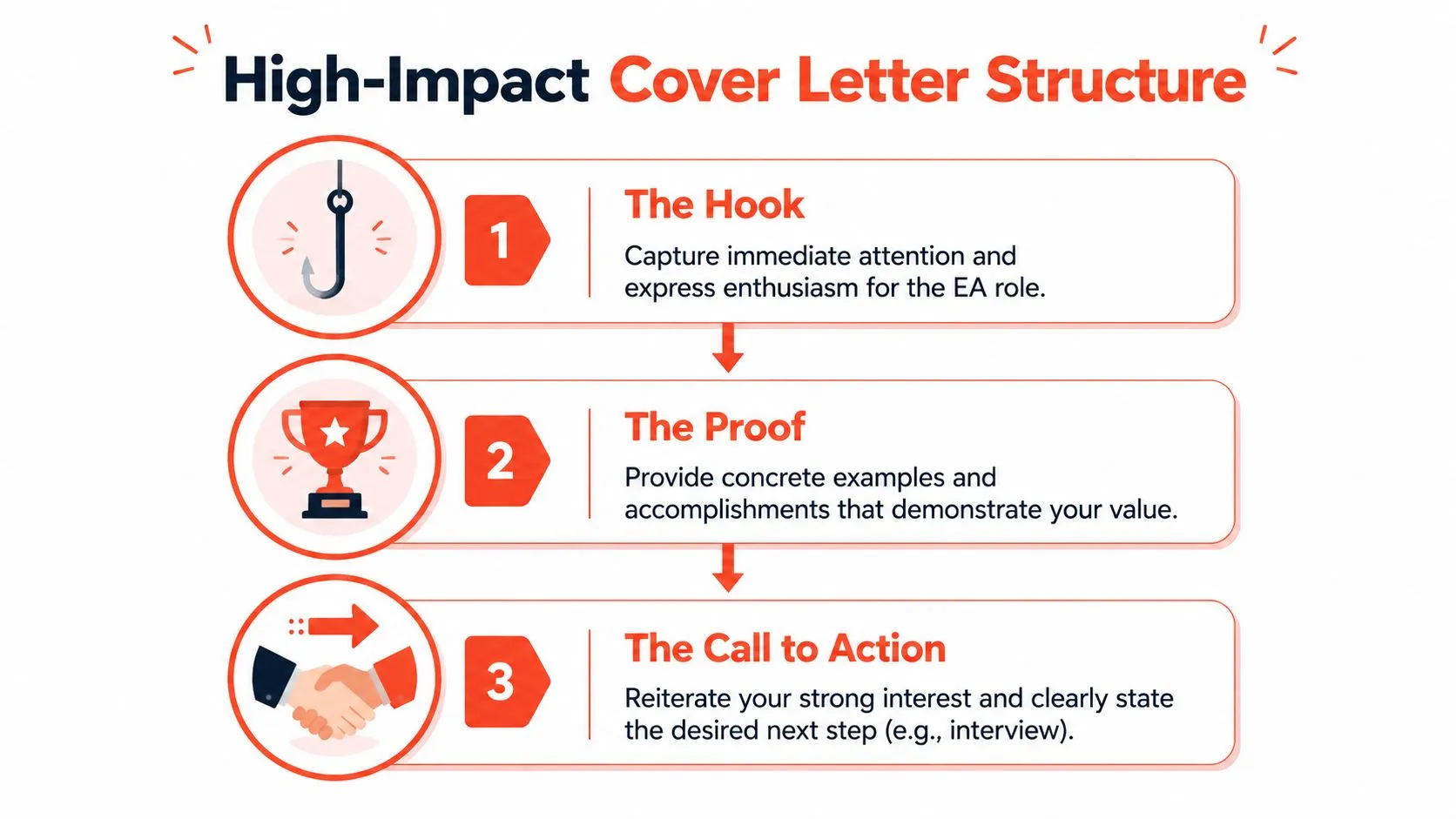
Paragraph one needs a hook
Lead with your strongest relevant result. Not your title. Not your enthusiasm.
Many applicants waste the most valuable real estate in the letter. You need one achievement or one high-signal responsibility that maps directly to the role. If the job asks for calendar management, board support, travel coordination, and executive communications, pick the accomplishment that shows you've done that under pressure.
Bad:
“I'm excited to apply for the Executive Assistant position at your company.”
Better:
“I've supported senior leaders in fast-moving environments where calendar complexity, shifting priorities, and confidential communication had to be handled cleanly and without delay.”
Paragraph two proves the fit
This is the body. It's where you match the role to your evidence.
A major failure point for EA candidates is skipping the three-trait demonstration of Judgment, Discretion, and Polish. Articuler's executive assistant cover letter guide notes that candidates who don't explicitly show they can prioritize without instruction, protect sensitive information, and draft error-free communications are less likely to pass initial screening.
Use one or two examples that prove those traits. Mention tools when they matter. Outlook, Google Workspace, Trello, and similar systems belong here if they support the story, not if they're just filler.
If you want a clean formatting reference, StoryCV's guide on cover letter format for software engineer is useful because the underlying rule is the same. Keep the structure tight and make every sentence earn its place.
Paragraph three closes like a professional
Don't end with “Thank you for your time and consideration.” That's wallpaper.
Close with confidence. Re-state fit in one line, then invite the next step. You're not begging. You're making it easy to move forward.
Try this:
-
Direct close
“I'd welcome the chance to discuss how I'd support your executive team with the same level of judgment, discretion, and operational calm.” -
Mission-aware close
“I'd value the opportunity to bring that support style to a company whose work and pace demand strong executive partnership.” -
Slightly warmer close
“If helpful, I'd be glad to discuss how I've supported leaders through competing priorities, confidential work, and communication-heavy operations.”
Write Body Paragraphs That Show Instead of Tell
Most weak letters are built from duties. Strong ones are built from moments.
“Managed travel.” Fine. So did half the applicant pool.
“Handled confidential information.” Good. Prove it.
“Supported leadership.” Meaningless unless you show how.
Start with a situation. Then show what you did. Then show what your action protected, improved, or prevented.
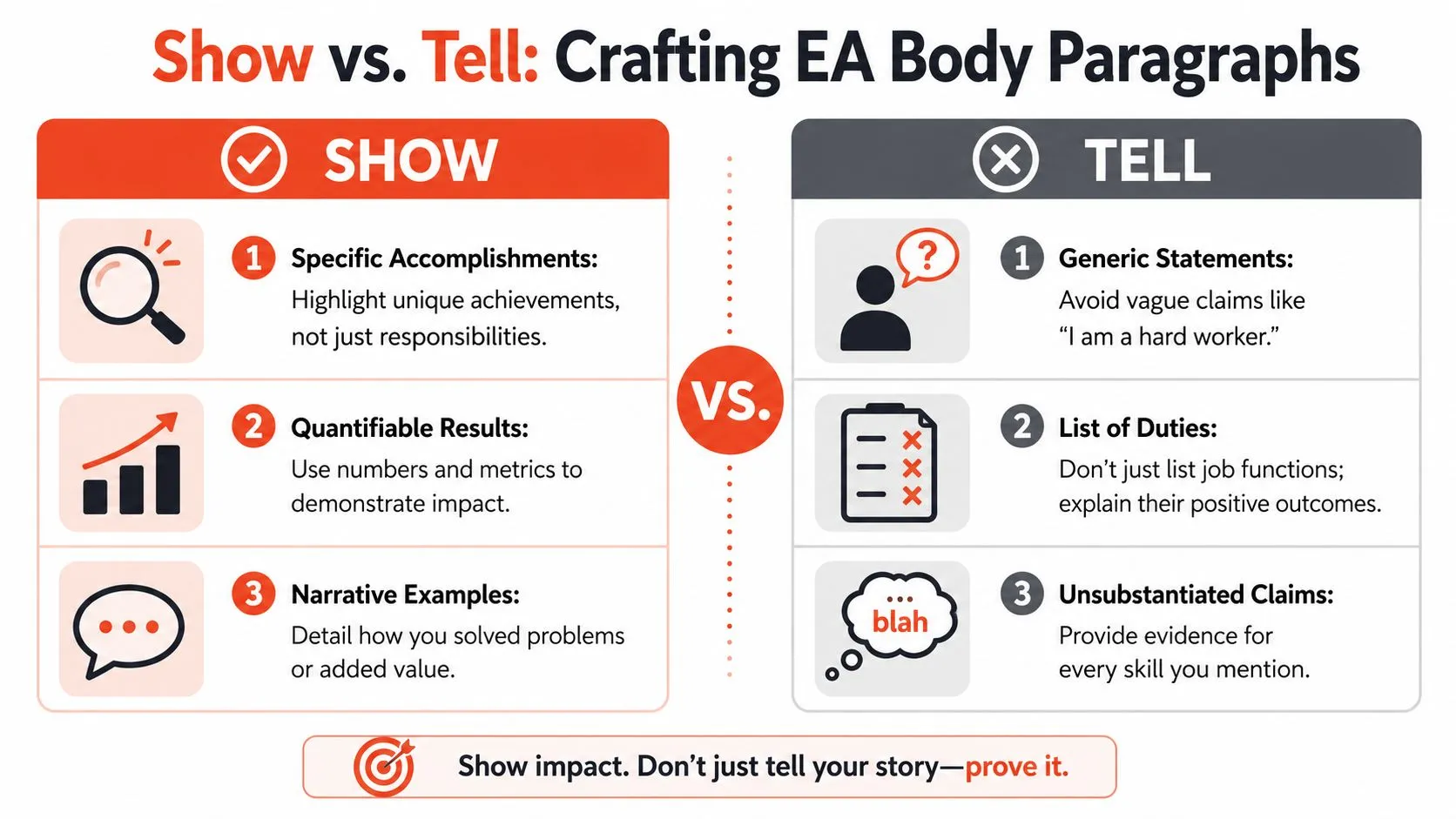
Before and after examples
| Tell | Show |
|---|---|
| “I managed executive travel.” | “I coordinated multi-stop executive travel, adjusted plans when meetings shifted, and kept leadership on schedule without disruption.” |
| “I have strong communication skills.” | “I drafted internal and external communications for senior leadership, tailoring tone for employees, partners, and clients.” |
| “I am detail-oriented.” | “I caught conflicting priorities before they reached the executive calendar and resolved them before stakeholders built around the wrong meeting.” |
| “I can handle pressure.” | “When priorities changed quickly, I re-sequenced meetings, updated stakeholders, and kept decisions moving without unnecessary escalation.” |
The difference is simple. The second version sounds like a person who has done the work.
Use a mini-story, not a skill list
A reliable formula is:
- Situation
What was happening? - Action
What did you do? - Outcome
What changed because of your judgment?
That's the same logic behind strong impact statements. You're not naming a trait. You're giving evidence for it.
Practical rule: If a sentence could appear in any applicant's letter, cut it.
Here's a better body paragraph:
“In my previous role, I supported a senior leader whose schedule changed constantly across internal meetings, external partners, and deadline-driven approvals. I built order by confirming priority shifts early, rewriting meeting blocks around decision needs, and keeping stakeholders updated before conflicts spread. That let the executive stay focused on decisions instead of logistics.”
That paragraph doesn't depend on inflated language. It shows calm control.
A quick breakdown helps if you're stuck:
- Use tools naturally
Mention Outlook, Google Calendar, Google Workspace, Trello, or Slack when they're part of the workflow. - Name pressure clearly
Competing priorities, confidential materials, shifting travel, board prep, and executive communications are all high-signal contexts. - Show prevention
Great EA work often means nothing exploded. That still counts.
For a practical walkthrough, this video covers the difference between generic claims and proof-driven writing:
Cover Letter Examples for Different EA Roles
The same letter won't work for every company. A public-company executive, a startup founder, and a career-change hiring manager are looking for different signals.
That matters even more because 42% of EA hires come from non-traditional backgrounds, according to Sorce's executive assistant cover letter guide. Yet most advice still assumes you already have “Executive Assistant” on your resume. That's lazy advice.
Example for a corporate C-suite EA role
A larger company usually cares about discretion, stakeholder control, and precision.
Dear Ms. Patel,
In my current role, I support senior leadership in a setting where competing priorities, confidential information, and polished communication all matter daily. I've managed complex scheduling, prepared materials for high-visibility meetings, and served as a reliable point of coordination across internal and external stakeholders.
What I'd bring to this Executive Assistant role is judgment. I don't simply schedule what arrives. I assess urgency, protect executive focus, and communicate changes with enough clarity that issues are resolved before they become distractions. I've also drafted correspondence and briefing materials that required accuracy, discretion, and a tone appropriate for senior audiences.
I'd welcome the chance to discuss how I can support your executive team with the same level of consistency and care.
Why it works: It sounds controlled. It emphasizes trust, not hustle.
Example for a startup executive assistant role
A startup needs range. The best letter sounds adaptable without sounding chaotic.
Dear Hiring Team,
I'm drawn to executive support roles in fast-moving companies because I'm comfortable building structure where it doesn't yet exist. In my recent work, I've coordinated shifting schedules, handled cross-functional follow-up, and kept priorities moving when timelines changed quickly.
I'm especially effective when a leader needs someone who can spot operational friction early. Whether that means tightening meeting flow, organizing scattered information in Google Workspace, or keeping communication clear across Slack, email, and live meetings, I focus on reducing decision drag. I don't wait for perfect instructions when the work is obvious.
I'd be glad to discuss how I'd bring that operating style to your team.
Why it works: It shows initiative and process thinking, which startups value more than ceremony.
Example for a career changer moving into EA work
If you're coming from teaching, military service, customer success, operations, or hospitality, stop apologizing for your background. Translate it.
Dear Mr. Lewis,
My background is in teaching, but the core of my work has always been coordination, prioritization, and communication under pressure. I managed daily schedules involving multiple stakeholders, resolved conflicts quickly, and maintained a calm, professional standard in an environment where details changed constantly.
Those same strengths apply directly to executive support. I'm used to protecting time, responding to shifting needs, and communicating clearly with people who need different things from the same day. I've also handled sensitive conversations with discretion and written communications that had to be accurate, clear, and audience-aware.
I'd welcome the opportunity to bring that judgment and composure to an Executive Assistant role.
Why it works: It doesn't rely on the phrase “transferable skills.” It translates lived work into executive-support language.
Good career-change letters don't defend the past. They reinterpret it.
The Final Polish Your Letter Needs
A strong EA letter can still lose on presentation alone. Sloppy formatting, a weak greeting, or one stiff sentence is enough to signal poor judgment. That is the wrong signal for a role built on judgment, discretion, and polish.
Keep the format tight. Standard advice recommends roughly 250 to 350 words, one page, readable fonts, and clean margins. That works because busy hiring teams skim first. Your letter needs to look controlled before it gets read closely.
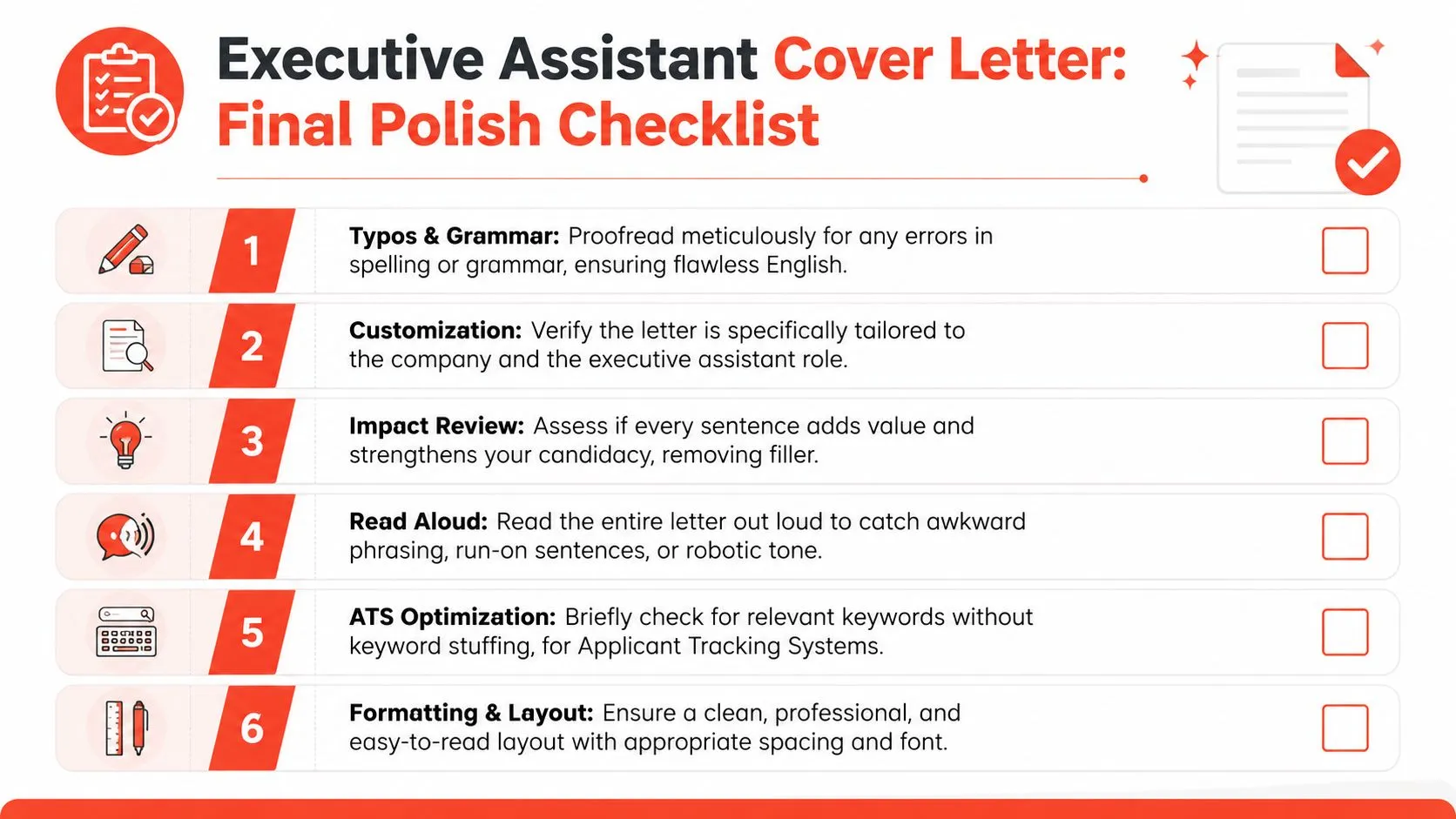
Final review checklist
-
Fix the greeting
Use a real name whenever possible. If you cannot find one, use “Dear Executive Hiring Team” or “Dear [Company Name] Hiring Team.” Skip “To Whom It May Concern.” It reads lazy. -
Cut duty language
Delete lines that only describe tasks. Keep lines that prove judgment, discretion, polish, or business impact. This matters even more for career changers. A teacher, operator, hotel manager, or military admin can write a strong EA letter if the examples show trusted decision-making and professional control. -
Check the tone for senior-level support
Your writing should sound calm, precise, and useful. No overselling. No buzzwords. No dramatic claims. Executives want someone who can handle sensitive work without adding noise. -
Read it aloud once
You will hear clunky phrasing immediately. If a sentence sounds rehearsed or inflated, rewrite it in plain English. -
Review the email subject line too
A careless subject line weakens a strong application. Use this guide to write a clear subject line for your job application before you send anything.
AI drafts are common now. The problem is not AI itself. The problem is obvious AI copy. It tends to sound padded, generic, and detached from real work. If you used AI for a first pass, rewrite until the letter sounds like a competent operator with standards. The Lumi Humanizer cover letter guide is useful for cleaning up that kind of draft.
Final test: if your letter could belong to any admin candidate, it is not ready. A good EA letter makes one thing clear fast. This person can be trusted with time, information, and representation.
Editing Prompts to Uncover Your Best Stories
The difficulty isn't a writing problem. It's a recall problem.
The best material for a cover letter for executive assistant roles usually lives in small moments you've stopped noticing. The meeting you moved before it became a conflict. The document you fixed before it went to leadership. The stakeholder issue you settled without drama.
Use prompts that force memory, not vague self-description.

Try these:
-
What did you prevent?
Describe a time you spotted a problem before your manager or executive had to deal with it. -
Where were you trusted?
Think of a situation involving confidential information, sensitive communication, or stakeholder tension. -
What did you clean up?
Name a messy process, scattered calendar, unclear handoff, or recurring confusion you made easier. -
What did you write that mattered?
Emails, agendas, summaries, briefs, follow-ups, talking points. Anything that had to be right.
Those prompts pull out real evidence. That's what gets the letter written.
Frequently Asked Questions
Do I still need a cover letter for executive assistant jobs
Yes.
For executive assistant roles, the cover letter does more than introduce you. It shows how you think on the page. Hiring teams read it for judgment, tone, and control. If your letter is vague, wordy, or careless, they will assume your email drafts, meeting briefs, and follow-ups will be too.
What if I can't find the hiring manager's name
Use a specific team-based greeting and move on.
“To Whom It May Concern” reads like a form letter from another decade. It signals distance, and EA hiring is built on precision and relationship awareness. You do not need to pretend you found a name you could not verify. You do need to sound current and deliberate.
Use one of these:
- Dear Executive Hiring Team
- Dear [Company Name] Hiring Team
- Dear Hiring Committee
How long should an executive assistant cover letter be
One page is the ceiling. Shorter is often better.
If your letter cannot hold attention in one screen length, it is not tight enough for an EA role. Executives and recruiters skim first. Dense blocks of explanation lose. A sharp letter gets to credibility fast, proves one or two high-value examples, and stops.
Should I mention tools in the letter
Only if the tool supports a point about how you work.
“Proficient in Outlook and Slack” says very little. “Built an executive briefing rhythm in Outlook, Slack, and Google Docs that cut missed follow-ups” says something useful. Tools matter when they prove judgment, speed, or organization. Software lists belong on the resume.
What if I'm changing careers
Career changers get hired into EA work when they translate their background into the three traits that matter. Judgment. Discretion. Polish.
A strong example: a hotel front office manager applying to support a COO. That candidate already handles VIP requests, schedule changes, upset stakeholders, private information, and high-pressure communication without losing composure. That is not unrelated experience. That is executive support material, if the letter frames it correctly.
StoryCV is an online resume writer built for people who've done strong work but don't want to sound generic describing it. It uses guided editorial judgment to pull out the stories, decisions, and outcomes that belong in your resume or cover letter, then turns them into clear drafts fast. If you're struggling to translate real experience into sharp language, it's a better place to start than another template.