Most advice on a cover letter format for software engineer roles is backwards. It starts with fonts, margins, and templates, then treats the actual message like an afterthought. That's how you end up with a clean-looking letter that says nothing.
Hiring managers don't need another decorative recap of your resume. They need a fast argument for why you fit the role, what problem you can solve, and what proof backs that up. Format matters, but not in the way commonly assumed.
Your Cover Letter Format Is Probably Wrong
If your first question is “Should I use Georgia or Times New Roman?” you're focused on the least important part.
Yes, a professional layout still matters. Keep it formal, readable, and clean. But the main failure point isn't visual formatting. It's weak thinking. The best guidance on software engineer cover letters says the letter should answer why the company is hiring and what problem you can solve, backed by one specific reason and one specific example in Indeed Canada's summary of Stack Overflow's advice.
That's the format that matters. Not decoration. Argument.
Most bad cover letters fall into the same trap. They perform professionalism instead of communicating value. They open with some version of “I am excited to apply,” list a stack of tools, then close with “thank you for your consideration.” Clean. Polite. Forgettable.
Your resume shows what you've done. Your cover letter should explain why it matters for this job.
If you're still treating the letter like a second resume, fix that first. The distinction matters, and if you need to sharpen it, read resume vs cover letter.
What recruiters actually need
They need three things, fast:
- Role fit: Why this role makes sense for you.
- Evidence: What you've done that proves you can handle it.
- Judgment: Why you chose those examples, for this company, right now.
What most engineers send instead
A bad letter usually includes some combination of these:
| Weak move | Why it fails |
|---|---|
| Generic opening | It sounds copied and signals low effort |
| Tool list with no result | It shows exposure, not competence |
| Company praise with no relevance | It flatters, but doesn't build a case |
The point of a cover letter format for software engineer applications isn't to make you sound formal. It's to make you easy to believe.
The Three Paragraph Software Engineer Cover Letter Format
Your cover letter format is not a typography problem. It is a thinking problem.
Engineers waste time tweaking margins, font size, and spacing because that feels safe. Hiring teams do not care. They care whether you can make a clear case, fast. The right cover letter format for software engineer roles is a three paragraph argument that proves fit, proof, and judgment in a small space.
Start with the visual model.
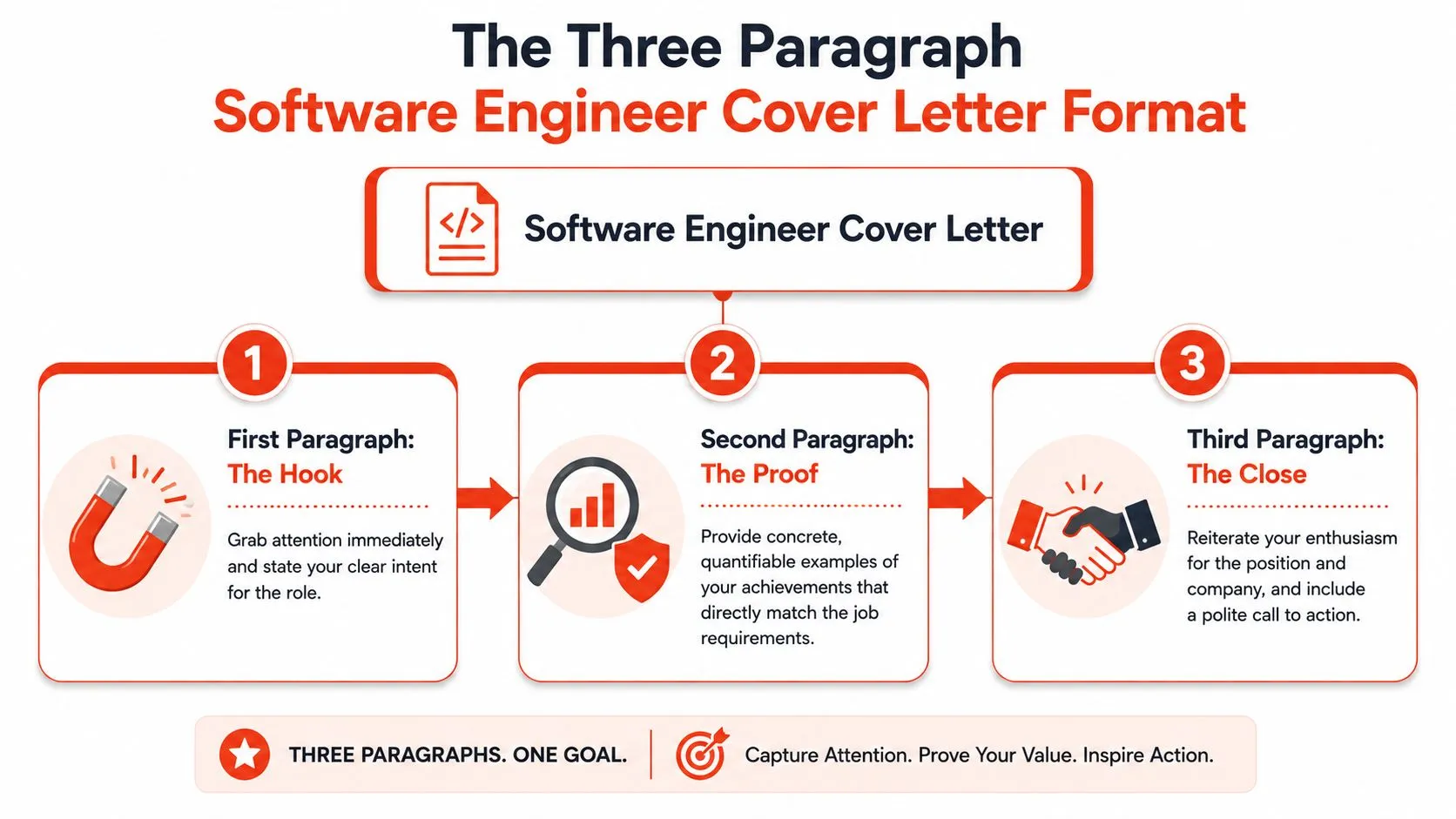
Paragraph one is the hook
Your first paragraph has one job. Make the reader believe this application belongs in the yes pile.
State the role. State the match. Point at the company's problem space. Do it in two or three sentences, not a dramatic introduction about your passion for technology.
Skip this:
I am writing to express my interest in the Software Engineer position at your company.
It says nothing.
Write something like this instead:
I'm applying for your backend software engineer role because my recent work focused on API reliability, incident response, and performance tuning, which lines up with the platform problems your team is solving.
That works because it does real work. It identifies the role, shows relevance, and frames your experience around their needs instead of your feelings.
Paragraph two is the proof
This paragraph carries the letter. If it is weak, the whole thing fails.
Pick one strong example, or two at most. Describe the problem, your specific contribution, and the result. Write like an engineer explaining a production change in a review. Be concrete. Be selective. If your draft reads like a career summary, cut half of it.
If you want a useful benchmark, read this sample cover letter for job application and pay attention to how the strongest examples choose one relevant story instead of listing everything.
Use this filter when you draft:
- What was the work? Service, migration, feature, incident, refactor
- What did you do? Designed, shipped, debugged, led, stabilized
- What changed? Reliability improved, latency dropped, releases got safer, users got a better outcome
Here's a short video walkthrough if you want a visual explanation before rewriting your draft:
Paragraph three is the close
Do not treat the close like a formality. It should finish the argument.
Reconnect your background to the team's work. Show that your interest is specific. Ask for the conversation. Keep it short.
For example:
I'd welcome the chance to discuss how my experience in backend reliability and performance engineering could help your infrastructure team ship more stable systems.
That is enough. Three paragraphs. Less filler, more proof. That is the format.
Writing Your Hook and Proof Paragraphs
Most cover letters fail because the writer gets vague right when they need to get precise.
The strongest shift in software engineer cover letters is away from generic self-description and toward quantified proof. Guidance now tells applicants to include measurable results, tie technical work to business value, and in some cases open with one concrete number, as explained in Intuit's software engineer cover letter examples.
That doesn't mean you should force numbers into every sentence. It means you should stop hiding behind responsibilities.
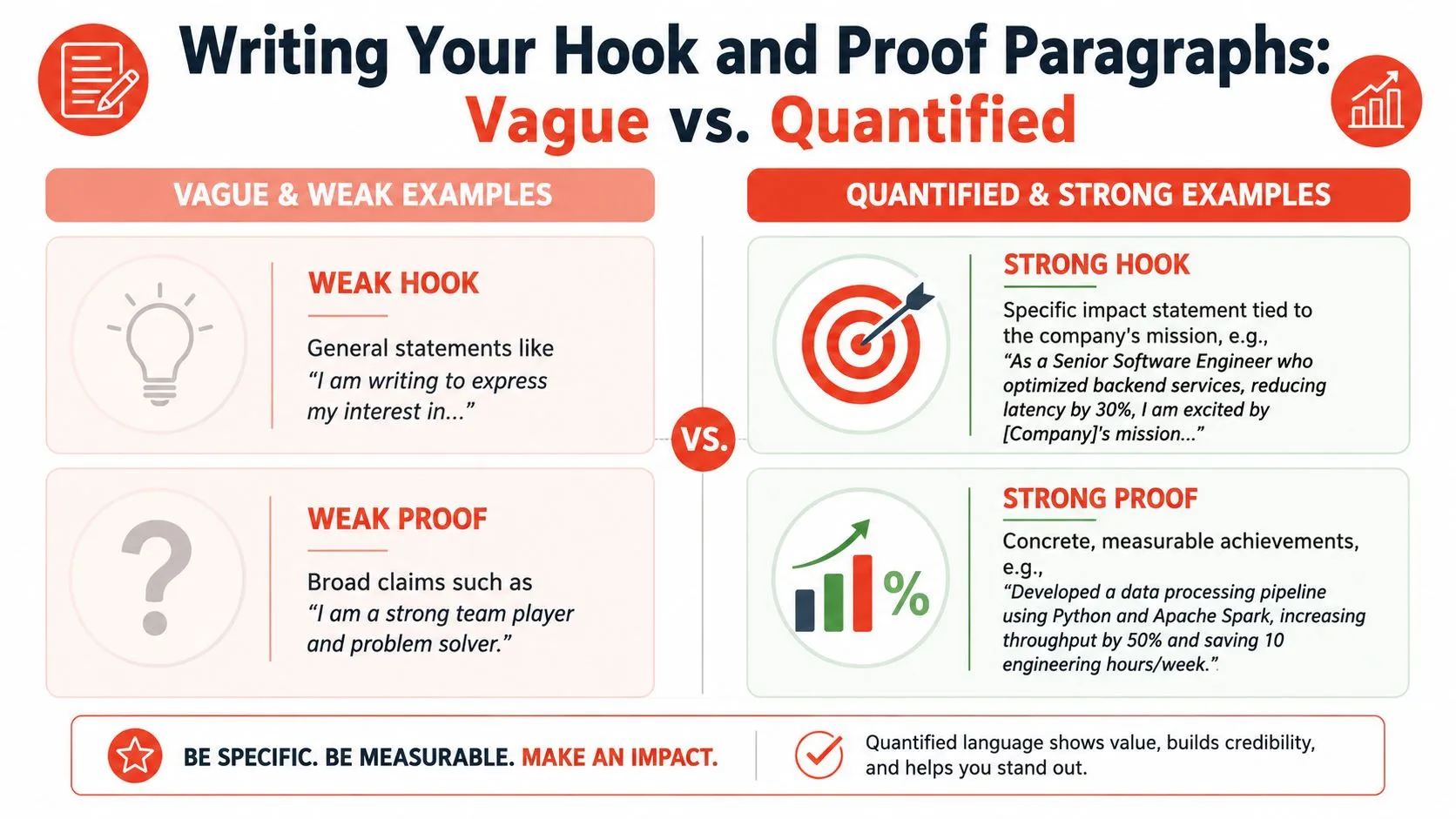
Weak versus strong writing
Here's the difference in plain English.
| Weak | Strong |
|---|---|
| Worked on the payments API | Improved the payments API by reducing latency and making checkout more reliable |
| Collaborated with cross-functional teams | Worked with product and design to ship a user-facing feature with clear adoption and support outcomes |
| Responsible for cloud migration | Led a migration plan, handled rollout risk, and improved system stability after deployment |
The weak version names activity. The strong version names impact.
Practical rule: if a sentence could sit in anyone's cover letter, cut it.
How to find proof when your memory is fuzzy
Open your resume, GitHub, Jira history, pull requests, performance reviews, and old release notes. You're looking for evidence, not prose.
Ask yourself:
- What changed because I worked on it?
- What got faster, safer, simpler, or more reliable?
- Who benefited from that change?
- What would the team have struggled with if I hadn't handled it?
Then turn the answer into a sentence.
Bad:
- Vague claim: I'm a strong problem solver with experience in backend systems.
Better:
- Specific proof: I've spent the last few years working on backend systems where the job wasn't just shipping code, but debugging failure points, improving reliability, and making services easier for other engineers to build on.
Before and after examples
Here are some rewrites you can use as models.
Before
I'm excited to apply for this role because I have experience with Python, AWS, Docker, and microservices.
After
I'm applying for this role because my recent backend work has centered on Python services, containerized deployments, and production reliability, which lines up with the platform and scaling problems your team is tackling.
Before
At my current company, I worked on internal tools and helped improve engineering processes.
After
At my current company, I built internal tools that removed recurring friction for engineers and improved how the team handled day-to-day delivery, which made my work valuable beyond the code itself.
If you struggle to write like this, you probably don't need a better template. You need better source material. Start with how to write impact statements, then bring only the strongest lines into the letter.
Tailored Examples for Every Engineer Level
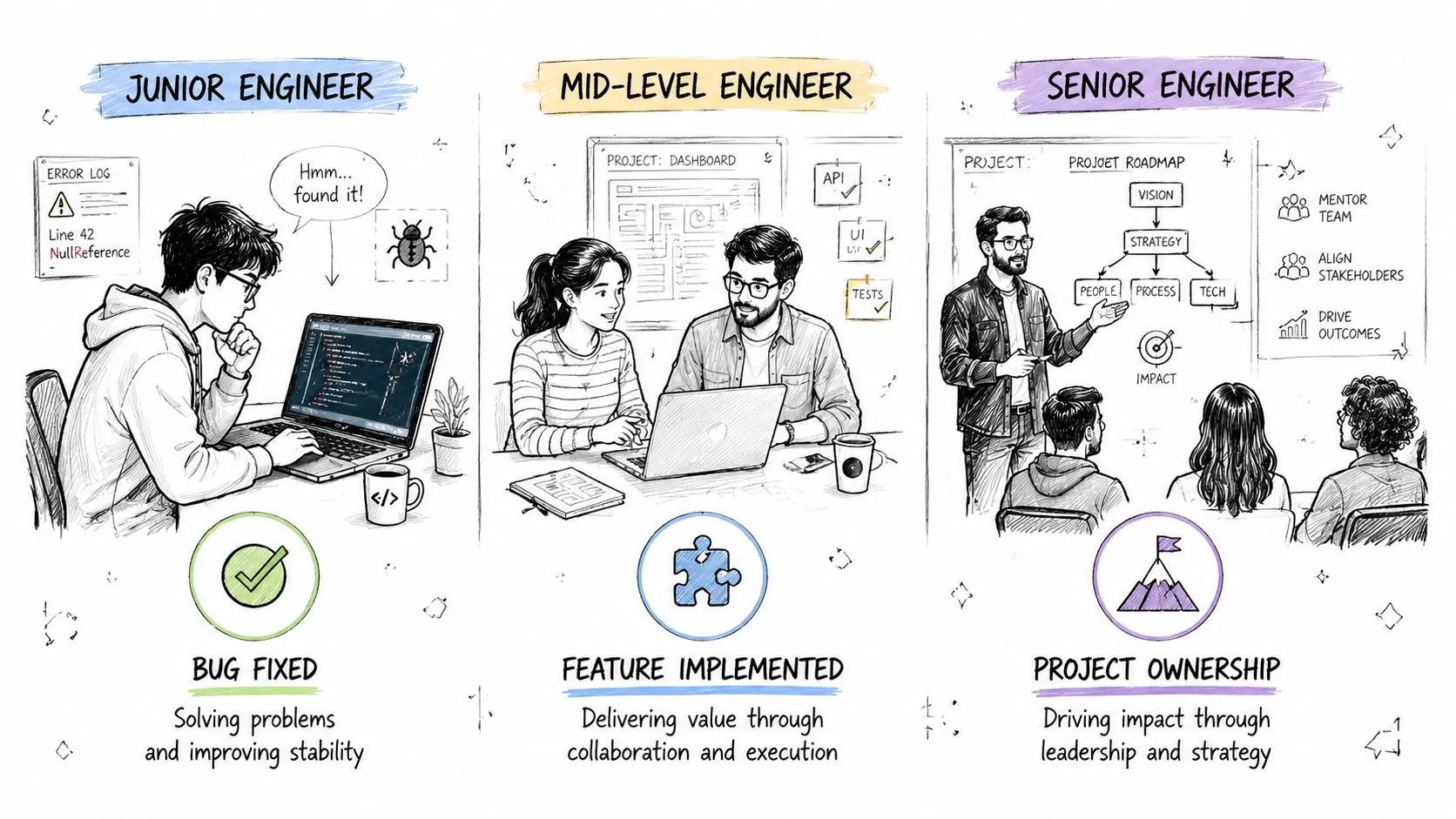
A junior engineer should not sound like a staff engineer. A senior engineer should not sound like a task taker. Scope matters.
That's where most cover letter advice falls apart, especially for people with nontraditional experience. Guidance often tells career changers and bootcamp grads to mention projects or GitHub, but rarely explains how to choose examples or turn limited experience into credible fit, as noted in Candor's software engineer cover letter guide.
Junior or career changer
You do not need to fake seniority. You need to show evidence of learning, shipping, and follow-through.
I'm applying for your junior software engineer role because my strongest work has been in building and finishing real projects, not just completing coursework. In my recent transition into software engineering, I built a full-stack application, documented tradeoffs, and iterated on bugs and feedback the way a real product team would. That matters to me because your team appears to value engineers who can learn quickly, communicate clearly, and contribute without needing everything spelled out.
This works because it doesn't pretend. It frames project work as proof of behavior.
Mid-level engineer
At this level, I expect ownership. Not just participation.
I'm applying for your software engineer role because my recent work sits at the intersection of delivery and engineering judgment. In my current role, I've owned production features from implementation through rollout, worked across product and design to manage tradeoffs, and improved systems that other engineers depend on. Your team's focus on building reliable product infrastructure is exactly the kind of environment where that mix of execution and judgment is useful.
This sounds like someone who can be trusted with real work.
Senior engineer
Senior letters should show impact. Architecture. mentoring. decision-making. Calm under ambiguity.
I'm interested in your senior software engineer opening because the role calls for more than implementation. It calls for technical leadership. In recent roles, I've shaped system direction, guided engineers through difficult delivery decisions, and balanced short-term shipping pressure against long-term maintainability. I'm most useful in teams that need someone to reduce ambiguity, raise engineering standards, and keep product momentum without creating future mess.
That's the level shift. Junior proves capability. Mid proves ownership. Senior proves judgment.
Common Mistakes That Get You Ignored
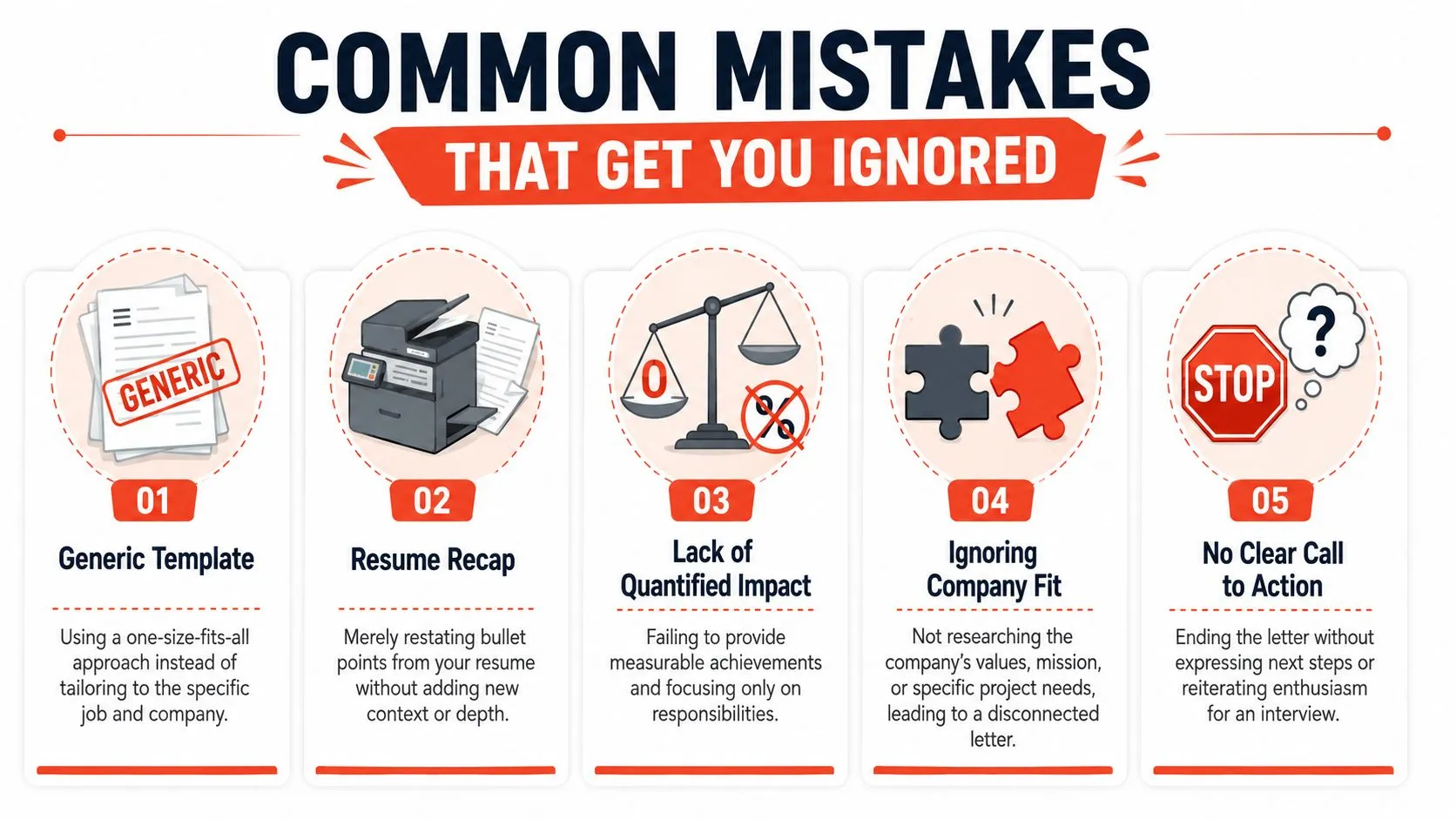
A typo usually won't kill your application. Strategic laziness will.
The echo
This is the resume recap. Same bullets. Same facts. Same wording.
If the letter adds no new frame, don't send it. A cover letter should interpret your experience, not photocopy it.
The love letter
This one is all admiration, no argument. You praise the company's mission, product, or culture and never connect it to your own work.
That reads like fan mail. Hiring managers need relevance.
If your paragraph about the company could be sent unchanged to ten other companies, it's useless.
The buzzword salad
You list React, Kubernetes, Python, AWS, CI/CD, GraphQL, Agile, microservices, leadership, and problem-solving in one breath. Nothing is false. Nothing is convincing.
Tools without context are noise.
Here's the cleaner test:
- Keep: technologies tied to a real example
- Cut: long skill inventories
- Keep: one company-specific reason
- Cut: generic enthusiasm
- Keep: a closing that asks for a conversation
A strong cover letter format for software engineer roles prevents these mistakes by forcing compression. Fewer paragraphs. Better choices.
Your Two Minute Pre-Flight Checklist
Stop polishing tone. Check the argument.
A good cover letter format for software engineer roles is a final systems check. You are not reviewing style. You are verifying that the three-paragraph structure proves something: who you are, what you've shipped, and why that matters to this team.
Final pass questions
- Does the opening sentence make a claim worth reading? “I'm applying for” is admin text. Lead with relevance or results.
- Did you name the role and company? Make the context obvious in one line.
- Does the body include one concrete proof point? Pick a shipped feature, solved failure mode, performance gain, migration, or ownership example.
- Did you connect that proof to the company's situation? Show that you understand the job, not just that you want it.
- Did you cut empty self-description? Delete “team player,” “passionate,” “hard worker,” and similar padding.
- Is it short enough to skim fast? Keep it tight. If it starts feeling like a fourth paragraph, cut.
- Does the close ask for a conversation? End with intent, not gratitude theater.
The blunt test
Read it once.
Would a hiring manager come away with a clear reason to interview you?
If not, the format failed. Fix the structure, tighten the proof, and send less.
StoryCV is a Digital Resume Writer, not a template dump. It helps you turn vague experience into clear, credible impact with editorial judgment at software speed. If your cover letter still sounds like a performance instead of a case for hiring you, StoryCV can help you say less and prove more.