The difference is simple.
Your resume is the evidence. Your cover letter is the argument.
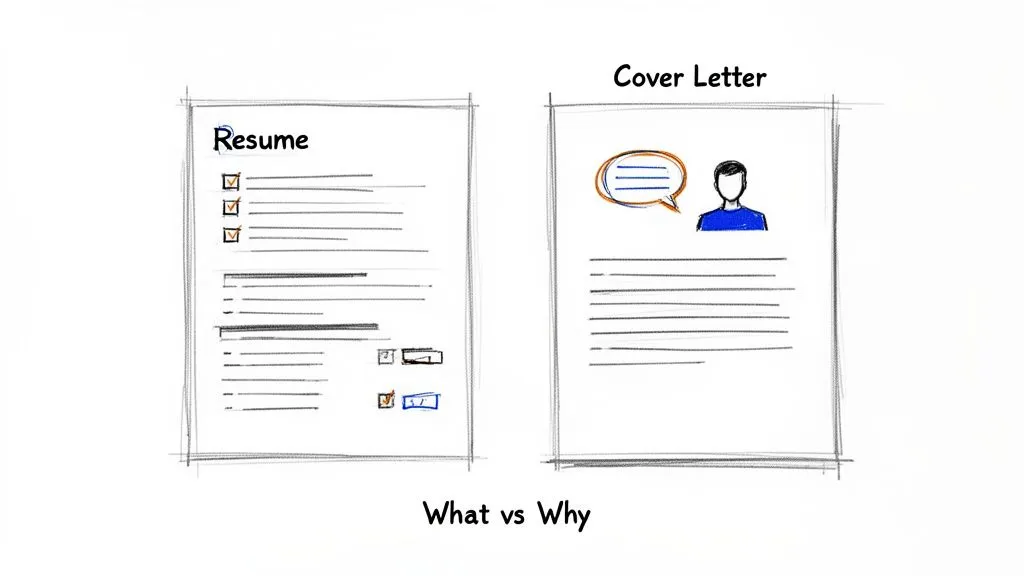
The resume gives the facts: a clean, historical record of your skills and wins. It’s the "what" and "where" of your career, built for a six-second scan. The cover letter is the "why." It connects those facts into a story for one specific job.
One gets you past the machine. The other convinces the human.
Resume Vs Cover Letter: The Core Distinction
These two documents have different jobs. Know the difference, and you'll make them both work for you.
Your resume is built for speed. A hiring manager or an Applicant Tracking System (ATS) scans it for baseline qualifications. It has to be factual, tight, and easy to parse. No BS.
Your cover letter is your pitch. It’s for a person. This is where you show some personality, explain your motivation, and draw a straight line from your wins to their problems. It fills the gaps a resume can’t. Like why you’re switching careers or why you actually want this job, not just any job.
Resume Vs Cover Letter At a Glance
The easiest way to see the resume vs. cover letter split is to put their jobs side-by-side. One is a factual summary; the other is a targeted story. One is your past; the other is your future with them.
| Attribute | Resume (The Evidence) | Cover Letter (The Argument) |
|---|---|---|
| Purpose | A factual summary of your professional history, skills, and accomplishments. | An introduction that argues why you are the best fit for this specific role. |
| Content | Bulleted lists of achievements, skills sections, education, and work history. | Narrative paragraphs connecting your experience to the job description and company goals. |
| Tone | Formal, objective, and factual. Uses strong action verbs. | Professional yet persuasive and engaging. More personal and conversational. |
| Audience | First, an ATS bot. Then, a recruiter scanning for keywords. | A hiring manager reading to gauge interest, fit, and communication skills. |
| Focus | Backward-looking: It documents what you have done. | Forward-looking: It explains what you can do for the company. |
This table boils it down. The real takeaway? They work together. The resume proves you can do the job. The cover letter proves you want to do this job.
Does a Cover Letter Still Matter?
Some people claim the cover letter is dead. The data says otherwise.
One analysis found that sending a compelling cover letter makes you 1.9 times more likely to land an interview. Your resume is non-negotiable, but a great cover letter adds the story that makes you memorable.
Your resume gets you on the longlist. A great cover letter gets you on the shortlist. Each document has a distinct role. Master both. For more on creating a document that stands out, see our guide to a perfect resume.
A Strategic Comparison Of Purpose And Tone
These aren't two versions of the same thing. They're different tools for different jobs. Nail their Purpose, Length, Content, Tone, and ATS Optimization, and you move from "filed" to "interviewed."
Purpose: The What Vs The Why
Your resume answers, “What has this person done?” It’s a clean inventory of your roles, skills, and results. A recruiter should get it in under 10 seconds.
A cover letter answers, “Why this person for this job?” It doesn’t just repeat your resume. It weaves your best wins into a story that solves the problems in the job description.
Your resume proves you can do a job.
Your cover letter argues you're the one for this job.
One is a timeline. The other is a pitch.
Length: Brevity Vs Directed Brevity
Keep it tight. For a resume, one page per decade of experience. Usually no more than two pages. Every line must earn its place.
Cover letters demand even more discipline. Never more than one page. In fact, 70% of employers want them half a page or shorter. Four sharp paragraphs are plenty.
Find out what recruiters really want in these resume statistics.
Content: The Past Vs The Future
A resume looks backward. It lists:
-
Roles and responsibilities
-
Quantified achievements
-
Hard and soft skills
Example (Resume):
Increased Q4 lead generation by 45% with a revamped marketing automation workflow.
A cover letter looks forward. It:
-
Picks your top achievements
-
Maps them to the company’s goals
-
Shows your future impact
Example (Cover Letter):
“My track record of boosting lead generation by 45% is a direct match for your expansion targets. I’m ready to drive that same growth for your team.”
Tone: Factual Vs Persuasive
Resumes are formal and objective. Strong action verbs, no fluff. Cover letters let your personality through. Still professional, but with enough warmth to connect with a human.
ATS Optimization: Robots Vs Humans
Your resume has to beat the bots first. That means:
-
Standard headings
-
Simple formatting
-
Keywords from the job description
Cover letters are for humans. You still use relevant terms, but your main goal is to tell a story that grabs the hiring manager.
Deciding When to Use a Resume Or Cover Letter
This isn’t a debate. It’s about reading the room and picking the right tool.
Your resume is the baseline. You always need it. A sharp cover letter turns a data dump into a conversation starter.
The Standard Online Application
You're scrolling jobs. You upload your resume. You see an "optional" cover letter field.
That "optional" tag is a test. Most people skip it. A short, targeted cover letter shows you actually care.
On platforms like remote-first jobs, remote roles are crowded. Your cover letter isn’t fluff—it’s your opening handshake.
Your resume opens the door. Your cover letter starts the conversation.
Networking Referrals And Direct Outreach
Someone refers you. You cold-email a hiring manager. Just attaching a resume is lazy.
Use the email body as your cover letter. A strong outreach note answers:
-
Who you are
-
How you know the referrer (if you have one)
-
Why you care about this company
-
What value you bring, right now
Without that context, your resume is just another attachment in a crowded inbox.
Making The Case For A Career Change
Switching fields? Your resume might confuse a bot or a recruiter doing a quick scan.
Your cover letter builds the bridge. It:
-
Explains why you’re pivoting
-
Connects past skills to future impact
-
Tells a clear story
A project manager moving into product marketing might write:
“My five years managing cross-functional teams taught me how to get products to market. I’m ready to apply that strategic execution to elevate your product story.”
Guidance For Senior And Specialized Roles
The higher you climb, the more your cover letter matters. It becomes a strategic tool.
-
For Senior Leaders: Share your vision or leadership style.
-
For Tech Roles: Explain why their stack excites you, or how you’d solve one of their challenges.
-
For Speculative Applications: If there's no open role, your letter is the entire pitch. Identify a need and position yourself as the solution.
Here’s a quick visual guide.
Application Scenario Decision Matrix
Use this matrix to decide which document to prioritize.
| Scenario | Resume Priority | Cover Letter Priority | Key Action |
|---|---|---|---|
| Standard Online Application | High | Medium | Provide resume and concise, role-specific letter |
| Networking Referrals | Medium | High | Introduce yourself and reference your connection |
| Career Change | High | High | Highlight transferable skills and explain your motive |
| Senior Or Executive Roles | High | High | Outline leadership vision and strategic impact |
| Speculative Applications | Medium | High | Identify a company need and present yourself as the fix |
Keep this handy. A tailored approach gives you an edge.
How to Write Each Document Effectively
Knowing the difference is step one. Writing well is step two. Let's skip the theory and build documents that get you hired. Be direct. Be confident. Fluff gets you ignored. Impact gets you interviews.
Writing Your Resume: From Tasks to Impact
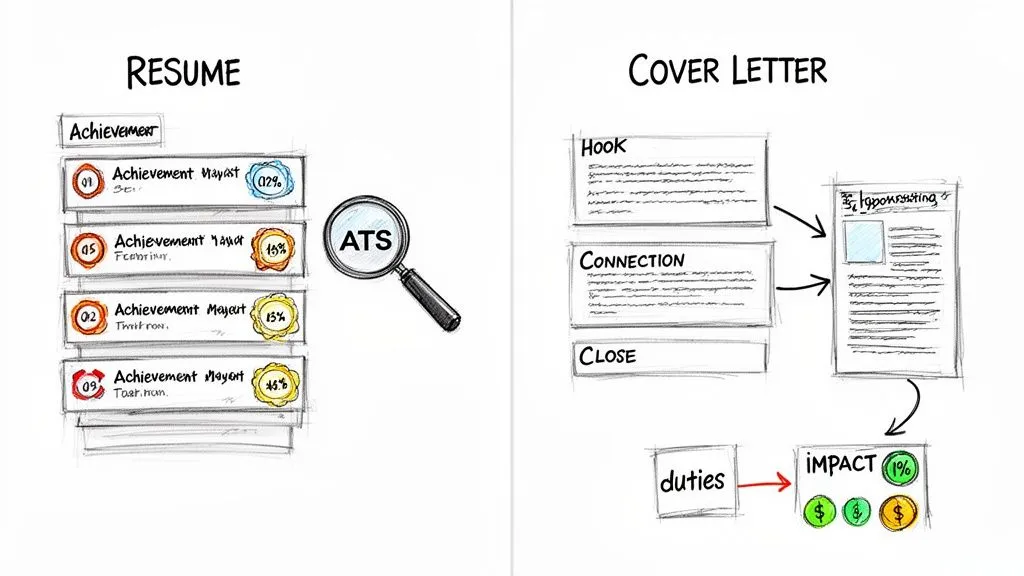
Most resumes are just boring lists of job duties. They're passive. They don’t show what you actually did. The fix is simple: shift from what you did to what you achieved.
Every bullet point should be a mini-story of your impact. Use a strong action verb and a number. This isn't about lying; it's about framing your work in the language of results.
Here’s what that looks like.
Before (Task-Focused):
-
Responsible for managing social media accounts.
-
Wrote blog posts and created content.
-
Tracked marketing campaign performance.
This just says you showed up. It doesn’t say if you were any good.
After (Impact-Focused):
-
Grew organic social media engagement by 45% in six months by launching a data-driven content strategy.
-
Authored 15+ long-form blog posts, attracting 20,000+ unique monthly visitors.
-
Analyzed campaign data to reallocate $50,000 in ad spend, improving MQLs by 18%.
See the difference? The second version proves your value. It’s evidence, not a claim.
A great resume doesn’t list responsibilities; it showcases results. If a bullet point has no number or clear outcome, kill it.
This is the single most important change you can make to your resume. Don't just list tasks. Prove your worth.
Writing Your Cover Letter: The Three-Paragraph Pitch
A cover letter is not your life story. It's a sharp, three-paragraph pitch to make a hiring manager read your resume. Forget the old five-paragraph template.
Keep it under one page. Aim for 250-300 words. Brevity is confidence.
Paragraph 1: The Hook
Get straight to it. State the role you want and immediately deliver your core value. Why are you the right person? Don’t waste time with "I am writing to express my interest..."
Example (Business Analyst):
"I'm applying for the Senior Business Analyst position. My experience streamlining operations, which led to a 15% reduction in overhead at my last company, is a direct match for the core requirements of this role."
Paragraph 2: The Connection
This is the core of your letter. Pick two or three key needs from the job description. Connect your specific achievements to them. A short bulleted list is scannable and powerful.
Example (Software Engineer):
"Your emphasis on scalable architecture and team mentorship stood out. My background is a match:
-
Scalable Architecture: I led the re-architecture of a monolithic app to microservices, cutting latency by 60% and supporting 3x user growth.
-
Team Mentorship: I mentored three junior engineers through two major feature releases, improving our team's code review efficiency."
Paragraph 3: The Close
End with confidence. Restate your interest and close with a clear, professional call to action.
Example (Marketing Manager):
"I'm confident my experience driving revenue growth can directly contribute to your goals. I'm eager to discuss how I can bring similar results to your team and am available for an interview at your convenience."
This structure is direct. It respects the reader's time. For more, see our guide with a sample cover letter for a job application. You can also get more expert advice on how to write a compelling cover letter for another perspective.
StoryCV: The Digital Writer for Your Career Narrative
You’ve done great work. So why is writing about it so hard? Staring at a blank page, trying to shrink years of experience into a few bullets, is a pain most of us know.
This is when people grab templates and builders. They give you clean boxes and expect you to fill them with a great story. It’s like being handed a paintbrush and told, "Go paint a masterpiece." The tool doesn't solve the real problem: finding your story.
StoryCV is different. We're not a template library. We're your Digital Resume Writer. We bring the judgment of a professional writer at the speed of software. No high costs, no long waits.
We Interview You to Find Your Story
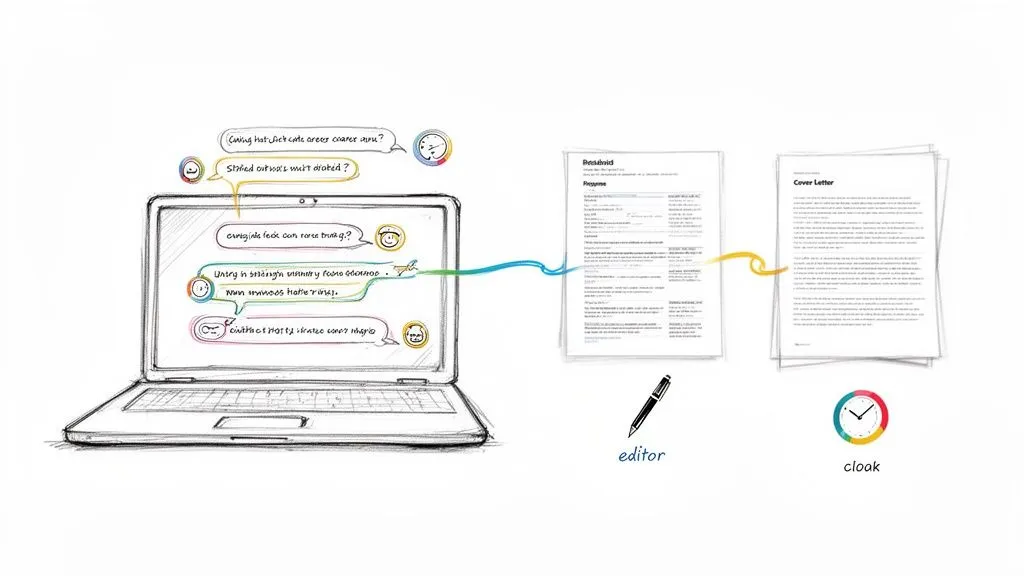
Instead of a blank slate, StoryCV starts with a conversation. We use a guided interview to pull the story out of your experience. We ask the right questions—the same ones a human strategist would—to uncover the context, challenges, and results that matter.
You talk, we write. It’s a partnership. You bring the raw material; we help you shape it with clarity.
This is powerful for building both your resume and cover letter because it respects their difference. One is evidence, the other is an argument. Our process helps you create both.
-
For your resume: We dig into each role to turn passive duties into quantified wins. We help you find the numbers that prove your value.
-
For your cover letter: We guide you to find the strongest stories and connect them directly to the problems the new company needs to solve.
Our process is designed to turn your raw experience into a clean, compelling narrative.
From Raw Experience to a Coherent Narrative
This isn't about gaming the system. It's about building a story that connects with a human. When you’re a mid-to-senior professional, your value isn’t just what you did, but how and why it mattered.
Templates are soul-crushing. Filling out boxes is for machines. Talking about your work is for humans. We facilitate that conversation.
The result is a resume and cover letter that sound like you—confident, focused, and clear. We provide the sharp language and structure, but the story is yours. You get the benefits of a professional editor without losing your voice. To see how it works, our guide explains what a resume writer does to polish a career story.
Stop fighting with templates. Stop guessing what recruiters want. Start a conversation about your work, and let us help you build the story that gets you hired.
Your Questions, Answered
You have the strategy. Now for the small questions that trip people up. Here are straight answers to common hang-ups.
Should My Resume and Cover Letter Match?
Yes, but keep it simple. The goal is consistency, not a design project. Use the same font, name heading, and contact info on both.
It creates a clean, professional package. Think of it as your personal letterhead. Avoid distracting graphics or columns that confuse recruiters and bots.
Simplicity signals confidence. Over-designing looks like you're compensating.
Can I Use an AI Tool Like ChatGPT to Write My Cover Letter?
You can, but it’s a shortcut to sounding generic. AI tools spit out clichés like "I am a highly motivated team player." They completely miss your unique voice and the real story behind your work.
The result is a letter that sounds like everyone else's.
A tool like StoryCV is different. We are a Digital Resume Writer. We interview you to understand the context and impact of your work, helping you shape an authentic story instead of generating fluff. Use AI for ideas, not the final draft.
Is a Cover Letter Really Necessary if It’s “Optional”?
Think of "optional" as a test. When you submit a sharp, tailored cover letter that wasn't required, you signal real interest. You show you're willing to do the work.
In a crowded market, that extra effort can be the tiebreaker. It’s one more chance to connect with a human.
Bottom line: Always send one unless the application explicitly says “do not include a cover letter.”
How Long Should a Resume Be for a Senior Professional?
For anyone with 10+ years of experience, two pages is standard. Trying to cram a complex career onto one page sells you short.
But be ruthless. Every line on those two pages must earn its spot with high-impact, relevant info. Don't waste space on fluff or jobs from 15 years ago that don't matter now.
Focus the prime real estate on your last 10-15 years. Summarize everything before that. Relevance dictates length, not years of experience.
You've done the work. Articulating it shouldn't be the hard part. StoryCV acts as your Digital Resume Writer, using a guided interview to pull the narrative out of your experience and build a resume that gets results. Stop staring at a blank page and start a conversation at https://story.cv.