You’ve rewritten the same resume three times. First you tried chronological because it looked “professional.” Then functional because everyone said it helps career changers. Then hybrid because that sounded like the safe middle ground.
It still feels wrong.
That feeling is usually correct. You’re not failing to pick the right resume format. You’re trying to force a future career into a document built to explain your past. That’s why a hospitality leader applying to tech, or an operations manager moving into strategy, ends up with a resume that reads like a mismatch even when the underlying work is strong.
Resume format switching industries is less about layout than argument. Your resume needs to answer one question fast: why does your past make sense for this next role?
You Cant Fit a New Career in an Old Box
You’re applying to product, operations, customer success, strategy, or people roles, and your resume keeps dragging you backward. Every line reminds the reader what industry you came from instead of where you’re going.
That’s the core problem.
Yes, format matters. In 2025, 96.6% of recruiters said resume formatting directly influences hiring decisions, and 30.1% said it has a significant impact on whether they advance a candidate, according to CareerKit’s write-up on changing-industry resume format. But people read that and make the lazy jump to templates. The issue isn’t whether your headings are stylish. It’s whether the document creates clarity.
For career changers, clarity doesn’t come from a prettier list of old jobs. It comes from a story.
Your resume is making the wrong argument
A standard resume says, “Here’s what I did, in order.”
A career-change resume needs to say, “Here’s why what I did matters for this role.”
Those are not the same document.
Most advice stops at “just use a hybrid resume.” That’s better than pure chronology, but it’s still shallow advice. If your top section says “Leadership, communication, collaboration” and your work history still reads like task lists from the wrong industry, you haven’t solved anything. You’ve just rearranged the confusion.
Most resumes fail career changers in a boring way. They describe a credible past but never make a credible case for the future.
That’s why format-switching advice often feels hollow. It treats the resume like furniture placement. Move the couch. Add a lamp. Put skills at the top. The room is still the same room.
Build a case not a catalog
You need a resume that behaves like a brief. It should lead the reader toward the conclusion you want them to reach.
If you’re moving from hospitality into customer success, your old resume might scream service industry. Your new one should show escalation handling, account retention instincts, training, process improvement, and calm under pressure. Same career. Different framing.
If you’re moving from teaching into learning and development, don’t hand over a school timeline. Show curriculum design, stakeholder communication, facilitation, performance improvement, and measurable outcomes.
That’s the shift.
If you want a deeper walkthrough of that mindset, StoryCV’s guide on how to write a career change resume is useful because it focuses on reframing, not template shopping.
The Resume Format Trap Chronological Functional and Hybrid
Let’s be blunt. The three famous resume formats are not three equal paths to the same outcome. For career changers, they each create a different kind of problem.
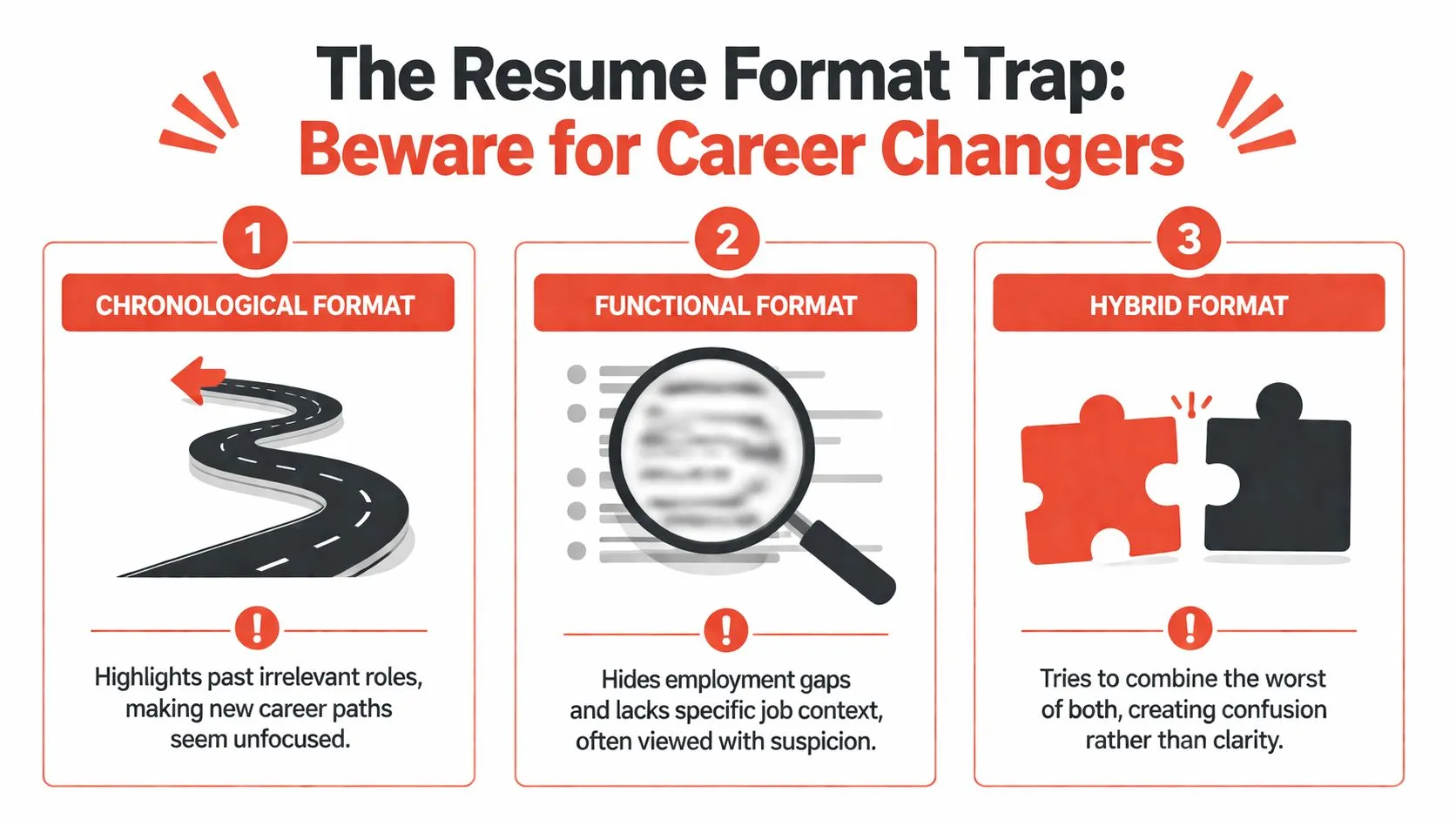
Why chronological works against you
Chronological is clean. Recruiters know how to scan it. If you’re staying in the same lane, it’s usually fine.
If you’re switching industries, it often puts the least helpful fact at the top of the page. Your last job title.
That title can trap the reader before your bullets get a chance to rescue you. “Restaurant Manager.” “Teacher.” “Military Logistics Specialist.” “Nonprofit Program Lead.” None of those titles are the problem. The problem is that a tired recruiter may stop there and decide you’re a mismatch.
A chronological resume makes your old identity loud and your transferable value quiet.
Why functional raises suspicion
Functional sounds smart in theory. Lead with skills. Minimize dates. Downplay the timeline.
In practice, it often reads like you’re hiding something.
Recruiters want context. Where did you use that skill? How recently? In what setting? “Leadership” means almost nothing without a scene, a scope, and a result. Functional resumes strip out too much of that context, which leaves claims floating in space.
That’s why they feel defensive.
Why hybrid only works when the story is real
Hybrid gets recommended for good reason. According to Herzing’s summary of career transition resume strategies, the combination format is widely recommended for career changers and can increase callbacks by 40-60% versus chronological resumes. But that same source makes the important point people skip: it fails when it’s just a skills list slapped on top of a duty-focused work history.
That’s the whole article in one sentence.
Hybrid is not magic. It’s just the least bad container. It works only when the top half and bottom half tell the same story.
| Format | What it does well | Why it fails in a career change |
|---|---|---|
| Chronological | Easy to scan, familiar, credible timeline | Leads with your old lane |
| Functional | Surfaces transferable skills fast | Lacks proof and often feels evasive |
| Hybrid | Gives you room to frame and prove | Becomes messy if the story and evidence don’t match |
Decision rule: If you use a hybrid format, every section has to argue for the same target role. Not vaguely. Specifically.
Stop asking which format wins in the abstract. None of them do. The winner is the one that helps you make a clean argument with real evidence.
Reframe Your Experience From Job Duties to Impact
Your bullets are probably too loyal to your old job description. That’s why they sound irrelevant.
Fix that first.
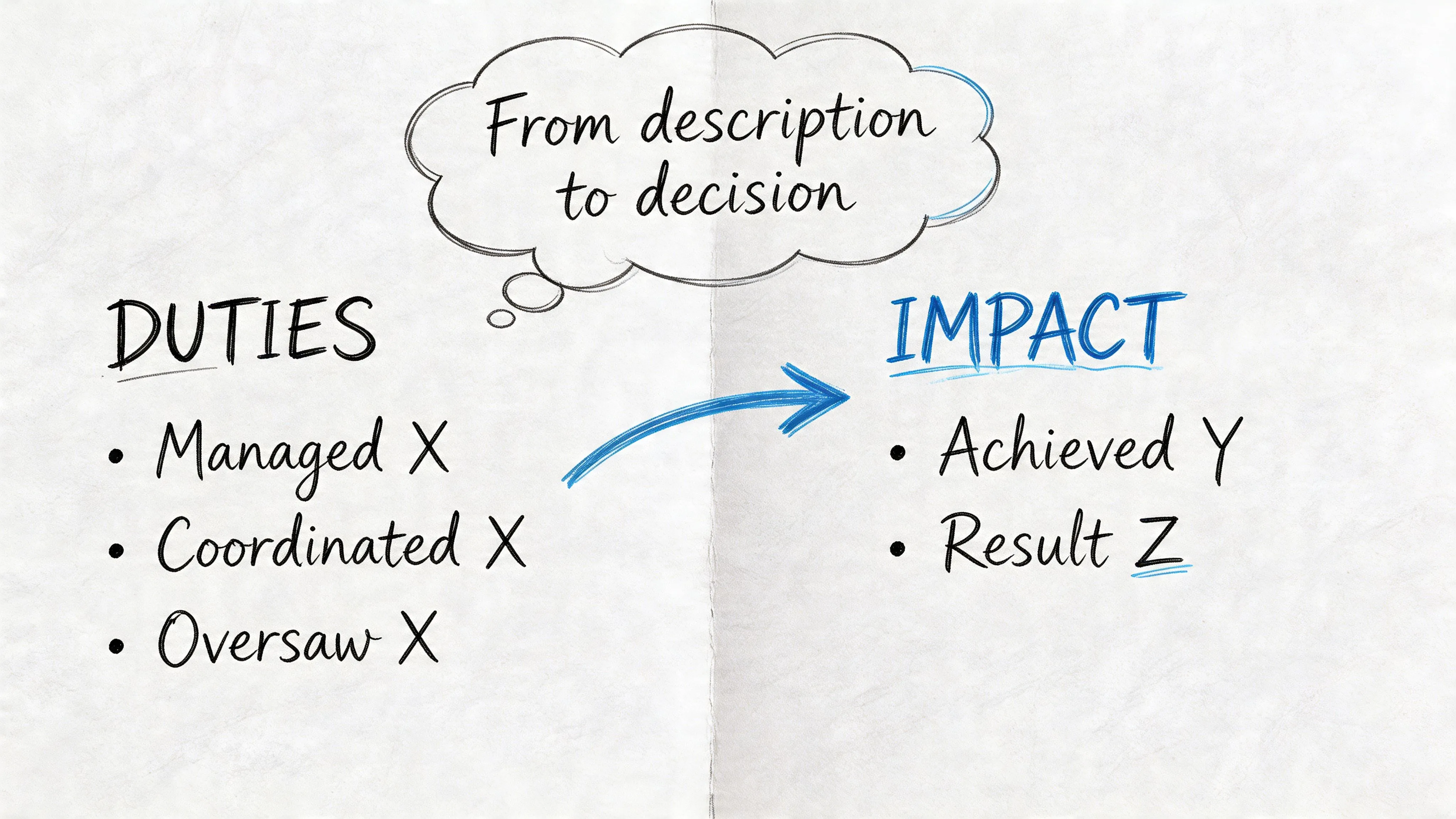
For career switchers, quantifying 80% of resume bullets is the standard to aim for, according to CVAnywhere’s career change resume guidance. That same source says an unquantified bullet like “managed a team” wastes the opportunity to show transferable value. I agree. “Managed” tells me your responsibilities. It doesn’t tell me your usefulness.
Bullets are decisions not descriptions
A weak bullet describes the surface of your work.
A strong bullet shows what changed because you were there.
Compare these:
-
Weak: Managed front desk operations and handled customer issues.
-
Strong: Resolved high-volume customer escalations, trained staff on service recovery, and improved handoff consistency across busy shifts.
The second one still isn’t perfect if you have real metrics and leave them out. But at least it points toward outcomes, systems, and repeatable judgment.
If you want more concrete rewrites in this style, StoryCV’s page of career change resume examples is worth studying because it shows the translation work, not just the final format.
Before and after examples for career changers
Here are a few real-world style translations.
Retail manager moving into operations analyst
-
Before: Responsible for store performance, staff supervision, and inventory.
-
After: Monitored daily sales and inventory patterns, adjusted staffing and stock priorities, and improved operational consistency across fast-moving store workflows.
Teacher moving into corporate training
-
Before: Developed lesson plans and taught students in classroom settings.
-
After: Designed structured learning materials, facilitated training for varied audiences, and adapted complex information for faster understanding and adoption.
Hospitality supervisor moving into customer success
-
Before: Assisted guests, handled complaints, and supported team members.
-
After: Managed service escalations, protected customer relationships during high-pressure issues, and coached frontline staff on consistent resolution practices.
Marketing manager moving into business operations
-
Before: Led campaigns and coordinated with cross-functional teams.
-
After: Drove cross-functional execution, tracked performance trends, and used reporting insights to support budget and process decisions.
Notice what changed. The facts didn’t. The lens did.
A simple translation method
Use this sequence when rewriting bullets:
-
Start with the problem you handled. Was it churn, confusion, delays, errors, training gaps, stakeholder friction?
-
Name the action in the new industry’s language. Not fake jargon. Just clearer framing.
-
Show the result. Use percentages, dollars, volumes, team size, time saved, throughput, or another real measure when you have it.
-
Cut old-industry clutter. If a term only makes sense inside your old field, swap it for the underlying business value.
“Led a 10-person team to a 20% efficiency gain” works because anyone can understand it. The old title matters less once the impact is obvious.
This quick video does a good job of showing the mindset shift from listing tasks to presenting value:
If a bullet could fit a thousand people, rewrite it. The point of resume format switching industries is not to sound acceptable. It’s to sound specifically useful.
Building Your Resume Beyond the Work History
Most career changers obsess over the Experience section because that’s where the anxiety lives. Fair enough. But the most important part of your resume often sits above it.
The top third controls the interpretation of everything that follows.
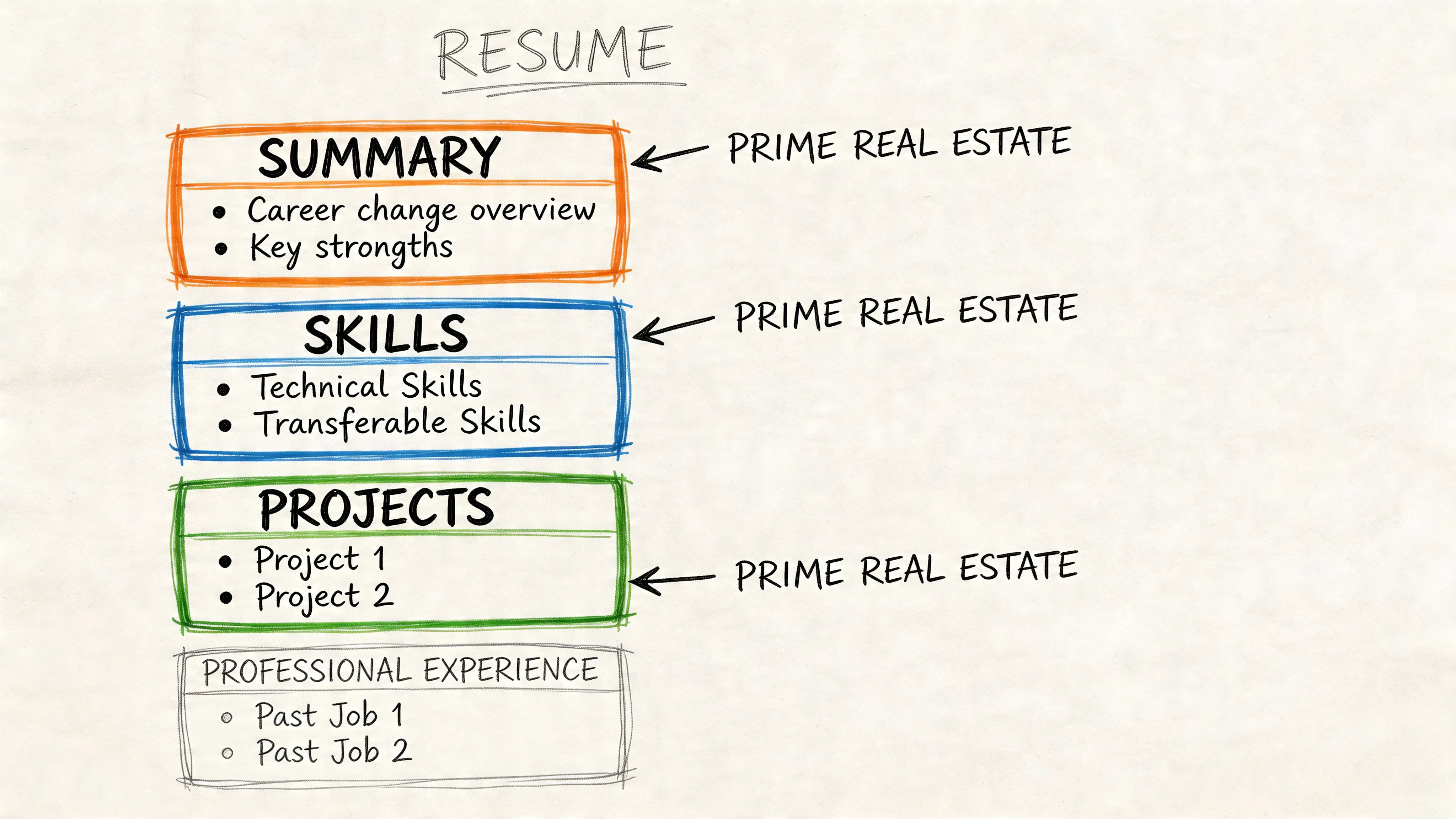
Your summary is the bridge
Your summary is not an objective statement and it’s not a personal slogan.
It’s a bridge sentence set. It should connect your old expertise, your new direction, and your strongest evidence. Short. Sharp. Specific.
For example:
Operations leader moving into business systems roles after years improving workflows, training teams, and coordinating cross-functional execution in high-pressure environments.
That works because it doesn’t apologize. It interprets.
Skills need evidence not decoration
A skills section without proof is wallpaper. It fills space and says almost nothing.
The better move is to group skills by relevance and keep them close to supporting evidence. If the job asks for stakeholder communication, process improvement, documentation, reporting, or onboarding, mirror that language where it’s true and then back it up in your bullets or project lines.
Many people misuse soft skills. They list “communication” and “leadership” because they know those traits matter, but they leave them abstract. The better approach is to convert those traits into outcomes. As Proficiently’s career change examples point out, context changes everything. “Mentored 30+ individuals” is weaker than role-specific proof such as leading code reviews and spec walkthroughs for a junior team and reducing bugs in production by 15%.
Consider this alternative:
-
Communication becomes documenting complex processes for non-experts.
-
Leadership becomes coaching a team through change with visible performance improvement.
-
Adaptability becomes learning a new system fast enough to stabilize a messy process.
StoryCV’s guide on transferable skills for career changers is especially good on this point because it treats skills as evidence-backed signals, not personality labels.
Projects prove you already started
Projects are the section career changers underuse most.
If you’ve completed a certification, rebuilt a workflow, run a side analysis, documented a system, led a volunteer initiative, or created a process that resembles the work you want next, that belongs on the page. Not hidden in LinkedIn. Not saved for the interview. On the resume.
A project section does something your old job titles can’t. It shows motion.
Use it to prove three things:
-
You’ve begun the transition: You didn’t just declare interest. You did relevant work.
-
You understand the field: Your project language shows you know what the role values.
-
You can operate in the new context: Even a small project can demonstrate tools, judgment, and communication.
If your resume format switching industries still feels awkward, it’s usually because the work history is carrying too much weight. Summary, skills, and projects should do more of the persuasion.
From Resume to Interview The Final Tailoring Steps
Your resume is not the whole story. It’s the trailer.
If the trailer and the movie don’t match, the interview goes badly.
Keep one story across every step
The best career-change applications feel consistent. Your summary introduces the pivot. Your bullets prove it. Your cover letter explains why now. Your interview examples deepen the same themes.
That matters because career changers face what one source calls the authenticity paradox. Mike McRitchie’s piece on reframing your resume mid-career puts it cleanly: adopting new industry language can make your resume feel fake, while sticking to old terms can get you filtered out by ATS. The way through is narrative. Use authentic examples from your actual past, but frame them in language the new field understands.
That same logic should shape your interview prep. If you need help turning your resume themes into answers, HypeScribe's job interview tips are a solid next step.
The last mistakes to cut
A few things to remove before you hit send:
-
Old-industry jargon: If the target role won’t recognize the term, translate it.
-
Generic summaries: “Results-driven professional” wastes precious space.
-
Skill dumping: Long keyword lists without proof don’t persuade anyone.
-
Overexplaining the pivot: You don’t need a confession. You need a case.
-
Mismatched document logic: If your top section says one thing and your bullets say another, the resume breaks.
Your resume for a career change is not a record of where you’ve been. It’s a disciplined argument for where you belong next.
StoryCV is a Digital Resume Writer built for this exact problem. Not a template library. Not a builder that makes you fill boxes and hope for the best. It uses a guided interview to pull out the context, impact, and transferable value buried inside your experience, then turns that into a resume that sounds like a real person with a clear case to make. If your current resume still feels like your old career talking, StoryCV helps you write the version that points forward.