You're probably not asking whether resumes matter. You already know they do. You're asking whether paying someone a few hundred, or a few thousand, is a smart move, or just expensive panic.
My take: for most mid-career professionals, the answer isn't a clean yes or no. It depends on the job you need the resume to do. Not the document. The job.
The Wrong Question to Ask
Two hundred dollars on the low end. Up to $2,500 on the high end. That's the normal price range for professional resume writing in North America, depending on level and package quality. So people default to the obvious question: is paying for a resume writer worth it?
Usually, that's the wrong question.

The better question is: what problem are you trying to solve?
If you're a mid-to-senior professional, you probably don't have a “resume problem.” You have a translation problem. You've done strong work. Led projects. Fixed messy systems. Made decisions that mattered. But when it's time to write it down, it all comes out flat.
Three paths, not one decision
This is why the yes-or-no debate is dumb. You're really choosing between three paths:
| Path | What you get | Main downside |
|---|---|---|
| Human writer | Strategy, reframing, outside judgment | High cost, slower process |
| DIY builder | Full control, low spend | High effort, weak thinking support |
| AI writer | Guided drafting, speed, structure | Quality depends on the system and your input |
That's the choice.
Some people need a strategist. Some need a structured way to think. Some just need help pulling their own story out of their head without paying premium rates for hand-holding.
A resume bullet is a decision, not a description.
That matters because the market for resume help is huge. The global resume writing service market was valued at $2.9 billion in 2025 and is projected to grow to $5.6 billion by 2034 according to Dataintelo's resume writing service market report. That tells you a lot of people are paying for help. It does not tell you the expensive option is the right one for you.
The real job to be done
For most professionals with 3+ years of experience, the job isn't “make my resume sound polished.”
It's this:
- Pull out the work that actually matters
- Frame it for the role I want next
- Make it readable by both ATS filters and actual humans
- Do it without turning my experience into generic corporate sludge
If you judge the decision through that lens, the answer gets clearer fast.
The True Cost of Hiring a Resume Writer
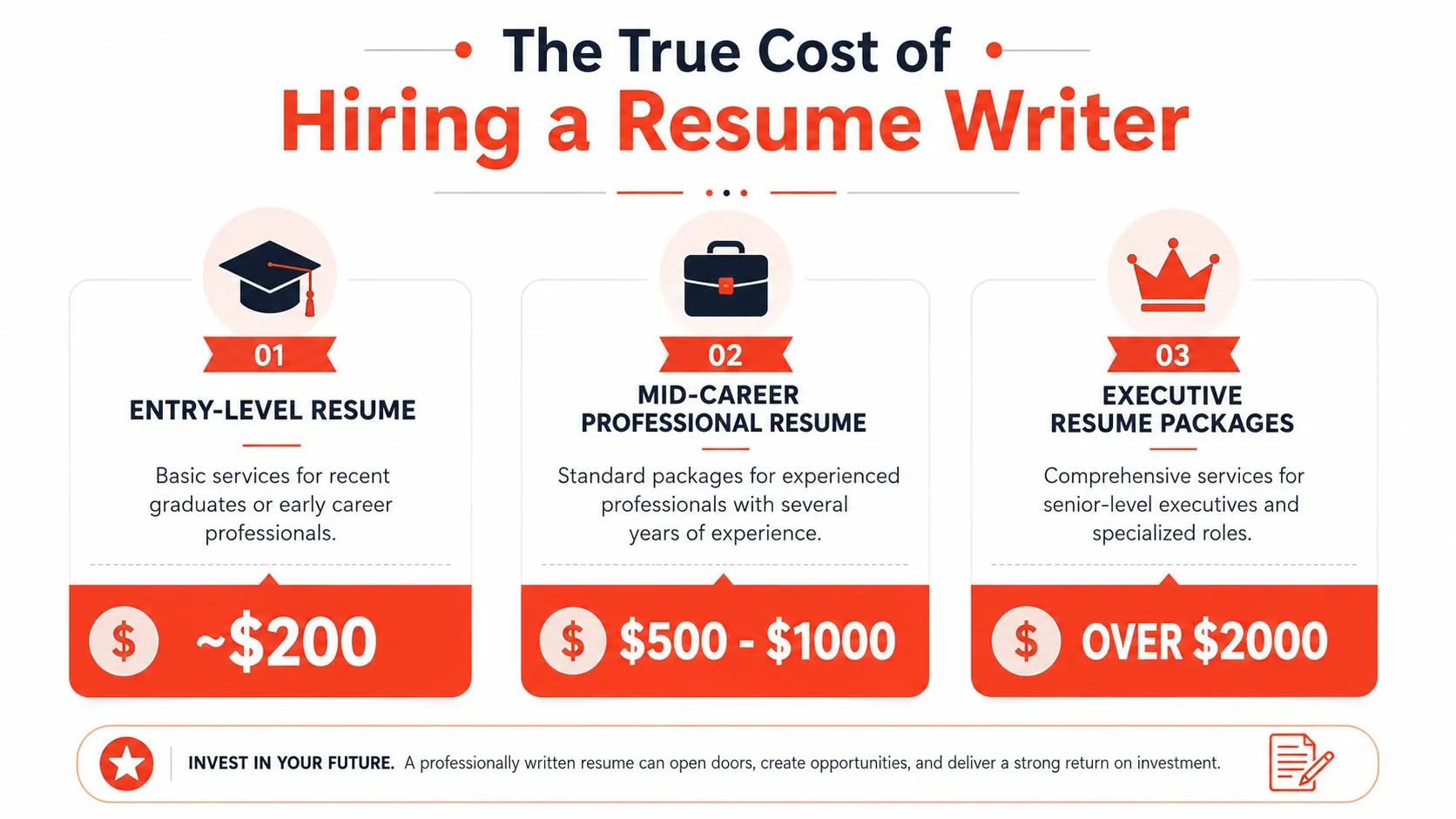
The price tag is real. In North America, professional resume writing services typically cost between $200 and $2,500, and for a mid-career professional earning $70,000, a $700 resume equals 1% of annual salary, according to ResumeSpice's breakdown of average resume writer cost.
That's not a small purchase. It's a financial decision.
What you're actually paying for
A good writer isn't just fixing grammar. They're supposed to do four things well:
- Interrogate your experience so vague tasks become outcomes
- Shape a narrative that fits the target role
- Handle ATS basics without writing for robots only
- Edit hard so the resume sounds focused, not bloated
That last part matters. A lot of people confuse writing help with cleanup. But editing and proofreading are not the same thing. If you need a clean breakdown of that difference, this guide on differentiate copy editing and proofreading is useful because resume work often requires deep rewriting, not just typo correction.
The hidden costs are not on the invoice
Money is only one part of the bill.
A human writer usually means intake forms, calls, follow-ups, revision rounds, waiting, and then more waiting if the first draft misses your voice. If you're in a live job search, that friction matters.
There's also a quality risk. Expensive doesn't automatically mean sharp. Plenty of resume services charge premium rates and still produce the same stiff, sanitized copy for everyone.
Practical rule: If the process sounds like “send us your old resume and we'll take it from there,” expect generic output.
You also need to separate content work from surface work. If the pitch leans on formatting, colors, or a “modern template,” be skeptical. The core question is whether the writing clarifies your value.
If you want a broader view of what hiring help should include, this piece on what to look for when hiring a resume writer covers the substance well.
My opinion on the cost
For most mid-career professionals, paying for a human writer only makes sense if the writer is solving a thinking problem, not just a wording problem.
If all you need is cleaner phrasing, the price is hard to justify.
If you need someone to extract, order, and sharpen years of work into a credible next-step story, then the spend can be rational. But only if the output is indeed strategic.
When a Human Writer Is a Smart Investment
To be blunt, sometimes paying a human writer is absolutely worth it. Just not for everyone.
If you're aiming for an executive role, making a major career leap, or trying to reposition a messy, multi-stop career into one coherent narrative, a strong human writer can do work that cheaper options often can't.
The right use case
A human writer earns their fee when the situation is high stakes and high complexity.
That usually looks like this:
- Executive search where the story has to signal scope, judgment, and leadership fast
- Industry pivot where your past experience needs translation, not just editing
- Long career history that needs pruning and reframing without losing credibility
- Sensitive positioning where title changes, consulting work, gaps, or overlapping roles need careful handling
For this group, you're not buying sentences. You're buying perspective.
Where the ROI can be real
According to Wishing Well Coach on when a professional resume writer makes sense, for candidates targeting drastic career leaps or executive roles, a quality writer costing $550 to $1,000+ can shorten job search timelines by 30% to 50% by building accomplishment-driven narratives that connect with hiring managers.
That's the clearest case for paying up.
If your next move has real compensation upside, or you're trying to cross a credibility gap, speed matters. A better resume won't get you hired by itself, but it can stop weak framing from blocking you before the conversation starts.
What a good human writer actually does
A good writer will challenge your assumptions. They'll ask what changed because you were there. They'll push past task lists. They'll notice the pattern in your career that you can't see because you're too close to it.
A bad writer will just make you sound more corporate.
Here's the dividing line:
| Good human writer | Bad human writer |
|---|---|
| Extracts real outcomes | Adds buzzwords |
| Presses for context | Recycles templates |
| Writes for target roles | Writes one generic version |
| Preserves your voice | Replaces it with jargon |
If you're deciding between AI and a person for this kind of transition, this comparison of AI resume writer vs human writer is worth reading.
If your career move is simple, don't pay for executive-level strategy. If your career move is complicated, don't cheap out and expect a template to save you.
That's the line.
Red Flags and What to Ask Before You Pay
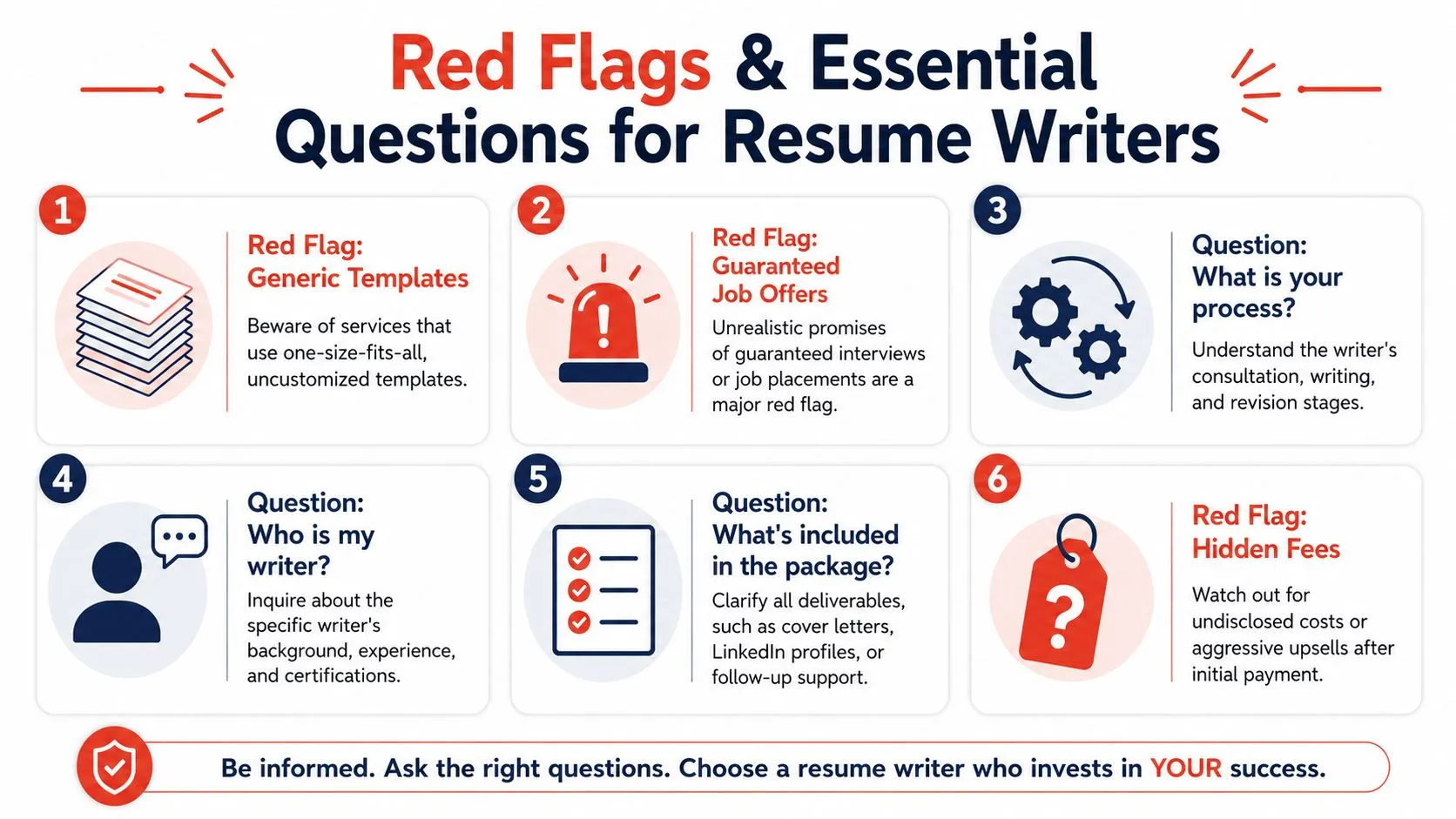
A lot of resume writers are selling confidence, not craft. You need a filter.
Start with this. If the writer can't explain how they'll get from your experience to a sharper narrative, don't hire them.
The biggest risk people miss
The usual warnings are obvious. Cheap service. Big promises. Fancy template. Thin substance.
The more dangerous problem is the narrative echo chamber. That's when a writer gives you a resume full of polished, generic language that technically sounds impressive but doesn't sound like a real person who did real work.
According to Intrico's discussion of paying for resume help, 72% of recruiters reject resumes in phone screens that feel over-polished or generic, even if they pass ATS checks, because they lack authentic voice.
That number should get your attention.
A resume can survive the software and still die the moment a recruiter thinks, “This sounds fake.”
Here's a quick video that covers common pitfalls in the hiring process:
Questions worth asking
Don't ask whether they're certified first. Ask whether they can think.
Use questions like these:
-
How do you learn the specifics of my work?
If the answer is “we use a questionnaire,” that's incomplete. You want probing, not form filling. -
How do you avoid generic language?
If they can't answer this clearly, they probably don't. -
Can you tailor this for the roles I'm targeting?
A writer who doesn't ask for job descriptions is writing backward. -
Who is writing the resume?
You need to know whether the work is done in-house, outsourced, or passed through a resume mill. -
What is included after the first draft?
Revisions matter. So does response quality when you push back on wording.
Red flags that should end the conversation
- Guaranteed job offers or guaranteed interviews
- Suspiciously cheap pricing paired with fast turnaround
- A pitch centered on design, not content
- No industry examples
- No clear revision process
- Language that sounds like everyone else's resume
“Can you show me how you'd turn one of my bullets into a stronger one?”
If they won't do that, they probably can't.
The DIY Trap and Smarter Alternatives
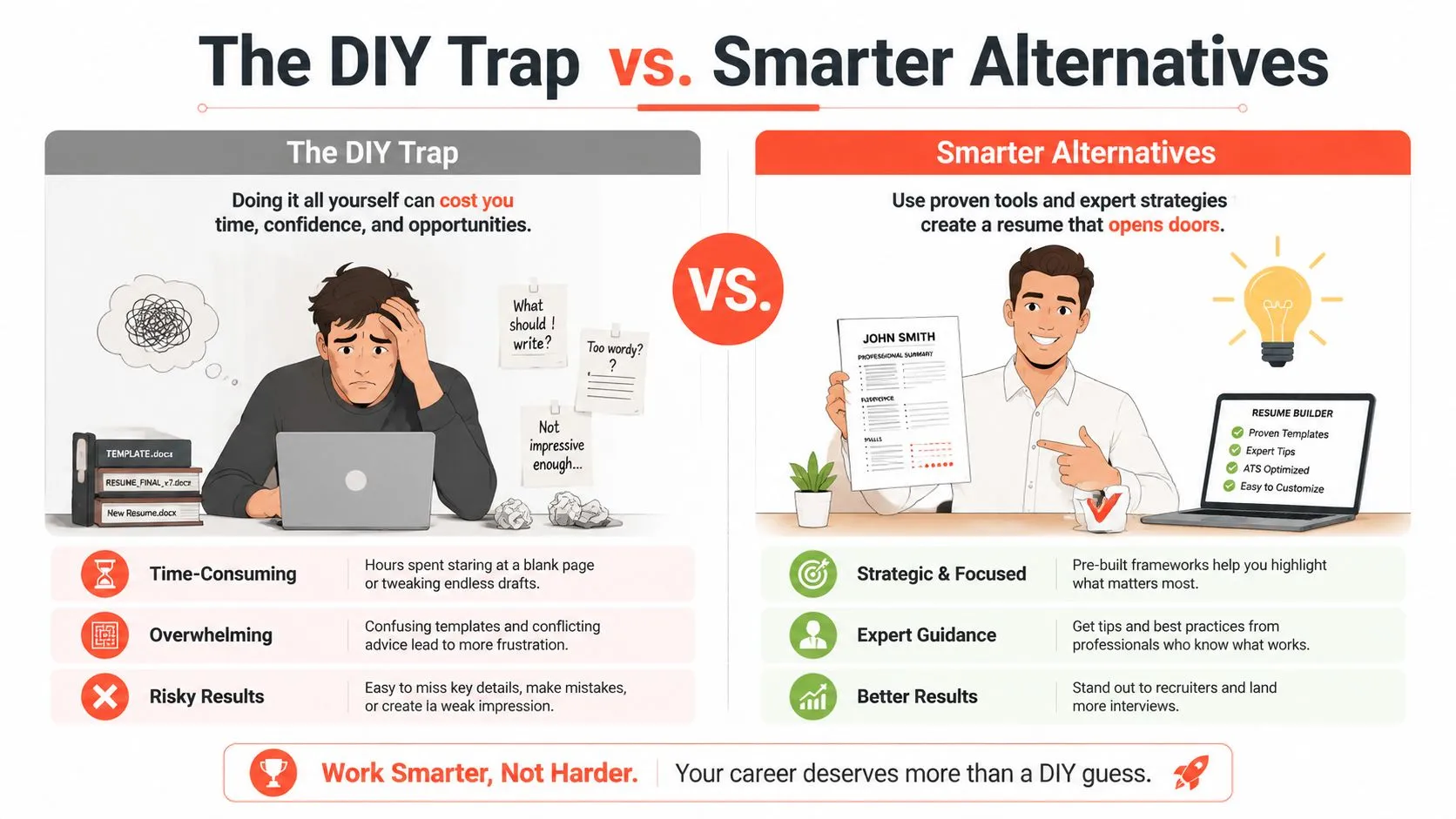
DIY sounds cheap. It often ends up expensive in time, energy, and missed opportunities.
The trap is thinking resume writing is a formatting task. It isn't. It's a thinking task. The hard part isn't choosing a font. It's remembering what mattered, naming it clearly, and matching it to the job you want.
Why builders fail smart people
A lot of capable professionals get stuck because builders ask for output before they've helped you think.
They give you boxes for summary, experience, and skills. Fine. But boxes don't tell you which projects matter. They don't challenge weak bullets. They don't ask what changed because of your work.
That's why so many DIY resumes end up as job descriptions with line breaks.
According to Hired Resume's analysis of what professional resume services actually improve, effective resumes require rewriting 70% to 80% of bullet points to mirror job descriptions and include measurable achievements. That's the real work. Not formatting.
The middle ground that makes sense
The AI writer category is useful. Not generic AI chat. Not a dumb builder. An actual online resume writer that guides the thinking process.
Used well, this middle ground does three important things:
- Prompts for context instead of asking you to invent polished bullets from scratch
- Turns rough memory into clearer outcomes
- Gets you to a strong draft quickly, without the cost and delay of hiring a person
For mid-career professionals in tech, business, ops, finance, and similar fields, that's often the sweet spot. You keep ownership of your story, but you stop doing all the editorial heavy lifting alone.
If you work in a field where positioning matters a lot, these CV tips for finance and data roles are a useful reminder that strong resumes depend on specificity, not generic competence claims.
One example in this middle ground is StoryCV's take on affordable resume writing services, which frames the category well. It uses a guided interview approach to pull out real achievements and draft the content fast, which is very different from a template library or a blank builder.
My opinion on DIY
If you're a strong writer who already knows exactly how to position yourself, DIY can work.
Those who think they should DIY don't need full DIY. They need structured extraction. Some way to get the right stories out without paying premium human-writer fees.
That's the smarter alternative.
The Final Verdict Your Action Plan
Here's the shortest honest answer to is paying for a resume writer worth it.
Entry-level: usually no.
Mid-career: often not for a human writer, yes for guided writing help.
Executive or major pivot: often yes, if the writer is genuinely strategic.
If you're entry-level
Don't spend heavily on a professional writer.
The return usually isn't there. This guidance on entry-level resume writer ROI is right. Hiring a professional resume writer is not recommended for entry-level job seekers due to insufficient ROI at that stage.
You don't have enough complexity yet to justify premium narrative help. Focus on clarity, relevance, and basic tailoring. Save the money.
If you're mid-to-senior and stuck
This is the group I care most about because you're the one most likely to waste money.
You've done good work. You just can't see your own strongest material clearly. That doesn't automatically mean you need a human writer. It means you need help with articulation.
Pick the path based on the actual blocker:
- Choose DIY if you're a strong writer, have time, and can translate your work into outcomes without much support.
- Choose an AI writer if your real problem is extraction, structure, and speed.
- Choose a human writer only if your career story is unusually complex or high stakes.
That's the practical answer. Not “it depends.” That.
If you're changing careers or aiming high
Spend more only when the upside is real and the narrative challenge is hard.
A serious pivot, executive move, or unusually layered background can justify the premium because the document has to do heavier lifting. In those cases, the right writer is closer to a strategist than an editor.
One more thing. Your resume is only part of the search. Once it's sharp, you still need better visibility, outreach, and positioning. If that's a weak spot, this B2B guide for LinkedIn success is worth a read for practical profile and networking ideas without the usual fluff.
Your goal isn't to buy a prettier resume. Your goal is to make your experience legible, credible, and compelling fast enough to get into real conversations.
If you're mid-career, that's the standard.
If you want help turning solid experience into a sharper resume without hiring a traditional writer, StoryCV is built for that middle ground. It works like an online resume writer, using a guided interview to pull out real achievements and draft content that sounds like you, not a template.