Most licensed practical nurse resumes fail for the same boring reason. They read like task logs. Hiring managers don't need a diary of what you touched. They need proof that you noticed the right things, acted fast, and made care safer or smoother.
That's the shift. A strong licensed practical nurse resume doesn't just say you worked. It shows judgment. In a market this large, that matters, because the Bureau of Labor Statistics reported 651,400 employed licensed practical and licensed vocational nurses in May 2024, with 54,400 openings per year on average projected from 2024 to 2034 and 3% projected growth over that same period. Employers can compare a lot of similar candidates, so the resumes that clearly show scope, setting, and outcome win the first look BLS occupational outlook for licensed practical and licensed vocational nurses.
Your LPN Resume Is a Clinical Note Not a To-Do List
A clinical note tells the truth quickly. It doesn't ramble, and it doesn't waste space on what everyone already knows. Your resume should work the same way, it should show what happened, what you handled, and what changed because you were there.
Practical rule: if a bullet could describe any LPN in any unit, it's too weak.
The biggest mistake I see is not a lack of experience. It's a weak translation of experience. “Provided patient care” tells me almost nothing. Did you handle high-volume long-term care, med pass, wound care, admissions, family education, or escalation to the RN? Those are different jobs wearing the same badge.
The labor market backs this up. The BLS projects about 54,400 openings per year for licensed practical nurses on average from 2024 to 2034 BLS occupational outlook for licensed practical and licensed vocational nurses. That isn't a tiny niche where vague bullets slip through. It's a large replacement-driven market where a recruiter can compare similar resumes in seconds.
So don't write for sympathy. Write for screening. Your resume needs to prove that you understand patient load, documentation, setting, and outcomes. That's the difference between “I showed up and did tasks” and “I kept care moving under pressure.” One gets ignored. The other gets a callback.
How to Structure Your LPN Resume for a 10-Second Scan
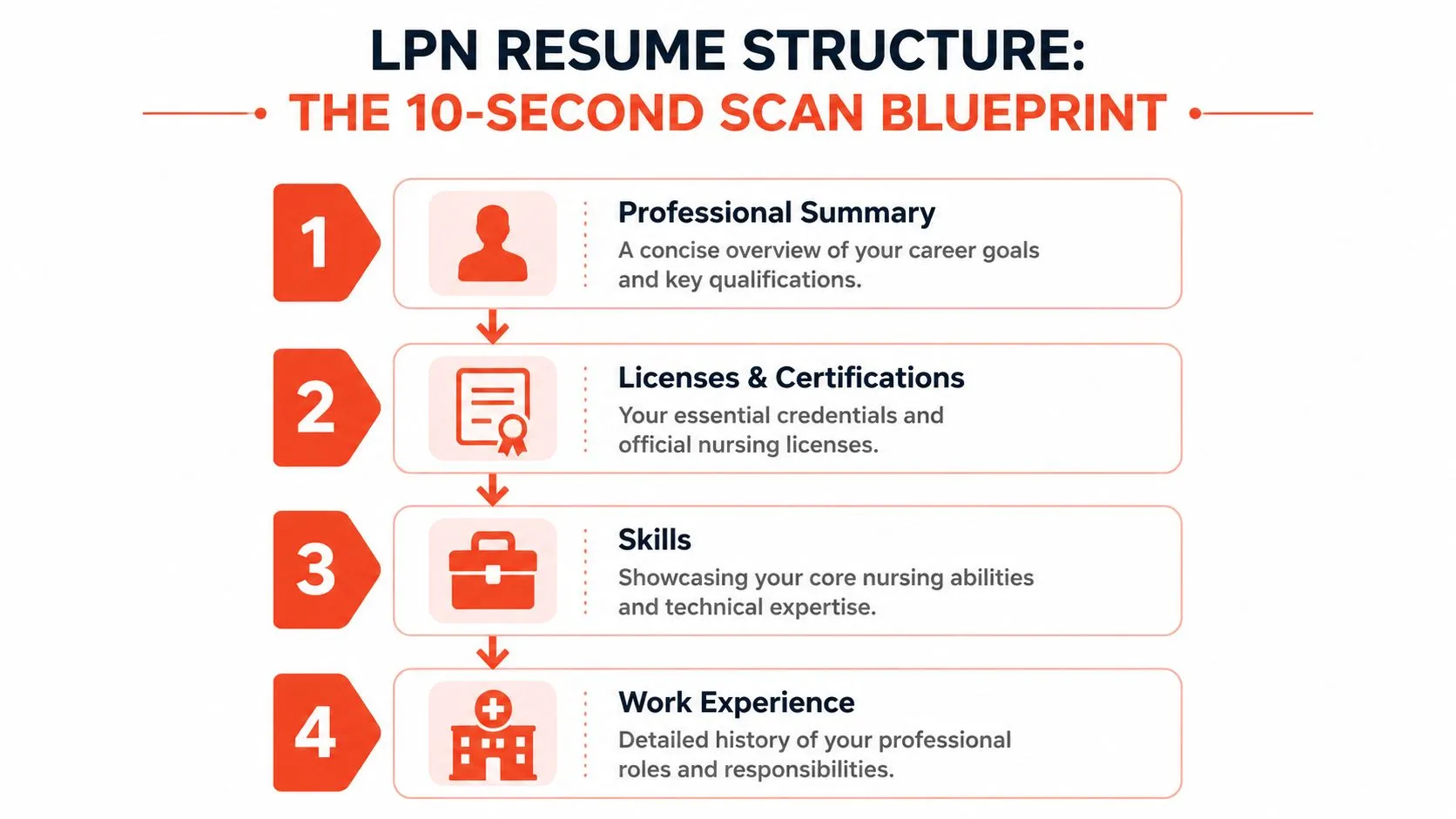
Put the most important credentialing information where tired humans and software can see it fast. For an LPN, that means the resume opens with your Professional Summary, then Licenses & Certifications, then Skills, then Work Experience, then Education. Don't bury your license under work history. That's backwards for this role.
Start with what gets screened first
Recruiters and ATS both look for proof that you're eligible and relevant before they care about the story. A high-signal LPN resume places the license and certifications first, followed by a clinical skills block, then reverse-chronological experience Articuler LPN resume guide. That order isn't cosmetic. It matches how nursing applicants get filtered.
Use a one-page resume if you've got under 10 years of experience, keep body text at 10–12 pt, and headings at 12–14 pt, and skip graphics, photos, and weird layout tricks because they can confuse ATS parsing ProRes AI LPN resume guide, Resume Now LPN examples. A clean page beats a fancy one every time.
For categories, think simple. Your summary should say who you are and where you work best. Your skills should show the clinical language hiring teams screen for. Your experience should prove you've used those skills in real settings. If you need a refresher on how resume categories work, use this resume category guide as a quick reference.
Keep the order boring and effective
Here's the structure I'd use every time:
- Professional Summary. Two or three lines, not a biography.
- Licenses & Certifications. Put the state license first.
- Skills. Group clinical and technical skills together.
- Work Experience. Reverse chronological, with achievement bullets.
- Education. Keep it clear and plain.
That order gives the reader the facts they need before they read your story. It also keeps you from hiding your strongest evidence in the wrong place.
Turn Patient Care Duties into Compelling Impact Statements
Most LPN resumes fall apart. People list duties like they're copying from a job description, then wonder why nothing lands. Recruiters already know an LPN helps with care. They want to know how much, in what setting, and with what result.
Write bullets that show scope, setting, and outcome
Most guides still push the same lazy formula, list duties, add keywords, stop there. That's weak advice. Generic statements like “provided patient care” are explicitly called out as weak because they don't separate one candidate from another Monster LPN resume template.
Use this structure instead:
- Action. What did you do?
- Scope. How many patients, residents, or charts?
- Setting. What kind of unit or facility?
- Outcome. What improved, sped up, or stayed accurate?
A bad bullet says, “Monitored vital signs.” A better one says, “Monitored and documented vital signs for a busy long-term care assignment, escalating changes quickly to the RN to support timely intervention.” That second version tells me you understand urgency, handoff, and judgment.
Need a cleaner formula? Start with a strong verb, add the volume, then name the clinical context, then close with what your work protected or improved. Don't stuff every bullet with every detail. One good bullet does one job.
Strong resumes don't describe nursing in general. They describe your unit, your pace, and your impact.
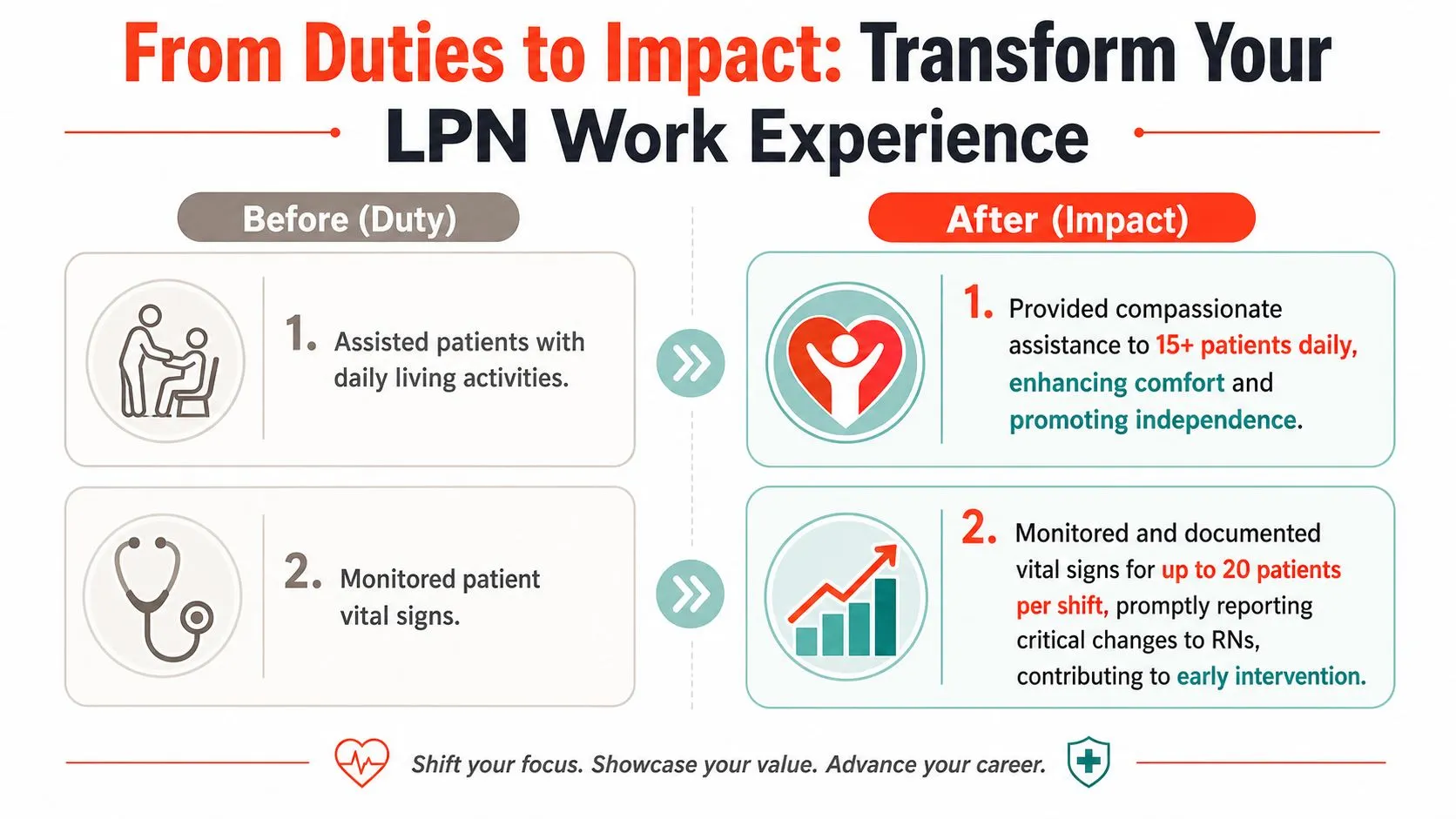
Before and after examples that actually work
Before: Assisted patients with daily living activities.
After: Provided compassionate assistance to 15+ patients daily in a long-term care setting, supporting comfort, mobility, and independence.
Before: Monitored patient vital signs.
After: Monitored and documented vital signs for up to 20 patients per shift, then reported critical changes to the RN to support early intervention.
Before: Administered medications.
After: Administered scheduled medications in a fast-paced unit, keeping documentation accurate and maintaining safe handoff communication.
Before: Educated patients.
After: Reinforced discharge and self-care instructions with patients and families, helping them understand follow-up care and warning signs.
That's the level of detail that gets attention. It's not about sounding impressive. It's about sounding specific.
If you've got a caregiving background, a return-to-work gap, or a non-linear path, pull the same method into your caregiver resume experience. The evidence may come from rotations, family care, or prior healthcare roles, but the writing rule stays the same. Show what you handled, not just that you helped.
Listing Your LPN License and Certifications Correctly
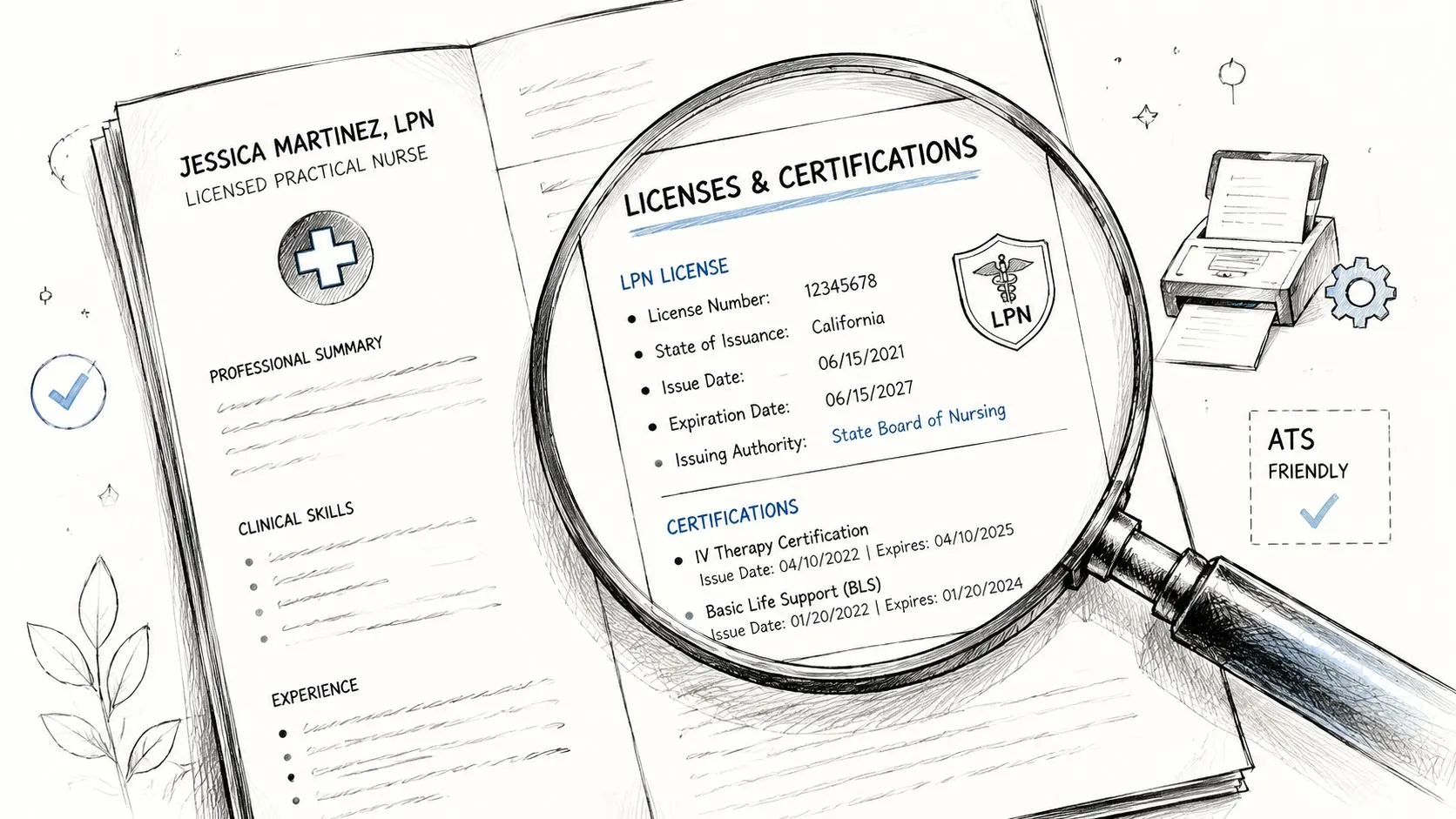
This section should be clean enough to survive a fast scan without effort. Put your licensure in a blunt, standard format. No clutter. No creative writing. The employer wants to see that you're active, current, and qualified.
Use a format that's easy to read and easy to verify
Write it like this:
Licensed Practical Nurse
State of [State Name], License #[Number]
Issue Date, Expiration Date
Then add certifications in a separate line or short list:
- BLS
- ACLS
- PALS, if relevant
- IV Certification, where required
LPN resume advice consistently emphasizes the state license number, issue date, and expiration date, and those credentials often work as screening keywords Practical Nursing LPN resume job application guide. Don't hide them in education or tuck them into a paragraph. Put them where they can't be missed.
A simple layout also helps if you're comparing your own format against a different healthcare standard. For nurses updating documentation and credentials across regions, the updates for Australian nurses page is a useful reminder that credential formatting changes by market, but clarity never goes out of style.
Keep the section honest and current
Don't list an expired certification unless you're actively renewing it. Don't pad the section with irrelevant badges. Put the credentials that matter for the role. If the job asks for IV skills, show IV certification. If it doesn't, don't pretend a long list makes up for weak experience.
If you want a clean model for formatting these lines, use a certifications placement guide and adapt it to your nursing credentials. The goal is simple, make licensure impossible to miss and easy to trust.
Avoid These Common LPN Resume Mistakes
Most bad LPN resumes don't fail because the nurse wasn't good at the job. They fail because the page was bloated, vague, or lazy. That's fixable. And fixing it gives you a real edge.
Stop making the easy mistakes
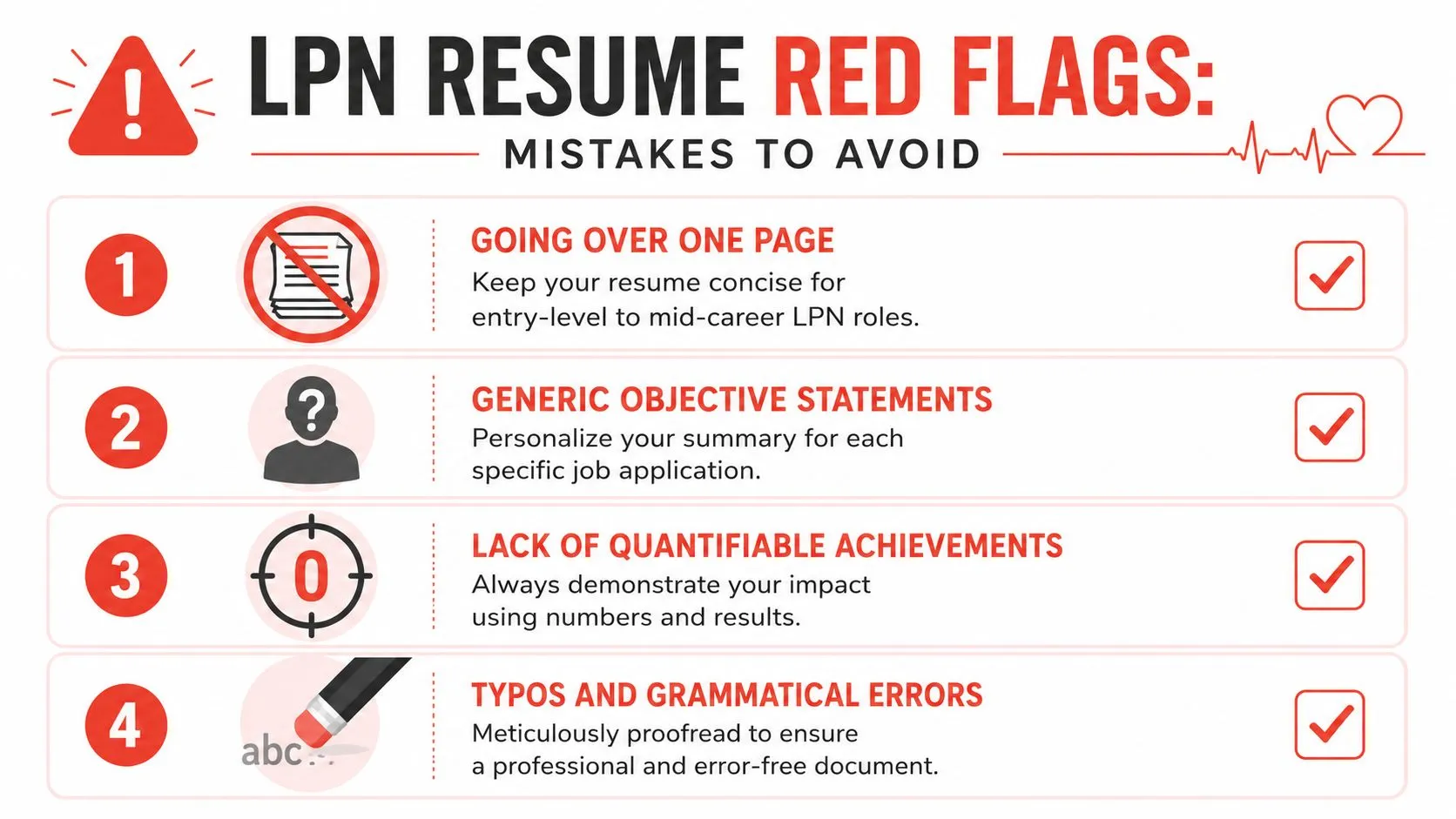
- Going over one page. Multiple LPN guides recommend one page for candidates with under 10 years of experience, because brevity helps you pass the first recruiter scan Resume Now LPN examples. A two-page resume for a mid-career LPN usually says, “I didn't prioritize.”
- Writing an objective instead of a summary. An objective is often about what you want. A summary tells the employer why you're useful right now. Hiring managers care about the second one.
- Using generic language. If your bullets all sound like “helped patients,” “worked with team,” and “did charting,” you're blending in. That's not safe. That's forgettable.
- Listing soft skills without proof. “Compassionate” means nothing if the resume doesn't show patient education, calm escalation, or careful documentation under pressure.
- Skipping the tailoring step. If the job asks for wound care, med pass, or EHR experience and your resume doesn't echo that language, you're making screening harder for no reason.
Make the page earn its space
A tight page forces discipline. That's a good thing. It makes you choose the experience that matters for the role instead of dumping everything you've ever done into the file. Good resumes are edited hard. Bad resumes are just longer.
If a detail doesn't help the employer picture you in the role, cut it.
Proofread for basics too. Typos and sloppy formatting read as careless in a field where accuracy matters. You don't need a flashy design. You need a resume that's easy to trust, easy to scan, and easy to match to the job.
Your Resume Is Ready What Now
Your next move is simple. Rewrite the work history so every bullet shows scope, setting, and impact, then make sure your license and certifications sit near the top where they belong. That's how you stop looking like every other applicant and start reading like a nurse worth interviewing.
If your feet hurt after long shifts, that's a reminder that the job already takes enough out of you. Keep your resume just as practical as your shoes, and if you want a useful break from the job hunt grind, you can also find all-day comfort for nurses.
StoryCV turns rough work history into clear resume copy that shows impact instead of filler. If you want a licensed practical nurse resume that sounds like a real nurse wrote it, visit StoryCV and start shaping your experience into bullets that get read.