Every caregiver resume online seems to offer the same bad advice. Copy a list of duties. Mirror the job posting. Add “assisted with ADLs,” “meal prep,” “medication reminders,” and call it done.
That's exactly why most caregiver resumes disappear.
I get why people do it. Care work is hard to explain. It's repetitive on the surface, human beneath the surface, and much of the value lives in judgment, trust, and quiet problem-solving. So copying the standard duties feels safer than trying to describe what occurred. Safe, but useless.
Your Caregiver Resume Looks Like Everyone Else's
The problem with most advice about caregiver duties on a resume is that it tells you what the role included, not what made you good at it. A hiring manager already knows caregivers help with bathing, grooming, meals, mobility, safety, transportation, and companionship. If your resume just repeats that, you haven't added information. You've added wallpaper.
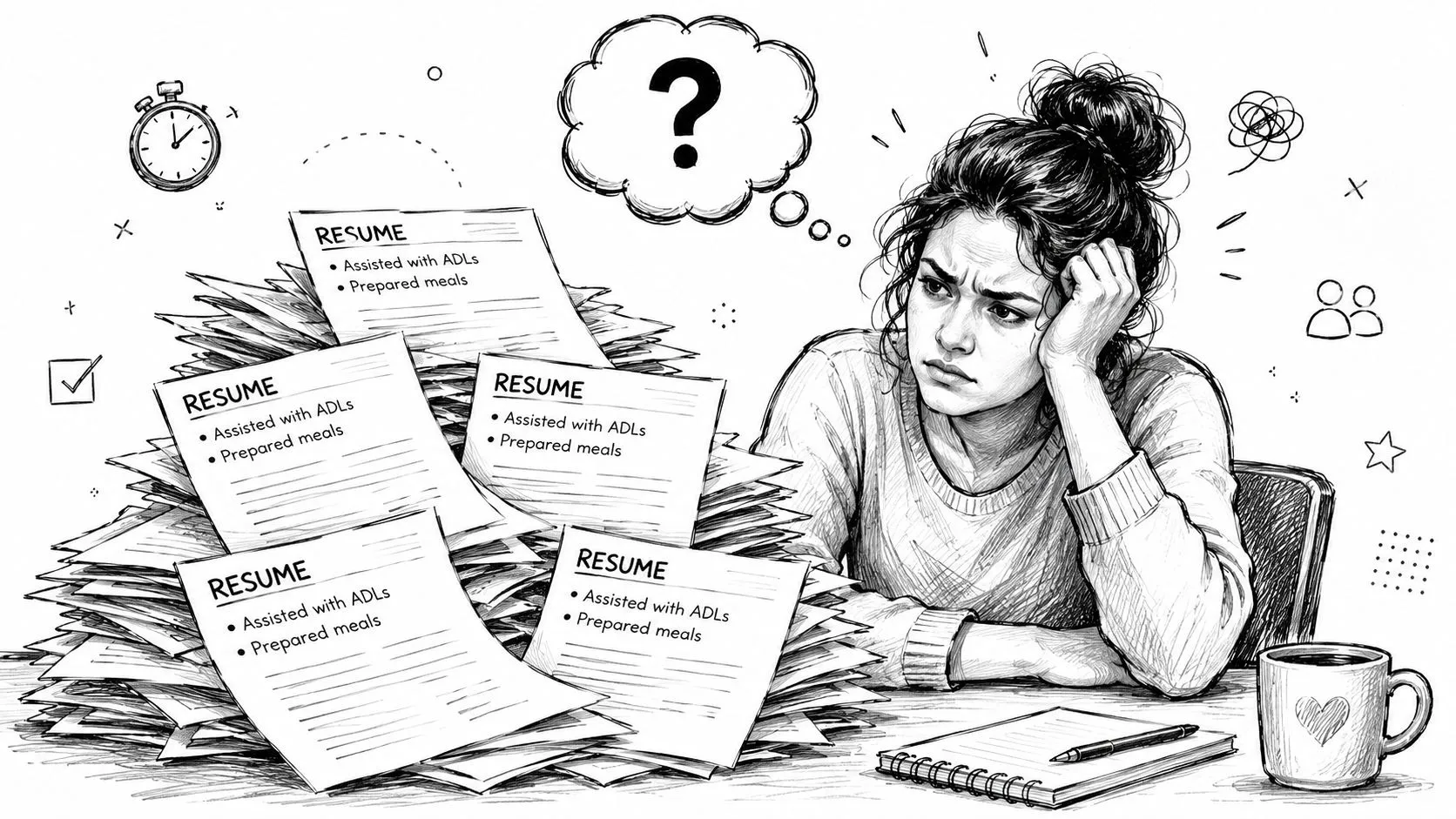
This is why the copy-paste approach costs you. It makes you interchangeable. Your resume could belong to any home health aide, personal care assistant, elderly caregiver, or nanny who grabbed the same list from the same search results.
The duty list isn't wrong. It's incomplete.
Caregiving is substantive work done by millions. About 53 million U.S. adults serve in caregiving roles, and the work commonly includes household tasks, self-care tasks, mobility assistance, emotional and social support, and health management, as noted by Wake Forest's caregiving resume guidance. The experience is real. The burden is real. The responsibility is real.
What's missing from the generic resume is your version of that work.
A duties list tells me what the job was. It doesn't tell me what happened because you were the one doing it.
That's the whole game. Employers don't need proof that caregiving exists. They need proof that you noticed problems, made decisions, and handled responsibility well.
Why people reach for the generic version
Because the work doesn't always turn into neat, flashy metrics. A lot of it is relational. You calmed someone down. You adjusted a routine. You caught a pattern before it became a crisis. That's hard to squeeze into one line.
So people fall back on the task list. It feels factual. It feels ATS-friendly. It also strips out judgment, which is the most valuable part of the job.
A Resume Bullet Is an Outcome Not a Task
Stop trying to find a fancier synonym for “assisted.” That's not the issue. Your vocabulary isn't failing you. Your framework is.
A strong resume bullet is not a task description. It's a compressed story about a problem, the choice you made, and what improved. That's true in any field. It matters even more in caregiving because so much of the work looks identical until you explain the context.
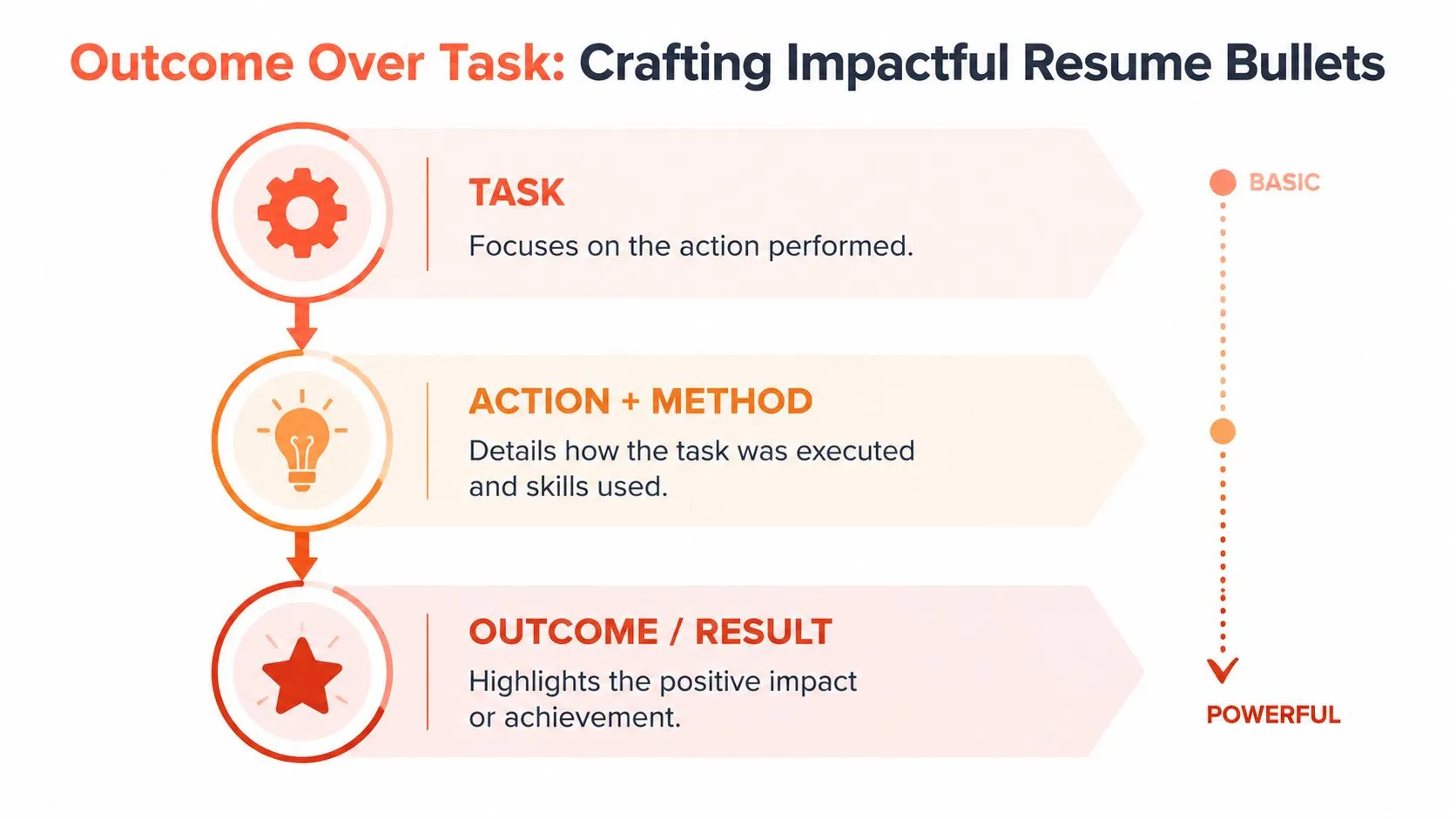
What most bullets do by listing caregiver resume duties
They name the action.
| Weak bullet type | What it says | Why it fails |
|---|---|---|
| Task only | Assisted with daily living activities | Too broad |
| Task only | Administered medication | Says nothing about reliability |
| Task only | Provided companionship | Sounds kind, not capable |
What good bullets do
They show how you handled the work and what changed.
For caregivers, that might mean a safer transfer routine, better medication consistency, cleaner communication with family, stronger documentation, or a calmer daily schedule. General caregiver job descriptions emphasize documentation, home safety, mobility assistance, and coordination with clinicians, which is why those details make strong raw material for bullets when you attach real context to them in Indeed's caregiver job description guide.
Practical rule: The duty is the raw material. The bullet is the judgment.
If you need a cleaner framework for writing this way, read StoryCV's guide on how to write resume bullet points. The core idea is simple. Don't write what you were assigned. Write what you handled.
How to Rewrite Your Caregiver Duties in Resume
Don't ask, “What duties should I include?” Ask, “Where did I make the situation better?”
That question forces you out of checklist mode.
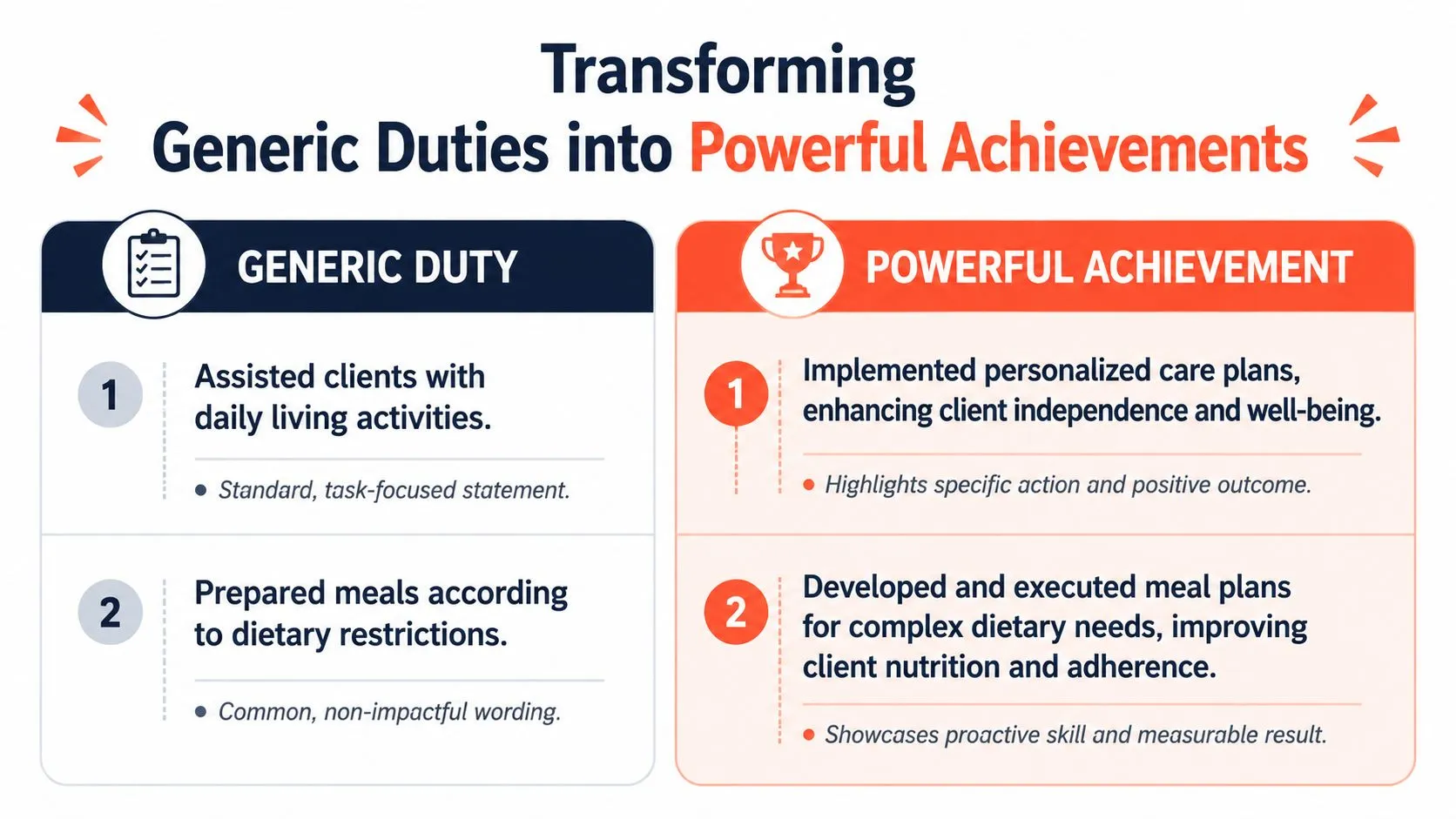
Rewrite one from ADLs to judgment
Before
Assisted clients with daily living activities.
That bullet is true, and nearly worthless. “Daily living activities” covers bathing, dressing, eating, toileting, mobility, and grooming. It tells me nothing about the situation.
After
Adjusted morning care routines for a client with mobility limitations by breaking transfers and dressing into a slower, repeatable sequence, improving safety and helping the client stay more independent during daily care.
See the difference. Same domain. Different level of thinking.
The useful questions behind that rewrite:
-
What was hard: Was the client resistant, fatigued, unsteady, confused, or embarrassed?
-
What did you decide: Did you change timing, sequence, communication style, or equipment use?
-
What changed: More independence, calmer routines, better safety, more trust from family.
Rewrite two from medication to control
Before
Administered medication and monitored adherence.
Still generic. It sounds like you touched the medication process. It doesn't show whether you managed it well.
After
Created a simple medication tracking routine with documented reminders and family updates, maintaining 95% adherence and giving relatives clear visibility into daily follow-through, as reflected in examples from MyPerfectResume's caregiver resume guidance.
That works because it shows process control. It also uses one of the few caregiver metrics that is meaningful. If you have a real number like adherence rate, number of clients supported, or frequency of updates, use it. If you don't, stay qualitative and specific. Don't make one up.
Good caregiving bullets often come from process. Routines, logs, handoffs, scheduling, and communication are easier to prove than vague traits like “compassionate” or “hardworking.”
The questions that produce stronger bullets
Use this when you're staring at a blank page:
-
Start with the duty: bathing, meal prep, transportation, safety monitoring, recordkeeping, communication with doctors.
-
Find the friction: What made that duty difficult in real life?
-
Name your move: What did you change, organize, notice, prevent, or coordinate?
-
Finish with the effect: What was easier, safer, steadier, clearer, or more trusted afterward?
If you're supporting a family through complex elder care, even outside a formal job, it helps to understand adjacent coordination roles like help for aging parents. That broader lens can help you describe care planning, provider communication, and logistics as actual responsibilities instead of fuzzy “support.”
For a deeper method on turning work into proof, StoryCV's article on how to write achievements in resume is worth your time.
Unpaid Caregiving Is Real Work
If you cared for a parent, spouse, or relative full time, stop labeling it a gap. It was work. Name it that way.
Citizens Careers guidance, cited in the Wake Forest resource already mentioned above, recommends using a direct title like Full-Time Caregiver when that's what you were. That's the right move. Don't hide behind vague wording like “family responsibilities.”
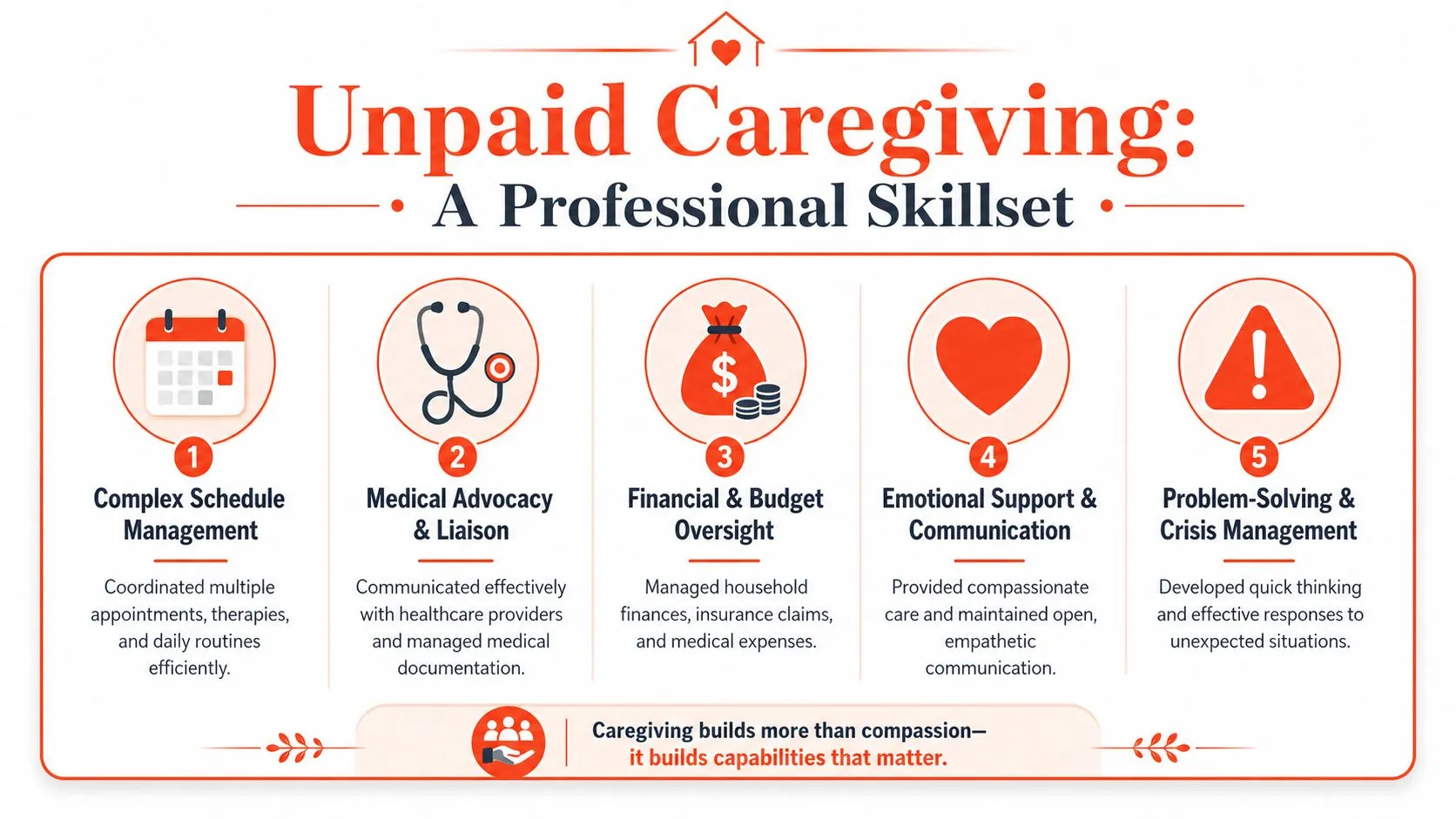
Family caregiving is often closer to a job than people admit. The average family caregiver spends about 25 hours a week on caregiving, and 25% devote more than 40 hours a week, according to Indeed's caregiver resume guidance. That's not empty time. That's scheduling, advocacy, medication support, transportation, budgeting, and daily decision-making.
If your caregiving also involved legal responsibility, learning the basics of understanding guardian duties in Texas can help you frame what belonged to you and what didn't. That matters because overclaiming regulated family caregiving responsibilities on a resume is a bad idea.
Here's a simple way to present unpaid care:
A clean caregiver CV example
Full-Time Caregiver
Provided daily care coordination, medication support, appointment scheduling, household management, and communication with medical providers for an elderly family member; maintained consistent routines and handled changing care needs with discretion and reliability.
If you also did volunteer work or informal care while re-entering the workforce, StoryCV has a practical guide to building a resume with volunteer work.
Your Resume Is a Reflection of Your Thinking
The hardest part of writing caregiver bullets isn't writing. It's remembering clearly enough to see what mattered.
CaringInfo gets this exactly right: the struggle is a thinking problem disguised as a writing problem, especially because caregiving is relational and doesn't always reduce to tidy metrics. Their advice is the right one. Reflect on a specific situation, what you decided, and what improved, and the sentence gets easier to write, as outlined in CaringInfo's caregiver duties guidance.
So stop polishing generic verbs. Go back to the actual work.
Ask yourself which client was difficult to stabilize. Which routine you improved. Which family trusted you because communication got clearer. Which situation got safer because you noticed what others missed. Then write that.
A resume built from borrowed duties says you can do the job. A resume built from real decisions says you already have.
StoryCV is a Digital Resume Writer for people who've done real work and are tired of sounding generic on paper. It helps you turn messy experience into sharp, specific resume language without defaulting to lifeless templates. If your caregiver resume still reads like a copied duties list, start there.