You've probably been told to treat volunteer work like a hobby. Something to hide at the bottom of your resume.
That's a mistake.
A resume with volunteer work isn't about filling space. It’s about showing your skills, drive, and character. Frame it right, and it becomes a serious professional asset.
Should you put volunteer work on resume?
Yes. Bad advice says it's just filler. Wrong. Your volunteer experience is real proof of your skills.
I hear it all the time: "Should you put volunteer work on resume?" and "Does volunteering look good on a resume?"
Yes, but only if you frame it right. This isn’t about charity. It’s about showing your professional value.
It's your secret weapon if you're changing careers or have an employment gap. Unpaid work often holds the most relevant proof of what you can do. It’s your chance to control the narrative.
It's a Showcase of Skills and Drive
Recruiters don't just scan job titles. They hunt for initiative, leadership, and problem-solving. Volunteering is a giant sign pointing to all three. You chose to dedicate your time, often learning new skills without a corporate safety net.
Your volunteer work proves you're mission-driven. It shows you can devote energy to something larger than yourself. Every employer wants that.
This is where you build transferable skills:
-
Project Management: Organizing a fundraiser? That's project management.
-
Team Leadership: Training new volunteers? That's leadership.
-
Stakeholder Communication: Coordinating with partners? Stakeholder management.
Learn more about what skills to put on a resume in our detailed guide.
Employers Are Looking for It
In a tight market, this gives you an edge. 2.1 billion people worldwide—34.5% of working-age adults—volunteer monthly. Employers know this talent pool exists. They scan for these experiences because they signal soft skills like teamwork and grit that keywords can't capture.
This is a strategic career move. A well-presented volunteer role can be more powerful than an irrelevant paid job. It tells a story about your values. You can't fake that.
Stop hiding this work. Start featuring it.
Where to put volunteer work on resume
Where you place volunteer experience sends a signal. It’s not about a rigid resume format for volunteer work; it’s a strategic choice.
Don't just bury it at the bottom. Be intentional. You have three solid options. Each tells a different story.
The Dedicated "Volunteer Experience" Section
This is the classic move. Create a section called "Volunteer Experience" or "Community Leadership" right after your professional history.
This works if:
-
You’ve held a few meaningful volunteer roles.
-
Your volunteering has been consistent.
-
The skills are relevant, but the industry is different from your target job.
It keeps your resume clean. Your professional history is the hero; your community work is strong supporting evidence.
Integrated into "Professional Experience"
This is a power move. Especially for career changers or those with an employment gap. List a relevant volunteer role right inside your main "Professional Experience" section. Treat it like a paid gig.
This is about framing. If you led a project, managed a budget, or supervised a team as a volunteer, that is professional experience. Full stop.
Relevance is everything. If a volunteer role gave you the exact skills the job demands, putting it front and center is the most direct way to show you're qualified. It makes the recruiter see your capabilities first, not the "volunteer" label.
The Concise "Community Involvement" Section
What if the work isn’t directly related but still says something important about you? Use a quick, punchy section at the bottom.
Titled "Community Involvement" or "Leadership & Community," this can be a single line or a short entry. It signals you’re an engaged, mission-driven person without distracting from your core career narrative.
This decision tree helps you choose.
The takeaway? Career changers get the biggest boost from weaving volunteer roles into their main experience. For everyone else, a dedicated section showcases commitment without messing up your professional timeline. Your choice tells a story. Make it the right one.
How to word volunteer work on resume
This is where people fail. They list duties, not impact.
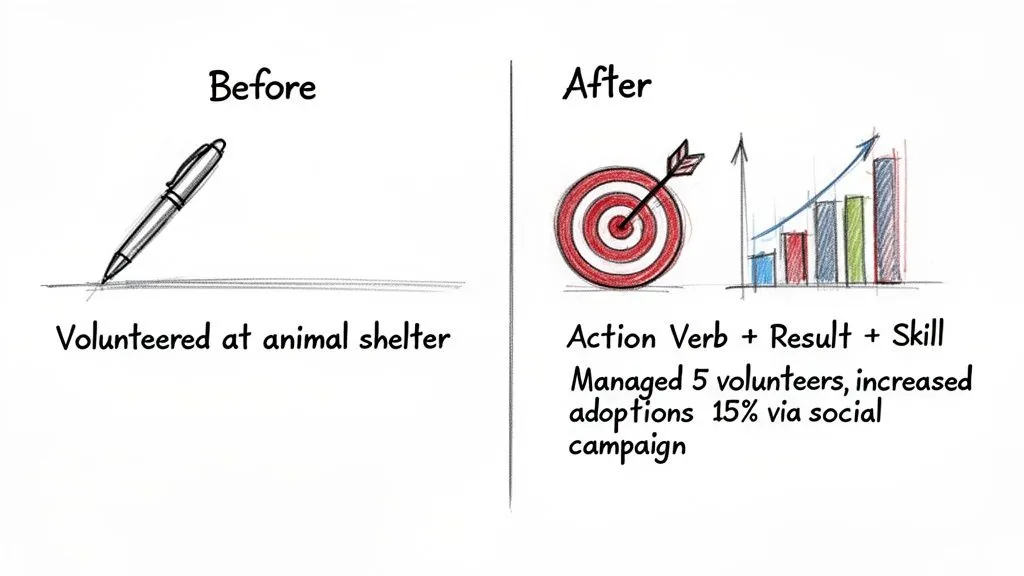
"Volunteered at animal shelter" tells a hiring manager nothing. It's noise.
"Managed a team of 5 volunteers to increase adoption rates by 15% through a targeted social media campaign" tells a story. It shows leadership, strategy, and results. That’s the language recruiters get.
Translate your unpaid work into the language of professional achievement. This isn't fluff; it's accurately representing the value you created. Get this right, and recruiters and Applicant Tracking Systems (ATS) will notice.
The Impact Formula: Action Verb + Quantifiable Result
Forget responsibilities. Nobody cares what you were supposed to do. They care what you did.
Your volunteer experience is a goldmine of achievements. Use this formula for every bullet point:
Action Verb + Quantifiable Result + Skill Demonstrated
This forces you to focus on outcomes. It’s the difference between "helped with fundraising" and "Coordinated a fundraising gala that raised $25,000 for local scholarships." The first is passive; the second screams project management.
The best resume with volunteer work entries read exactly like professional experience. They're confident, specific, and focused on results. No apologies just because it was unpaid.
For personalized strategies on framing achievements, you might consider professional career coaching services.
Resume Volunteer Examples: Before and After
Let's look at some resume volunteer examples. Here’s how to reframe common volunteer tasks to show their professional worth.
Before:
- Helped organize the annual charity run.
After:
- Managed logistics for a 500-participant charity 5K, coordinating with 3 vendors and 20 volunteers to ensure the event ran 10% under budget.
Before:
- Wrote content for the non-profit's newsletter.
After:
- Authored and edited a monthly newsletter for a 2,000-subscriber list, leading to a 40% increase in volunteer sign-ups over 6 months.
Before:
- Mentored high school students.
After:
- Mentored 8 at-risk students in STEM subjects, resulting in a collective 15% improvement in their GPA and a 100% high school graduation rate for the cohort.
This isn’t about sounding impressive. It's about being precise. You’re giving the hiring manager concrete proof. Need more guidance? Our guide on how to write achievements in a resume is a great resource.
Align Volunteer Skills with Job Requirements
Volunteering isn't just for students. Experienced professionals are a huge part of the volunteer workforce. Gen X leads formal volunteering in the US at 27.2%. You need to frame your high-level volunteer experience to match corporate needs.
Dissect the job description. Find the top 3-5 required skills—"stakeholder management," "data analysis," "agile project management."
Then, reverse-engineer your volunteer bullets to mirror that language.
-
Job requires stakeholder management? "Worked with community partners" becomes "Managed relationships with 12+ community stakeholders to secure event sponsorships."
-
Job demands data analysis? "Tracked donations" becomes "Analyzed donation data using Excel to identify giving trends, informing the Q4 fundraising strategy."
This direct alignment makes it impossible for a recruiter or ATS to ignore you. You're not hoping they connect the dots; with good resume writing volunteer work, you're drawing the line for them.
Sample resume with volunteer work
Theory is fine. Seeing it work is better. Here are some rock-solid frameworks you can steal for your own resume with volunteer work sample.
I’ll break down how to frame your experience for common career situations. You'll see a weak version and a strong, impact-driven version. Learn the thinking, don't just copy-paste.
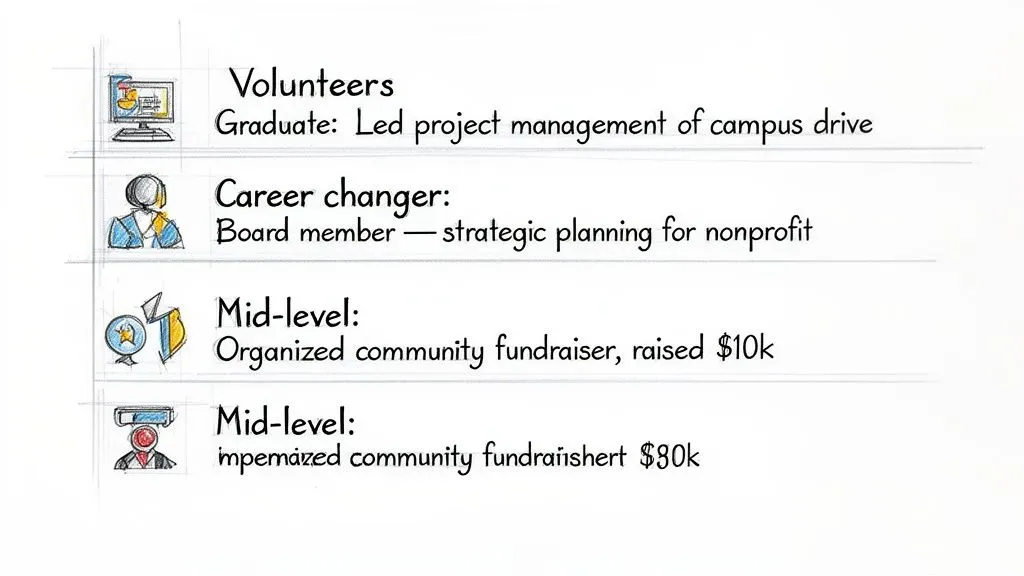
For the Career Changer
Changing careers? Your goal is to prove your new skills are legit, even if they weren't earned in a paid role. Integrate a high-impact volunteer position right into your professional experience section. It's a bold move. It works.
Weak Version (Hidden away):
Board Member, Local Arts Non-Profit (2022 – Present)
Attended board meetings
Helped with strategic planning
Voted on organizational matters
This is passive filler. A complete waste of space.
Strong Version (In "Professional Experience"):
Board Member & Strategy Lead, Local Arts Non-Profit (2022 – Present)
Steered a 3-year strategic plan, defining growth initiatives that led to a 15% increase in community program attendance.
Oversaw a $150K annual budget, reallocating funds to digital outreach that boosted online donations by 25%.
Championed a partnership program with local businesses, securing $40K in sponsorships for the annual arts festival.
See the difference? This version is packed with leadership, financial oversight, and measurable results. It reads like a senior-level job because it was one.
For the Mid-Level Professional
Mid-level pros volunteer to get leadership experience their day job isn't offering. A dedicated "Volunteer Leadership" section spotlights this growth perfectly.
Weak Version:
Event Organizer, Tech for Good Hackathon (2023)
Helped plan the event
Recruited volunteers
Managed the event on the day
Just a list of duties. Flat. No sense of scale.
Strong Version:
Project Lead, Tech for Good Hackathon (2023)
Directed a team of 10 volunteers to organize a 48-hour hackathon for 100+ developers, resulting in 5 functioning prototypes for local non-profits.
Secured and managed relationships with 4 corporate sponsors, acquiring $15,000 in funding and in-kind donations.
Executed a multi-channel marketing campaign that drove a 200% increase in event applications over the previous year.
Now that shows project management, fundraising, and marketing chops. Skills that translate directly. For more on crafting statements like these, see our guide on resume bullet points examples.
Turning Vague Entries into Stories
Volunteer roles are becoming more professionalized worldwide. The UNV's 2023 report showed a 4% surge in UN Volunteers mobilized globally. Recruiters are more open than ever to seeing quantified, high-impact volunteer work. An entry like, "Supported family planning for 500+ in Nigerian communities," turns a vague duty into a story of global competence.
Stop thinking of it as "just volunteering." It's experience. It's leadership. It's proof you deliver results, paid or not.
Apply these frameworks. Stop listing activities and start telling a story of impact. That’s how your resume with volunteer work grabs attention and doesn't let go.
Resume writing volunteer work: final review before you send
You've done the work. You’ve framed your volunteer experience to show real impact. Now for the last, crucial step.
Don't get lazy here. This final check separates a resume that gets tossed from one that lands an interview.
Tailor Your Language
Pull up the job description. Read it again. Zero in on the top 3-5 skills they need.
Now, look at your volunteer work bullets. Mirror their language. If the ad screams "stakeholder management," your old bullet "worked with community partners" is dead.
It becomes: "Managed relationships with 15+ community stakeholders to secure funding." This is a direct translation of your experience into their language.
Your resume isn't your story. It's how your story solves their problem. Make the connection obvious.
Check for Consistency
Your volunteer section can't look like an afterthought. Formatting, tense, and structure must match your professional experience. Any deviation signals you see it as less important.
-
Verb Tense: Use past-tense action verbs for past roles. Be consistent.
-
Structure: If you use the "Action Verb + Quantifiable Result" formula for jobs, use it for volunteering. No exceptions.
-
Visuals: Font, size, and indentation must be identical.
The "Real Job" Test
Find a trusted friend. Don't ask them to "proofread."
Ask them one question: "Does this volunteer section sound like a real job?"
If they pause, you have more work to do. If they say "yes, absolutely," you’re ready. This simple test tells you if you’ve successfully translated unpaid impact into professional value. A strong resume with volunteer work speaks for itself.
FAQs: Do you put volunteer work on resume?
Let's clear up the confusion. Quick, no-BS answers to the questions we hear all the time.
Should I list volunteer work if it's unrelated?
Yes, but only if it showcases strong, transferable skills. Think leadership, project management, or public speaking. Organizing a charity run is really event planning, budgeting, and marketing. Frame the experience around the skills, not the task. The context matters less than the capability you prove.
How far back should I go?
Treat it like paid work. The last 10-15 years is the sweet spot. If you have a massive, long-term role from further back—like a decade on a non-profit board—it’s okay to include. Just keep it brief. Focus on recent, relevant impact. Anything older is noise.
What about a resume with no work or volunteer experience?
Don't panic. Shift focus to what you have done: academic projects, personal projects, or in-depth coursework. Frame them like a professional role. Built a small app on your own? Detail your role ("Lead Developer, Personal Project"), the tools (Python, SQL), and what it accomplished. The goal is to prove you have the initiative to build things and apply skills. That's often more impressive than a formal job title.
Stop wrestling with generic advice and clunky templates. StoryCV is your digital resume writer. Our smart interview process pulls out your real impact and crafts a narrative that gets you noticed. Build your first role for free and feel the difference.