
A customer service manager is the person who leads a support team, making sure they deliver a great experience for customers while hitting business goals. But they’re more than just a supervisor. They’re the architects of customer happiness, blending team leadership, strategic planning, and operational oversight to keep the entire service department running like a well-oiled machine.
What Does a Customer Service Manager Actually Do?
Think of a customer service manager as the conductor of an orchestra. The agents are the musicians, each an expert on their instrument—whether that's live chat, email, or phone support. The technology, like your CRM and ticketing system, is the sheet music they all follow. The conductor doesn't play every instrument, but they make damn sure every section works in harmony to create a seamless performance for the audience: your customer.
This really gets to the heart of what the job is today. It’s not just about handling escalations or obsessing over call times anymore. Modern managers are orchestrating a complex operation focused on two things at once: the health of their team and the loyalty of their customers. Their success isn't just measured by CSAT scores, but by how engaged, skilled, and motivated their people are.
Blending People Leadership with Business Strategy
At its core, the job is a balancing act. On one hand, you're a coach and mentor. You're responsible for hiring, training, and building up a high-performing team. A huge part of this is creating an environment where agents feel supported and empowered, which is the only real way to fight the burnout and high turnover that plague the industry.
On the other hand, you have to be a business strategist. This means using data to make smart decisions, turning customer feedback and support metrics into real insights for the rest of the company. A sharp manager might spot a ticket trend pointing to a recurring product bug, then work with the product team to get it fixed at the source. That proactive thinking turns customer service from a reactive cost center into a strategic asset that actually drives retention and business growth.
The best customer service managers are a bridge between the customer and the company. They translate customer pain points into the language of business, influencing everything from product updates to company policy.
Before we dive into the nitty-gritty, let's look at the role from a high level. This table breaks down the main functions, the metrics they live by, and the skills needed to pull it all off.
The Customer Service Manager Role at a Glance
| Core Function | Key Metrics | Essential Skills |
|---|---|---|
| Team Leadership & Development | Agent Satisfaction, Attrition Rate, Skill Progression | Coaching, Mentoring, Empathy, Communication |
| Performance Management | CSAT, NPS, FCR, AHT, SLA Adherence | Data Analysis, Goal Setting, Performance Reviews |
| Operational Excellence | Ticket Volume, Staffing Levels, Workflow Efficiency | Process Optimization, Project Management, Tech Savvy |
| Strategic Business Impact | Customer Retention, Churn Rate, Budget Management | Strategic Thinking, Reporting, Cross-Functional Collaboration |
This summary gives you a quick snapshot, but the day-to-day reality is all about execution. Let's explore the core responsibilities that fill a manager's calendar.
Core Day-to-Day Functions
So, what does this multifaceted role actually look like every day? While the specifics change depending on the company and industry, a few core functions are always there. A customer service manager is fundamentally responsible for the people, processes, and technology that shape the customer experience.
Their primary duties usually fall into these buckets:
-
Team Development: Running regular one-on-ones, giving practical coaching and feedback, and mapping out career paths for agents who want to grow.
-
Performance Management: Setting clear goals and tracking key performance indicators (KPIs) like Customer Satisfaction (CSAT), Net Promoter Score (NPS), and Average Handle Time (AHT).
-
Operational Oversight: Fine-tuning workflows, managing staffing to meet customer demand without burning out the team, and making sure everyone has the right tools for the job.
-
Strategic Contribution: Reporting on the department’s performance to leadership, managing budgets, and using customer insights to recommend improvements across the entire organization.
At the end of the day, a successful customer service manager ensures their team doesn't just solve problems—they build relationships. They create loyal customers who feel heard, valued, and understood.
The Four Pillars of Customer Service Management
To really get what a customer service manager does day-to-day, it helps to think of the role as a structure held up by four distinct pillars. Each one is critical for building a department that runs like a well-oiled machine but still feels deeply human. Getting these four domains right is what separates a good manager from a great one.
Think of it this way: these pillars are the core competencies you absolutely have to nail. They’re a mix of people skills, process wizardry, big-picture thinking, and tech smarts.
This chart shows how the manager sits right in the middle, conducting the orchestra of their team, technology, and processes.
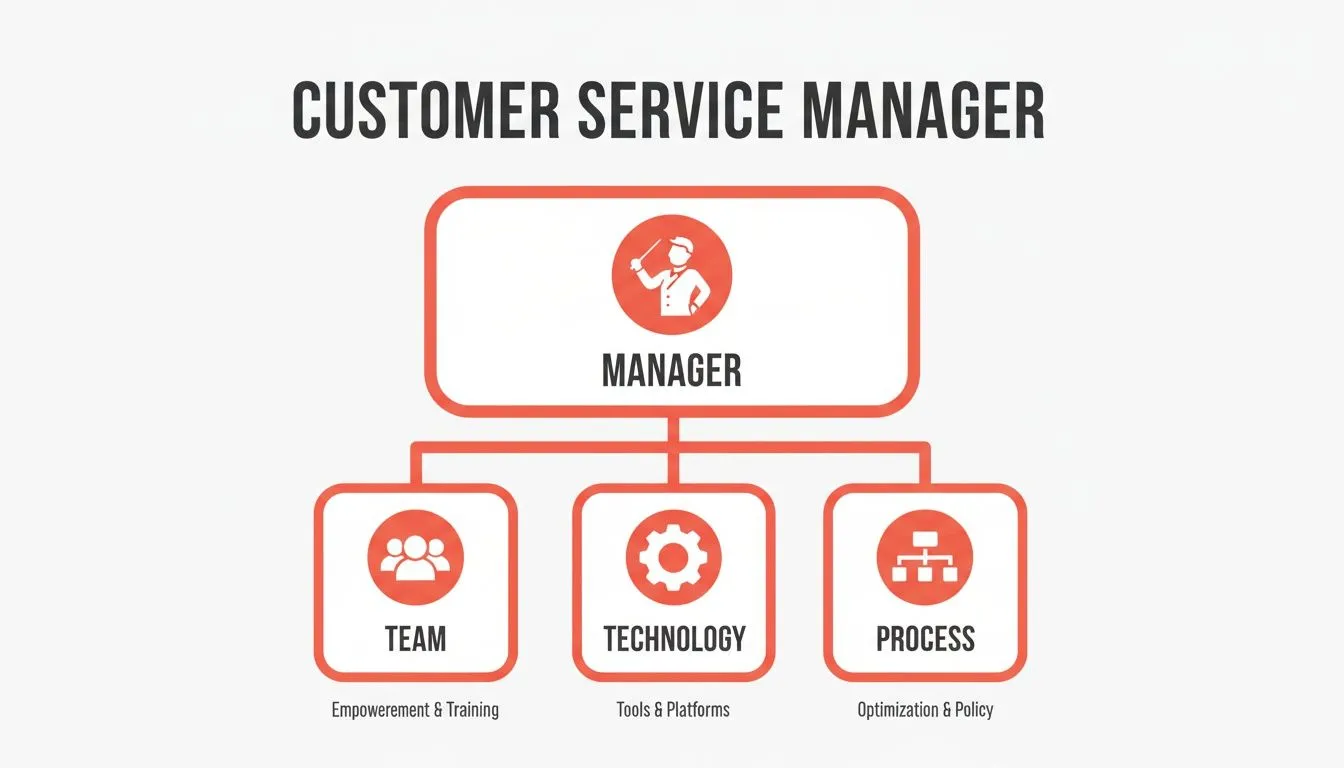
It’s a great visual reminder that leadership isn't just about managing people. It's about weaving every component together into a single, high-performing unit. Let’s break down what each of these pillars actually looks like on the ground.
Team Leadership and Development
This is the most human part of the job, and honestly, it’s probably the most important. A customer service manager is a people leader, first and foremost. Their success is a direct reflection of their team's performance, motivation, and overall well-being.
And this goes way beyond just making the weekly schedule. It’s about:
-
Hiring and Onboarding: Finding people with that perfect blend of empathy and problem-solving skills, and then actually setting them up to win with great training.
-
Coaching and Feedback: Running regular one-on-ones, listening to calls, and giving real, constructive feedback that helps agents improve their craft.
-
Career Pathing: Figuring out where your team members want to go in their careers and helping them get there. This is a massive, often overlooked, key to keeping your best people around.
A manager's job is to build a team that wants to provide amazing service. That starts the moment you post the job and continues with daily coaching to knock down any barriers standing in their way.
Operational Excellence
If leadership is the "who," then operational excellence is the "how." This pillar is all about designing and fine-tuning the workflows that let the team deliver consistently great service without burning out. It’s about making the entire support engine run smoothly.
A manager obsessed with operational excellence is always asking, "Can we do this better?" They're digging into ticket data to find bottlenecks. For example, if they see that 30% of all tickets are for the same password reset issue, they'll work with the product team to build a self-service option. That frees up the team for tougher, more interesting problems.
This pillar covers:
-
Workflow Optimization: Mapping the journey of a ticket from first contact to "solved" and looking for spots to make it faster and smarter.
-
Knowledge Management: Building an internal knowledge base that’s actually useful, so agents can find accurate answers in seconds, not minutes.
-
Quality Assurance (QA): Creating a fair QA program to make sure everyone is hitting the same high standard of service.
Strategic Planning
This is the pillar that turns the role from a purely operational one into a strategic business partner. A great customer service manager doesn't just put out fires; they look ahead and align their department's goals with where the company is headed.
It means looking past the daily ticket queue to see the bigger picture. The manager has to prove the department’s value, shifting the perception from a "cost center" to a powerful engine for customer loyalty and retention. This involves setting clear goals, managing a budget, forecasting staffing needs, and using customer feedback to influence product roadmaps and company strategy.
Technology Management
Finally, you can't run a modern support department without the right tools. The fourth pillar is all about mastering the tech stack. A customer service manager has to be tech-savvy enough to choose, implement, and get the most out of the software their team lives in every day.
This covers everything from the main Customer Relationship Management (CRM) platform to specialized tools for analytics, chatbots, or social media support. The manager makes sure the team knows how to use these tools and that the tech is actually helping them, not getting in their way. As AI and automation become more common, this pillar is only getting more critical for driving efficiency and making the agent's job easier.
Skills Every Great Customer Service Manager Possesses
A great customer service manager is a rare breed—part coach, part strategist, and part tech wizard. The best ones aren't just following a playbook; they bring a unique mix of skills to the job that separates the good from the truly exceptional. Success isn't just about what you do, but how you do it.
It really boils down to balancing deep emotional intelligence with sharp, data-driven decisions. One minute you might be de-escalating a sensitive customer issue, and the next you're building a staffing model based on ticket forecasts. This blend of hard and soft skills is what makes a manager truly effective.

To really get a handle on what this looks like day-to-day, it helps to see the skills broken down. While hard skills get you in the door, it's the soft skills that make you a leader people want to follow.
Hard Skills vs Soft Skills for Customer Service Managers
| Skill Category | Hard Skills Examples | Soft Skills Examples |
|---|---|---|
| Data & Analytics | Building dashboards, analyzing ticket trends, forecasting volume | Using data to tell a compelling story, explaining complex trends simply |
| Technology | Mastering Zendesk or Salesforce, implementing automation | Training the team on new tools, showing patience with non-technical users |
| Operations | Creating schedules, optimizing workflows, managing budgets | Motivating the team during high-volume periods, resolving internal conflicts |
| Strategy | Developing KPIs, connecting support metrics to business goals | Communicating the team's vision, getting buy-in from other departments |
Mastering both sides of this table is what turns a manager into a strategic leader. Now, let's dig into the most crucial skills in more detail.
Leadership and People Skills
This is the heart of the role. A customer service department is a direct reflection of its leader's ability to inspire, guide, and support the team. These aren't just "nice-to-haves"—they're essential for building a resilient culture that keeps both agents and customers happy.
Key people skills include:
-
Empathy: The ability to genuinely understand where customers and team members are coming from. It's the secret sauce for resolving conflicts and coaching agents through tough calls.
-
Motivational Leadership: Creating an environment where people feel valued and want to do their best. This means clear communication, fair recognition, and being the team's biggest cheerleader.
-
Conflict Resolution: Skillfully navigating disagreements—whether it’s with an angry customer or between two team members—and finding a way forward that works for everyone.
Analytical and Problem-Solving Abilities
While empathy builds the team, analytical skills drive the business forward. A modern customer service manager has to be comfortable with data. They use it to spot trends, solve root problems, and make strategic calls that actually improve things.
A manager's ability to analyze data turns the customer service department from a reactive cost center into a proactive source of business intelligence. They don’t just solve today's problems; they prevent tomorrow's.
This data-driven mindset involves:
-
Data Analysis: Diving into metrics like First Contact Resolution (FCR), Average Handle Time (AHT), and ticket trends to find the story behind the numbers. For example, noticing that 25% of inquiries are about a confusing checkout step can lead directly to a product fix.
-
Strategic Thinking: Using those insights to see the bigger picture. This means connecting support data to business goals like customer retention and presenting that case to other departments.
-
Process Optimization: Always looking for ways to make things run smoother. A manager with strong problem-solving skills will map out the entire support process to find and fix bottlenecks.
Technical Proficiency
Today's support teams run on some seriously sophisticated software. A customer service manager doesn't need to be a developer, but they absolutely must be fluent in the tools their team uses every single day. Without this, you can't get the full value out of your tech stack.
The market for this tech is exploding. The global customer service software market was valued at around $14.9 billion in the mid-2020s and is projected to hit $68.2 billion by 2031. That means platforms are constantly evolving, and managers need to keep up.
Essential technical skills include:
-
CRM and Helpdesk Mastery: Deep, hands-on knowledge of platforms like Zendesk, Salesforce Service Cloud, or HubSpot Service Hub is non-negotiable.
-
Reporting and Analytics Tools: The ability to build dashboards and pull custom reports to track KPIs and measure team performance.
-
Understanding of AI and Automation: Knowing how to implement tools like chatbots and automated ticket routing to boost efficiency without losing that critical human touch.
How to Build a Resume That Gets You Hired
Think of your resume as your opening argument. For a customer service manager, a great resume does more than just list your old job duties—it tells a story about your impact, your leadership, and the strategic value you bring. It's the difference between saying you "managed a team" and proving you "led a team to new heights."
To make your resume work, you have to shift your thinking from responsibilities to achievements. Both hiring managers and the Applicant Tracking Systems (ATS) they use are looking for results they can measure. They want to see the numbers, the tangible proof that you didn't just do the job, but you knocked it out of the park.
Every single bullet point needs to be a mini success story.
From Duties to Achievements: The PAR Framework
The simplest way to transform your resume is with the Problem-Action-Result (PAR) framework. This structure forces you to connect what you did to a real business outcome, which is exactly what gets a hiring manager's attention.
Here's how it breaks down:
-
Problem: What was the challenge? Think low team morale, sky-high Average Handle Time, or sinking CSAT scores.
-
Action: What did you do about it? Maybe you rolled out a new coaching program, redesigned a workflow, or launched a better QA rubric.
-
Result: What was the measurable outcome? This is where the numbers come in. An agent retention boost of 15%, a 20% drop in AHT, or CSAT climbing from 85% to 92%.
Let’s see it in action. A generic, forgettable bullet point might read:
- Responsible for managing a team of 15 agents.
Using PAR, that same experience becomes a powerhouse statement:
- Led a 15-agent team to achieve a 95% CSAT score, a 10% increase quarter-over-quarter, by implementing a new QA framework and bi-weekly coaching sessions.
The second version is specific, packed with metrics, and shows undeniable leadership. For a deeper look at structuring your experience section, our guide on a student resume template with real examples has some great pointers that apply no matter where you are in your career.
Crafting Compelling Bullet Points
Okay, let's build a few more examples with this achievement-first mindset. Notice how each one starts with a strong verb and weaves in the metrics that matter in customer service.
Before:
-
Handled customer escalations.
-
Trained new hires.
-
Monitored team performance.
After:
-
Resolved 98% of escalated customer issues within the first contact, reducing churn risk by an estimated 5%.
-
Developed and launched a comprehensive 4-week onboarding program that decreased new hire ramp-up time by 30%.
-
Monitored team performance via a custom dashboard, identifying and coaching the bottom 20% of performers to meet and exceed their KPIs within one quarter.
Quantifying your impact is non-negotiable in today's job market. Statements like “reduced average handle time by 18% while increasing CSAT from 78% to 86% across a 120‑agent team” are what separate a good resume from one that lands an interview.
This focus on data is what hiring managers in competitive markets expect. For resume writers and jobseekers, quantifying impact—e.g., “implemented AI routing that decreased escalations by 32% and saved an estimated $45,000 annually”—translates directly into measurable, market-relevant accomplishments. You can learn more about how data shapes the industry on custify.com.
Must-Have Metrics and Powerful Verbs
To make your resume connect with both a human reader and an ATS, you have to speak the language of the industry. That means loading it with key metrics and starting your bullet points with dynamic action verbs.
Key Metrics to Include
-
Customer Satisfaction (CSAT): Show percentage scores and, more importantly, the improvements you drove.
-
Net Promoter Score (NPS): Mention increases in promoters or decreases in detractors.
-
First Contact Resolution (FCR): Highlight how you boosted your FCR rate.
-
Average Handle Time (AHT): Detail how you cut it down without hurting quality.
-
Agent Attrition/Retention: Prove you can build and keep a strong team together.
-
Service Level Agreement (SLA) Adherence: Provide your team's compliance percentage.
Powerful Action Verbs to Use
-
Leadership Verbs: Coached, Mentored, Guided, Inspired, Led, Developed
-
Improvement Verbs: Optimized, Revamped, Overhauled, Reduced, Increased, Streamlined
-
Strategic Verbs: Implemented, Established, Launched, Pioneered, Analyzed, Forecasted
When you combine these elements, your resume stops being a simple list of your past jobs. It becomes proof of your value as a strategic leader. Each bullet point is a testament to your ability to drive real results, making it impossible for a hiring manager to ignore.
Navigating Interviews and Salary Negotiations
Getting the interview means your resume did its job. Now it’s on you to bring that story to life. Interviews for customer service manager roles are intense; they’re built to test your leadership style, your knack for problem-solving, and your strategic thinking, all at once.
The goal isn't just to list your skills. It's to prove them with real stories. Think of every question as a new opportunity to show another side of your leadership.
Decoding Common Interview Questions
Most interviews for this role will mix three question styles, each digging into a different part of your expertise. Figuring out what they're really asking is the first step to nailing your answer.
You’ll typically run into these categories:
-
Behavioral Questions: These almost always start with "Tell me about a time when..." They want to see how you’ve actually handled things in the past. A classic is, "Describe a time you coached an underperforming agent to success."
-
Situational Questions: These are the "what if" scenarios that test how you think on your feet. You might get something like, "How would you handle a sudden 30% spike in ticket volume during a product launch?"
-
Technical and Strategic Questions: These are all about your grasp of the tools and metrics that run a modern support team. A common one is, "Which KPIs do you believe are most critical for measuring team performance, and why?"
For every answer, you have to go deeper than a generic statement. This is where having a simple storytelling framework in your back pocket makes all the difference.
Using the STAR Method to Tell Your Story
The STAR method is a dead-simple, incredibly powerful way to structure your answers to behavioral questions. It forces you to be clear, concise, and focused on results—which is exactly what hiring managers are listening for.
It breaks your story down into four clean parts:
-
Situation: Quickly set the scene. What was the context?
-
Task: What was your specific goal or responsibility?
-
Action: What specific steps did you take? Use strong, active verbs.
-
Result: What was the measurable outcome? Put a number on it whenever you can.
Instead of just saying, "I'm good at coaching," you use STAR to prove it: "I coached an agent whose CSAT was stuck at 75% (Situation). My goal was to get them above 90% (Task). I created a personalized development plan with weekly call reviews (Action), which boosted their score to 92% within two months (Result)."
This technique turns your past experiences into compelling proof of your impact. Remember, your interview answers need to be optimized just like your resume. You can learn more about this by reading up on the ATS filter and the 90-10 rule in our guide on optimizing your application materials.
Confidently Discussing Salary
Talking about money can feel awkward, but it doesn’t have to be. Good preparation turns a potentially tense conversation into a standard business discussion. The key is to walk in with data.
Before you ever get to the interview, research the typical salary range for a customer service manager in your industry, your city, and for a company of a similar size. Tools like Glassdoor, Levels.fyi, and Payscale are your friends here.
When the salary question inevitably comes up, don't throw out a single number. Instead, offer a well-researched range. You could say something like, "Based on my research for this role in this market, I'm seeing a range between $X and $Y. Given my experience, I'm confident we can find a number in that range that works for both of us."
This approach shows you’ve done your homework and you’re a serious candidate. And don't forget to look at the whole package—bonuses, benefits, and professional development opportunities are just as important as the base salary.
Your Career Path and the Future of the Role

The role of a customer service manager is changing, and fast. What used to be a job centered on daily supervision and putting out fires is becoming a much more strategic function, built around technology, data, and genuine human development. Getting a handle on this shift is your ticket to a long and successful career.
The biggest force behind this change is technology. Artificial intelligence and automation aren't just buzzwords anymore; they’re here, and they're reshaping the entire industry. As AI gets better at handling routine questions, the manager's focus naturally moves up the food chain to more complex, valuable work.
And this isn't a fringe trend. Industry research shows that between 76–81% of support teams are sinking money into AI in 2024. As these tools become the new standard, your job transforms from overseeing repetitive tasks to conducting a sophisticated orchestra of human agents and automated systems. You can dig into the full customer service statistics on blog.hubspot.com to see the data for yourself.
The Evolving Role of a Manager
Instead of just keeping an eye on call times, the modern customer service manager will spend their days on high-impact activities that no machine can replicate. Your work is becoming more about strategy.
This new reality puts a heavy emphasis on:
-
Advanced Coaching: Developing your agents’ skills in empathy, complex problem-solving, and navigating the sensitive interactions that AI simply can't touch.
-
Technology Strategy: You'll be the one evaluating, implementing, and fine-tuning AI tools, chatbots, and automation workflows to make things smoother for both your team and your customers.
-
Data Analysis: Using analytics to uncover deep truths about customer behavior and then working with other departments to drive real improvements to products and processes.
The modern customer service manager doesn't just manage people; they manage an ecosystem of people and technology. Your value lies in your ability to elevate human skills while maximizing the efficiency of automated systems.
Charting Your Career Progression
Think of the customer service manager position as a launchpad. With the right skills and a strategic mindset, you can build a clear path toward the executive suite. The ladder isn't just vertical anymore, either; it branches out across the entire customer journey.
A typical career path might look something like this:
-
Senior Customer Service Manager: Overseeing multiple teams or taking charge of a particularly critical region or product line.
-
Director of Customer Support/Experience: Moving into a strategic role with full ownership of the entire support function, including its budget and long-term vision.
-
VP of Client Services or Customer Experience: Leading multiple customer-facing departments and having a real voice in shaping company-wide strategy.
Getting ahead means you have to develop cross-functional leadership skills. Actively look for projects that force you to work with product, marketing, and sales teams. Pursuing certifications in things like project management or customer experience (CX) can also give you a serious edge, making you a much stronger candidate for those senior roles and ensuring your career keeps climbing.
Frequently Asked Questions
Thinking about a career as a customer service manager? Let's cut through the noise. Here are some straight answers to the questions that come up most often, designed to give you a real feel for the role.
What Is the Typical Career Path to Become a Customer Service Manager?
You don't just land in a manager role. You earn it from the trenches. Nearly every great customer service manager I know started on the front lines, taking calls or answering tickets as a Customer Service Representative or Technical Support Specialist. That's where you build the foundation—you learn the customers, the product, and what it really takes to solve problems.
From there, after you've shown you can handle the work and have a knack for leadership, you'll likely step into a Team Lead or Supervisor position. This is your training ground for management. You start coaching agents, overseeing daily operations, and getting a feel for the bigger picture. Nail that part—by hitting your team's goals and genuinely developing your people—and you'll be ready to make the jump to manager.
What Are the Biggest Challenges a Customer Service Manager Faces?
It’s a serious balancing act, every single day. One of the toughest parts is trying to meet sky-high customer expectations while being constrained by very real budgets. You're constantly fighting for resources. At the same time, you're responsible for preventing agent burnout in a job that can be incredibly stressful and emotionally draining. High turnover is a constant threat.
The biggest challenge, though? Shifting the company's view of customer service from a simple cost center to a powerful revenue driver. This means using data to prove, unequivocally, how excellent service creates loyal customers who stick around and spend more.
And if that wasn't enough, you have to stay on top of all the new technology. Figuring out how to use AI and automation to make your team more effective without losing that essential human connection is a puzzle every single CS leader is trying to solve right now.
How Important Is Technology in This Role Today?
It's everything. You simply can't do this job well without being comfortable in a complex software environment. We're not talking about just knowing your way around a computer; you need to be fluent in the tech that runs the entire department.
Your core toolkit will almost always include:
-
CRM Systems: Think Salesforce or HubSpot. This is your command center for all customer information.
-
Helpdesk Software: Tools like Zendesk or Freshdesk are non-negotiable for managing tickets and workflows.
-
Analytics Platforms: If you can't pull data and build reports to track performance, you're flying blind.
Beyond that, a manager who wants to get ahead needs to understand how to bring in AI-powered tools like chatbots and intelligent routing. How well you use technology directly shapes your team's efficiency, the quality of your service, and the entire customer experience. If you're looking to switch careers, knowing how to frame these skills is crucial—it’s the same logic a professional uses when they explain what is a resume writer and how they translate your experience into the language of the job you want.
Ready to tell your leadership story? StoryCV uses AI to help you craft a resume that showcases your real-world impact and strategic value. Move beyond generic templates and build a narrative that gets you noticed. Start for free at https://story.cv and see the difference.