“I was on maternity break.”
If you’re here, there’s a good chance you’ve said this before, or you’re trying to figure out how to say it in a way that doesn’t feel incomplete, especially when you’re updating your resume or preparing to explain that time in an interview.
It’s the default line most of us reach for when talking about pregnancy breaks at work, because it sounds neat, it sounds acceptable, and more importantly, it helps move the conversation along without raising too many questions.
But if you pause for a moment, it also feels like it doesn’t quite capture what actually happened.
Why “maternity break” feels off (even if you can’t explain why)
You might call it a maternity break, or maternity leave, or even just a gap if you’re trying to keep things simple on your CV, but if you’ve lived through that phase, you already know that none of these words really hold the weight of the experience.
Because it wasn’t a break in the way we usually understand breaks.
It wasn’t time off where responsibilities paused and life slowed down.
If anything, it was a phase where multiple things intensified at once, where your body was recovering while your mind was constantly engaged, and where decisions had to be made continuously, often without enough information and almost always without enough sleep.
There is no onboarding into motherhood, no gradual ramp-up where you observe and learn before taking ownership. From the moment the baby arrives, you are already responsible, already accountable, and already operating in a role that doesn’t come with weekends, shifts, or the option to step away.
And yet, when it comes to writing maternity leave on resume or maternity leave on CV, we reduce all of this into a phrase that sounds closer to rest than responsibility.
The real problem is how we’ve learned to frame maternity phase
If you’ve been searching for how to explain maternity gap, or how to write on resume work gap due to child, or even wondering whether motherhood on resume is something you should include at all, the friction you’re feeling isn’t because you don’t have enough to say.
It’s because the format you’re trying to fit into doesn’t naturally accommodate this kind of experience.
Resumes are designed to reward things that are easy to measure, easy to summarise, and easy to attribute, while motherhood is continuous, layered, and often invisible in ways that don’t translate neatly into bullet points.
But invisible does not mean insignificant, and just because something is difficult to measure does not mean it isn’t shaping outcomes in very real ways.
What if you stopped treating it like a gap?
Instead of trying to minimise your child care gap in resume or compress your maternity break on resume into a single line that quietly disappears between roles, what if you approached it differently.
What if you treated it like what it actually was.
A role.
Not a symbolic one, but a real, high-responsibility, full-time role that required decision-making, learning, adaptation, and emotional regulation on a daily basis.
Because the moment you shift from “gap” to “role,” the question itself changes.
You’re no longer asking how to explain maternity break on resume.
You’re asking what actually happened during that time, and how to represent it honestly.
Maternity leave on resume example (real, not theoretical)
When I tried this for myself, it didn’t feel natural at first, mostly because we’re not used to seeing motherhood described in this way, but the more I sat with it, the more it felt like I was finally getting closer to the truth of the experience.
Here’s a real example of how I translated that time into resume bullet points using StoryCV.
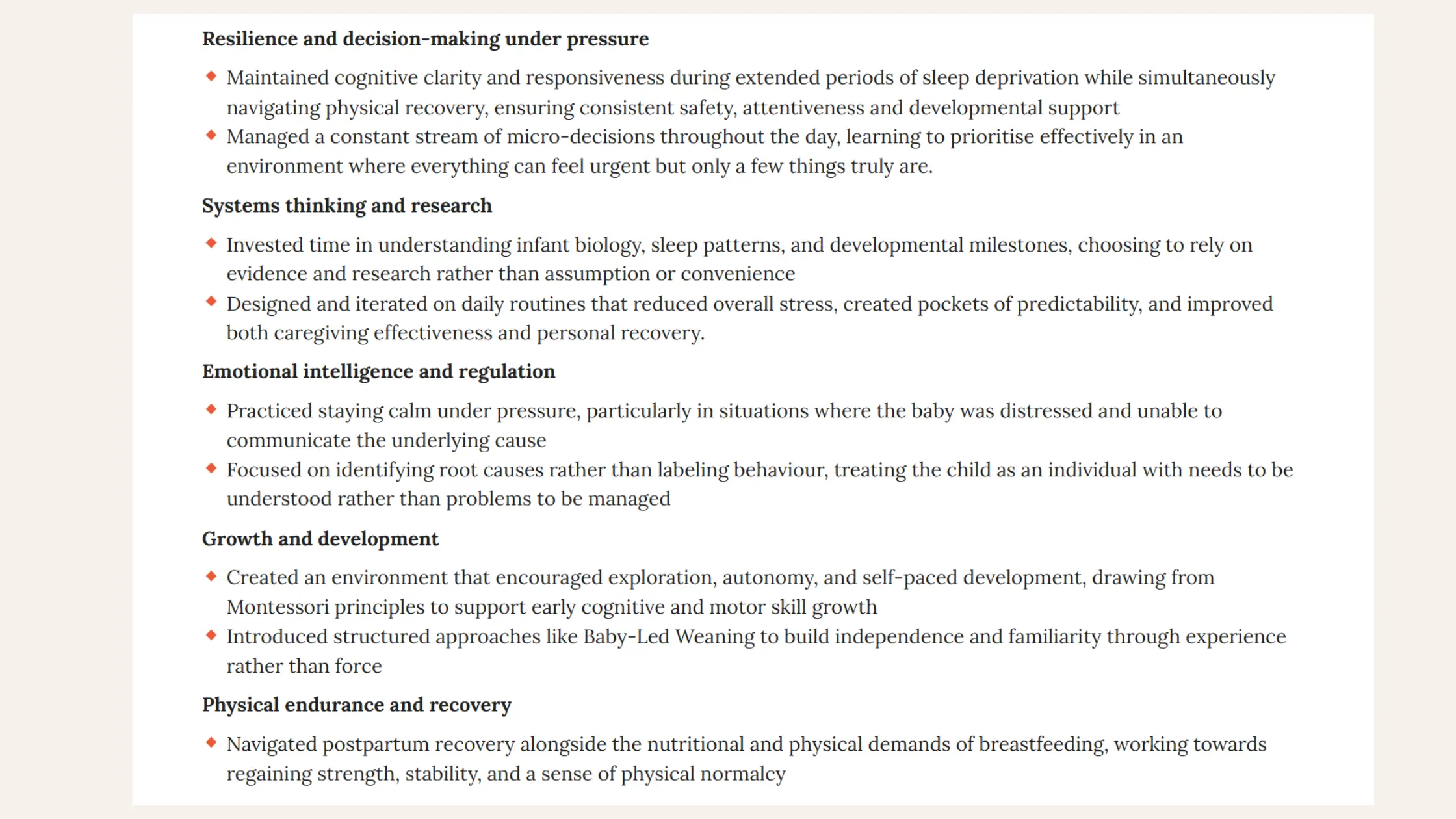
Resilience and decision-making under pressure
- Maintained cognitive clarity and responsiveness during extended periods of sleep deprivation while simultaneously navigating physical recovery, ensuring consistent safety, attentiveness and developmental support
- Managed a constant stream of micro-decisions throughout the day, learning to prioritise effectively in an environment where everything can feel urgent but only a few things truly are
Systems thinking and research
- Invested time in understanding infant biology, sleep patterns, and developmental milestones, choosing to rely on evidence and research rather than assumption or convenience
- Designed and iterated on daily routines that reduced overall stress, created pockets of predictability, and improved both caregiving effectiveness and personal recovery
Emotional intelligence and regulation
- Practiced staying calm under pressure, particularly in situations where the baby was distressed and unable to communicate the underlying cause
- Focused on identifying root causes rather than labeling behaviour, treating the child as an individual with needs to be understood rather than problems to be managed
Growth and development
- Created an environment that encouraged exploration, autonomy, and self-paced development, drawing from Montessori principles to support early cognitive and motor skill growth
- Introduced structured approaches like Baby-Led Weaning to build independence and familiarity through experience rather than force
Physical endurance and recovery
- Navigated postpartum recovery alongside the nutritional and physical demands of breastfeeding, working towards regaining strength, stability and a sense of physical normalcy
What this does for your resume (and how you’re perceived)
When you present your maternity break on CV this way, something subtle but important changes in how your experience is perceived.
You’re no longer trying to explain away a gap or hoping that it doesn’t get too much attention.
Instead, you’re showing how you operated in a high-responsibility environment, how you made decisions under pressure, how you learned quickly, and how you managed complexity without the usual structures that most roles provide.
These are not secondary skills.
They are foundational.
Why this still feels uncomfortable (even when it makes sense)
Even when this approach makes sense logically, it can still feel slightly uncomfortable to write, and that discomfort is worth acknowledging rather than brushing aside.
Because you are, in a way, translating something deeply human into a format that prefers clarity over nuance and outcomes over effort.
Motherhood doesn’t come with dashboards or performance reviews or clean metrics that you can point to and say, “this is what I achieved.”
It comes with responsibility that is continuous, impact that is often invisible, and progress that doesn’t always announce itself clearly.
The part that rarely gets articulated
If you’ve been through this phase, you’ll recognise the tension immediately, even if you’ve never put it into words.
The baby is not here to make your life difficult.
But your life will become more difficult because of the baby.
And in that space, you are constantly managing not just the situation, but your own response to it.
You are tired, the baby is crying, and instead of reacting instinctively, you are trying to stay composed enough to think through what might be causing the distress, whether it is hunger, sleep, discomfort, or overstimulation, and to respond in a way that is intentional rather than impulsive.
You don’t want to dismiss it as a tantrum, because that simplifies something that often has a legitimate cause. Over time, you begin to see that what looks like behaviour is often communication that just takes more effort to understand.
This is the actual work
At some point, a realisation settles in.
Managing the baby is not the hardest part. Managing your own mind is.
Staying calm when you are exhausted, thinking clearly when your capacity is stretched, and choosing patience when reacting would be easier becomes the real work underneath everything else.
So how should you write maternity leave on your CV or resume?
You don’t need to overcomplicate it, and you don’t need to turn it into something it wasn’t.
You just need to stop minimising it.
Don’t hide it. Don’t apologise for it.
And don’t reduce it to a single line if it played a significant role in shaping how you think, decide, and operate.
Instead, treat it like a role, focus on transferable skills, and highlight the kind of responsibility you handled, even if it doesn’t fit neatly into traditional metrics.
Maybe the problem isn’t that motherhood doesn’t fit into a resume.
Maybe it’s that our definition of experience is still too narrow to include it.
Because if this doesn’t count as experience, it’s worth asking what does.
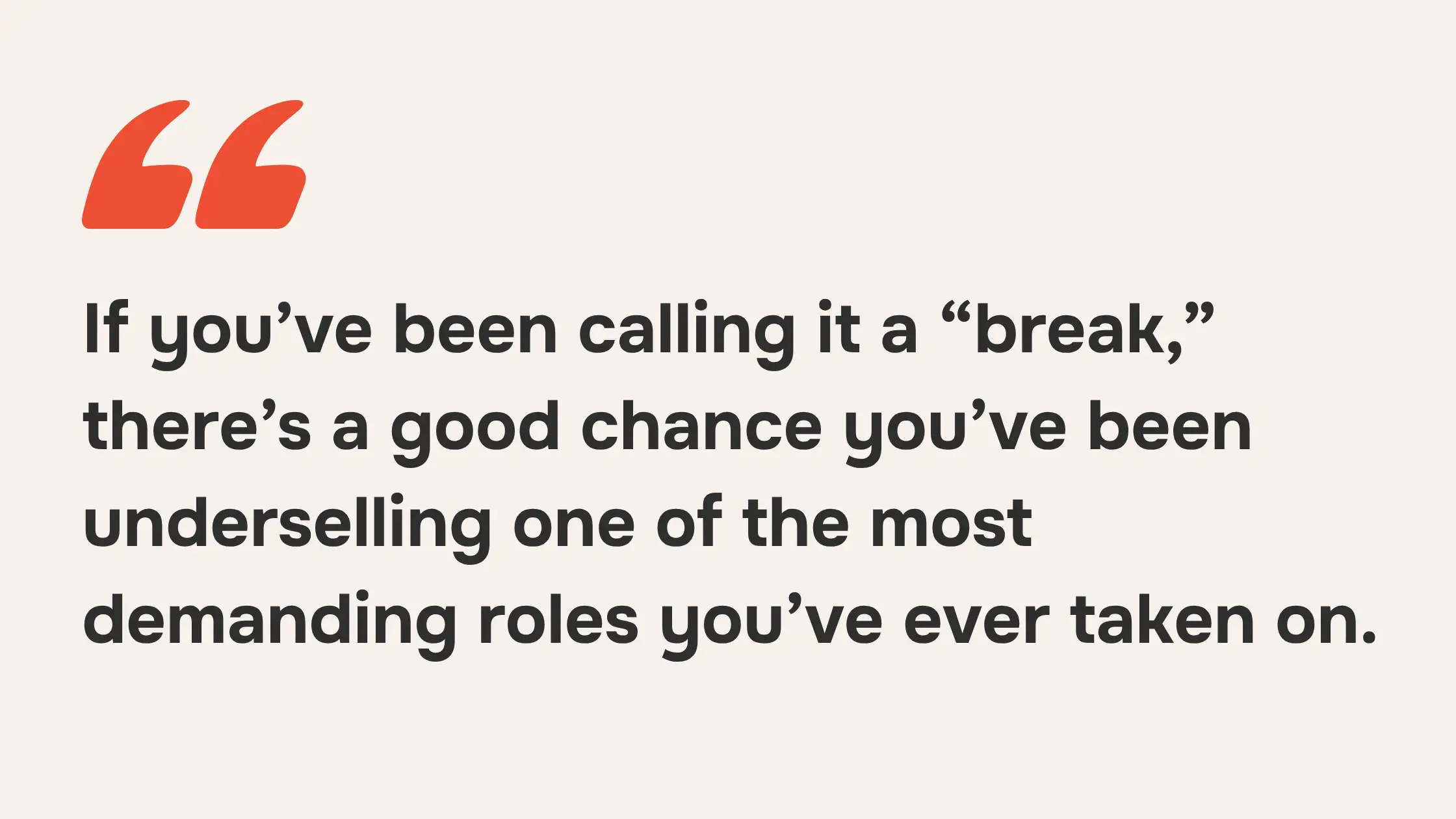
And if you’ve been calling it a “break,” there’s a good chance you’ve been underselling one of the most demanding roles you’ve ever taken on.
Need help reframing your story?
At StoryCV, we help you turn your maternity leave on resume into something that actually reflects your experience, instead of hiding it.
Because it was never just a break.