If you think of your Curriculum Vitae in Singapore as just a history of your jobs, you're already making a mistake. In this market, a CV isn't a simple record—it's a strategic marketing document. It has to be engineered from the first line to get past both robotic screeners and human recruiters.
Why Your Standard CV Fails in Singapore

Sending a one-size-fits-all CV in Singapore is like trying to use a master key on a high-security lock. It just won’t work. The local job market moves fast, and it leans heavily on technology to sift through the mountains of applications. Your CV is your professional sales pitch, plain and simple.
This means every section, every word, and even the layout must be a deliberate choice. The mission is to make a crystal-clear case for why you are the perfect fit for a specific role at a specific company here. Anything less, and your application will just disappear into the digital void.
Meeting the Dual Audience Challenge
When you write a curriculum vitae for a Singapore role, you’re actually writing for two very different readers.
-
The Applicant Tracking System (ATS): Think of this as the digital bouncer. The ATS scans your CV for specific keywords, phrases, and standard section titles. If you get fancy with complex graphics, tables, or weird fonts, the software chokes, and you're automatically rejected before a human even knows you exist.
-
The Human Recruiter: Once you're past the bot, your CV lands in front of a real person. But they are short on time. They need to see your value proposition almost instantly. That means clear, concise language and a sharp focus on what you’ve achieved, not just what you were told to do.
Getting this dual-audience dynamic right is everything. It changes your mindset from simply listing your past to strategically selling your future.
The Critical First Impression
The structure of your CV is more critical than ever in Singapore's tough job market. It's a shocking statistic, but around 75% of resumes get tossed out by the ATS before they even have a chance.
For the few that make it through, recruiters spend a mere 6 to 8 seconds on the initial scan. Their eyes jump to clear headings and bullet points that scream achievement. To get a better feel for what they're looking for, it's worth exploring the proven resume formats that recruiters in Singapore prefer.
Your CV isn't an autobiography; it's a targeted advertisement for your skills. The "product" is your professional value, and the "customer" is the hiring manager. A generic ad fails because it speaks to no one in particular.
To win, you have to be precise and customize every time. That means ditching the generic templates and thinking hard about how every part of your CV lines up with what Singaporean employers actually want. This guide will show you exactly how to do that, so your application doesn't just get seen—it gets results.
Crafting Each Section of Your Singapore CV

Think of your CV as a series of building blocks. Each one needs to be solid and placed just right to build something that grabs a recruiter’s attention instantly. Let's assemble your curriculum vitae for Singapore piece by piece, making sure every section has a clear job to do.
This isn’t about just filling in a template. It’s about telling a strategic story where every part, from your contact details to your skills, works together to prove you’re the right person for the role.
Your Contact Information and Professional Header
This is the first thing a recruiter sees. It has to be clean, professional, and give them everything they need without any extra noise. It sets the tone for the whole document.
Keep it simple and direct. It should include:
- Full Name: Make this the biggest text on the page.
- Professional Title: This doesn’t have to be your last job title. Feel free to align it with the role you want, like "Digital Marketing Specialist" or "Supply Chain Analyst."
- Contact Details: A professional email and your Singapore contact number are all you need.
- LinkedIn Profile URL: Make sure you've customized your URL so it looks clean and professional.
- Work Pass Status: If you're not a Singaporean citizen, stating your status upfront (e.g., "Singapore Permanent Resident" or "Employment Pass Holder") is a huge help. It answers a key logistical question before they even have to ask.
What should you leave out? Your full address, date of birth, and definitely a photograph. These details are unnecessary for the first screening and can introduce unconscious bias.
The Compelling Professional Summary
Your professional summary is your elevator pitch. A Singaporean recruiter might only give this section a few seconds, so it has to hook them and make them want to read more. This is where you frame your entire career story.
A powerful summary is a tight paragraph, just three to four lines, that quickly covers:
- Who you are: Your title and years of experience.
- Your key strengths: Pick one or two core areas where you excel.
- A concrete achievement: Add a number-driven win that proves your value.
A great summary doesn't use vague fluff like "results-oriented professional." It provides hard evidence, like "spearheaded a project that increased team productivity by 15%." Numbers always speak louder than adjectives.
Showcasing Your Work Experience with Impact
This is the heart of your CV. Don't just list your duties—that’s a job description, not a track record. This is where you prove you can deliver. So many people just copy and paste their responsibilities, which is a huge missed opportunity. You need to showcase your achievements.
The easiest way to turn a responsibility into a compelling accomplishment is the STAR method:
- Situation: Briefly set the scene or the challenge.
- Task: What were you supposed to do?
- Action: What specific steps did you take?
- Result: Quantify the outcome. What happened because of your actions?
Here’s what that looks like in practice for a Marketing Manager role:
Before (Duty-focused):
* Managed social media campaigns for new product launches.
After (Achievement-focused using STAR):
* Led a targeted social media campaign (Action) for a new product launch (Task), resulting in a 40% increase in online engagement and S$50,000 in direct sales within the first quarter (Result).
This shows not just what you did, but how well you did it. Always kick off your bullet points with strong action verbs like "managed," "developed," "negotiated," or "streamlined."
Education and Relevant Certifications
Your education section provides crucial background, but where you put it depends on your experience level.
- For experienced professionals: This section goes after your work experience. Just list your degree, university, and graduation year. No need for extra details unless your academic work is super relevant to the job.
- For recent graduates or students: With limited work history, your education is a key selling point. Move this section right up after your Professional Summary. You can include a strong GPA, relevant coursework, and any academic awards. If you're a student building your first CV, our guide on a student resume with real examples will give you the structure you need.
Don't forget to add a subsection for professional qualifications. In Singapore's skills-driven market, credentials like a PMP (Project Management Professional) or a Google Ads Certification carry serious weight.
Highlighting the Right Skills
The skills section should be a quick, scannable list of what you can do. It helps your CV get past the automated screeners (ATS) and gives a human recruiter a snapshot of your capabilities.
Break your skills into logical groups to make them easy to read:
- Technical Skills: Programming languages (Python, Java), software (Salesforce, SAP), tools (Google Analytics, Figma).
- Functional Skills: Project Management, Financial Modelling, Digital Marketing, Supply Chain Optimization.
- Languages: List your languages and proficiency level (e.g., "English (Native)", "Mandarin (Professional Working Proficiency)").
The focus here should be on hard skills—the specific, teachable abilities you can prove. While soft skills like "communication" and "teamwork" are critical, you don't list them here. You demonstrate them through the achievement-focused bullet points in your work experience section.
Formatting Your CV to Beat the Bots
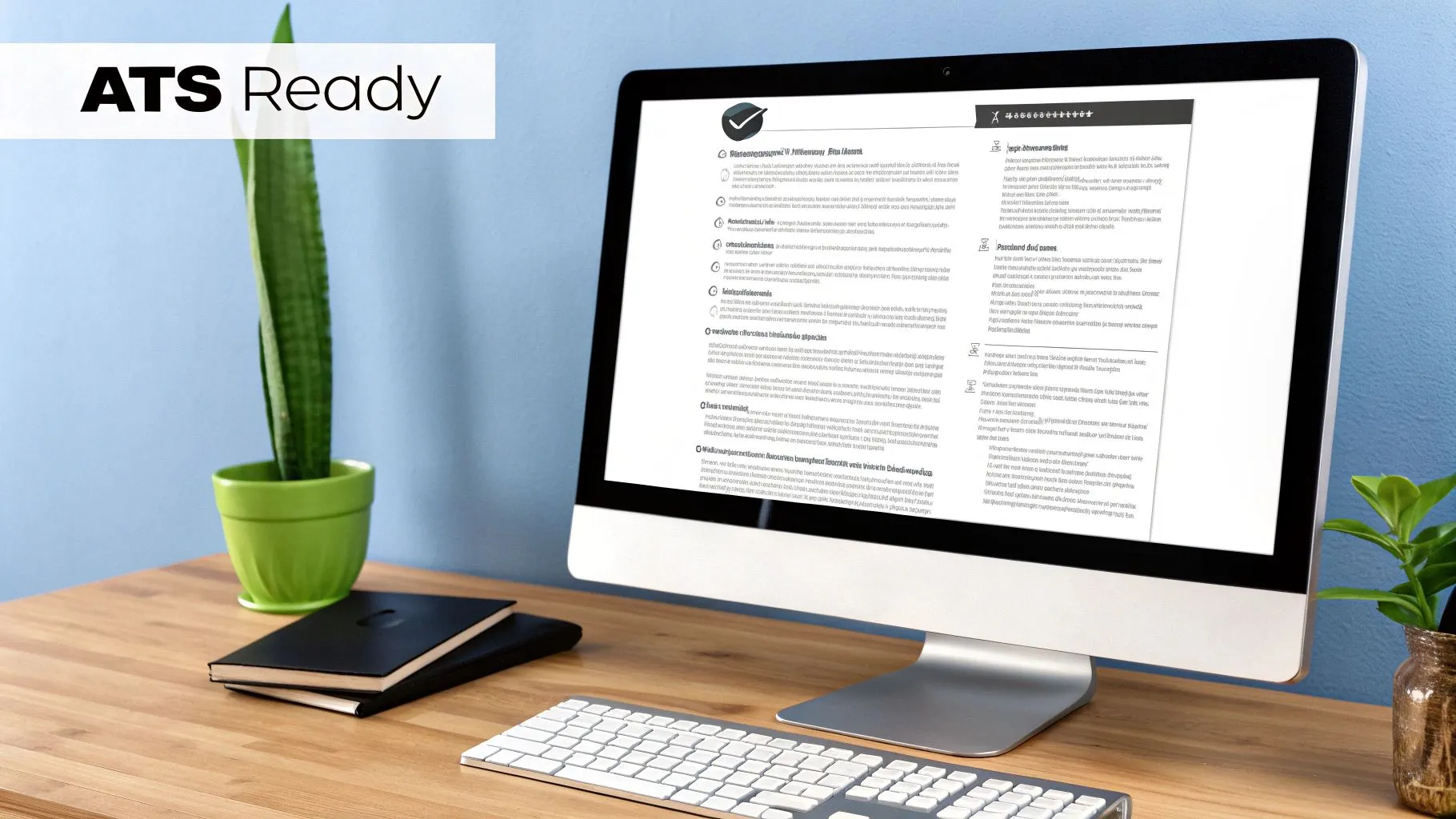
Before your carefully crafted curriculum vitae for Singapore ever reaches a human recruiter, it has to get past a digital gatekeeper. This bouncer is the Applicant Tracking System (ATS), software used by nearly every company to automatically screen and sort applications.
Think of an ATS as a very strict, very literal robot. It doesn't care about pretty designs or clever layouts. Its only job is to scan for specific information—keywords, skills, and standard section titles—and decide if you’re a match. If it can't read your CV, it just tosses it in the digital bin.
This means even the most qualified person can get rejected without a second thought, all because their formatting confused a piece of software. Your first goal isn't to impress a human; it's to create a document that's clean, simple, and perfectly legible for these bots. Only then does a person get to see how great you are.
The Golden Rules of ATS-Friendly Formatting
To make sure your CV sails through that initial screening, you need to play by the software's rules. These aren't just suggestions. They’re what get your application into the “to be reviewed” pile. Simplicity and clarity are your best friends here.
Your focus should be on making a document that's predictable. Easy for a machine to parse. That means sticking to conventions and ditching any fancy visual elements that might throw the system off.
Here are the non-negotiable rules for an ATS-compliant CV:
- Use Standard Fonts: Stick to universally recognized fonts like Arial, Calibri, or Times New Roman. Avoid script, decorative, or custom fonts that an ATS probably won't recognize.
- Keep Margins Generous: Ensure margins are at least 1cm (0.4 inches) on all sides. This stops text from being cut off and makes it easier for human eyes to read later.
- Use Standard Section Headings: Use clear, conventional titles like "Work Experience," "Education," and "Skills." Avoid creative alternatives like "My Journey" or "What I Can Do."
- Left-Align Your Text: Centering your name and contact details is fine, but all the body text should be left-aligned. It’s the standard and ensures consistent readability for both bots and humans.
An ATS is programmed to find specific patterns. When you use standard headings and a clean, linear format, you’re basically speaking the software’s language. This makes it dead simple for the system to identify and categorise your qualifications.
Common Formatting Traps That Get Your CV Rejected
Many job seekers, trying to stand out, accidentally use formatting that is poison to an ATS. These common mistakes can trigger an instant rejection, no matter how strong your background is. Knowing what these traps are is the first step to avoiding them.
You have to strip your CV of anything a machine might misread. Remember, the software is looking for text, not art. You can learn more about navigating these systems by understanding the ATS filter 90-10 rule, which explains the crucial balance between pleasing the bot and impressing the human.
Here are the top formatting mistakes to avoid at all costs:
- Tables and Columns: They look neat to us, but an ATS often reads tables line by line, from left to right, turning your organised content into an incoherent jumble.
- Graphics and Logos: Images, logos, icons, and those visual skill-rating bars are invisible to most ATS. To the software, they’re just blank spaces or, worse, parsing errors.
- Headers and Footers: Information you put in the header or footer of your document can be completely ignored by the software. Keep all your vital info, like your name and contact details, in the main body of the page.
- Special Characters and Symbols: Avoid anything beyond standard bullet points (simple circles or squares). Fancy arrows, checkmarks, or other symbols can cause the system to fail.
- Saving in the Wrong File Format: Always, always submit your CV as a .docx or .pdf file. JPEGs, PNGs, or Pages files are often completely incompatible with applicant tracking systems.
Of course. Here is the rewritten section, crafted to sound completely human-written and natural, following all the provided guidelines and examples.
Tailoring Your CV for Singapore's Hottest Industries
A generic CV is a fast-track to the rejection pile. In a market like Singapore where deep expertise is everything, sending a one-size-fits-all document is like showing up to a treasure hunt with a map of the entire country—you’re in the right place, but you have none of the specific clues you need to win.
To even get a first look, your CV needs to speak the language of the industry you’re targeting. This isn’t just about listing skills. It’s about highlighting the exact technologies, methodologies, and wins that recruiters in that sector are actively scanning for. You need to show them you’re not just another applicant, but an insider who already gets it.
Optimizing for Tech and IT Roles
The Singapore tech scene is exploding, but it’s also facing a massive talent crunch. The Info-Comms industry recently added around 5,900 new jobs, growing at 3.4% year-on-year. Yet, a staggering 79% of companies say they can't find the right people, with a projected need for 1.2 million digitally skilled workers by 2025. This is a huge opportunity, but only if your CV hits the right notes. You can explore insights on Singapore's tech talent trends to see just how wide this gap is.
To get a tech recruiter’s attention, your CV has to be precise and packed with the right keywords.
- Languages and Frameworks: Be specific. Don't just say "programming." List Python, Java, Go, React, or Vue.js. Mentioning your proficiency level is even better.
- Methodologies: Keywords like Agile, Scrum, or Kanban tell them you can slot right into a modern development team without missing a beat.
- Cloud and DevOps: For any infrastructure or DevOps role, terms like AWS, Azure, Google Cloud, Docker, and Kubernetes are absolutely non-negotiable.
- Show, Don't Just Tell: Link directly to your GitHub or a personal portfolio. Showing your code is always more powerful than just talking about it.
Instead of "Developed software applications," try something like this: "Engineered a scalable microservices architecture using Go and Kubernetes, slashing API response time by 30% and supporting a 50% spike in user traffic."
Crafting a CV for Business and Finance
In Singapore's cut-throat financial hub, recruiters are looking for one thing: proof that you can directly impact the bottom line. This industry runs on numbers, and your CV needs to reflect that. Vague claims about your contributions will get you nowhere. You need cold, hard data.
Every single bullet point should, ideally, have a number attached to it that proves your value.
Key Elements for a Finance CV:
* Certifications: Put qualifications like CFA, CA (Singapore), or FRM front and centre. They’re instant credibility boosters.
* Financial Modelling: Be explicit. Mention your skills in DCF valuation, LBO modeling, or financial forecasting.
* Quantitative Achievements: Frame everything in numbers. How much revenue did you drive? By what percentage did you cut costs? What was the size of the portfolios you managed?
* Regulatory Knowledge: If it’s relevant, show you understand the local landscape by mentioning the Monetary Authority of Singapore (MAS).
Example Bullet Point Transformation:
- Before: "Analyzed company financials to support investment decisions."
- After: "Constructed detailed DCF models for 15+ TMT sector companies, identifying undervalued assets that delivered an average portfolio return of 18%."
Structuring for Operations and Logistics
As a global logistics powerhouse, Singapore’s operations sector is all about efficiency, process improvement, and resilience. Recruiters want problem-solvers who can untangle complex supply chains and eliminate friction. Your CV must prove you know how to make things run better, faster, and cheaper.
The whole story should be about process improvement and the tools you used to get there.
Must-Haves for an Operations CV:
* Supply Chain Software: Name the systems you've worked with, like ERPs (SAP S/4HANA or Oracle NetSuite) and warehouse management systems (WMS).
* Process Improvement Methodologies: Keywords like Lean Six Sigma, Kaizen, and Value Stream Mapping are what hiring managers are looking for.
* Performance Metrics: Use industry KPIs to show your impact. Talk about how you improved On-Time-In-Full (OTIF) rates, slashed inventory holding costs, or boosted warehouse throughput.
* Supplier and Vendor Management: Describe your experience negotiating contracts and managing supplier relationships to drive quality and cut costs.
By tailoring your CV with the specific language and metrics of your industry, you stop being a general applicant and become a must-interview candidate. You're not just telling them you can do the job—you're proving you already speak their language.
Avoiding Common Singapore CV Mistakes
You've spent hours crafting the perfect CV, tweaking every bullet point and polishing each section. Now for the final, most crucial step: the quality check. One small, avoidable mistake can get your CV tossed in the "no" pile in seconds, undoing all that hard work. So many job seekers fall into the same traps—tiny errors that are huge red flags for Singaporean recruiters.
Think of this final review as more than just proofreading. You're scanning for cultural missteps and professional blunders. Things like overly casual language or including unnecessary personal details can signal a lack of professionalism or an unfamiliarity with local business etiquette. This is your last line of defence before you hit send.
Ditching Unprofessional Language and Tone
Singapore is a global business hub, and professional English is the undisputed language of the workplace. While Singlish is a cherished part of the local culture, it has absolutely no place on your CV.
Using informal slang or colloquialisms is an instant dealbreaker. It screams unprofessionalism. Stick to a formal tone throughout. This shows you understand the corporate environment and can communicate clearly with clients, colleagues, and stakeholders from all backgrounds.
- Don't: "Managed the team, can handle high-pressure situations one."
- Do: "Successfully managed a team of five in a fast-paced, high-pressure environment."
Protecting Your Personal Information
Hiring practices have changed, and so have the rules around personal data. Including sensitive information on your CV isn't just outdated; it's a liability. Employers in Singapore are actively discouraged from asking for personal details that could lead to discrimination.
You should never include your NRIC number, date of birth, marital status, or a photograph unless the job portal specifically requires it. A study found that 58% of hiring managers will reject a resume for typos alone. Including irrelevant personal data is viewed just as critically, as it suggests you haven't kept up with modern application standards.
The rule is simple: if it's not directly relevant to your ability to do the job, leave it out. This protects you and shows employers you’re in tune with current professional norms.
The focus of your CV also needs to shift depending on the industry you're targeting.
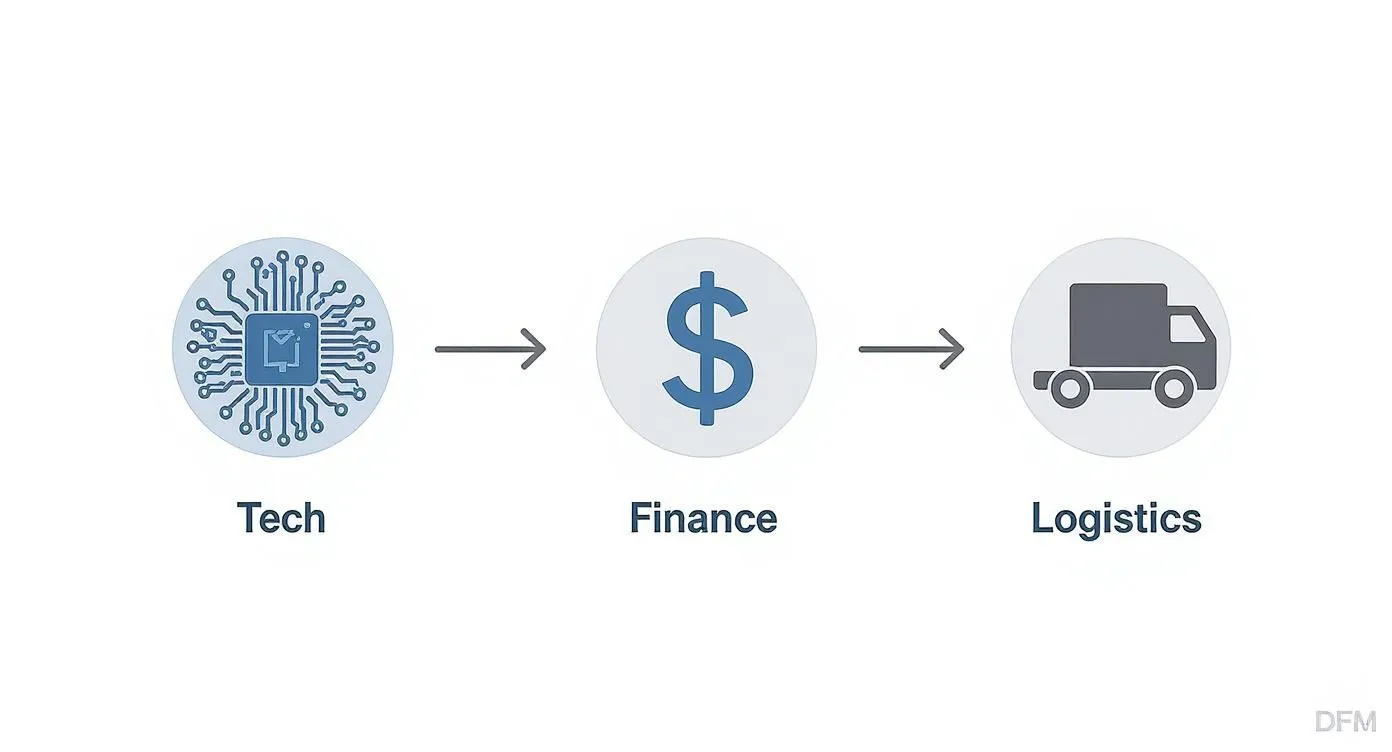
As you can see, tech roles demand a showcase of technical skills, finance is all about quantifiable results, and logistics prioritizes metrics around process and efficiency.
Addressing Employment Gaps and National Service
Leaving a gap in your work history unexplained is a major red flag. It creates doubt, and a recruiter’s imagination will almost always fill that void with negative assumptions. Don’t hide a gap—address it head-on with confidence.
Whether you took time off for professional development, family matters, or a planned sabbatical, a brief and positive explanation is all you need. Frame it as a period of growth.
- Example for a career break: "Took a planned six-month career break for professional development, completing certifications in Project Management and Advanced Excel."
For male Singaporean citizens and PRs, National Service (NS) is a significant experience. Don't just list it as a date range. Frame the transferable skills you developed—leadership, discipline, teamwork—which are highly valued by employers.
How to Present National Service:
* Role: Section Commander, Singapore Armed Forces
* Key Achievement: Led and mentored a platoon of 20 personnel, ensuring operational readiness and achieving a 100% safety record during field exercises.
To help you with that final check, here is a quick rundown of the essential dos and don'ts to ensure your curriculum vitae for the Singapore market is polished, professional, and ready to impress.
Singapore CV Dos and Don'ts Checklist
| Do | Don't |
|---|---|
| Keep it to 1-2 pages. Be concise and focus on impact. | Include a photograph. Unless specifically requested by the employer. |
| Use a professional, formal tone. English is the standard. | Use Singlish or any informal slang. This is an immediate red flag. |
| Quantify your achievements with numbers. Show, don't just tell. | List your NRIC, marital status, or date of birth. This is outdated and unnecessary. |
| Tailor your CV for each job application. Highlight relevant skills. | Leave employment gaps unexplained. Address them briefly and positively. |
| Frame National Service as valuable experience. Focus on transferable skills. | Submit a generic, one-size-fits-all document. It shows a lack of effort. |
| Proofread meticulously. Typos and grammatical errors are dealbreakers. | Use a flashy or hard-to-read format. Keep it clean and ATS-friendly. |
By proactively avoiding these common mistakes, you ensure your CV makes the best possible first impression and clears the path for your next career move.
Using AI as Your CV Writing Assistant
Writing a strong curriculum vitae in Singapore takes serious time and strategic thinking. But you don't have to do it alone. Modern tools can act as your personal writing partner, helping you shape your story without making it sound robotic.
Think of AI not as an author, but as a smart assistant. Its job is to help you get past writer's block and sharpen your message. Platforms like StoryCV are built to generate powerful, data-driven bullet points by asking you targeted questions about what you actually accomplished.
This process keeps your CV from filling up with generic phrases. Instead, it pulls out your unique contributions. A good AI assistant can suggest stronger action verbs, spot important keywords in a job description, and make sure your professional tone stays consistent from top to bottom.
Using AI this way isn't about letting a robot write your CV for you. It's about using smart technology to brainstorm, polish, and ultimately produce a document that truly reflects your skills and experience.
In the end, this kind of partnership saves you hours of work and helps you explain your value much more clearly. If you're curious how these tools stack up against traditional services, take a look at the role of a professional resume writer in our comprehensive guide.
Your Lingering Questions, Answered
Even with a solid guide, a few questions always pop up. Crafting a curriculum vitae for Singapore means navigating some local quirks, so it's smart to iron out the details.
This is your final check-in before you hit send. We’ll cover the most common sticking points—length, photos, and salary—so you can submit your CV with complete confidence.
How Long Should My CV Be?
The golden rule in Singapore? Keep it tight. Your CV should be a highlight reel, not your life story.
- If you have under 10 years of experience: Stick to a firm two-page maximum. That’s more than enough room to showcase your wins without boring the reader.
- For senior leaders or deep technical experts: A three-page CV can work, but only if you have a long, relevant track record of projects, publications, or critical leadership roles.
Anything more is a red flag. Recruiters spend just seconds on their first look, and a long document works against you.
Should I Put a Photo on My CV?
No. Don't do it unless a job ad specifically asks for one.
In Singapore, leaving your photo off is standard professional practice. It helps companies avoid unconscious bias during the screening process and keeps the focus where it should be: on your skills and experience. Including a photo can make you look out of touch.
Do I Need to State My Salary Expectations?
Definitely not on the CV itself. It's a classic rookie mistake.
Putting a number on your CV can get you screened out before you even get a chance to talk. You either price yourself too low or too high. Save the salary talk for later in the interview process, once you’ve shown them what you can do and you understand the full scope of the role.
If a mandatory online form asks for a number, give a well-researched range. But keep it off the document.
Remember, Singapore's job market is always shifting. Skilled sectors like Financial Services are adding jobs (+5,300), but cautious hiring also means more contract roles are available. Your CV needs to prove your value with hard numbers—something nearly 99% of recruiters look for. To get a better feel for these shifts, check out this overview of Singapore's evolving job market.
Feeling stuck? Let StoryCV do the heavy lifting. Our AI helps you frame your achievements in a way that gets noticed, building a powerful, professional CV in minutes. Stop guessing what recruiters want and start telling a story that lands you the interview. Give it a try for free and write your first role today at https://story.cv.