
The market for digital marketing jobs in Singapore is on fire. It's not just strong; it's a core part of what makes the nation a premier business hub in Asia. This creates a constant hunger for skilled marketers who know how to get things done in a fast-paced economy. Whether you're fresh out of school or a seasoned pro, the opportunities are real and rewarding.
Why Singapore Is a Hub for Digital Marketing Careers
Think of Singapore's marketing scene as a bustling digital port. It’s where global brands, scrappy startups, and ambitious talent all come together. The city-state didn't become a powerhouse for marketing careers by accident—it’s the result of some very smart, strategic advantages.
A few key things fuel this engine. A booming e-commerce market, serious government backing for a digital-first economy, and its role as the regional HQ for countless multinationals create a massive demand. These companies need marketers who can run campaigns not just for Singapore, but across the complex and diverse markets of Southeast Asia.
A Market Defined by High Demand
This isn't just a feeling; the data backs it up. The need for digital talent has been surging for years, showing a fundamental shift in how businesses work. Companies are all-in on online customer acquisition and e-commerce, making digital marketing a core function, not just a side project.
This isn't a temporary blip. LinkedIn put digital marketing in the top five most in-demand jobs in Singapore back in 2023, and that trend has only gotten stronger as businesses double down on their online presence.
Recent analysis confirms it, showing that digital roles—including marketing—made up roughly 11% of all online job postings in the country. That number alone tells you how critical these skills have become to the entire job market. You can explore more about these recruitment trends to get the full picture.
Key Factors Driving Growth
It's the convergence of several factors that makes Singapore such a great place to build a digital marketing career:
- Regional HQ Magnet: Global giants like Google, Meta, and TikTok have their regional command centers here. That means a high concentration of senior-level, strategic roles.
- Thriving Startup Ecosystem: The startup scene is electric, fueled by venture capital and government grants. This creates fertile ground for nimble and innovative marketers who want to make a big impact, fast.
- Government Initiatives: Programs like SkillsFuture are actively pushing people to upskill in digital competencies. This ensures the talent pool stays sharp and ready for whatever comes next.
Understanding Digital Marketing Salaries In Singapore
Let's get straight to the numbers. When you're looking at digital marketing jobs in Singapore, money is a huge part of the conversation. But it's not as simple as quoting a single average salary. What you can earn really depends on your experience, your specific skills, and the industry you land in.
A performance marketing guru in a fast-moving fintech company will be on a completely different pay scale than a content strategist at an e-commerce brand. Think of it this way: your base salary is the main dish, but performance bonuses and KPI-driven incentives are the secret sauce. These extras are especially common in roles where you can directly track the results of your work.
Breaking Down the Pay Scale
The good news is that career and salary progression in Singapore's digital marketing world is pretty clear. You’ll start at an entry-level salary as an executive, but with a few years of solid, proven results under your belt, that number can climb fast. The highest salaries, naturally, go to senior roles that involve leading a team and driving strategy.
Recent salary guides show a mid-level digital marketer in Singapore can expect to earn somewhere between SGD 6,000–7,000 per month. But that's just a baseline. If you're in a specialized role like a performance marketing manager or an analytics lead, you'll command a much higher package. The biggest pay bumps go to those with proven skills in AI, data analytics, or complex paid media campaigns. You can discover more insights on digital marketing roles and see for yourself how skills directly impact your earning potential.
This next chart really drives home just how high the demand is for digital marketing talent, which is a big reason why the salaries are so competitive.
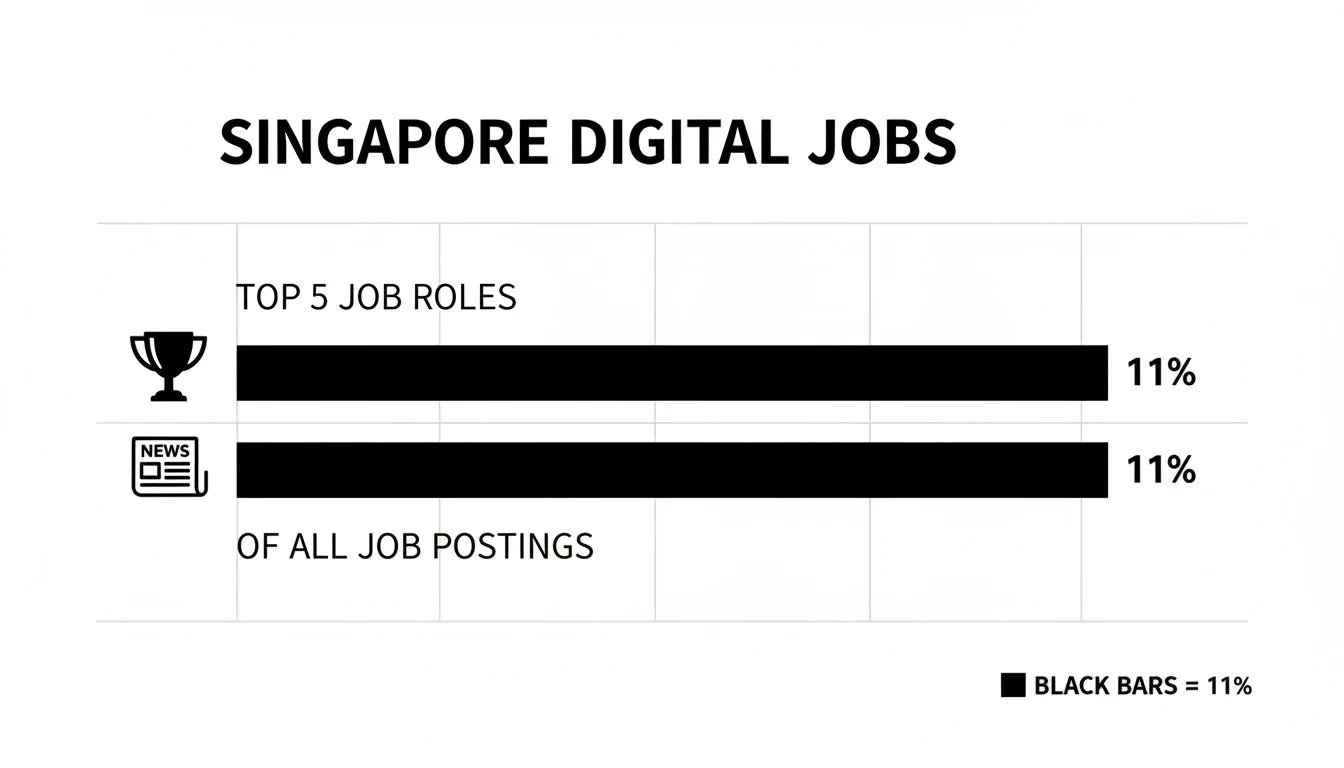
As you can see, digital marketing isn't some tiny niche. It makes up a huge chunk of the job openings across the country.
Digital Marketing Salary Bands In Singapore By Role And Seniority (SGD/Month)
To give you a much clearer picture, here’s a breakdown of the typical monthly salary ranges you can expect. Remember, these are estimates. The final number will always depend on the company's size, its industry, and frankly, how well you negotiate. But this table gives you a solid starting point for benchmarking your worth.
Your specialization acts as a multiplier on your base experience. An in-demand skill set, like marketing automation or advanced SEO, can place you at the higher end of any salary bracket, even with fewer years of experience.
Use the table below to see where you stand now and what you can aim for as you climb the career ladder.
| Job Title / Specialization | Entry-Level (0-2 years) | Mid-Level (3-5 years) | Senior (5+ years) |
|---|---|---|---|
| Digital Marketing Executive | SGD 3,000 - 4,500 | SGD 4,500 - 6,500 | SGD 6,500 - 8,500 |
| SEO Specialist | SGD 3,500 - 5,000 | SGD 5,000 - 7,500 | SGD 7,500 - 10,000+ |
| Performance Marketing | SGD 4,000 - 5,500 | SGD 5,500 - 8,000 | SGD 8,000 - 12,000+ |
| Social Media / Content | SGD 3,200 - 4,800 | SGD 4,800 - 7,000 | SGD 7,000 - 9,500+ |
| Digital Marketing Manager | N/A | SGD 6,000 - 9,000 | SGD 9,000 - 15,000+ |
As you can see, specializing in high-impact areas like Performance Marketing or SEO often leads to the highest earning potential, especially once you hit that senior level where you're not just executing campaigns but building the entire strategy.
The Most In-Demand Digital marketing Roles and Skills

Getting hired for a top digital marketing job in Singapore isn’t about knowing the latest buzzwords. It’s about mastering skills that directly make a business money. Companies aren’t just looking for someone to "do marketing"—they need specialists who deliver measurable growth and a clear return on investment (ROI).
Think of it this way: a business puts money into marketing and expects to get more money back. The skills everyone wants are the ones that make this happen reliably and efficiently. That’s exactly why roles tied to performance and data are exploding right now.
Performance Marketing and Data Analytics
At its heart, performance marketing is all about results you can actually count. This covers paid channels like Google Ads and social media ads, where every single dollar spent is tracked against actions like clicks, leads, or sales. Companies love it because it takes the guesswork out of their marketing budget.
A Performance Marketing Specialist is like a financial analyst for ad campaigns. They live in the numbers, constantly tweaking bids, targeting, and ad creative to squeeze out the best possible ROI. They speak fluently in acronyms like CPA (Cost Per Acquisition) and ROAS (Return On Ad Spend).
Working hand-in-hand with performance is data analytics. A Marketing Analyst doesn’t just run the campaigns; they dig into the data to tell the story of what customers are doing. They answer the big questions: Which channels bring in our best customers? Where are people dropping off in the sales funnel? This kind of insight is pure gold for making smart business decisions.
SEO and Content Strategy
While paid ads can get you quick results, Search Engine Optimization (SEO) and content strategy are about building something that lasts. Think of SEO as building a permanent magnet for your website that pulls in a steady stream of free, organic traffic from search engines. It's a foundational skill that pretty much every company needs.
An SEO Specialist focuses on a few key areas:
* Keyword Research: Figuring out what your potential customers are actually typing into Google.
* On-Page Optimization: Making sure your website's content and code are easy for search engines to understand.
* Link Building: Earning trust and authority from other respected websites by having them link back to you.
A strong content and SEO strategy doesn't just bring in traffic; it builds brand authority and trust over time. It’s the difference between renting an audience through ads and owning one through valuable content.
This strategy makes sure your business shows up at the exact moment a customer is looking for what you offer, making it one of the most powerful and cost-effective forms of marketing out there.
The Rise of Automation and AI
Finally, as companies grow, marketing automation becomes a necessity. People skilled in platforms like HubSpot or Marketo help businesses automatically nurture leads, send personalised messages, and manage complex customer journeys. This frees up the team to focus on big-picture strategy instead of getting bogged down in repetitive tasks.
More recently, knowing your way around AI has become a massive advantage. Being able to use AI tools for content creation, data analysis, and campaign optimization is no longer just a "nice-to-have." It’s a core skill that shows you’re ready for where marketing is headed next.
Where to Find the Best Digital Marketing Jobs
Knowing which skills are in demand is one thing. Knowing where to actually look is the real challenge. To find the best digital marketing jobs in Singapore, you need to know which industries have the biggest appetite for new talent. Just scrolling through job boards isn't enough—if you want a top-tier role, you need to be strategic.
Singapore's economy runs on a few key industries, and each one has a constant, growing need for skilled marketers. These aren't just companies looking to fill a seat; they're building entire digital ecosystems that depend on sharp marketing to thrive. If you focus your search here, you're fishing where the fish are biting.
Top Hiring Industries for Marketers
Some sectors are just hiring more than others. If you understand what makes each one tick, you can tailor your application and show them you have exactly what they're looking for.
- E-commerce and Retail: This is a fast-paced, consumer-driven world. Think of companies like Shopee, Lazada, and Zalora. They're always on the hunt for marketers who live and breathe performance marketing, social commerce, and driving online sales through razor-sharp campaigns.
- Technology (B2B and B2C): This is the big one, covering everything from global giants to local heroes. Companies like Google, Meta, and Grab need marketers who get the whole picture, from brand building to complex, data-heavy customer acquisition.
- Fintech and Financial Services: This is a high-stakes, regulated space where trust is everything. Brands like DBS, Stripe, and a wave of new challenger banks need marketers skilled in content, lead generation, and building authority in a crowded market.
The industry you choose really shapes your day-to-day. A marketer in e-commerce might be obsessed with daily ROAS and flash sales, while someone in B2B tech is building out six-month lead nurturing sequences. Make sure your skills and interests align with the rhythm of the industry.
This demand isn't happening in a bubble. Singapore’s digital economy now makes up around 18.6% of its GDP. With the tech workforce growing to about 214,000 people in 2024, the need for digital experts has spilled over from just tech companies into finance, manufacturing, and professional services. You can discover more about Singapore's digital economy growth to see just how big the opportunity is.
Key Companies to Watch
Beyond just looking at industries, it pays to keep an eye on specific companies known for their strong marketing teams and consistent hiring. These are often the places setting the pace for marketing innovation and offering real career growth.
Keep these names on your radar:
1. Global Tech Leaders: Google, Meta, Microsoft, TikTok.
2. Regional Champions: Grab, Shopee, Gojek.
3. Innovative Startups: Pay attention to companies that have just closed their Series B or C funding rounds. That's usually the signal that they're about to scale their marketing teams—fast.
How to Create a Resume That Gets Noticed

Your resume is your one shot to make a first impression. Think of it as your most important marketing document. Yet, so many job seekers treat it like a boring list of duties.
Especially for digital marketing jobs in Singapore, where results are everything, a resume that just lists your tasks gets ignored. Hiring managers don't care that you "managed social media." They want to know what happened because you managed it.
The secret is simple but powerful: turn your responsibilities into achievements you can measure. Using numbers to tell the story of your value is the single biggest change you can make. It's often the difference between getting an interview and getting lost in the "no" pile.
Shift from Tasks to Impactful Results
You need to think like a storyteller, not a stenographer. Every single bullet point on your resume should answer the question, "So what?" What was the result of your work? Frame your experience around metrics that matter—revenue growth, new leads, cost savings, or better engagement.
Let's look at how to make that shift in practice:
- Before (Just a task): "Wrote blog posts and managed the company blog."
-
After (Shows impact): "Authored 20+ SEO-optimised blog posts that increased organic traffic by 45% in six months, contributing to a 15% rise in inbound leads."
-
Before (Just a task): "Ran paid advertising campaigns on Google and Facebook."
- After (Shows impact): "Managed a $50,000 quarterly ad budget, achieving a 3.5x ROAS by optimising campaigns, which generated over $175,000 in direct e-commerce sales."
This approach proves you can deliver real business results, which is exactly what Singaporean employers are looking for.
Weave in Keywords and Tools Naturally
Recruiters rely on Applicant Tracking Systems (ATS) to scan resumes for specific keywords and skills. Go through the job description and pull out the important terms and marketing tools they mention, like "SEO," "Google Analytics," "HubSpot," or "performance marketing."
But don't just dump them into a skills section. That’s lazy. Instead, weave them directly into your achievement bullet points. This gives context and proves you've actually used these tools to get things done.
Your resume should read like a case study of your career, not an inventory of your past duties. Each bullet point is a mini-story with a beginning (the challenge), a middle (your action), and an end (the measurable result).
For instance, don't just write "Google Analytics." Say this instead: "Used Google Analytics to identify a 30% drop-off in the checkout funnel, leading to a UI redesign that recovered an estimated $15,000 in monthly revenue."
See the difference? You’re showing proficiency while reinforcing your impact. If you're just starting out, getting this structure right is non-negotiable. You can find more tips and inspiration from a well-structured student resume template with real examples to guide your own.
When you build a resume this way, you create a compelling story that proves your value before you even walk into the interview room. It’s the most effective strategy to land the best digital marketing jobs in Singapore.
Nailing Your Job Application and Interview
Getting a digital marketing job in Singapore isn’t just about having the right skills; you have to know where to look and how to sell your story. Sure, you can scroll through the usual job boards, but the real action happens on platforms like LinkedIn and MyCareersFuture. These are the places where you can connect directly with recruiters from the companies you actually want to work for.
Don't stop there. Some of the best roles are never even advertised publicly. This is where specialized recruitment agencies and good old-fashioned networking come in. Recruiters often have the inside track on hidden opportunities and can put your name forward. And those industry events—whether online or in person—are goldmines for building connections that can turn into referrals down the road.
Mastering the Interview
Okay, so you landed the interview. This is where you prove you're more than just a list of skills on a resume. Hiring managers want to see how you think, especially when things go wrong. They will ask behavioural and situational questions to see how you handle real-world marketing challenges. So, be ready to talk about your wins, but be even more prepared to discuss your failures.
A classic question is, "Tell me about a campaign that failed and what you learned." This isn't a trap. It's a test to see if you're accountable and if you can analyze a situation, learn from it, and adapt.
The secret to a killer interview is telling stories backed by data. Don't just list what you did. You need to walk them through the entire journey: the situation you faced, the specific actions you took, the measurable results you achieved, and the overall impact your work had on the business.
A simple way to keep your answers on track is to use a framework like STAR (Situation, Task, Action, Result). It forces you to be clear, concise, and focused on outcomes—which is exactly what hiring managers are listening for.
Answering Common Interview Questions
Let's look at how to tackle a couple of standard questions with answers that actually show your value.
-
Question: "How do you measure the ROI of a marketing campaign?"
- Weak Answer: "I look at clicks and impressions."
- Strong Answer: "It starts with the campaign's core goal—is it about generating leads, driving sales, or just building brand awareness? For a lead-gen campaign, I’d be tracking metrics like Cost Per Lead (CPL) and the Lead-to-Customer Conversion Rate. By comparing the total revenue from the customers we converted against what we spent, I can calculate a clear ROI."
-
Question: "What's your process for keyword research?"
- Weak Answer: "I use tools like Ahrefs."
- Strong Answer: "My process is all about understanding customer intent first. I'll use a tool like Ahrefs to find the high-volume keywords, of course. But I dig deeper by analyzing what competitors are ranking for and what people are asking on forums to uncover long-tail keywords that signal a strong intent to buy. That's how we attract traffic that actually converts."
Before you even hit "apply," make sure your resume can get past the automated screeners that most companies use. It’s a crucial first step. If you want to understand how these systems work, it's worth learning about the ATS filter 90-10 rule for resume writing.
Finally, always go into an interview with a few smart questions of your own. It shows you’re genuinely interested and thinking strategically, and it leaves a much stronger impression than just saying, "Nope, no questions from me."
Frequently Asked Questions
Stepping into a new job market can feel like you're trying to figure out the rules to a game everyone else already knows. So, let's get straight to the point and tackle some of the most practical questions people have about landing a digital marketing job in Singapore.
Do I Need Local Experience to Get Hired?
This is a big one, and the answer is: it depends, but probably not as much as you think. While having local experience is definitely a plus, it’s not always a hard requirement.
Many of the big multinational companies here in Singapore are regional hubs. They often value international experience, especially if you've worked in other Asian markets. Your expertise from outside Singapore can be a huge asset.
However, if you're aiming for a role that's laser-focused on the Singaporean consumer, then yes, knowing the local scene matters. Understanding cultural quirks and being familiar with platforms like Carousell will give you a serious advantage. If you're new to the market, the trick is to show you're a fast learner and can apply your existing skills to this new context.
Agency vs. In-House: Which Is Better?
Ah, the classic fork in the road for every marketer. There's no single "better" path here—it all comes down to what you want out of your career right now.
- Agency Life: Get ready for a whirlwind. You’ll be juggling multiple clients across different industries, learning a ton of skills in a very short amount of time. It’s an amazing training ground, but it often comes with tight deadlines and a high-pressure, fast-paced culture.
- In-House Role: Here, you go deep. You become the expert on one brand, owning its strategy from start to finish. This often brings a greater sense of ownership and a more predictable work-life balance, letting you see the long-term impact of your work.
Think of it this way: agency life is like a series of sprints on different tracks, while an in-house role is a marathon focused on just one.
No matter where your experience comes from, the single most important thing is framing it around impact. Your resume shouldn't be a laundry list of tasks; it needs to tell a story of what you actually achieved.
If you find it hard to turn your day-to-day duties into compelling results, it can be useful to understand what a professional resume writer does. It’s all about connecting your work to the "so what?"—a skill that will make any hiring manager sit up and take notice.
Ready to tell your career story with impact? StoryCV uses AI to help you move beyond generic templates, crafting a compelling resume that highlights your true achievements. Stop listing tasks and start demonstrating your value.