A front end developer career is all about building the parts of a website or app that people actually see and touch. It’s a unique role that sits right at the intersection of creativity and technical skill, turning design mockups into living, breathing digital experiences that are responsive, accessible, and just plain work.
What Does a Front End Developer Actually Do?
Think of a website like a restaurant. The front end developer is in charge of everything a customer experiences—the decor, the menu layout, the seating, the overall vibe. They don't cook the food (that's the back end), but they create the entire environment that makes the dining experience feel intuitive and enjoyable.
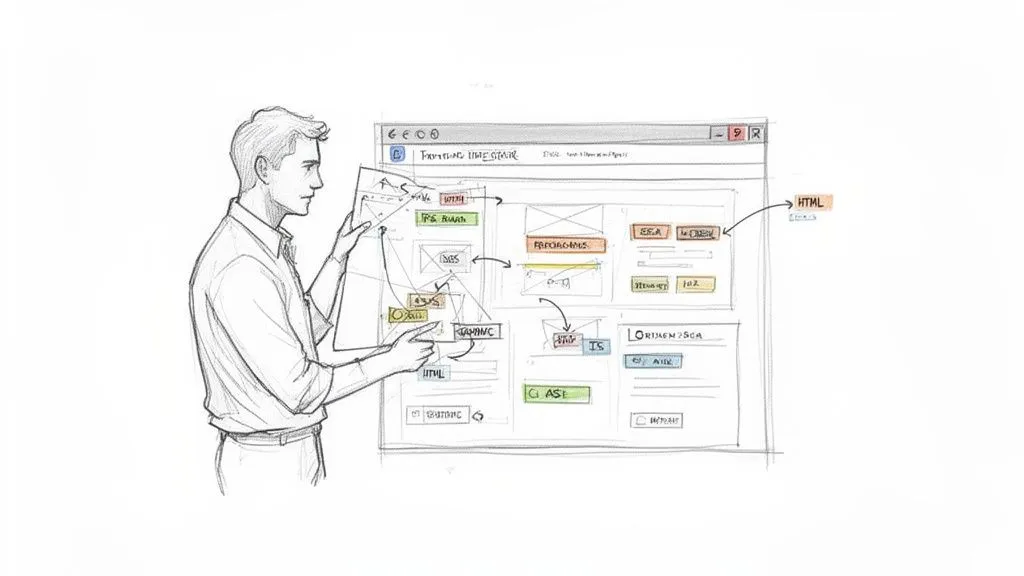
In more technical terms, a front end developer takes a static design file from a UI/UX designer and brings it to life in the browser. They are the essential bridge between design and technology, making sure every button, menu, and animation functions exactly as intended.
The Core Responsibilities
Day-to-day, a front end developer's world revolves around three core technologies: HTML, CSS, and JavaScript. These are the absolute building blocks of the web.
-
HTML (HyperText Markup Language) provides the basic structure and content of a page. Think of it as the walls and rooms of a house.
-
CSS (Cascading Style Sheets) adds all the styling—the colors, fonts, and layouts—that makes the house look good.
-
JavaScript introduces interactivity, like functional light switches, doors that open, and appliances that work when you press a button.
With this powerful trio, they build everything from simple landing pages to incredibly complex, data-driven applications. The end goal is always to create a seamless user interface that isn't just nice to look at but is also fast, accessible to users with disabilities, and works perfectly across every conceivable device and browser.
At its heart, the role of a front end developer is to be a user advocate. They are the first line of defense in ensuring a digital product is usable, enjoyable, and accessible to everyone, translating human needs into functional code.
Distinguishing Front End from Other Roles
To really get what a front end developer career is about, it helps to see where it fits in the bigger picture. The web development world is mostly split into two camps: front end and back end.
The back end developer works behind the scenes, managing the server, application logic, and databases. In our restaurant analogy, they are the chefs in the kitchen, actually preparing the food and making sure the restaurant's operations run without a hitch.
A full stack developer is a jack-of-all-trades, a versatile pro who is comfortable working with both front end and back end technologies. They can build and manage an entire application from start to finish, acting as both the interior designer and the head chef.
This is a critical distinction for anyone trying to chart their course in software development. To make it even clearer, here’s a quick breakdown.
Front End vs Back End vs Full Stack at a Glance
| Aspect | Front End Developer | Back End Developer | Full Stack Developer |
|---|---|---|---|
| Primary Focus | User interface (UI) and user experience (UX) | Server, database, and application logic | Both client-side and server-side development |
| Core Technologies | HTML, CSS, JavaScript (React, Angular, Vue) | Node.js, Python, Java, PHP, Ruby | Proficient across both front end and back end stacks |
| Main Goal | Create a visually appealing, interactive, and responsive user-facing experience | Build and maintain the server-side logic that powers the application | Develop and manage the entire application from end to end |
| Restaurant Analogy | The restaurant's dining area, decor, and menu | The kitchen, chefs, and supply chain | The restaurant owner who designs the space and also runs the kitchen |
Understanding these roles helps clarify where you might want to focus your energy. A front end developer career is perfect for those who love to see their work come to life visually and are passionate about creating great user experiences.
Climbing the Ladder From Junior to Lead Developer
A front-end developer career isn't just one job. It's a journey, and each stop along the way asks something different of you. You evolve from a coder focused on small tasks into a technical leader shaping strategy for an entire team. Knowing what's expected at each stage is the key to moving up with purpose.
The whole thing starts at the junior level. Think of a junior developer as an apprentice. They get handed well-defined, bite-sized tasks—build this button, fix that bug, style this page—and work under the close watch of more senior teammates.
Their main job is to write clean code that works, but the real goal is to learn. They're soaking up everything they can about the team's codebase, tools, and workflow. This is all about building a rock-solid technical foundation and figuring out how to contribute in a professional environment.
The Mid-Level Developer: The Autonomous Problem Solver
After a couple of years in the trenches, a developer usually moves into a mid-level role. This is a big shift. You're no longer just taking orders; you're given more freedom to solve problems on your own.
A mid-level dev isn't just handed small tasks anymore. They're trusted with whole features and are expected to figure out the tricky parts with less hand-holding. They know the core tech inside and out and can actually add value in technical debates. This is also where they start taking real ownership, thinking through all the weird edge cases and potential pitfalls. Often, they start mentoring juniors, which is a great way to solidify what they already know.
The Senior Developer: The Strategic Influencer
Hitting the senior level is another huge leap. Your focus expands from owning a feature to influencing the entire team's strategy. A senior developer's job goes way beyond just the code they write. They have to think about the big picture—system architecture, scalability, and how to keep the codebase from becoming a mess in two years.
They are the ones guiding the technical direction of projects, making key architectural calls, and establishing the best practices everyone else follows. Their impact is measured as much by their mentorship and communication as their code. They unblock other developers, help translate fuzzy business ideas into solid technical plans, and generally make the whole team better.
A senior developer's value isn't just in the code they write, but in their ability to be a force multiplier for the team. They elevate the skills and output of everyone around them.
The Path to Technical Leadership
Once you're a senior, the path often splits. You can move toward managing people or dive even deeper into the tech.
-
Tech Lead: This role is a mix of deep technical skill and people management. A Tech Lead makes sure a project succeeds technically while also helping their team members grow. They’re often the ones managing timelines and talking to stakeholders.
-
Principal Engineer: This is for the individual contributor who wants to stay hands-on and tackle the gnarliest technical problems without managing a team. They're the go-to expert for tough architectural questions and often set the technical vision for the whole company.
This climb up the ladder comes with real financial rewards, too. As you gain experience and make a bigger strategic impact, your salary grows. Entry-level roles might start in the $65,000 to $88,000 range, but that number climbs fast. Mid-level developers can expect closer to $94,000, and seniors often command salaries well over $107,000. The top specialists can even push past $141,500, showing just how much earning potential there is on this path. You can learn more about front-end developer salary trends on PayScale.
The Modern Front End Developer Skill Set
Building a career in front-end development isn't about chasing every shiny new tool. It’s about creating a strong, layered foundation of skills that work together. Think of it like building a skyscraper. You can't start with the penthouse windows; you have to pour a solid concrete foundation first.
This roadmap takes you from those non-negotiable fundamentals to the frameworks and advanced concepts that will define your expertise—and your value in the job market.
The Foundational Trio: HTML, CSS, and JavaScript
These three technologies are the bedrock of everything you see on the internet. They aren't optional. Mastering them before you move on to anything else will make learning everything else significantly easier.
-
HTML (HyperText Markup Language): This is the skeleton of a web page. It gives your content structure and meaning, telling the browser what’s a heading, what’s a paragraph, and what’s an image.
-
CSS (Cascading Style Sheets): This is the aesthetic layer. It handles the colors, fonts, layout, and overall visual feel that turns a plain HTML document into something people actually want to look at.
-
JavaScript (JS): This is the engine that brings a page to life. It manages all the interactivity—button clicks, form submissions, and dynamic updates—letting users actually do things.
Once you have a firm grip on these, it's time to start using the tools that separate the hobbyists from the professionals.
The Essential Developer Toolkit
No developer is an island. A modern workflow depends on a standard set of tools for managing code, automating tasks, and working effectively in a team. This is where you really start to think like a professional.
The most critical tool here is Git, a version control system. Imagine it as a "save" button for your entire project's history. It lets you track every change, roll back mistakes, and work with other developers without stepping on each other's toes. You'll use platforms like GitHub or GitLab to store and share that code.
A strong skill set isn't just about what you can build, but how you build it. Mastering version control and build tools is a clear signal to employers that you understand professional workflows and are ready to contribute to a team.
You’ll also get familiar with package managers like npm (Node Package Manager) or Yarn. These tools are lifesavers, helping you manage all the external code libraries and plugins your projects depend on, a process that would otherwise be a manual, error-prone nightmare.
These skills build on each other as you move from a junior to a senior role. The journey is one of expanding responsibility, moving from pure coding tasks toward more complex problem-solving and strategic planning.
To help you visualize this journey, here’s a technology roadmap outlining what to learn and when.
Front End Technology Roadmap
This roadmap breaks down the essential technologies into three stages, helping you prioritize what to learn as you progress in your career.
| Skill Category | Foundational (Must-Have) | Intermediate (Core Tools) | Advanced (Specialization) |
|---|---|---|---|
| Languages | HTML5, CSS3, JavaScript (ES6+) | TypeScript, SASS/SCSS | WebAssembly, GraphQL |
| Frameworks | None (focus on vanilla JS) | React, Vue, or Angular | Next.js, Nuxt.js, Svelte |
| Tooling | Git & GitHub, VS Code | npm/Yarn, Webpack/Vite | Docker, CI/CD (e.g., Jenkins) |
| Testing | Manual Browser Testing | Jest, React Testing Library | Cypress, Playwright |
| Concepts | Responsive Design, DOM | State Management (Redux/Pinia) | Web Performance, Accessibility (a11y) |
This table isn't a checklist to be completed overnight. It's a guide to show you how skills build upon one another, moving from the absolute essentials to the specialized tools that will define your senior-level expertise.
Mastering JavaScript Frameworks
With your foundation and toolkit in place, you’re ready for JavaScript frameworks. These aren't new languages. They are powerful structures built on top of JavaScript to solve common problems, providing pre-written code and conventions that make building big, complex applications way faster and easier to maintain.
The "big three" you'll hear about constantly are:
-
React: Developed by Meta, React is technically a library, not a framework, but it dominates the job market. Its component-based approach and massive community support make it a go-to choice for most companies.
-
Vue.js: Known for its gentle learning curve and fantastic documentation, Vue is a flexible framework that's easy to adopt piece by piece. Developers love it for its simplicity and elegance.
-
Angular: A full-blown platform from Google, Angular is an opinionated, all-in-one solution for building huge, enterprise-scale applications. It’s powerful but comes with a steeper learning curve.
You don't need to learn all three. Pick one—usually React, based on market demand—and get really good at it. That's what will get you hired.
Advanced Concepts for Top-Tier Developers
To truly stand out and climb into senior roles, you need to think beyond just making things work. The best developers focus on the quality of the user's experience and the resilience of the code itself.
This is where you dive into things like web performance optimization (making sites load lightning-fast), accessibility (a11y) (ensuring your site is usable by people with disabilities), and automated testing (writing code that tests your other code to prevent bugs).
These aren't just buzzwords; they are the skills that separate a good developer from a great one. They show you care not just about the "what," but also the "how" and the "why."
Building a Portfolio That Gets You Hired
Your resume and portfolio aren't just lists of skills. They’re your professional story. They're the first handshake with a hiring manager, and in a crowded market, they need to do more than just exist—they need to grab someone’s attention.
The real goal is to stop talking about what you did and start showing the impact you made. This one change flips your application from a passive list of tasks into a powerful case study of your problem-solving skills. It proves you don't just write code; you create real value.
Curating a High-Impact Portfolio
Your portfolio is where the proof lives. It’s where you show you can actually build things with the skills you claim on your resume. The biggest mistake developers make is filling it with the same tutorial projects everyone else has. That’s a guaranteed way to blend in.
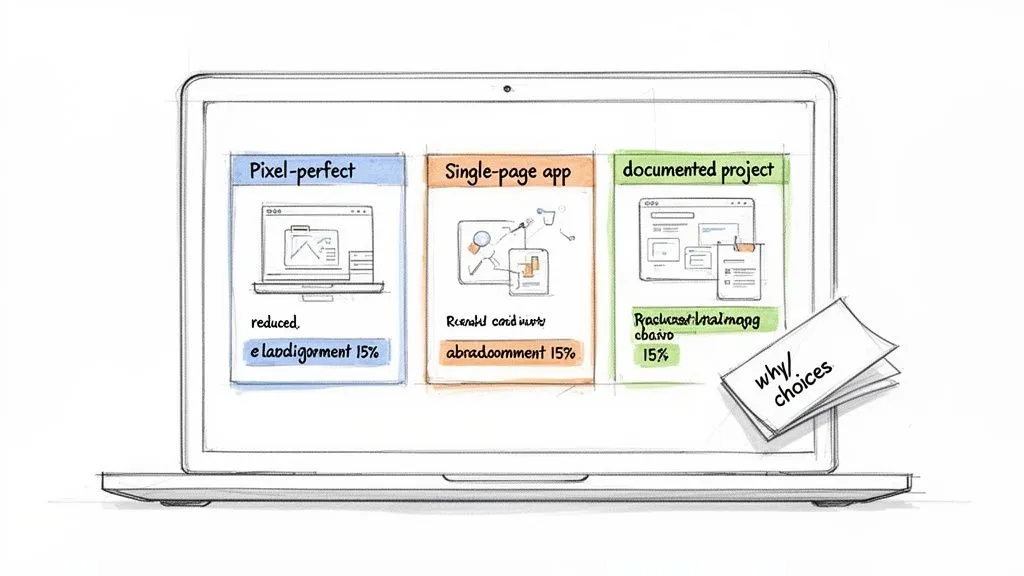
Instead, aim for a tight, focused collection of three to five polished projects. This number is small enough to let you go deep on each one but large enough to show you have range.
-
A Pixel-Perfect Static Site: Find a beautifully complex design and clone it down to the last pixel. This is your chance to prove you’ve mastered the fundamentals: HTML, CSS, and true responsive design.
-
A Data-Driven Single-Page App (SPA): Build something that pulls data from an API and lets users interact with it. This shows you can handle asynchronous JavaScript, manage state, and build modern UIs with a framework like React or Vue.
-
A Passion Project: Make something that solves a weird problem you have or dives into a niche interest. This is where your personality shines through. It shows initiative and a genuine love for building things, which hiring managers love to see.
For every single project, the documentation is just as critical as the code itself. Write a detailed README.md or a project page that explains the why. What problem were you trying to solve? Why did you pick that specific tech stack? What roadblocks did you hit and how did you get past them?
From Tasks to Achievements on Your Resume
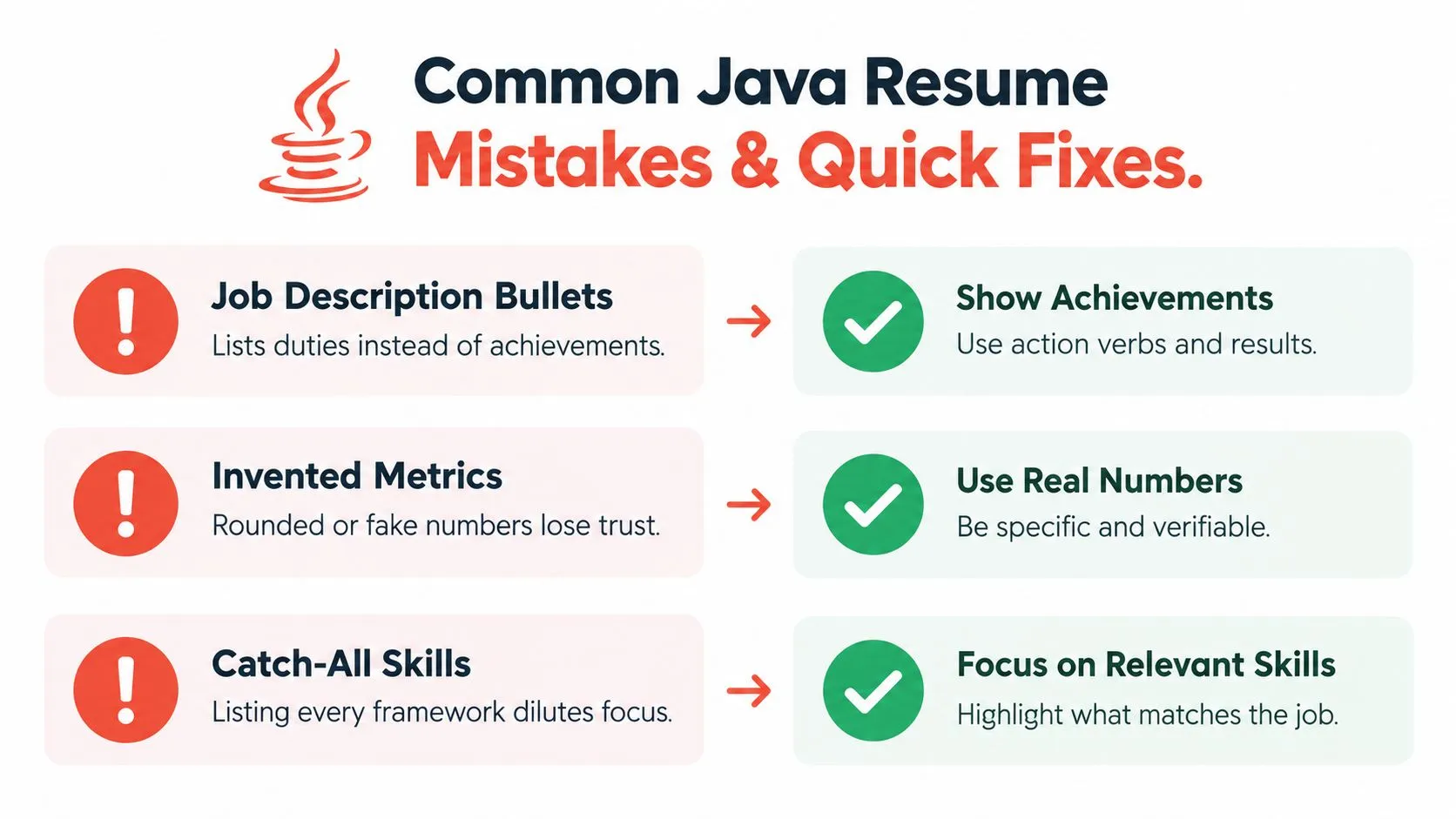
Your resume is your story told in bullet points, and each one is a chance to sell your impact. Too many developers just list their job duties, which tells a hiring manager absolutely nothing about how well they did them.
Instead of writing, "Wrote HTML and CSS for landing pages," you need to reframe it with a measurable outcome: "Developed and launched five responsive marketing landing pages using HTML5 and SASS, contributing to a 15% increase in lead generation."
See the difference? It immediately reframes you as a strategic partner, not just a coder waiting for instructions. This is especially vital for junior developers who need every bit of experience to count. If you need inspiration, check out resources like this student resume template with real examples to see how to frame your own wins.
The Art of Framing Your Impact
To get into this mindset, ask yourself three simple questions for every project or task you list:
-
What was the problem? (e.g., The checkout process was clunky and losing customers.)
-
What action did I take? (e.g., I rebuilt the entire flow with React to make it faster and more intuitive.)
-
What was the result? (e.g., We cut cart abandonment by 20% and got better user feedback scores.)
Even if you don't have perfect, hard numbers, you can still talk about improvements to performance, efficiency, or user experience.
| Before (Task-Focused) | After (Impact-Focused) |
|---|---|
| Built a navigation menu. | Engineered an accessible, keyboard-navigable mega-menu, improving site navigation for all users. |
| Fixed bugs on the team's project. | Resolved 30+ critical bugs in the main application, improving stability and reducing user-reported issues by 25%. |
| Worked with React components. | Refactored legacy class components into functional components with Hooks, improving code readability and performance. |
This storytelling approach is what separates you from the pack. It shows you understand the business context behind your code, which is the hallmark of a truly effective front-end developer.
Navigating the Interview Process and Landing the Job
Okay, you've got a polished portfolio and a resume that actually tells your story. Now it’s time to find the job.
Job boards are fine for seeing what's out there, but don't stop there. A real strategy for your front end developer career goes deeper. Getting involved in the community—whether that's through networking events or contributing to open-source projects—can open doors you didn’t even know existed.
The good news? Demand is high. The US Bureau of Labor Statistics projects an 8% growth for web developer roles between 2023 and 2033. That's faster than average and translates to around 16,500 new job openings every single year. So, the opportunities are definitely out there. You can dig into more stats over on the front-end developer job market on Coursera.
Understanding the Interview Gauntlet
The front-end interview process isn’t a single event; it's a multi-stage marathon designed to test you from every angle. If you know what's coming, you can stay confident and prepared.
-
Initial Recruiter Screen: This is just a quick, non-technical vibe check. The recruiter wants to know if you're a potential fit. They’ll ask about your background, what you’re looking for, and your salary expectations. Your job here is to sound enthusiastic and clearly explain why you’re interested.
-
Hiring Manager Call: Next up is usually the person who would be your direct boss. This conversation gets more specific. They’ll dig into your resume and portfolio, asking about past projects and how you work on a team. Be ready to talk through your technical decisions and connect your skills to what their company actually needs.
-
The Technical Challenge: This is where you prove you can walk the walk. It could be a live coding session, a take-home project, or a system design chat. The format changes, but the goal is always the same: they want to see how you think.
The most important part of any technical interview isn't just spitting out the right answer. It’s about articulating your thought process out loud. Talk through your approach, explain the trade-offs, and show the interviewer how you solve problems.
Acing the Technical and Behavioral Rounds
For live coding, grinding LeetCode or HackerRank helps, but make sure you’re focusing on problems relevant to web development. If you get a take-home project, treat it like you're already on the job. That means clean, well-documented code and a README that explains your choices.
The final hurdle is often a behavioral interview. This is less about code and more about your soft skills—communication, teamwork, and how you handle challenges. The best way to nail this is with the STAR method.
-
Situation: Set the scene. What was the context?
-
Task: What was your specific responsibility?
-
Action: What exact steps did you take to handle it?
-
Result: What was the outcome? Use numbers if you can.
This framework stops you from rambling and helps you give sharp, compelling answers that show you can get things done.
And don't forget, before any human even sees your application, it has to get past the bots. Most companies use an Applicant Tracking System (ATS) to filter resumes. To beat them, your resume needs to be compelling for a human and formatted for a machine. This is a core part of the ATS filter 90-10 rule.
Master each of these stages, and you’ll turn that promising front end developer career path into your new job.
A career as a front end developer isn't just about building cool things—it's also a financially solid move. The demand for skilled developers who can craft slick, engaging user interfaces is high, and that keeps salaries competitive. Thinking about your earning potential is a crucial part of planning your career, and knowing the market helps you set goals and, just as importantly, negotiate your worth.
Pay in this field isn't a simple, flat number. It’s a mix of your experience, where you live, and the specific, niche skills you bring to the table. Your salary isn't just a paycheck; it’s a direct reflection of the value you deliver to a company's products and its bottom line.
What the Market Data Shows
As of late 2025, the average salary for a front-end developer in the U.S. is a very healthy $110,412. That's just the average. Top earners are pulling in as much as $141,500 a year, and even developers in the 25th percentile are making a solid $104,000. These numbers show that a front end career is built on a strong financial foundation. You can dig into more front end developer salary insights on ZipRecruiter to see the latest trends.
Geography plays a huge role here, too. A developer in a tech hub like Redwood City, CA, for example, can see their average salary jump to $135,184. That's a serious location-based premium.
Your salary is a direct function of your ability to solve increasingly complex problems. Junior developers are paid to execute tasks, while senior developers are compensated for their strategic impact and ability to multiply the team's effectiveness.
Key Factors That Drive Higher Salaries
While your years of experience and location set the baseline, a few other factors can seriously boost your earning potential. The single most powerful lever you can pull is strategically leveling up your skills.
Think of these as your salary multipliers:
-
Framework Specialization: Going deep on a high-demand framework like React is one of the fastest ways to become more valuable. Companies are desperate for specialists who can not only build but also maintain and scale complex applications.
-
Niche Technical Skills: Once you move beyond the core web dev skills, you enter a whole new salary bracket. Getting good at things like WebGL for 3D graphics, WebAssembly for high-performance apps, or advanced animation libraries makes you a rare find.
-
Industry Knowledge: A developer who just knows code is valuable. A developer who knows code and understands the unique problems of a specific industry—like fintech, healthcare, or e-commerce—is invaluable. This domain expertise means you can contribute to product strategy, not just sling code.
Ultimately, your salary journey is in your hands. If you focus on high-impact skills and keep an eye on what the market wants, you can put yourself in a great position for some serious financial growth.
Your Top Questions About a Front-End Career, Answered
Jumping into a front-end developer career brings up a lot of questions. It's totally normal. Let's tackle the big ones so you can move forward with a clear head.
Do I Need a Computer Science Degree?
Short answer: No.
While a CS degree gives you a solid theoretical background, the tech world cares way more about what you can do than what your diploma says. Tons of incredible developers are self-taught or came out of bootcamps. The proof is in the work.
What gets you hired is your ability to solve real problems with code. A sharp portfolio filled with actual projects is your best friend—it's direct evidence of your skills. If you're worried about how your resume looks without a traditional degree, it's all about how you frame your experience. Our guide on what a resume writer does can teach you how to spin your journey into a compelling story.
How Long Until I'm Actually Job-Ready?
This really depends on how intensely you study, but most dedicated learners can get there in about 6 to 12 months.
Here’s a rough idea of the timeline:
-
Full-Time Learner (30-40 hours/week): You could be applying for junior roles in as little as 6-9 months.
-
Part-Time Learner (10-15 hours/week): It's more realistic to aim for a 12-18 month timeline.
The real key here is consistency. Your goal isn't just to learn a list of technologies; it's to build things. Once you have 3-4 solid projects under your belt, you’re ready to hit the job market.
How Do I Keep Up with All the New Technologies?
It feels like a new JavaScript framework drops every week, right? Don't panic. You don't have to learn everything. The secret is to master the fundamentals: HTML, CSS, and especially JavaScript. Most new tools are just clever abstractions on top of these core concepts.
Instead of chasing every shiny new framework, focus on understanding the problems they're trying to solve. This keeps you from burning out and makes your skills far more adaptable for the long haul.
A smart strategy is to pick one major framework (like React), go deep, and get really good at it. You can stay in the loop on everything else by reading blogs, signing up for newsletters, and just being part of the online developer community.
What's the Hardest Part of the Job?
It's not writing the code. It’s debugging it.
Hunting down a bug, especially in a massive codebase you didn't write, takes a special kind of patience and logic. It can be incredibly frustrating, but finding and fixing the problem is one of the most satisfying feelings in the world.
The other big challenge is dealing with ambiguity. You’ll often get project specs that are vague or incomplete. A great front-end developer knows how to ask the right questions, work closely with designers and back-end engineers, and turn a fuzzy idea into a functional, beautiful user interface.
Ready to build a resume that tells your unique story? StoryCV uses an AI-powered interview to uncover your true impact and crafts compelling, professional drafts in minutes. Stop wrestling with templates and start showing hiring managers the value you bring. Try it for free and create your first role at https://story.cv.