If you're a project manager in Singapore, you're likely sitting somewhere between S$120,000 for mid-career roles and upwards of S$240,000 if you're a seasoned pro. That number is a great starting point, but it's just the ground floor of a much bigger conversation.
Your salary isn't just one number. Think of it like building a house. Your years of experience are the foundation, but the final value depends on the materials you add—your industry, niche skills, and the certifications you've earned. Let's break down each part so you have the full blueprint to understand, and maximize, your pay.
Before we get into the details that can really bump up your paycheck, let's establish a clear baseline. Here’s what you can generally expect at different points in your career.
Average Project Manager Salary in Singapore by Experience Level
Let's cut to the chase. The numbers tell a pretty clear story about the demand for skilled project leaders in Singapore.
Based on recent figures from the Morgan McKinley salary guide, the average salary for a Project Manager in Singapore for 2025 is a healthy S$180,000. But this average hides some important details.
Here’s a simple table to show how experience directly shapes your earning potential.
| Experience Level | Average Annual Salary (SGD) |
|---|---|
| 5-10 Years | S$120,000 |
| 10-15 Years | S$180,000 |
| 15+ Years | S$240,000 |
As you can see, hitting those key milestones—crossing the 10- and 15-year marks—comes with significant financial rewards. It reflects the market's willingness to pay a premium for proven leadership and a track record of successful delivery.
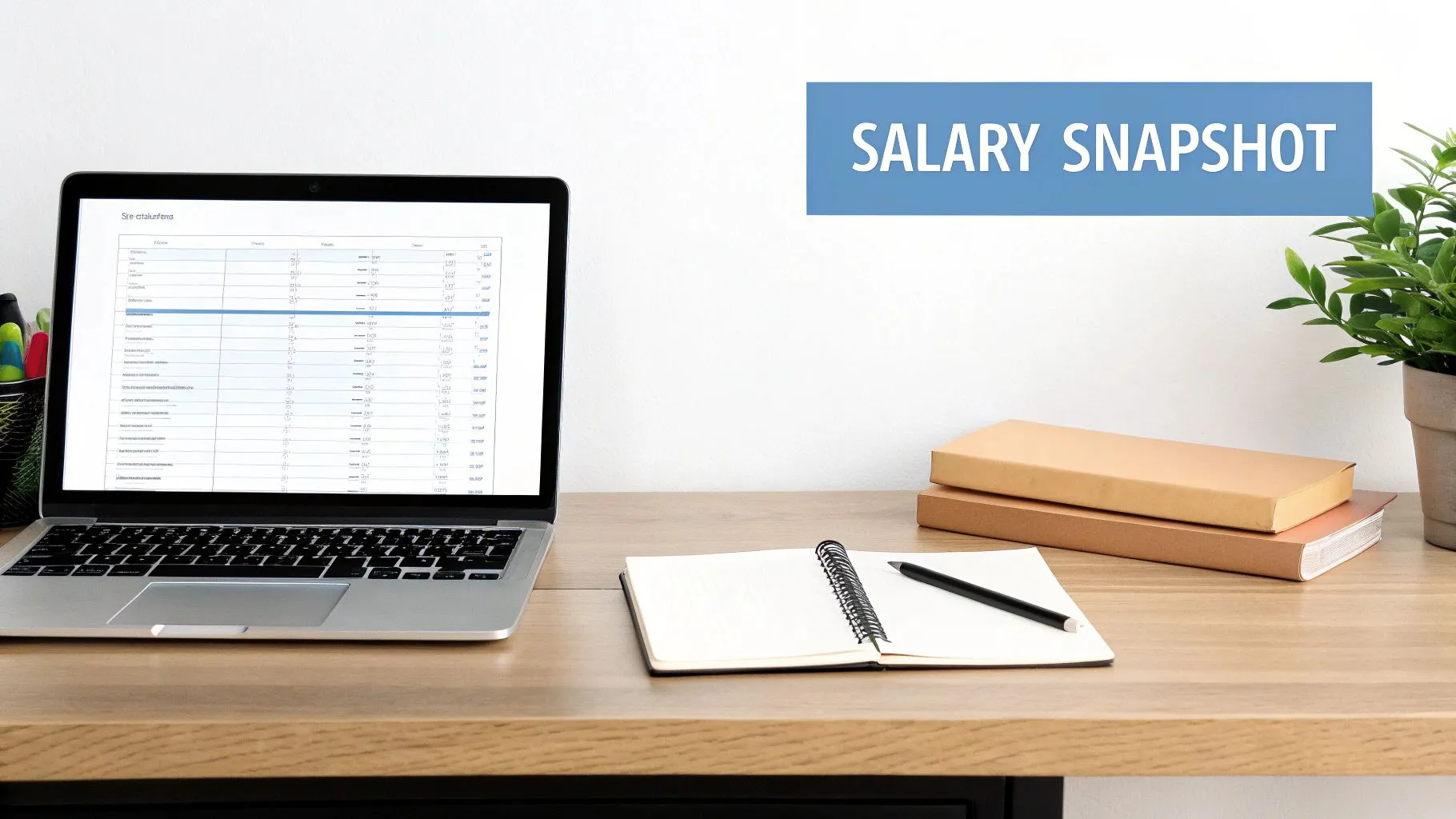
The chart makes it obvious: your salary doesn’t just inch up year by year. It takes big leaps once you’ve proven you can handle complex projects over the long haul.
Key Takeaway: These figures are a solid snapshot, but remember they are averages across many different sectors. Your specific industry—whether it’s fast-moving tech or the more traditional finance world—will have a huge say in where you land within these ranges. We'll dig into that next.
How Experience Shapes Your Earning Potential
Let’s be direct: experience is the single biggest engine driving your project manager salary in Singapore. Certifications and industry knowledge add horsepower, sure, but your proven track record is what really puts the pedal to the metal on your earning potential.
This isn’t just about putting in the years. It’s about the growing complexity of the problems you solve and the value you deliver. Think of it like a career ladder. Each rung represents bigger responsibilities, more strategic input, and larger project budgets. Your salary climbs with every step, reflecting your ability to handle tougher challenges and deliver more critical results.
The Entry-Level Foundation
When you're new to the field, your job is to learn the ropes. You’re focused on executing tasks, coordinating moving parts of a bigger project, and making sure the work meets the required specs. This is where you build the foundational skills that will carry you for the rest of your career.
In Singapore, even freshers start on solid ground, earning between S$5,000 to S$5,600 a month. Get a year under your belt as an assistant project manager, and you can expect a bump to around S$6,500 monthly. Senior roles jump significantly, commanding S$8,000 to S$13,000.
This quick ramp-up shows just how much the Singaporean market values hands-on experience, a trend confirmed by market data like KnowledgeHut's salary insights.
Mid-Career Growth and Strategic Impact
After a few years, your role pivots from pure execution to strategic oversight. You’re not just managing tasks anymore; you're managing entire projects from start to finish. This means navigating tricky stakeholder relationships and making calls that directly impact the project's success. This is where you see your salary really start to take off.
Your value is no longer just about getting things done. It's about your ability to:
-
Own Budgets and Timelines: You're the one accountable for keeping the project on schedule and within its financial limits.
-
Lead and Mentor: You guide junior team members, building a team that works well together.
-
Spot and Handle Risks: Your experience helps you see problems coming and create plans to deal with them before they blow up.
At this point, your resume needs to reflect this shift in responsibility. It's not enough to list what you did; you have to show the impact you made. To get this right, it helps to understand the ATS filter and the 90-10 rule.
A mid-career project manager in Singapore doesn't just manage projects; they drive business goals. Their ability to connect a project's success to the company's bottom line is what justifies a major pay increase.
Senior Leadership and High-Value Expertise
As you climb into a senior project manager or director role, your focus becomes almost purely strategic. You’re not managing a single project—you’re likely overseeing a whole portfolio of high-stakes initiatives. Your decisions can shape the direction of a department or even the entire company.
Senior pros earning over S$13,000 a month are paid for their deep expertise. They can navigate complex corporate politics and have a proven history of delivering multi-million dollar projects. They are trusted leaders whose experience minimizes risk and maximizes the return on every dollar the company invests.
This journey from execution to strategy is the core of how your salary grows in project management.
The Impact of Industry and Specialization
Just like a heart surgeon earns more than a general practitioner, a project manager's industry and area of expertise are huge factors in their pay. Not all PM roles in Singapore are created equal. The sector you’re in acts as a massive salary multiplier, with high-stakes, fast-moving industries offering a serious premium.
Think about it. Managing a multi-million dollar fintech product launch comes with a completely different set of risks and rewards than overseeing a commercial construction build. Both are complex, sure, but the required skills, regulatory hoops, and brutal speed are worlds apart. It only makes sense that the project manager salary Singapore employers are willing to pay reflects that gap.
Why High-Growth Industries Command Higher Salaries
Industries wrestling with rapid change or complex digital systems simply place a higher value on skilled project leadership. A PM in the tech world, for example, needs a real grasp of software development cycles, Agile methods, and cloud infrastructure. That’s specialized knowledge, and companies will pay for it.
The same goes for financial services, especially with the fintech boom. These roles demand PMs who can navigate a maze of regulations and manage projects where even a few minutes of downtime could cost millions. That kind of high-stakes environment naturally drives salaries up.
The rule of thumb is simple: where the financial stakes are highest and the skills are most specialized, the money will follow. A PM leading a company's digital transformation is almost always going to be paid more than one managing a standard infrastructure update.
In-Demand Specializations That Boost Your Paycheck
Beyond the industry itself, your specific specialization is another powerful lever you can pull to increase your earnings. Expertise in a high-demand area makes you a more valuable—and much harder to replace—asset.
A few specializations are particularly hot in the Singapore market right now:
-
Agile and Scrum Leadership: With more companies ditching old-school methods, professionals holding certifications like a Certified ScrumMaster (CSM) are in constant demand to lead fast-paced development teams.
-
Digital Transformation: Project managers who can confidently guide a company through massive technological shifts—like migrating to the cloud or bringing in AI—are in a prime position to ask for top-tier salaries.
-
Cybersecurity Projects: As digital threats become more sophisticated, PMs who can manage complex cybersecurity initiatives are essential. Their paychecks reflect that importance.
Project Manager Salary Comparison Across Key Singapore Industries
To give you a clearer picture, this table breaks down how salaries can vary across some of Singapore's most important sectors. It shows just how much your industry choice can impact your monthly earnings.
| Industry / Specialization | Average Monthly Salary (SGD) | Notes & Key Skills |
|---|---|---|
| Technology & Fintech | S$9,000 - S$15,000+ | Requires Agile, Scrum, and knowledge of software development lifecycles. High-stakes projects drive top pay. |
| Financial Services | S$8,500 - S$14,000 | Demands expertise in regulatory compliance, risk management, and large-scale system integrations. |
| Construction | S$7,000 - S$11,000 | Focuses on budget control, contractor management, and adherence to strict safety and building codes. |
| Pharmaceuticals | S$8,000 - S$13,000 | Involves managing clinical trials, product launches, and navigating complex healthcare regulations. |
By aligning your skills with these high-growth sectors and in-demand specializations, you put yourself in a much stronger position to earn a higher project manager salary in Singapore. It’s all about being strategic.
The Skills and Certifications That Actually Move the Needle on Pay
Experience and industry get you in the game, but your specific skills and qualifications are what let you command a higher salary. Think of these as direct investments in yourself. A solid track record opens doors, but a specialized toolkit is what justifies a top-tier offer.
Employers in Singapore will happily pay a premium for project managers who have proven they’ve mastered specific methodologies. This is where certifications become salary accelerators. They’re a universal language that tells a hiring manager you operate at a high, standardized level of competence—before you even walk into the interview room.
Key Certifications to Maximize Your Earnings
Adding the right letters after your name is one of the fastest ways to see a pay bump. The data doesn't lie: certified project managers consistently earn more than their peers, often by as much as 20%.
These are the certifications that carry the most weight in the Singaporean job market:
-
Project Management Professional (PMP): This is the global gold standard. Run by the Project Management Institute (PMI), the PMP is respected everywhere and is often a non-negotiable requirement for senior roles.
-
PRINCE2 (PRojects IN Controlled Environments): Big in the UK, Europe, and Asia, PRINCE2 is a process-driven method that gives you a clear, step-by-step playbook for managing projects. It’s highly valued in government and large corporate settings.
-
Certified ScrumMaster (CSM): As more Singaporean companies go Agile, especially in the tech world, the CSM has become essential. It proves you know how to lead projects in a fast, iterative environment where change is constant.
Getting certified isn't just about learning; it's a negotiation strategy. It gives you tangible proof of your skills, a clear advantage, and a rock-solid reason to ask for more money.
The High-Value Skills Top Earners Have in Common
Certifications are powerful, but they work best when paired with sharp soft and strategic skills. These are the abilities that separate a good project manager from a truly great one—and the paychecks reflect that difference. The highest earners are always masters of stakeholder negotiation, risk management, and clear communication.
It's one thing to have these skills; it's another to show them on your resume. You have to frame your accomplishments in a way that proves your value. For some practical tips on this, check out our guide on building a powerful student resume template with real examples—the core principles apply whether you're a student or a seasoned pro. These skills prove you don't just manage a project plan; you can navigate the messy, complex human dynamics that actually determine if a project succeeds or fails.
Think Beyond the Monthly Paycheck

Fixating on the base project manager salary in Singapore is like judging a restaurant by the price of its appetizer. That number is just the starting point. A great offer is a full package, and the other parts can seriously boost your total earnings for the year. Getting a clear picture of this total compensation is the only way to know what an offer is really worth.
A huge piece of that puzzle is the performance bonus. For many project managers, this isn't just a nice little extra—it's a massive chunk of their income. It’s pretty standard in Singapore for bonuses to add another 10-20% on top of your base salary, all tied to how you and the company perform. That’s how a good offer becomes a fantastic one.
How Bonuses Actually Work
Bonuses aren’t just handed out randomly. They’re tied to specific, measurable results—your Key Performance Indicators (KPIs). This is where your ability to deliver real business impact turns into cash in your pocket.
So, what do companies measure?
-
On-Time Project Delivery: The classic. Did you hit your deadlines without the quality slipping? This is always priority number one.
-
Budget Adherence: Can you manage resources like a pro and keep spending under control? This skill is highly valued.
-
Stakeholder Satisfaction: Happy clients and internal teams are a clear sign of success, and this often feeds directly into your bonus.
-
Team Performance and Morale: A motivated, high-performing team doesn’t happen by accident. Good leaders who build this kind of environment get rewarded.
Don’t be shy about this during negotiations. Ask about the bonus structure. Find out what the payout percentages have been for the role in past years and what metrics you’ll be judged on. This not only helps you forecast your earnings but also shows you’re focused on delivering the results they care about.
A base salary might average S$6,000 a month, but with an additional S$12,000 in bonuses and other variable pay, you could see your take-home pay jump significantly. The total pay structure is where the real earning potential is unlocked.
It's Not All About the Cash
Beyond the bonus, other perks round out a truly competitive offer. These non-cash benefits add a ton of value to your financial health and overall work-life balance. When you're weighing an offer, think about what these are worth:
-
Stock Options or RSUs (Restricted Stock Units): Very common in tech and startups. Equity gives you a real stake in the company's future success.
-
Comprehensive Health Insurance: Good coverage for you and your family can literally save you thousands in medical bills.
-
Professional Development Budget: When a company pays for your certifications, courses, or conference tickets, they're investing directly in your career.
-
Flexible Work Arrangements: Never underestimate the value of hybrid or remote options. The time and money saved on commuting, plus the added autonomy, are huge benefits.
Market data backs this up. The trend is moving toward total compensation packages that reflect the high demand for skilled PMs, especially with the push for digital transformation. It's why some reports show annual salaries for Project Managers hitting S$150,000. To get a better feel for the numbers, you can find more insights about project manager compensation in Singapore on Levels.fyi.
How to Negotiate Your Project Manager Salary
Knowing the numbers is one thing. Actually walking into a room and getting the salary you deserve? That’s a completely different skill.
Too many people see negotiation as a confrontation. It’s not. It's a strategic conversation where you build a business case for yourself. The goal is to shift the focus from what you want to the value you deliver.
Your argument can't be based on feelings. It has to be built on hard data and real achievements. Use the salary benchmarks in this guide as your baseline, but the real power comes from your own track record. Don't just say you "managed a project." That's generic.
Instead, say you "delivered a S$1.5M project 10% under budget and two weeks ahead of schedule, which boosted client satisfaction by 15%." See the difference? One is a job duty; the other is a result.
Preparing Your Case
Whether you're starting a new job or heading into a performance review, you need to walk in prepared. You’re not just asking for more money—you’re showing them why it’s a smart investment.
Here’s a quick checklist to get you ready:
-
Do Your Homework: Know the going rate for your specific role, industry, and experience level in Singapore. Don't guess.
-
List Your Wins: Pinpoint 3-5 major accomplishments from your recent work. Each one needs to be tied to a clear business outcome—money saved, revenue earned, or efficiency gained.
-
Frame Your Future Value: Think about the company’s upcoming goals. Connect your skills directly to their next big projects and explain how you’ll help them win.
When you structure your argument this way, it shows you're a professional. It also makes it much easier for a hiring manager to go to bat for you and get your number approved. If you need help turning your career history into a compelling story, learning from a professional resume writer's perspective can be a game-changer.
Using a Simple Script
You don't need to memorize a long speech, but having a few key phrases in your back pocket will keep the conversation from feeling awkward.
When they ask for your salary expectation:
"Based on my research for similar roles in Singapore's tech sector, and considering my PMP certification and track record of delivering complex projects on time, I'm targeting a salary in the range of S$130,000 to S$145,000."
This one sentence does a lot of work. It shows you’re prepared, anchors the discussion in a realistic range, and subtly reminds them of your qualifications.
Remember, the point isn't to "win" the negotiation. It's to reach a fair agreement where you're properly compensated for the incredible value you bring to the table.
Frequently Asked Questions

Even with all the data, you probably have a few specific questions bouncing around your head. Let’s tackle some of the most common ones to clear up any lingering doubts you might have about project manager pay in Singapore.
What Is a Good Starting Salary for a Project Manager in Singapore?
For a junior or entry-level project manager, a good starting point is somewhere between S$5,000 and S$6,500 per month. Think of this as the baseline.
Where you land in that range depends on your academic background, any impressive internships you’ve completed, and the industry you’re breaking into. For example, fast-moving sectors like tech and finance are known to offer a bit more right out of the gate to snag promising talent.
How Much Does a PMP Certification Increase a Salary in Singapore?
Getting your Project Management Professional (PMP) certification is one of the quickest ways to see a real jump in your pay. On average, PMP-certified PMs in Singapore can earn 15-20% more than their peers who don't have the credential.
Why the big difference? Employers see the PMP as a stamp of approval. It signals that you have a standardized, high-level skill set and are serious about your craft, which makes you a less risky hire and justifies a bigger investment.
It's a powerful bargaining chip to have in any salary negotiation.
Which Industry Pays the Highest Project Manager Salaries in Singapore?
Right now, the big money is in the technology and financial services industries. We’re talking about high-growth areas like fintech, software development, and investment banking.
These fields are built on high-stakes, technically demanding projects where a single misstep can be incredibly costly. They’re actively hunting for PMs with specialized skills—like a deep understanding of Agile, cybersecurity, or digital transformation—and they’re more than willing to pay top dollar for that expertise. If maximizing your salary is the goal, aligning your career with these sectors is a smart move.
Crafting a resume that shows your true impact is the first step toward that top-tier salary. It’s not about listing tasks; it’s about telling the story of the value you delivered. StoryCV helps you find that story. Our AI-powered platform guides you to frame your achievements in a way that gets a hiring manager's attention. Start building your high-impact resume for free at StoryCV.