You're trying to write about a project you're proud of. Maybe it's for your resume. Maybe it's for a portfolio entry, a LinkedIn update, or a recommendation request. And every draft goes wrong in one of two ways.
Version one makes you cringe. It sounds puffed up, self-important, weirdly theatrical.
Version two feels polite, but dead. It shrinks the work so much that it almost insults what you did.
That tension isn't a confidence problem. It's a framing problem. Many try to write themselves as the hero of the story, then wonder why the result sounds awkward. The fix is simpler than the advice you usually hear. Stop centering yourself. Center the work.
The Awkward Middle Ground of Self-Promotion
You're not confused because you lack self-esteem. You're stuck because the usual frame is broken.
A lot of resume advice treats this as a mindset issue. Be bolder. Sell yourself harder. Own your accomplishments. That misses the point. If your draft feels off, your ear is probably catching something real.
The problem is usually calibration, not self-erasure. Resume guidance from MIT Comm Lab makes this point well: show impact, use objective evidence, tailor to the employer, and avoid vague self-praise in this advice on bragging and brag-nots. That's why “I'm highly effective” feels flimsy, while a concrete description of the work feels solid.
Why your draft sounds wrong
When you write lines like “I drove,” “I spearheaded,” or “I single-handedly led,” you turn the project into a prop. The work becomes supporting evidence for your greatness.
That's why it feels gross.
Your discomfort is useful. It's telling you the sentence is about your identity when it should be about the work.
There's a better way to write resume without bragging. Describe the project the way you'd describe a respected colleague's project. You'd be specific. You'd mention what was hard. You'd explain what changed. You wouldn't write fan fiction about how amazing they are.
The cleaner alternative
Use facts, context, and decisions. Let the reader infer competence.
If you need help shifting out of self-description mode, this guide on how to describe yourself in a resume is useful for separating empty traits from actual evidence.
That's the whole move. Small change in frame. Big change in tone.
Why 'Just Own It' Is Bad Resume Advice
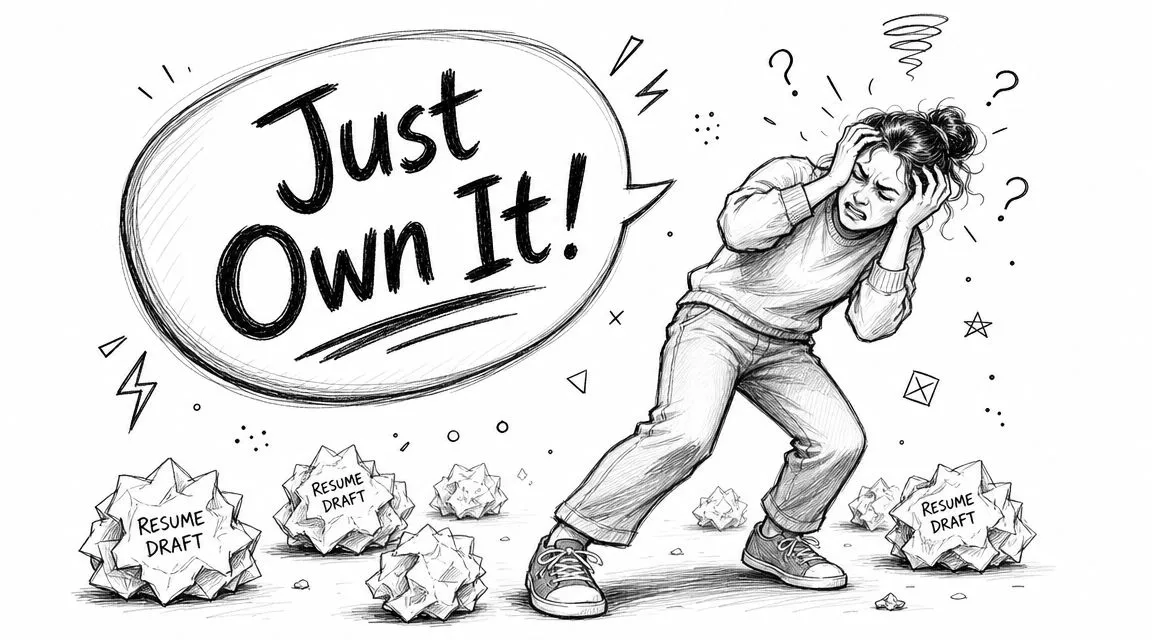
“Just own your accomplishments” sounds motivating. It's also lazy advice.
It tells you to push past the cringe instead of asking why the cringe is there in the first place. If the line sounds inflated, pushing harder usually makes it worse.
Historical hiring research reported by the Association for Psychological Science found that a medium amount of self-promotion could help perceived fit, but too much was judged as disingenuous in this summary of resume bragging research. That's the part most “own it” advice skips. More self-promotion is not automatically better.
Why the cringe is valid
When a bullet says:
-
“I drove a major transformation”
It raises a trust issue. What changed, exactly? -
“I successfully delivered a high-impact initiative”
It sounds polished, but empty. No project. No scope. No proof. -
“I'm a results-oriented leader”
That's not evidence. That's a label.
If you want a quick reminder of what to remove, these common resume don'ts are a decent gut-check. A lot of braggy writing isn't too strong. It's too vague.
Practical rule: If a bullet would sound embarrassing out loud in front of the people who worked on the project with you, rewrite it.
What to do instead
Stop trying to sound impressive. Start trying to sound credible.
That's a reason a lot of people struggle to talk about your work. They think the job is to project confidence. It isn't. The job is to make the work legible.
A good resume doesn't shout. It documents.
The Better Frame Make The Work The Protagonist
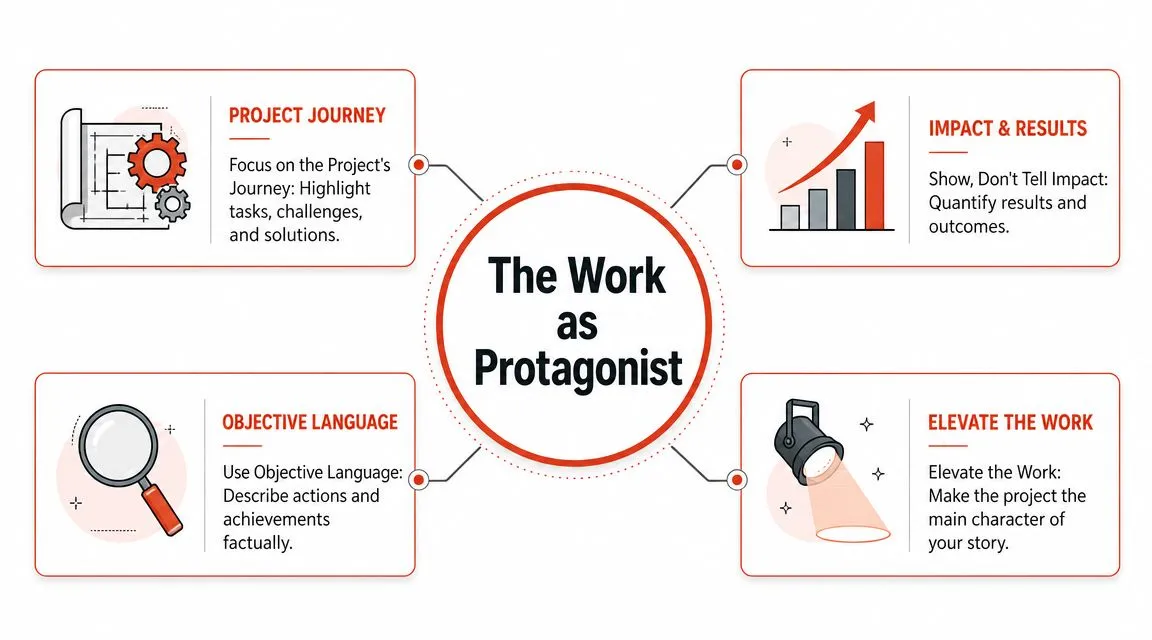
Here's the structural fix. Make the work the protagonist.
Not you. Not your confidence. Not your personal brand.
Use the colleague test
Think about a colleague you respect. They shipped something difficult. You're explaining that project to another smart person.
You probably wouldn't say, “She's an incredible superstar who drove excellence.” You'd say what the work required, what constraints it had, and what changed because of it.
That's the tone you want for yourself.
What the new frame sounds like
The project is the thing moving through the sentence. You are the person making decisions inside it.
Compare these:
| Self-centered frame | Work-centered frame |
|---|---|
| I led a major system migration | Migration of the legacy system required staged rollout planning, stakeholder coordination, and issue triage across teams |
| I drove efficiency improvements | The intake process was reworked to reduce handoff friction and shorten response time |
| I delivered a successful launch | The launch shipped after scope was tightened, dependencies were resolved, and support documentation was rebuilt |
The second version sounds calmer because it is calmer. It also gives the reader more to trust.
Keep your role precise
This matters even more in team settings. The least braggy line is usually the most specific one.
Part of a four-person team that rebuilt the underwriting model; I owned the data work and the integration with the legacy system.
That line works because it gives team credit and names your slice of the work clearly.
If you're also polishing your public-facing profile, the same framing helps beyond resumes. For example, if your headline is vague or overcooked, these ideas to improve your LinkedIn headline are useful. The same rule applies there too. Specific beats performative.
Before and After Resume Bullets
Theory is cheap. Here's what this looks like in practice.
Example one in tech
Before
I led the successful rebuild of our internal reporting dashboard and delivered major efficiency gains for the business.
After
Rebuilt the internal reporting dashboard used by support and operations teams, simplifying access to recurring performance data and reducing manual reporting work.
Why the first one fails
It's self-congratulatory and fuzzy. “Successful” and “major” tell me nothing.
Why the second one works
It names the thing, the users, and the change. It lets the project carry the weight.
Example two in operations
Before
I drove critical process improvements across onboarding and helped the team work much more efficiently.
After
Onboarding workflow was reorganized to remove duplicate steps, clarify handoffs, and make training easier for new team members.
Why the first one fails
“Drove” and “critical” are classic filler words. They sound important while hiding the actual work.
Why the second one works
It describes the process itself. That's more believable and more useful.
A simple structure helps here: an achievement-first pattern, using action + scope + result + metric.
You don't need all four parts in every bullet, but you do need enough context to prove the point.
Example three in marketing
Here's a quick walkthrough if you want to hear this thinking out loud:
Before
I created an effective campaign strategy that notably improved brand visibility and engagement.
After
Campaign strategy was revised around audience segmentation, tighter messaging, and cleaner handoff between content and email execution.
Why the first one fails
It reads like an awards submission. Words like 'cutting-edge' and 'high-level' are mood words.
Why the second one works
It shows what changed in the work. That's the point.
Evidence beats adjectives. Every time.
How to Rewrite Your Own Impactful Bullets
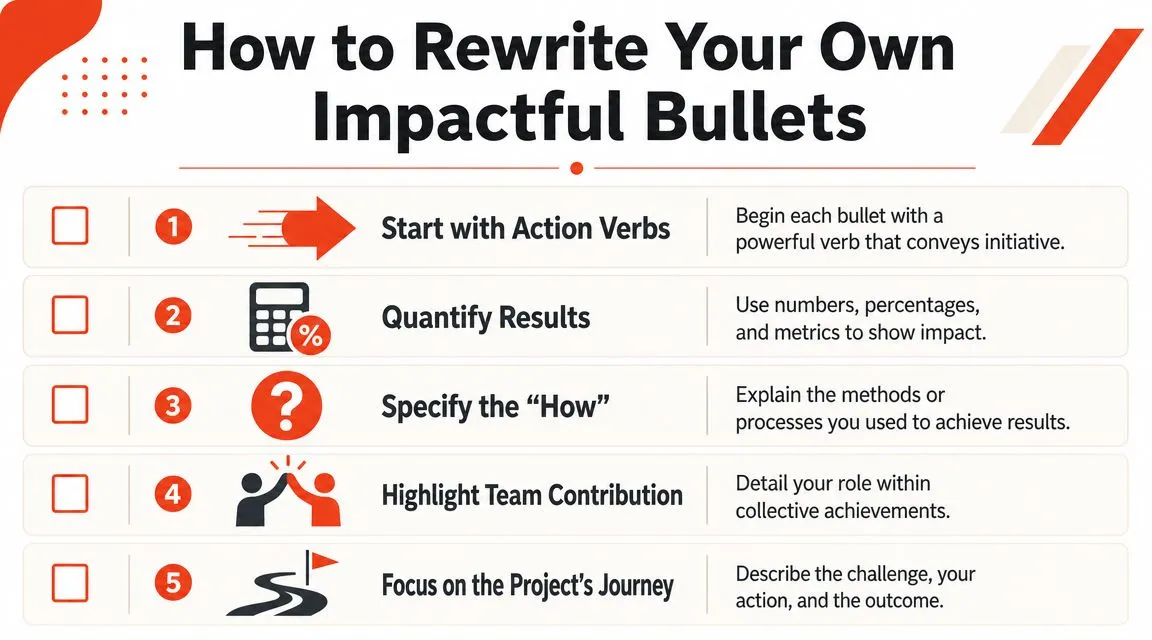
Job applicants don't need better adjectives. They need a rewrite process.
Start with the raw facts
Before you polish anything, write the ugly version in plain language.
Answer these:
-
What was the project
Name the actual thing. Dashboard. Migration. Hiring process. Onboarding flow. -
What was hard about it
Tight timeline, messy handoffs, legacy system, cross-team coordination, unclear ownership. -
What part was yours
Be precise. Not “supported.” Try “owned data cleanup,” “handled stakeholder updates,” “wrote training docs,” or “managed vendor rollout.” -
What changed
Think in time, volume, errors, money, response speed, or workload.
Then rewrite into a bullet
Indeed's guidance is right on this point. Quantifying achievements with verified metrics or even concrete ranges keeps the tone factual and reduces ambiguity in its article on how to quantify a resume. If you know the number, use it. If you only know the range, use the range. If you can't verify it, don't fake it.
A clean formula is:
Action + scope + result + metric
For example:
-
Team context first
Part of a four-person team that rebuilt the underwriting model; owned the data work and legacy-system integration. -
Ownership second
Reworked customer intake process across support and operations, reducing response times by [verified metric]. -
Constraint included
Delivered documentation rewrite for a product change under a compressed timeline, improving handoff clarity for sales and support.
Use tools as editors, not ghostwriters
If you want help structuring raw experience, use a system that asks about the work instead of forcing you into template language. StoryCV, for example, uses a guided interview to turn your answers into resume drafts. That's different from filling boxes with generic “achievement” phrases. If you want more examples of this structure, this guide on how to write impact statements is useful.
And if you're writing beyond a resume, seeing how other professionals present work samples can help.
What If You Do Not Have Hard Numbers
Then don't pretend you do.
A lot of resume advice falls apart. It assumes everyone has revenue figures, conversion rates, or neat dashboards. Plenty of people don't. Operations, nonprofit, early-career, internal-facing, and shared-team roles often produce impact that isn't captured in a tidy metric.
That doesn't mean you have no evidence.
Jody Michael's resume guidance is helpful here. When hard metrics are missing, use contextual accomplishment framing in this piece on no quantifiable achievements. That means problem-solution stories, training you delivered, and your specific role in a successful team effort.
What counts as evidence
Use these instead:
-
Problem and fix
The handoff between sales and implementation was unclear, so onboarding documentation was rewritten and standardized. -
Training and enablement
Trained new team members on the updated process and became the point person for questions during rollout. -
Specific team contribution
Worked on the launch as part of a cross-functional team; owned QA coordination and release notes.
You do not need a flashy metric to sound credible. You need a clear account of what the work needed and what you did inside it.
That's how you write resume without bragging. You stop performing confidence and start describing reality well.
StoryCV helps people do exactly this at StoryCV. It uses a guided interview to pull out context, ownership, and results, then turns that into resume language that sounds specific instead of inflated. If writing about yourself is the part that keeps stalling you, that kind of editorial structure is often the difference between a vague draft and a usable one.