Most sales manager resumes make the same mistake. They try to impress with quota numbers and end up sounding identical.
That advice is lazy. A resume for Sales Manager roles shouldn't read like a leaderboard screenshot. It should show how you changed the business. If all you've got is attainment, you're telling me the team hit a number. You're not telling me whether you can hire, coach, forecast, clean up a bad territory, or build a system that keeps producing when the easy wins dry up.
That's the line that matters. Seller versus manager. If your resume blurs it, recruiters will blur it too.
Your Resume Says You Hit Quota So What
Every sales manager candidate says some version of the same thing. Hit target. Grew revenue. Built pipeline. Led a high-performing team.
Fine. So did everyone else.
The problem isn't that quota attainment is bad. It's that it's table stakes. In a market where buying cycles are harder and deals involve more stakeholders, the better signal is how you adapted. One resume guide puts it plainly: most advice over-focuses on keywords, metrics, and leadership clichés, while stronger resumes show how a manager improved cycle time, forecast accuracy, or multi-stakeholder deal execution in a tougher market (resume guidance on proving sales effectiveness).

What recruiters actually want to infer
They want to know whether you can do things like:
- Stabilize a shaky team when performance is uneven
- Improve sales execution instead of inheriting a hot patch
- Make better decisions about territory, pipeline, and rep coverage
- Lead through friction when deals get slower and messier
A weak bullet says:
- Hit quota and drove revenue growth across the region
A stronger bullet says:
- Rebuilt territory coverage, tightened pipeline inspection, and improved forecast discipline to help the region finish stronger
That second version gives a hiring manager something to work with. It implies judgment.
Practical rule: If your bullet could fit any sales manager on the planet, it's too generic.
If you're struggling to tighten the wording, study sharp resume bullet points for sales. The pattern is simple. Lead with action. Add scope. Show the business result. Cut the filler.
Separate the Manager from the Seller
This is the biggest failure on a resume for Sales Manager jobs. People mash together team leadership and personal selling as if they're the same thing.
They're not.
If you were carrying a meaningful individual book while managing, that's fine. But your resume has to label the work correctly. Otherwise the reader can't tell whether your success came from your own deals or from how you led the team.
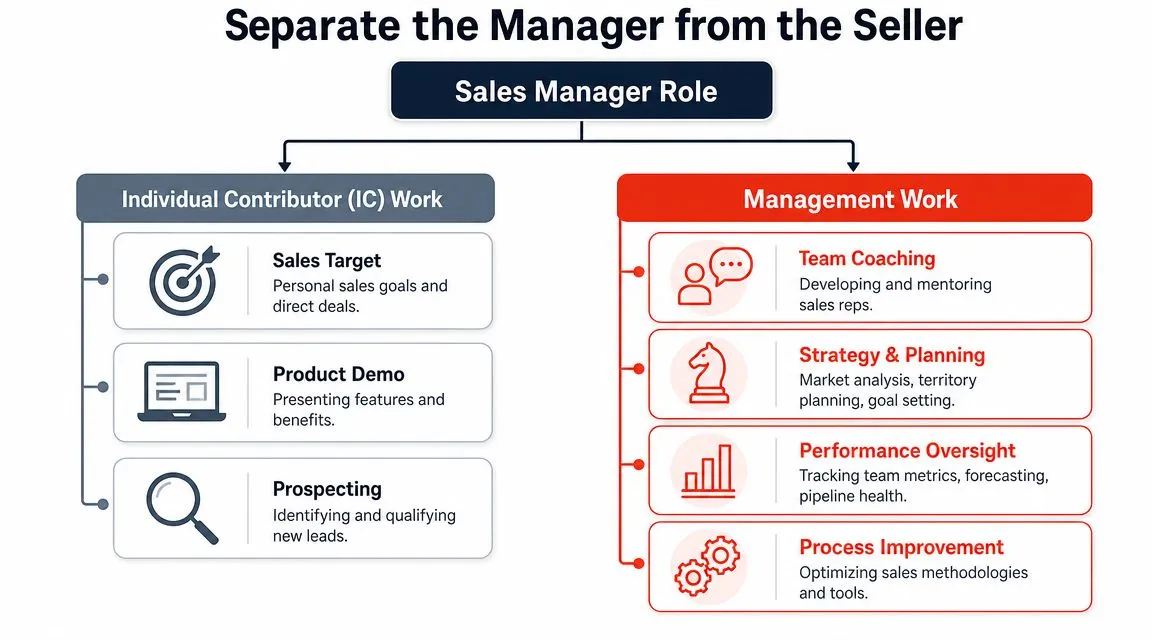
A strong sales manager resume balances leadership proof with sales proof. Hiring teams want evidence of team management, strategy implementation, account leadership, and verifiable KPIs, not just a pile of claims (sales manager resume guidance from CVmaker).
Use this structure every time
Start each role with four parts:
- Job title
- Company and location
- Employment dates
- Accomplishment bullets
That structure is standard. Where many applicants stumble is with the bullets.
Under the role, add a short scope line first. Name the team, segment, geography, or commercial remit. Then write bullets that focus on team outcomes and the decisions that produced them.
Example scope line:
Led regional new business team across enterprise accounts in a multi-state territory; owned hiring, coaching, forecast reviews, and territory planning.
Then split the evidence.
Bad version versus better version
| Version | Example |
|---|---|
| Bad | Closed major accounts, exceeded quota, coached reps, and grew territory revenue |
| Better | Directed team performance across the region through rep coaching, pipeline reviews, and coverage changes; separate line below for personal selling where relevant |
If your own selling mattered and it was recent, separate it cleanly.
Management bullets
- Team outcomes first Improve team performance, forecast quality, pipeline health, coverage, hiring, onboarding, or retention
- Decision second Show what you changed as the manager
- Business result third Tie it to the commercial outcome
IC bullets
- Keep them isolated Put them in a short subsection like “Selected individual contribution”
- Only include them if material If your personal selling was minor, leave it out
Later, if you want a practical outside read on the actual work behind leading reps, this guide to leading a sales team is useful because it focuses on coaching, cadence, and execution instead of motivational poster nonsense.
This is worth watching if you're rewriting from an IC-heavy resume and need to think like a manager again.
When a recruiter can't tell whether the result came from your deals or your management, they usually assume the safer answer. You were a seller with a manager title.
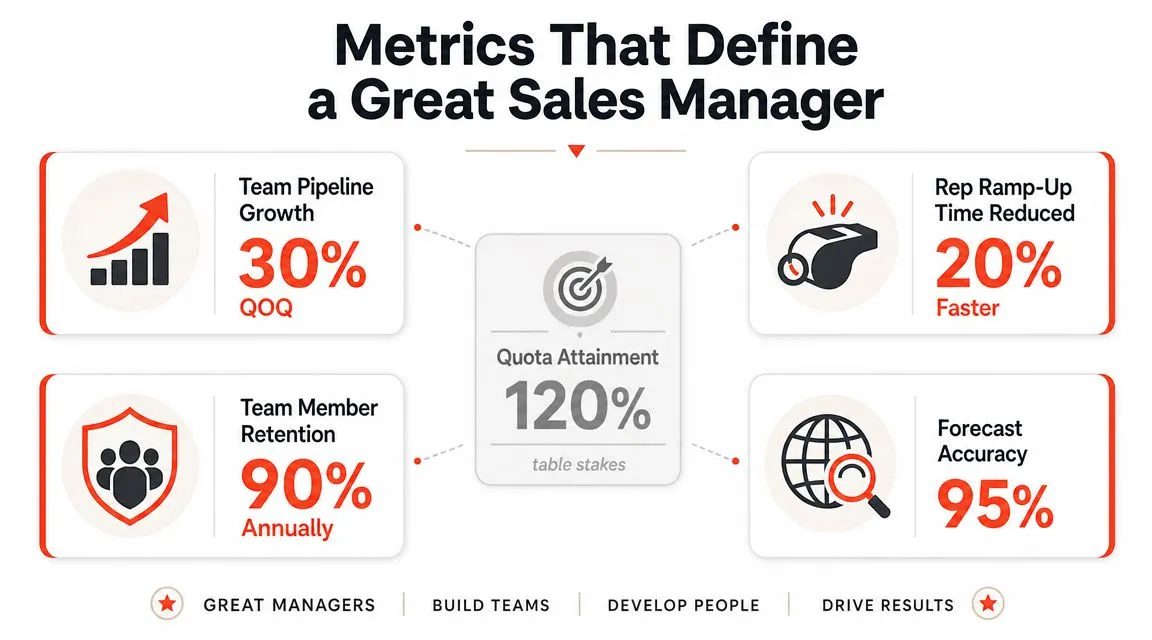
Use Metrics That Matter More Than Attainment
The strongest sales resumes show measurable business impact, not a list of responsibilities. Good guidance for sales roles keeps repeating the same point: employers want numbers on the page, such as revenue growth, quota attainment, rankings, and team outcomes, because sales work is judged by results (sales resume advice on quantifying impact).
That's true. But for managers, not all numbers carry the same weight.
If your headline metric is just attainment, you've told me what happened. You haven't told me why you were the reason it happened.
The better categories
Think in layers. A great manager leaves fingerprints in operating metrics.
Team health
Use metrics that reflect how your team functioned under your leadership.
Examples:
- Rep retention through a tough quarter
- Ramp time for new hires
- Internal promotions from your team
- Performance improvement across lower-performing reps
Sample bullets:
- Improved onboarding and coaching cadence, helping new hires ramp faster and contribute earlier
- Stabilized team performance during a difficult stretch by tightening one-on-ones and clarifying deal review standards
Pipeline quality
True management is evident. Strong managers don't just celebrate closed revenue. They improve the machine that produces it.
Examples:
- Pipeline coverage moved from 2x to 4x
- Forecast accuracy improved
- More disciplined qualification across the team
- Better territory coverage
Sample bullets:
- Reworked pipeline inspection and qualification standards, improving forecast confidence across the team
- Reset territory coverage and review cadence to build healthier pipeline depth across the region
If you need help deciding which numbers belong on the page, this piece on how to use metrics in a resume is a good filter. Not every number deserves a bullet. The right number should reveal your management judgment.
Sales effectiveness
These metrics show whether your team sold better, not just more.
Examples:
- Win rate on competitive deals
- Sales cycle length
- Expansion into a new segment
- Performance on complex, multi-stakeholder deals
Sample bullets:
- Strengthened deal coaching for competitive opportunities, helping reps defend value more effectively
- Introduced tighter stage definitions and review discipline to reduce deal slippage and improve close quality
What to stop doing
Don't pile random KPIs into a bullet to make it look heavy.
Use metrics that answer one of these questions:
| Question | Better metric type |
|---|---|
| Can you build a team? | retention, ramp, hiring quality |
| Can you run a forecast? | forecast accuracy, pipeline quality |
| Can you improve execution? | win rate, cycle time, competitive performance |
| Can you fix coverage? | territory health, account distribution, segment focus |
Hiring read: The metric that survives a fast resume scan is the one that says something about the manager, not just the market.
Tell the Story of the Territory You Fixed
A resume for Sales Manager roles gets stronger when each role follows a clean structure: title, company and location, dates, then accomplishment bullets built around quantified commercial outcomes. Strong advice on sales resumes also recommends writing bullets in an action + scope + metric + business result format, instead of vague task lists (UMass Isenberg resume guidance).
Good. Now push it further.
Don't write achievements in a vacuum. Write the before-state, the change you made, and the result. That's how you prove you can take over a mess and improve it.
Use baseline, action, result
This is the simplest useful formula I know:
- Baseline What was broken, stalled, unclear, or underperforming
- Action What you changed in team design, process, coaching, or territory strategy
- Result What improved commercially
That sequence makes your numbers believable because it gives them context.
Examples that sound like a manager wrote them
Weak
- Grew territory revenue and led team to strong annual performance
Better
- Took over an underperforming territory, rebuilt rep coverage, and reset review cadence; team finished the year with stronger execution and more predictable performance
Weak
- Improved pipeline and exceeded target in new market
Better
- Launched a new-market motion by refining account focus and coaching discovery quality; built enough pipeline consistency for the team to scale beyond early wins
Weak
- Managed enterprise sales team and closed strategic deals
Better
- Tightened deal inspection for complex accounts and coached reps through multi-stakeholder sales cycles; improved team execution on larger, slower-moving opportunities
Don't hide the mess you inherited. The before-state is often the most convincing part of the bullet.
This is the difference between a resume that says “I was around when good things happened” and one that says “I changed the trajectory.”
Nail the Headline Competencies and ATS Sanity Check
A weak summary is the fastest way to look like a rep who got promoted once and never learned to lead.
Your headline area has one job. Tell the reader you run a sales system, not just a book of business. If your top lines only say you beat quota, you'll get read as a seller with a team title. That's exactly the mistake this resume cannot make.
Write a summary that signals management scope
Skip the objective statement. Skip the soft traits. Use two or three sentences to define how you lead and what kind of commercial engine you improve.
Bad summary:
Results-driven sales manager with strong communication skills and a passion for growth.
That is filler. It could sit on any resume in the pile.
Better summary:
Sales manager who improves forecast accuracy, rep execution, and territory performance across regional teams. Known for coaching managers and reps, tightening inspection cadence, and turning uneven pipeline generation into a more predictable revenue motion.
That tells me you manage through process, coaching, and judgment. It separates you from an individual contributor who happened to post strong numbers.
Build a skills section around how you run the business
The skills section should reinforce your management identity. Generic words like leadership, communication, and teamwork waste space because they prove nothing.
Group skills by operating area. Make it easy for both a recruiter and a hiring manager to scan. This guide to a resume skills section that stays readable gets the format right.
A stronger version looks like this:
- Sales leadership Hiring, coaching, performance management, succession planning
- Revenue management Forecasting, pipeline inspection, deal review, CRM discipline
- Territory and GTM execution Account segmentation, coverage design, expansion planning, cross-functional alignment
- Systems and tools Salesforce, HubSpot, Gong, Outreach, Tableau
Only list skills you can defend with examples. If it's in the section, it should show up somewhere in your experience bullets.
Pass ATS without writing for a robot
ATS is a filter, not the audience.
Use the language the company uses, but use it truthfully. If the job description says forecasting, territory planning, sales coaching, pipeline management, and cross-functional leadership, those terms should appear in your resume. Put them in your summary, skills section, and work history where they fit naturally.
Keyword stuffing is lazy. A real hiring manager will spot it in seconds. The safer move is simple. Mirror the role language, then back it up with bullets that show where you used those skills to improve team performance.
Read your top third out loud before you send it. If it sounds like a manager who drives execution, keep it. If it sounds like a polished seller trying to look broader than they are, rewrite it.
Common Pitfalls and Your Final Polish
The best repositioning move for a sales manager isn't shouting louder about quota. It's showing operating cadence, cross-functional leadership, forecasting rigor, and process improvement. For candidates who build a revenue system, that story can be more persuasive than another list of attainment stats (career advice on repositioning a sales manager resume).
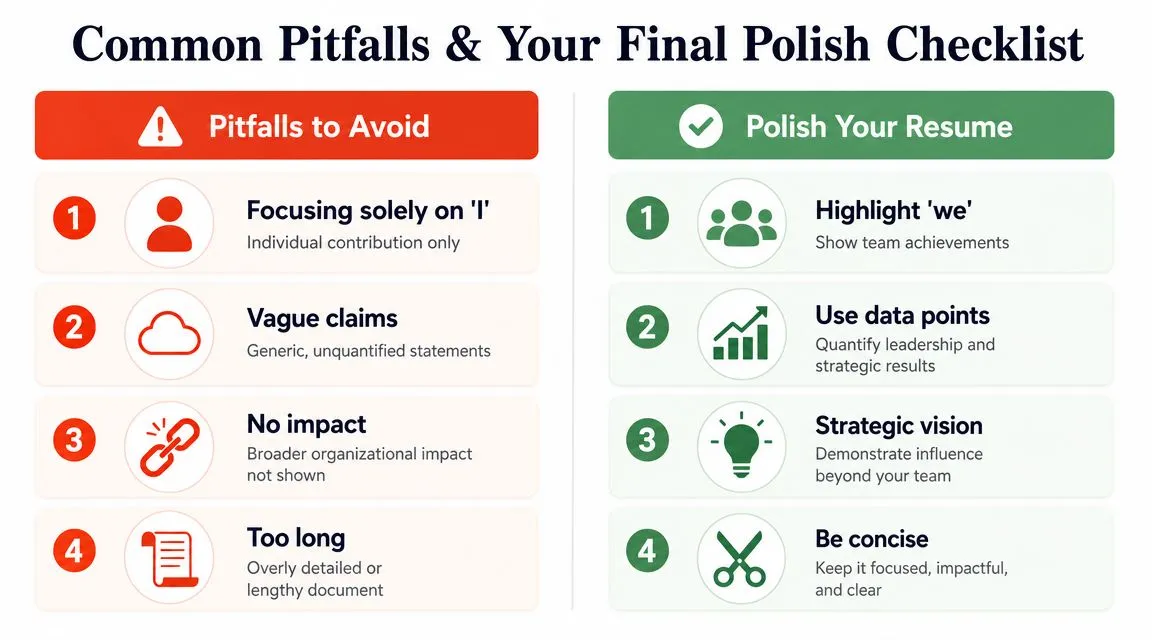
Run this final check before you send anything.
- Kill passive phrasing Delete “responsible for,” “tasked with,” and “involved in”
- Separate IC from management Don't make the reader guess what you personally sold versus what your team achieved
- Add context to claims “Improved team performance” means nothing without the before-state and the action
- Keep the document tight Early and mid-career candidates usually don't need more than a page, and a second page should earn its place through sustained high-impact experience
- Tailor the story One generic resume won't cover a frontline manager role, a regional leadership role, and a move into RevOps equally well
Your resume isn't a spreadsheet. It's evidence of judgment.
If it shows that you can diagnose a territory, improve the operating rhythm, and lead people to better execution, you're writing like a real manager. That's the difference.
If you've done the work but you're struggling to turn it into sharp, credible language, StoryCV helps you write the story behind the numbers. It works like a digital resume writer, not a template machine, so your resume sounds like a capable sales leader instead of a copied format with quota stats pasted in.