Walking into an IT interview, you’ve prepared for technical deep dives, system design challenges, and behavioral questions. But the interview is a two-way street. The questions you ask are just as crucial as the answers you give. They demonstrate your engagement, reveal your priorities, and help you evaluate if the role, team, and company are the right long-term fit.
Asking generic questions signals a lack of preparation, while thoughtful, strategic inquiries can set you apart from other qualified candidates. It's your opportunity to go beyond the job description and understand the reality of the work environment, the technical challenges you'll face, and the company's commitment to your growth. This isn't just about impressing the hiring manager; it's about gathering critical intelligence to make an informed decision.
This comprehensive guide provides a curated list of the most impactful questions to ask at an IT interview. We have categorized them to help you uncover the truth about the technology, the team, the processes, and your future career path.
For each question, we'll cover:
* Why It Matters: The strategic reason behind asking it.
* What to Listen For: The key details that indicate a healthy environment.
* Potential Red Flags: Warning signs that might suggest deeper issues.
By the end of this article, you'll be equipped to turn the final "Do you have any questions for us?" into your most powerful tool for making a lasting impression and a smart career move.
1. What does a typical day/week look like in this role?
This is one of the most fundamental questions to ask at an IT interview because it cuts through the abstraction of a job description. It translates high-level responsibilities into concrete, daily activities, giving you a realistic preview of the job you'd actually be doing. The answer reveals the true balance between different tasks like coding, meetings, system monitoring, documentation, and user support.

This question helps you gauge if the role aligns with your preferred work style. If you thrive on focused, deep work, a role dominated by constant meetings and context-switching might be a poor fit. Conversely, if you enjoy collaborative problem-solving, a position with 90% siloed coding could feel isolating.
Why It's a Top-Tier Question
- Reality vs. Job Description: A "Senior Software Engineer" title might sound like pure coding, but the reality could be 50% mentoring, 20% architectural meetings, and only 30% hands-on development. This question uncovers that crucial breakdown.
- Identifies Hidden Responsibilities: It can reveal important duties not emphasized in the initial description, such as on-call rotations for a DevOps role or frequent customer-facing demos for a development position.
- Highlights Workflow Inefficiencies: Learning that sprint planning consistently takes an entire day or that developers are frequently pulled into ad-hoc support tickets can signal process maturity issues.
Sample Phrasing & Follow-ups
Instead of a generic ask, try being more specific to get a richer answer.
- Initial Question: "Can you walk me through what a typical week looks like for someone in this position? What's the general split between planned project work and reactive tasks?"
- Follow-up on Meetings: "How much of the day is typically spent in scheduled meetings versus heads-down work?"
- Follow-up on Workflow: "What does the on-call rotation schedule and responsibility level look like?"
- Follow-up on Rhythm: "Are there specific 'crunch times' during a project cycle or is the workload generally consistent?"
Red Flag Alert: Be wary of vague answers like, "Every day is different," without any concrete examples. While true in many dynamic roles, a good manager should be able to provide patterns, such as, "Mondays are for sprint planning, but afternoons often involve responding to support escalations." A complete inability to describe a typical workflow could suggest a chaotic or poorly defined role.
2. What is the current tech stack, and are there plans to modernize or migrate?
This is one of the most critical questions to ask at an IT interview because it directly addresses the tools and technologies you will use every day. It goes beyond your role's responsibilities to reveal the technical environment you'll be inheriting. The answer provides a clear picture of the company's engineering culture, its appetite for innovation, and its approach to managing technical debt.

Understanding the tech stack helps you assess whether your existing skills are a strong match and where you'll have opportunities for growth. It shows if the company is investing in modern, scalable technologies like cloud-native architecture or if you'll spend significant time maintaining legacy systems. This information is vital for aligning your career goals with the company's technical trajectory.
Why It's a Top-Tier Question
- Assesses Skill Alignment: It confirms if your expertise in technologies like Python, Java, Kubernetes, or AWS is directly applicable or if there will be a steep learning curve with a proprietary or outdated stack.
- Reveals Engineering Philosophy: A company's willingness to discuss modernization plans, containerization strategies, or CI/CD pipelines indicates a forward-thinking engineering culture that values best practices.
- Uncovers Technical Debt: The presence of legacy systems isn't always a deal-breaker, but understanding the roadmap to migrate or modernize them reveals the company's commitment to long-term health over short-term fixes.
Sample Phrasing & Follow-ups
Drill down from the high-level stack to the specific tools and processes you'll interact with daily.
- Initial Question: "Could you provide an overview of the primary technologies used by the team, both in production and for development? Are there any significant modernization or migration projects on the horizon?"
- Follow-up on Rationale: "What was the reasoning behind choosing your primary framework or cloud provider? Are you happy with that decision?"
- Follow-up on Tooling: "What does your CI/CD pipeline look like? Which tools do you use for version control, monitoring, and infrastructure management?"
- Follow-up on Debt: "How does the team approach managing and prioritizing technical debt?"
Red Flag Alert: Be cautious if the interviewer is unable to articulate the tech stack clearly or dismisses questions about modernization. Answers like, "We use a lot of different things," or, "We don't have time to think about that," can signal a reactive, chaotic environment with little strategic technical direction. A strong team can explain why they chose their stack and what its future looks like.
3. How is the team structured, and what are the reporting lines?
This question moves beyond your immediate role to reveal the organizational ecosystem you'll be joining. The answer uncovers the team's size, its composition of roles (e.g., developers, QA, DevOps, product managers), and the formal hierarchy. It provides crucial context about who you'll collaborate with, report to, and depend on to get your work done.
Understanding the team structure helps you visualize your place within the company and foresee potential communication pathways and bottlenecks. A small, flat team in a startup offers broad responsibilities and direct access to leadership, while a large, matrixed enterprise structure involves navigating more complex cross-departmental relationships. This insight is vital for assessing cultural fit and potential for impact.
Why It's a Top-Tier Question
- Clarifies Collaboration Dynamics: It tells you if you'll be on a "full-stack" team with dedicated QA and DevOps, or if you'll be expected to handle those responsibilities yourself.
- Reveals Managerial Layer: Understanding if you report to a hands-on technical lead versus a non-technical project manager sets very different expectations for mentorship and day-to-day guidance.
- Indicates Company Maturity: A well-defined structure with clear roles often signals a more mature organization, whereas a chaotic or constantly changing structure might suggest a startup environment or internal reorganization.
Sample Phrasing & Follow-ups
Tailor your question to dig deeper into the aspects that matter most to you.
- Initial Question: "Could you describe the immediate team's structure? Who would I be working with most closely, and what would the reporting line look like for this role?"
- Follow-up on Collaboration: "How does this team interact with other teams, like product management or infrastructure?"
- Follow-up on Management: "What is my direct manager's background? Are they more technical or more focused on project management?"
- Follow-up on Scale: "How many people are on the immediate team versus the broader engineering department?"
Red Flag Alert: Be cautious if the interviewer can't clearly articulate the team structure or if reporting lines seem convoluted and constantly shifting. Answers like, "Well, you kind of report to a few different people depending on the project," without clear processes can signal a disorganized environment with competing priorities and a lack of clear ownership.
4. What does the code review and quality assurance process look like?
This is one of the most revealing questions to ask at an IT interview for any development or engineering role. It moves beyond individual tasks to uncover the team's engineering culture and commitment to quality. The answer tells you whether the organization prioritizes collaborative improvement, knowledge sharing, and robust systems, or if it operates with a more "throw it over the wall" mentality.

A well-defined process, like requiring peer reviews via pull requests and running automated CI/CD checks, indicates a mature development environment. Conversely, a vague or non-existent process can signal a culture where bugs are common, technical debt accumulates quickly, and individual developers work in silos. Understanding this process helps you gauge the level of support and learning you can expect.
Why It's a Top-Tier Question
- Reveals Engineering Maturity: It directly exposes the team’s standards. Do they use modern practices like GitHub flow and require automated testing, or is it an ad-hoc process?
- Indicates Team Collaboration: A strong review culture fosters learning and mentorship. It shows that feedback is valued and that developers are expected to help each other grow.
- Gauges Risk Tolerance: The rigor of the QA process, from unit testing requirements to dedicated QA teams and security scanning, shows how seriously the company takes stability and security.
Sample Phrasing & Follow-ups
Drill down into the specifics to get a clear picture of their day-to-day engineering reality.
- Initial Question: "Could you describe the lifecycle of a code change, from a developer's local machine to production? What do the code review and QA stages involve?"
- Follow-up on Reviews: "How many reviewers are typically required for a merge? Is there a formal process for giving and receiving feedback?"
- Follow-up on Testing: "What are the team's expectations around unit and integration testing coverage? Are there automated security scanning tools in the pipeline?"
- Follow-up on Deployment: "How frequently do you deploy to production, and what does the rollback procedure look like if an issue is discovered?"
Red Flag Alert: Be cautious if the interviewer says, "We trust our developers to test their own code," without mentioning any automated checks or peer review. This often translates to a high-pressure environment with little safety net, where blame for bugs falls squarely on individuals rather than on a flawed process.
5. What is the company culture, and how do technical teams integrate into it?
This question moves beyond technical specifics to explore the human element of the workplace. Company culture is the collection of shared values, beliefs, and behaviors that determine how employees and management interact. For an IT professional, understanding this is crucial because it dictates everything from communication styles and collaboration norms to how failure is treated and how innovation is fostered.
The second part of the question, "how do technical teams integrate," is key. It reveals whether engineering is seen as a core, strategic part of the business or as a siloed "cost center" that just fulfills requests. A healthy culture values and integrates its technical talent, leading to greater job satisfaction and more impactful work.
Why It's a Top-Tier Question
- Predicts Job Satisfaction: A toxic or misaligned culture is a leading cause of burnout and turnover. This question helps you find a place where you will feel respected, supported, and motivated.
- Values Engineering: It helps you understand if engineers have a seat at the table when business decisions are made or if they are simply expected to execute on commands from other departments.
- Uncovers True Work-Life Balance: The answer reveals attitudes toward flexible hours, remote work, and after-hours expectations, which often differ from official policy.
Sample Phrasing & Follow-ups
Drill down from the general to the specific to get a clear picture of the environment.
- Initial Question: "Could you describe the company culture? I'm particularly interested in how the engineering team fits into the broader organization and contributes to its values."
- Follow-up on Failure: "How does the team and the company as a whole handle mistakes or project failures? Is there a blameless post-mortem process?"
- Follow-up on Collaboration: "How do engineers collaborate with non-technical teams like product, marketing, or sales?"
- Follow-up on Values: "What are one or two company values that you see demonstrated every day on the engineering team?"
Red Flag Alert: Be cautious if the interviewer relies heavily on buzzwords like "we're a family" or "work hard, play hard" without providing concrete examples. A strong culture can be described with specific stories and practices, such as "we have weekly cross-department demos" or "we protect Friday afternoons for deep work and learning." An inability to articulate the culture is often a sign that one hasn't been intentionally cultivated.
6. What are the main challenges the team is currently facing?
This question moves beyond the ideal state of the role and uncovers the gritty reality of the team's current situation. It's a powerful way to assess transparency, problem-solving culture, and the true nature of the work you'll be doing. The answer reveals pain points like technical debt, resource constraints, or process bottlenecks that you wouldn't find in a job description.
By asking about challenges, you demonstrate that you're not just looking for a comfortable job; you're looking to make an impact and help solve real problems. It also helps you gauge whether the challenges are interesting, solvable problems or systemic, morale-crushing frustrations.
Why It's a Top-Tier Question
- Reveals Honesty and Culture: A team that openly discusses its challenges is often more mature and self-aware than one that pretends everything is perfect. It signals a culture of continuous improvement.
- Identifies Your Potential Impact: The answer tells you exactly where a new hire could provide the most value. If they're struggling with a legacy monolith, your microservices experience becomes a key selling point.
- Flags Unsolvable Problems: Challenges like constant re-orgs, lack of budget for essential tools, or inter-departmental conflict can signal deep-rooted organizational issues that you won't be able to fix.
Sample Phrasing & Follow-ups
Frame the question constructively to show you're a problem-solver, not just a critic.
- Initial Question: "Thinking about the team's goals for the next year, what are some of the biggest technical or process challenges you're currently working to overcome?"
- Follow-up on Strategy: "That's an interesting challenge. What's the current strategy or plan for addressing that?"
- Follow-up on Your Role: "How would the person in this role be expected to contribute to solving that problem?"
- Follow-up on Progress: "What progress has the team already made on this, and what have you learned so far?"
Red Flag Alert: A major red flag is the "Everything is great" answer. No team is without its challenges. This response can indicate a lack of transparency, a disengaged interviewer, or a culture that discourages honesty. Another warning sign is if they describe significant problems but have no clear plan or resources allocated to address them.
7. What does career growth and advancement look like for this position?
This is a forward-looking question that signals your ambition and desire for a long-term future with the company, not just a short-term job. It moves the conversation from "Can I do this job now?" to "What can this job become?". The answer reveals the company's commitment to employee development, the available career paths, and how they support professional growth.
Understanding the potential for advancement is critical for long-term satisfaction. A role with a defined growth trajectory, mentorship opportunities, and investment in training is far more valuable than a dead-end position, even if the initial salary is similar. This question helps you assess the true return on investment for your time and effort.
Why It's a Top-Tier Question
- Reveals Company Culture: A company that has well-defined career ladders (e.g., Engineer I, II, Senior, Principal) and dual tracks for individual contributors and managers demonstrates a mature approach to talent development.
- Sets Realistic Expectations: It clarifies the typical timeline for promotions and the specific skills or accomplishments required to advance, preventing future frustration. This is especially important for those building their early career, where a strong student resume needs to be backed by tangible growth.
- Identifies Growth Opportunities: The answer can uncover valuable perks like training budgets, conference attendance policies, formal mentorship programs, and support for certifications.
Sample Phrasing & Follow-ups
Tailor your questions to dig deeper into the company's specific growth structures.
- Initial Question: "Can you describe the typical career path for someone who excels in this role? Are there separate tracks for technical leadership and people management?"
- Follow-up on Timeline: "What does a realistic timeline for advancement to the next level look like, and what are the key performance indicators used to evaluate readiness?"
- Follow-up on Development: "What resources, like training budgets or mentorship programs, are available to help employees develop the skills needed for promotion?"
- Follow-up on Examples: "Could you share an example of someone who started in this role and has since been promoted within the company?"
Red Flag Alert: Be cautious if the interviewer gives a generic answer like, "The sky's the limit," or, "We're a meritocracy." Without specific examples or defined processes, this can indicate a lack of formal structure for advancement, meaning promotions may be subjective or rare. A strong answer will reference specific programs, role levels, and recent internal promotions.
8. How does the company handle on-call and incident management?
For many operational IT roles, from DevOps to Site Reliability Engineering, the on-call policy is a critical component of work-life balance. This is one of the most important questions to ask at an IT interview because it directly addresses potential burnout, stress levels, and the company's commitment to system stability and engineer well-being. It uncovers the reality behind the "always on" nature of technology.
The answer reveals the maturity of a company's operations. A well-defined process with clear escalation paths, runbooks, and a blameless culture suggests a proactive and supportive environment. In contrast, a chaotic, "everyone is always on call" approach can signal systemic issues and a high-stress culture.
Why It's a Top-Tier Question
- Reveals Work-Life Balance: It directly uncovers expectations around after-hours availability, which can dramatically affect your personal life. A role with a 1-in-8 weekly rotation is vastly different from a 24/7 "best effort" model.
- Indicates Process Maturity: A company that invests in automation, clear runbooks, and blameless post-mortems is likely a more mature and less chaotic place to work than one that relies on individual heroics.
- Assesses Company Culture: The philosophy around incidents (blame vs. learning) is a powerful indicator of the overall engineering culture. A focus on learning and systemic improvement is a strong positive signal.
Sample Phrasing & Follow-ups
Drill down into specifics to understand the full picture of their on-call and incident response strategy.
- Initial Question: "Could you describe the on-call process for this team? What is the rotation frequency, and what does the escalation path look like?"
- Follow-up on Volume: "On average, how many alerts or incidents does the on-call engineer handle during a typical rotation?"
- Follow-up on Culture: "What is the process after an incident is resolved? Do you conduct blameless post-mortems, and how are the learnings integrated back into the development cycle?"
- Follow-up on Tooling: "What tools are used for alerting, monitoring, and incident management? How much effort is put into reducing alert fatigue?"
Red Flag Alert: Beware of answers that downplay the on-call burden, such as "It's not too bad," without providing specifics on frequency or incident volume. A lack of a formal post-mortem or incident review process is also concerning, as it suggests the organization may not be learning from its mistakes, leading to recurring problems for the on-call engineer.
9. What development and collaboration tools does the team use?
This question goes far beyond simple curiosity about software; it provides a window into a company's technical maturity, budget, and philosophy on developer productivity. The tools a team uses, from their version control system to their project management board, define the daily workflow and can either be a source of seamless efficiency or constant frustration. Understanding the tech stack is a crucial part of evaluating your potential day-to-day experience.
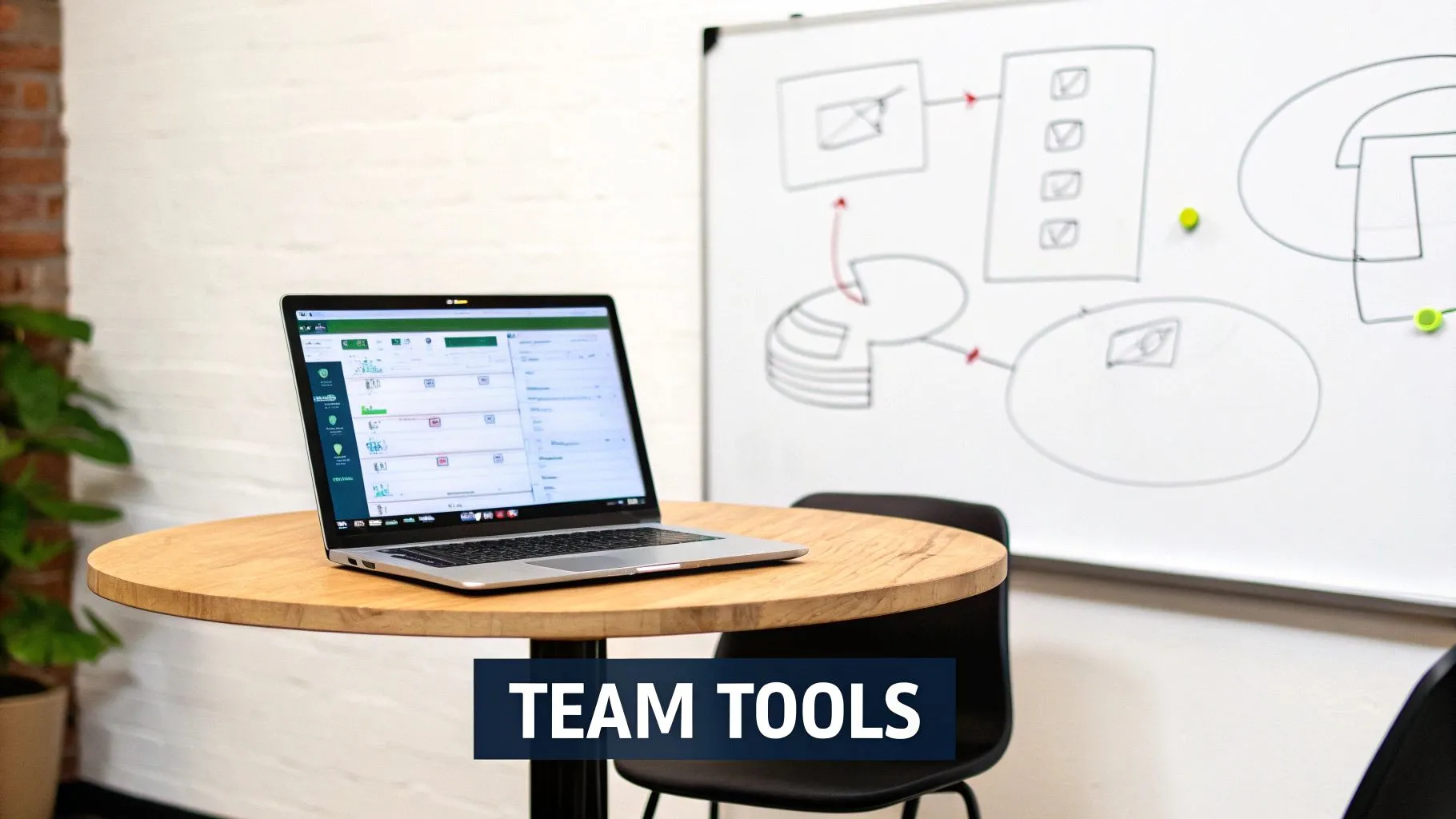
Learning whether a team uses a modern stack like GitHub, Slack, and Linear versus a more traditional enterprise setup like an on-premise GitLab, Microsoft Teams, and Jira can tell you a lot about their culture. It reveals their approach to collaboration, automation (CI/CD pipelines), and developer freedom, all of which directly impact job satisfaction and your ability to be effective.
Why It's a Top-Tier Question
- Reveals Technical Culture: A team that invests in modern tools like Datadog for monitoring or allows developers to choose their IDE (VS Code vs. IntelliJ) often signals a culture that values developer experience and productivity.
- Indicates Process Maturity: The presence of a well-integrated CI/CD pipeline (e.g., CircleCI, Jenkins) and robust project management software suggests mature, organized development processes.
- Gauges Investment in Tech: Companies using outdated, unsupported, or cumbersome homegrown tools may be underfunded or slow to adopt industry best practices, which can lead to significant friction in your work.
Sample Phrasing & Follow-ups
Drill down into specifics to get a clear picture of the environment you'd be joining.
- Initial Question: "Could you tell me about the primary tools the team uses for version control, communication, and project management? For instance, are you on GitHub or GitLab? Slack or Teams?"
- Follow-up on Development: "What does the local development environment typically look like? Are developers provided with powerful hardware like a modern MacBook Pro, and is there flexibility in choosing an IDE?"
- Follow-up on Automation: "What tools are used in your CI/CD pipeline for building, testing, and deploying code?"
- Follow-up on Operations: "How does the team handle monitoring, logging, and alerting for production systems?"
Red Flag Alert: Be cautious if the interviewer is unsure about their core toolset or describes a heavily manual process for tasks that are typically automated, like deployments. An answer like, "We just FTP the files to the server," for a modern web application role is a significant warning sign of outdated practices and technical debt.
10. How does the company approach learning, skill development, and conference attendance?
In the fast-evolving world of IT, continuous learning isn't just a perk; it's a necessity for staying relevant and effective. This question helps you determine if a potential employer sees your professional development as a strategic investment or an unnecessary expense. The answer reveals the company's commitment to your growth, which directly impacts your long-term career trajectory.
A company that actively supports learning through dedicated budgets, structured programs, and protected time is one that values its talent. It signals a culture of curiosity and improvement, which benefits both you and the organization. Conversely, a lack of clear policy or investment can indicate a stagnant environment where you'll be expected to learn entirely on your own time and dime.
Why It's a Top-Tier Question
- Signals Investment in People: A solid training budget and clear policies for attending events like conferences show the company values its employees beyond their immediate output.
- Future-Proofs Your Skills: The IT landscape changes rapidly. A role with built-in learning opportunities ensures your skills won't become outdated, making you a more valuable asset in the long run.
- Reveals Cultural Priorities: It uncovers whether learning is an integrated part of the workweek (e.g., dedicated learning days, internal tech talks) or an afterthought. This is a key differentiator in a modern tech culture. For more on crafting a career narrative that highlights your growth, you can find valuable insights on building a powerful professional story.
Sample Phrasing & Follow-ups
Drill down from a general question to get specific details about their programs.
- Initial Question: "Could you tell me about the company's philosophy on professional development? How do you support the team in staying current with new technologies and methodologies?"
- Follow-up on Budget: "Is there a specific annual budget for each team member for training, certifications, or conferences?"
- Follow-up on Process: "How does the team decide which conferences to attend or which certifications are worth pursuing? Is there an approval process?"
- Follow-up on Time: "Is learning time, like taking an online course, typically done during work hours, or is it expected to be personal time?"
Red Flag Alert: Be cautious with answers like, "We support learning, but we don't have a formal budget," or "You can learn a lot on the job." While on-the-job learning is crucial, the absence of any formal support structure often means that in practice, development opportunities are rare and difficult to secure. A strong employer can provide concrete examples of how they've recently invested in their team's skills.
10 Key IT Interview Questions Comparison
| Question | 🔄 Implementation complexity | ⚡ Resource requirements | ⭐ Expected outcomes | 📊 Ideal use cases | 💡 Key advantages / Tips |
|---|---|---|---|---|---|
| What does a typical day/week look like in this role? | Low–Medium — straightforward to describe but varies by interviewer | Low — time for concrete examples and follow-ups | High — realistic view of daily tasks and cadence | Assess work rhythm, meeting load, hands-on vs. managerial balance | Ask for meeting freq/duration, busiest periods, context-switch examples |
| What is the current tech stack, and are there plans to modernize or migrate? | Medium — technical details and roadmap clarity needed | Medium–High — may require diagrams or migration plans | High — shows skill alignment and modernization direction | Evaluate skill fit, learning opportunities, and risk of technical debt | Ask rationale for choices, debt roadmap, CI/CD and cloud specifics |
| How is the team structured, and what are the reporting lines? | Medium — org charts and responsibilities can be nuanced | Low–Medium — needs org map and examples of collaboration | High — clarifies mentorship, influence, and decision paths | Determine management style, cross-functional dependencies, remote setup | Request team size, manager background, and peer collaboration examples |
| What does the code review and quality assurance process look like? | Medium — involves process, tooling, and standards | Medium — examples of CI, tests, linting, and review SLAs | ⭐ High — indicates engineering maturity and learning culture | Assess code quality practices, onboarding, and release safety | Ask about review turnaround, test coverage targets, and security scans |
| What is the company culture, and how do technical teams integrate into it? | Low–Medium — qualitative; may differ by interviewer | Low — conversation-focused, may need examples | High — predicts job satisfaction and team dynamics | Cultural fit evaluation, remote/flex policy fit, values alignment | Ask for examples of values in practice, D&I metrics, failure handling |
| What are the main challenges the team is currently facing? | Medium — requires honest, specific disclosures | Low–Medium — ask for priorities, timelines, and resources | High — reveals impact opportunities and risk level | Identify problem-solving roles, technical debt, scaling issues | Ask about timelines, resources allocated, and recent improvements |
| What does career growth and advancement look like for this position? | Medium — needs clarity on ladders and promotion criteria | Low–Medium — examples of promotions and mentorship required | High — sets expectations for development and retention | Long-term fit, IC vs manager tracks, training investments | Request promotion timelines, recent promotion examples, mentorship programs |
| How does the company handle on-call and incident management? | Medium — covers schedules, SLAs, and postmortems | Medium — requires data on rotation, incident frequency, compensation | High — impacts work-life balance and operational maturity | Roles with operational responsibilities, SRE practices, on-call burden | Ask about frequency, compensation, runbooks, and blameless postmortems |
| What development and collaboration tools does the team use? | Low — factual list of tools and workflows | Low–Medium — may involve access and hardware policies | High — affects productivity, onboarding, and remote work | Evaluate dev experience, CI/CD, monitoring, and async collaboration | Ask about preferred IDEs, hardware provided, CI/CD and docs access |
| How does the company approach learning, skill development, and conference attendance? | Low — policies and budgets are usually defined | Medium — training budgets, time allocation, and programs | High — indicates investment in employee growth and retention | Candidates seeking growth, certification support, conference access | Ask about budget amounts, criteria, learning time, and recent examples |
From Candidate to Colleague: Making Your Final Decision
You have navigated the technical challenges and behavioral questions, but the true power move in any IT interview happens when the tables turn. The "do you have any questions for us?" segment is not a formality; it's your opportunity to interview the company. By deploying the strategic questions to ask at it interview we've detailed, you have moved beyond simply being a candidate and have become a discerning evaluator, actively shaping your professional future.
The information you've gathered is your decision-making toolkit. The answers to questions about the tech stack, code review processes, and on-call rotations are not just trivia. They are crucial data points that paint a vivid picture of your potential day-to-day reality, the team's engineering maturity, and the company's commitment to quality and work-life balance.
Synthesizing the Answers into a Coherent Picture
Now is the time to step back and connect the dots. Don't just review the answers in isolation. Instead, look for patterns and correlations that reveal the true nature of the organization.
- Aligning Technical Reality with Career Goals: Did their description of the tech stack and upcoming projects excite you? If they plan a migration from a legacy system to a modern framework you want to master, that's a huge green flag. Conversely, if they describe a maintenance-heavy role with no plans for modernization, you must ask if that aligns with your growth trajectory.
- Decoding the Cultural and Process Clues: A team that provides a detailed, enthusiastic explanation of their CI/CD pipeline, automated testing, and collaborative code reviews is broadcasting its commitment to engineering excellence. Vague, hesitant answers or a lack of defined processes can be a significant red flag, signaling potential chaos, technical debt, and frustration down the line.
- Evaluating the Growth and Support Trajectory: Consider the answers about career progression and learning budgets together. A company that claims to value growth but offers no clear path, mentorship program, or budget for conferences and certifications may not be the right place to advance your skills. Your goal is to find an environment that invests in you as much as you invest in it.
Key Insight: An interview is a two-way data exchange. The quality of your questions directly determines the quality of the data you receive to make one of the most important decisions of your career.
From Insight to Action: Making the Right Choice
Ultimately, the goal is not just to secure any job offer but to accept the right one. The right offer leads to a role where you are not just competent, but engaged, challenged, and valued. It's a position that serves as a powerful launching pad for the next stage of your career, not just a temporary landing spot.
Reflect on the complete picture you've assembled. Did the interviewers' energy match your own? Were they transparent about challenges and excited about opportunities? Trust your gut, but back it up with the concrete evidence you've gathered. By being deliberate and strategic with your questions to ask at it interview, you empower yourself to confidently identify and accept a role that is a true technical, cultural, and professional fit, ensuring your next move is a meaningful step forward.
Now that you know what to ask, ensure your resume tells a story that gets you into the room to ask it. StoryCV helps you craft a compelling, ATS-friendly resume that showcases your impact, not just your tasks. Visit StoryCV to transform your experience into a narrative that captures the attention of top tech employers.