Your resume has six seconds. Most student summaries waste them.
They start with "Motivated student seeking..." and tell a recruiter nothing. The problem isn't your lack of experience. It's that you're summarizing it badly.
A resume summary is not a timid request for a job. It's a sharp, confident statement of what you can do for an employer, backed by evidence. Your 30-second pitch in three powerful sentences.
Generic summaries get filtered out by talent acquisition software platforms. Specific ones get read.
These resume summary student examples show the difference between a summary that gets skipped and one that demands attention. Forget templates. Show your work.
1. General Internship Seeker
This is the most common student summary. It’s also the least effective. It uses clichés and tells the hiring manager nothing about what you can do.
The Before: Vague & Forgettable
"Motivated and hardworking student seeking an internship opportunity in marketing to apply my academic knowledge and grow my skills. Eager to contribute to a dynamic team."
This is filler. "Motivated," "hardworking," and "eager to contribute" are claims, not proof. The recruiter thinks, "Okay, but what can you do?"
The After: Specific & Impactful
Replace vague adjectives with concrete skills from coursework or projects.
"Marketing student with a focus on digital analytics. Completed a university project analyzing social media engagement for a local business, leading to a 15% increase in follower interaction. Proficient in Google Analytics and Hootsuite, seeking to apply data-driven insights to the Marketing Internship."
This works because it shows, it doesn't just tell.
2. The Career Changer (or Pivot)
For students pivoting from their major. Don't lead with a degree that seems unrelated. Lead with transferable skills that match the job.
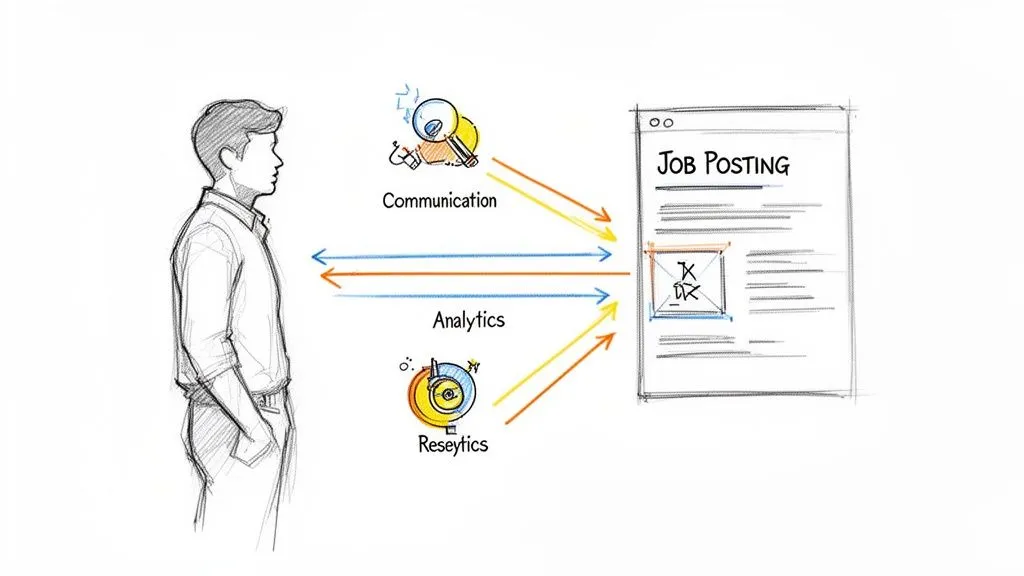
The Before: Unrelated & Confusing
"Psychology major with an interest in user experience. Looking to apply my understanding of human behavior to a UX research role and learn about the tech industry."
This creates questions. The recruiter has to guess how your background is relevant. They don't have time for that.
The After: Skills-First & Clear
Reframe your academic experience in the language of the target industry.
"Psychology student specializing in user research methodologies. Applied qualitative and quantitative data collection in a capstone project on cognitive biases in decision-making. Seeking to use skills in survey design and data analysis to support the UX Research team."
This connects the dots for the hiring manager. You've proven your value from the first sentence. For more ideas, see these professional summary examples for your resume.
3. The Storyteller with a Narrative Arc
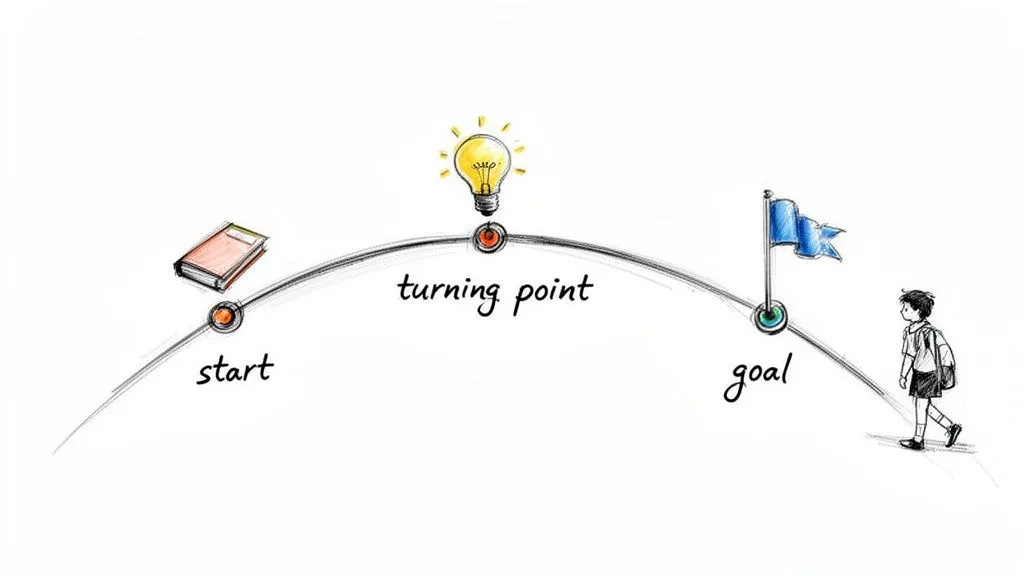
Tell a brief story of your journey. Connect an initial interest, a key turning point, and your current goal. This humanizes your application.
The Before: Flat & Lacking Context
"Business student interested in product management. Experience in marketing and customer service. Strong analytical and communication skills."
This is technically accurate but emotionally empty. It lists ingredients but doesn't show the recipe.
The After: Compelling & Purposeful
Weave a short, three-part story: the beginning, the turning point, and the future.
"Began in a marketing internship where I discovered a passion for the 'why' behind customer behavior. This led me to a project analyzing user feedback that informed two new feature proposals. Eager to bring this customer-centric product perspective to an Associate Product Manager role."
This shows your drive, not just your skills.
4. The Technical Specialist (STEM & Tech)
For students in CS, engineering, or any technical field. Your summary has one job: establish technical credibility immediately.
The Before: Too General
"Computer Science student with experience in programming and web development. Seeking a challenging role to apply my problem-solving abilities."
This is useless. "Experience in programming" means nothing without naming the languages. It fails the keyword scan.
The After: Tech-Specific & Credible
Front-load your summary with the languages, tools, and methodologies from the job description.
"Full-stack developer proficient in the MERN stack (MongoDB, Express, React, Node.js) and AWS for deployment. Developed and launched a scalable e-commerce application with a RESTful API and user authentication. Seeking to apply back-end development skills to a software engineering internship."
This acts as a mini-portfolio of your capabilities.
5. The Mission-Driven Student
For students entering nonprofit, social impact, or purpose-driven sectors. It goes beyond skills to connect your personal mission with the organization's goals.
The Before: Passion without Proof
"Passionate environmental science student looking to make a difference. Eager to apply my knowledge of sustainability to a role where I can help protect the planet."
"Passionate" is a claim, not evidence. A hiring manager at a climate NGO has seen this a thousand times.
The After: Commitment with Evidence
Prove your commitment with specific actions, projects, or volunteer work.
"Environmental Science student committed to advancing sustainable agricultural practices. Led a university project on soil regeneration techniques and completed 100+ hours of conservation fieldwork removing invasive species. Seeking to apply my research and hands-on experience to support the organization's climate action initiatives."
This shows you've already done the work.
6. The Cross-Functional Thinker
For liberal arts or interdisciplinary students. Frame your varied background as a unique strength for solving complex problems.
The Before: Unconnected & Confusing
"Interdisciplinary thinker with a degree in Psychology and a minor in Business. Skilled in data analysis and creative problem-solving. Seeking a role in consulting."
This presents a puzzle, not a solution. It forces the hiring manager to figure out how the pieces fit together.
The After: Synthesized & Powerful
Synthesize your skills into a single, compelling value proposition.
"Analyst skilled in synthesizing qualitative insights from psychology with quantitative business data. Used this approach in a capstone project to recommend a new customer service strategy, projected to reduce churn by 10%. Seeking to apply this human-centered data analysis to a Junior Consultant role."
This frames your diverse background as a strategic advantage.
Stop Filling Boxes. Start Telling Your Story.
Your resume summary is the single most important real estate you have. It's your one chance to frame your story before a recruiter moves on.
The pattern is clear: stop talking about what you want. Start showing what you have already accomplished and what you can do for them.
Key Takeaways
- From Adjectives to Actions: Ditch "hardworking." Use action verbs that describe concrete results.
- From Duties to Impact: Don't just list what you did. Show the result. Did you increase efficiency by 20%? Save 10 hours a week? Quantify it.
- From Generic to Specific: A "one-size-fits-all" summary fits no one. Read the job description. Frame your summary as the solution to their problem.
Mastering this isn't about finding the perfect template. It's about learning to see your experiences—even part-time jobs or class projects—as a collection of problems you've solved. Once you can articulate that value, you have a story that commands attention. You can then use tools like professional resume templates in Notion to structure your resume effectively.
Your Next Step
Reading about strong resume summary student examples is the first step. Now, do the work.
List your top three accomplishments. For each one, write a single sentence that connects your action to a quantifiable result. Combine these to build a summary that is undeniably yours.
Your resume is an argument for your future. The summary is your opening statement. Make it count.
Tired of staring at a blank page? StoryCV is a Digital Resume Writer. We use a smart interview to pull these achievements out of your experience and turn them into a sharp, confident career story.