When the interviewer leans forward and says, "So, tell me about yourself," it’s not just a casual icebreaker. It's your opening scene. You have a critical 60-to-90-second window to set the tone for the entire conversation.
This is your shot to go beyond the bullet points on your resume and show them who you really are—confident, clear, and the author of a compelling professional story.
Why This Question Sets the Stage for Your Interview
That simple request is a strategic move by the hiring manager. They aren’t asking for your life story or a verbal walkthrough of your resume. They already have that piece of paper. What they’re really looking for is much deeper. Your answer shows them how you think, communicate, and connect your past to their future.
It's your first real chance to frame the narrative on your terms. You get to immediately spotlight your most relevant skills and wins, steering the interview toward your strengths right from the start.
A well-crafted answer is more than a good first impression; it's a strategic preview of the value you bring. It proves you understand what matters for the role and can articulate it with poise.
What the Interviewer Is Really Asking
When they ask you to tell them about yourself, they're trying to quickly figure out a few key things:
- Communication Skills: Can you structure your thoughts clearly and concisely? Are you engaging or just reciting a script?
- Professional Confidence: Do you sound sure of yourself and your experience, or are you hesitant?
- Role Alignment: How well do you connect your background to the specific needs of this job at this company?
- Overall Personality: What’s your vibe? Your tone and delivery offer big clues about whether you'll fit in with the team.
This question is a favorite because it's so efficient. Research shows that between 50% and 60% of interviewers kick things off with this exact prompt. And your answer carries real weight—a recent survey found that 57% of hiring managers say it’s a key factor in their decision to move a candidate forward. You can read more about why this opener is so common and why it matters so much.
Once you understand what they're truly looking for, you can turn this moment from a source of anxiety into your biggest advantage. You'll start the interview with momentum, not nervousness.
Building Your Story with the Present-Past-Future Method
Crafting a memorable answer to "tell me about yourself" isn't about memorizing a script. It’s about having a simple, powerful framework in your back pocket. The Present-Past-Future method is exactly that.
It turns a vague, open-ended question into a tight, three-part story that connects where you are today with where you want to go. This isn't just about listing jobs; it's about building a coherent narrative that makes your career journey feel intentional and perfectly aligned with the role you're sitting there for.
This narrative approach is baked into how we communicate. People instinctively tell stories to explain who they are. A 2023 study found that 70% of responses to this prompt globally contain at least one narrative element, like a key challenge or success. It's a universal tool. You can read more about the science behind professional identity communication.
This simple timeline shows how the method flows.
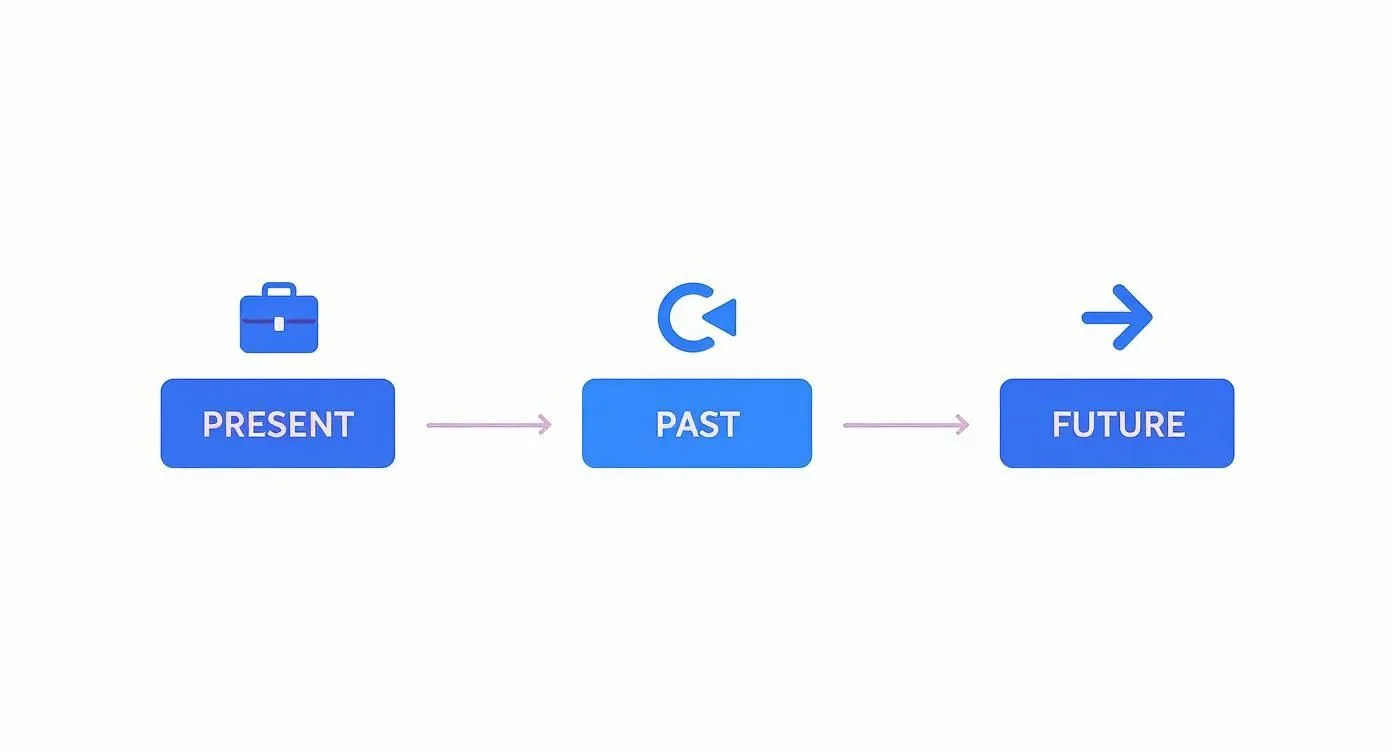
This structure gives the interviewer a clear, logical path to follow, making it easy for them to connect your experience to their needs.
Start with Your Present
Ground the interviewer in your current reality, right now. This part should be quick—just one or two sentences. Focus on your current role and a recent, high-impact accomplishment. Think of it as the headline of your professional story.
The goal is to immediately establish your current level of expertise and the value you're delivering. Don't just state your job title and company. Connect it to a specific, relevant achievement.
For instance, a project manager could kick things off with:
"Currently, I'm a Senior Project Manager at Innovate Corp, where I just led the launch of our new flagship software. It was a big cross-functional push, and we delivered it two weeks ahead of schedule and 10% under budget."
This opener is strong because it's specific, includes hard numbers, and immediately shows you get things done.
Connect It to Your Past
Next, you need to connect the dots. Briefly touch on the key experiences from your past that brought you here. This isn't a long-winded trip through your entire resume. Pick one or two pivotal moments or skills that directly set you up for success in your current role—and by extension, the one you’re interviewing for.
Think about the "why" behind your journey. What critical skills did you build? What important lessons did you learn?
- For Career Changers: This is where you highlight transferable skills. "My background in teaching was all about communication and stakeholder management, which became the foundation for my transition into product management."
- For Mid-Level Professionals: Show your progression. "Before this, I spent three years at a smaller agency building their digital marketing strategy from scratch. That experience prepared me to manage the larger, more complex campaigns I'm running now."
This section gives crucial context. It shows the interviewer your career has been a deliberate path of building and learning.
Pivot to the Future
Finally, bring it all home. Connect your story directly to the future—specifically, the future you see in this role, at this company. This is the most important part of your answer. It proves you’ve done your homework and aren't just looking for any job.
Explain why this role is the logical next step for you. What about the company or the position itself gets you excited?
Your goal is to make it crystal clear that your past and present have perfectly prepared you for the future you want to build with their organization.
A software engineer might wrap up by saying:
"What really excites me about this Senior Engineer role is the chance to apply my experience in scaling data pipelines to a new challenge in the fintech space. I'm really eager to contribute to a team that's focused on building such robust, high-performance systems."
This conclusion ties everything together. It's forward-looking and speaks directly to what the interviewer needs to hear.
Real World Examples for Every Career Stage
Knowing the Present-Past-Future framework is one thing. Seeing it in action is another.
A generic, one-size-fits-all answer just won't cut it, because your professional story is unique to your career stage. A recent graduate has to sell potential, while a career changer needs to connect seemingly unrelated experiences into a powerful, coherent narrative.
Let’s move from theory to practice. The following examples are detailed, annotated walkthroughs showing how different people can adapt this structure to tell a compelling story. Don't memorize these as scripts. Use them as blueprints to build your own authentic and impactful answer.
Example for the Recent Graduate
If you're a recent grad, you might feel like you don't have enough experience. That's a common fear, but it's misplaced. The key is to focus on your potential, your transferable skills, and your genuine enthusiasm. Your story should highlight academic wins, relevant projects, and internships that prove you have the foundational skills and drive to succeed.
For instance, a new marketing graduate interviewing for a social media coordinator role could say:
Present: "I just graduated from State University with a degree in Marketing, where I concentrated on digital communications. For my capstone project, I created a full-funnel social media campaign for a local non-profit, which boosted their online engagement by 30% in just two months."
Past: "Throughout my studies, I was really drawn to how brands build communities online. I took on an internship at a small tech startup where I managed their content calendar and learned to analyze engagement data, which solidified my passion for a data-driven social media strategy."
Future: "I was so excited to see this Social Media Coordinator position because it aligns perfectly with my goal of using my content creation and analytics skills to help a mission-driven brand grow its audience. I'm eager to contribute my fresh perspective and learn from an experienced team like yours."
This answer works because it showcases academic success, practical internship experience, and a clear connection to the specific role. It screams both capability and ambition.
For more guidance on structuring your early-career story, check out our in-depth article on building a standout student resume with real examples.
Example for the Mid-Career Professional
As a mid-career professional, your focus shifts. You're no longer selling potential; you're demonstrating a track record of concrete results and leadership. Your answer should be a tight summary of your proven value and how your expertise is the direct solution to the company's problems.
Here’s how a software engineer applying for a senior-level position might frame their pitch:
Present: "I'm currently a Software Engineer at TechSolutions, where I lead the development of our core API services. I recently spearheaded a project to refactor our main data processing module, which improved system performance by 25% and cut server costs."
Past: "Before this, I spent four years at Innovate Inc., where I honed my skills in building scalable, distributed systems. That experience was critical because it taught me how to manage complex projects from concept to deployment and mentor junior developers, preparing me for a leadership role."
Future: "I'm looking for my next challenge, and this Senior Engineer role caught my eye because of your company's focus on building high-performance financial platforms. I'm confident that my background in system optimization and team leadership can directly contribute to the success of your engineering goals."
This response is powerful. It highlights quantifiable achievements, shows a clear progression of responsibility, and explicitly states why the role is a logical and exciting next step.
Example for the Career Changer
If you're changing careers, your main job is to bridge the gap between your past experience and your future goals. You have to artfully connect your transferable skills—like project management, communication, or client relations—to the requirements of the new role. Make the leap feel natural, not random.
Consider a former teacher applying for a corporate training specialist position:
Present: "I'm transitioning from a decade-long career in education, where I most recently developed and implemented a new district-wide science curriculum for over 500 students. My focus was always on creating engaging learning materials that produced measurable outcomes."
Past: "As a lead teacher, my role was essentially project management and stakeholder communication. I was responsible for understanding student needs, designing a curriculum to meet those needs, and training other teachers on its delivery. Those skills in instructional design and adult learning are what I'm most passionate about."
Future: "That’s why I was so drawn to this Corporate Training Specialist role. I want to apply my experience in curriculum development and training to an environment focused on employee growth. I'm excited by the opportunity to help your team build effective learning programs that drive business results."
See how that works? The answer skillfully reframes teaching experience into valuable corporate skills, making the career change feel like a deliberate and natural evolution.
Your professional profile—whether you're just starting out, climbing the ladder, or changing paths entirely—shapes the story you tell. It’s not about having one perfect script, but about knowing which parts of your experience to spotlight for the role you want.
Adapting Your Pitch for Your Profile
| Your Profile | Primary Focus | Key Element to Emphasize |
|---|---|---|
| Recent Graduate | Potential & Enthusiasm | Academic projects, internships, and a demonstrated hunger to learn and contribute. |
| Mid-Career Pro | Proven Impact & Results | Quantifiable achievements, leadership growth, and direct solutions to the company's needs. |
| Career Changer | Transferable Skills & Vision | The "why" behind your pivot, connecting past skills to future contributions in the new field. |
Ultimately, the goal is the same for everyone: to present a coherent, compelling narrative that makes the interviewer think, "This person gets it, and they belong here."
Common Mistakes and How to Avoid Them
Knowing the right framework is only half the battle. The other half is dodging the common traps that can completely derail your answer. Even a perfectly structured story can fall flat if the delivery is off or the focus is wrong.
Think of it this way: the "tell me about yourself" question isn't just a filter for good answers; it’s also a way to quickly spot the bad ones. Let’s walk through the missteps I see most often and how you can sidestep them to keep your interview moving in the right direction.
Mistake 1: Reciting Your Resume
One of the fastest ways to lose an interviewer’s attention is to just verbally walk them through your resume, line by line. They’ve already read it—that’s why you’re in the room. Simply listing your jobs without any connecting thread is a massive missed opportunity.
- Why it's a problem: It shows you haven't prepared and can't synthesize your own experience. Honestly, it’s boring and adds zero new information.
- The fix: Don't just list your jobs; tell your story. Use the Present-Past-Future model to weave your key experiences into a narrative that explains why you’re a fantastic fit for this specific role.
Mistake 2: Rambling Without a Point
Nerves get the best of us, and that’s when the rambling starts. I've seen countless candidates start strong, only to drift into irrelevant side projects, long-winded technical details, or random personal anecdotes. Your pitch needs to be tight—aim for that 60-to-90-second sweet spot.
Your answer is an elevator pitch, not your autobiography. Every single sentence should have a purpose and lead to the next, all building up to why you are the right person for this job.
If you take five minutes, you’re not just wasting time. You’re sending a clear signal that you struggle to communicate important information efficiently. That's a red flag for almost any role.
Mistake 3: Oversharing Personal Details
You absolutely want to be authentic, but this question is about your professional self. Sharing deeply personal information about your family, hobbies, or life struggles can make the interviewer uncomfortable and completely shifts the focus away from your qualifications.
- Why it's a problem: It can feel unprofessional and shows a poor understanding of workplace boundaries.
- The fix: Keep it professional. Your story should center on your career journey, the skills you’ve built, and how your aspirations align with the job. You can build personal rapport later in the conversation if the moment feels natural.
Mistake 4: Using a One-Size-Fits-All Answer
Your "tell me about yourself" answer has to be customized for every single interview. A generic pitch that never mentions the company or the role you're interviewing for screams a lack of genuine interest. Trust me, interviewers can spot a canned response from a mile away.
This is the exact same principle as tailoring your resume. In fact, our guide on navigating the ATS filter with the 90-10 rule digs into why customization is so critical. The same logic applies here: do your homework on the company and the role, then weave specific details into the "Future" part of your answer to show you’re serious.
Delivering Your Answer with Confidence
You’ve done the hard part. You’ve mapped out a story that connects your past, present, and future into a tight, compelling narrative. Now what?
Now you have to deliver it. A perfectly crafted answer can fall completely flat if it doesn't land with confidence and a bit of genuine personality. How you say it matters just as much as what you say.
The goal here isn't to sound like you’re reading from a teleprompter. It’s to know your key points so well that the story just flows. Think of it less like reciting lines and more like telling a story you know by heart—because it's yours.
Master Your Non-Verbal Cues
Before you even say a word, your body language is already talking. It can scream confidence or whisper insecurity.
Here are a few small things that make a huge difference:
- Keep Your Eye Contact Natural. You're having a conversation, not a staring contest. Hold their gaze for a few seconds, then look away for a moment as you gather your next thought. It shows you're thinking, not just reciting.
- Use Open Gestures. Uncross your arms. It’s a classic defensive pose that closes you off. Instead, keep your posture open and use your hands to emphasize the points you’re making. It brings energy to your story and makes you seem far more dynamic.
- Sit Up Straight. Slouching looks lazy or nervous. Good posture telegraphs confidence and focus. Leaning in just slightly can also show you’re engaged and eager to connect.
These aren't just minor tweaks; they're signals that reinforce the confident, competent story you're telling.
Fine-Tune Your Vocal Delivery
Your voice is a powerful instrument. A flat, monotone delivery can make the most incredible career journey sound like a grocery list. You want to sound engaged, enthusiastic, and completely professional.
The secret to a natural delivery is to practice your talking points, not memorize a script. Internalize the highlights so you can talk about them conversationally, no matter the order they come out.
Watch your pace and tone. If you rush, you sound nervous. If you go too slow, you risk losing their attention. Aim for a clear, moderate speed. Let your intonation rise and fall to add color to your biggest wins and show genuine excitement when you talk about what’s next. That vocal energy is what makes your answer stick and helps you build real rapport from the first minute.
Using AI to Refine Your Professional Narrative
Crafting a powerful answer to "tell me about yourself" on the spot is tough. This is where the right tools can give you a serious edge. Modern AI platforms, like StoryCV, are designed to work like a career strategist in your corner, helping you find and articulate your most impressive achievements.
The goal isn't to get a robot to write a generic script for you. It's about sharpening your own unique story.
Think of it as a way to clearly connect the dots between your past wins and your future goals. This narrative isn't just for interviews, either; it's the foundation of your entire professional brand. In fact, people with strong, clear professional summaries see a 40% higher networking success rate.
An intelligent tool helps organize your experiences into a coherent story that actually connects with recruiters. It’s a similar process to working with a top-tier resume writer—they don't just write for you, they guide you to find the strongest narrative within your own career.
Your Top Questions, Answered
Even with a solid plan, a few tricky questions always seem to surface when you're polishing your answer. Let's tackle the most common ones I hear.
How Long Should My Answer Actually Be?
Keep it between 60 and 90 seconds. That’s the sweet spot. It gives you just enough runway to hit your Present-Past-Future narrative without the interviewer’s eyes glazing over.
If you go much shorter, you risk sounding unprepared. Veer past the two-minute mark, and you’re officially rambling. Do a few timed practice runs—it’s the only way to make sure your delivery feels natural and unhurried inside that window.
Think of it as a movie trailer for your career. It needs to be punchy, compelling, and make them eager to see the full feature—the rest of your interview.
Should I Talk About My Hobbies?
Probably not. Your answer should be laser-focused on your professional story. The interviewer is trying to figure out if you can solve their problem, not what you do on weekends.
There's one exception: if your hobby directly proves a skill that’s critical for the job. A software engineer mentioning a personal coding project is a perfect example—it shows genuine passion and drive. Otherwise, save the personal stuff for later if you build that kind of rapport.
What if My Past Experience Feels Totally Unrelated?
This is a huge one for career changers, but it's actually a golden opportunity to show how adaptable you are. The trick is to stop talking about job titles and start focusing on transferable skills.
Frame your past through the lens of the job you want now. You have to connect the dots for them.
- Project Management: "My time planning events was really about managing complex timelines and getting dozens of different stakeholders on the same page."
- Communication: "As a teacher, my entire job was to distill complex ideas into simple, clear concepts for different audiences."
- Data Analysis: "Working in retail, I was constantly looking at sales data to figure out which inventory strategies were working and which weren't."
When you do this, your career pivot stops looking random and starts looking intentional. You're showing them the bridge you've already built between your past and their future.
Ready to build a narrative that gets you noticed? StoryCV helps you find your most powerful achievements and weave them into a story that actually connects with recruiters.
Start crafting your professional story for free today.