Passing an ATS is the easy part of an electrical engineer resume. The hard part is proving that you've shipped something real, worked through compliance, and changed an engineering outcome.
A hiring engineer doesn't need another list of software names. They need to see the system you owned, the standards you designed to, the tools you used, and what improved because of your work. A resume is a proof file, not a document.
Why Most Electrical Engineer Resumes Fail Before They Start
The popular advice says to optimize for keywords first. That's backwards. Keywords can help a resume get found, but they can't prove that you've designed, tested, commissioned, or supported hardware outside a classroom.
Electrical engineering is also too broad for a generic pitch. Power systems, controls, embedded, RF, PCB design, and test engineering each use different evidence. A bullet that works for a controls engineer can be irrelevant to an RF hiring manager.
Practical rule: Name the standards you designed to. That's how another engineer knows you've shipped hardware.
Use standards such as IPC-2221, UL 508A, IEC 61010, NEC, and IEEE 519 only when they reflect real work. A standards list without context looks like keyword stuffing. A bullet that connects a standard to design reviews, safety testing, documentation, or approval shows practical exposure to a compliance cycle.
The field is substantial and durable. The U.S. Bureau of Labor Statistics reports about 185,430 electrical engineers in 2023, with a mean annual wage of $117,680. The broader electrical and electronics engineering category is projected to add 23,400 jobs from 2025 to 2035, so employers still need engineers who can connect technical depth to production-scale results.
That's why “responsible for circuit design” is weak. It describes a duty shared by thousands of candidates. “Designed power distribution hardware to UL 508A requirements, completed verification documentation, and supported production release” gives the reader something to evaluate.
Electrical Engineer Resume Structure That Works
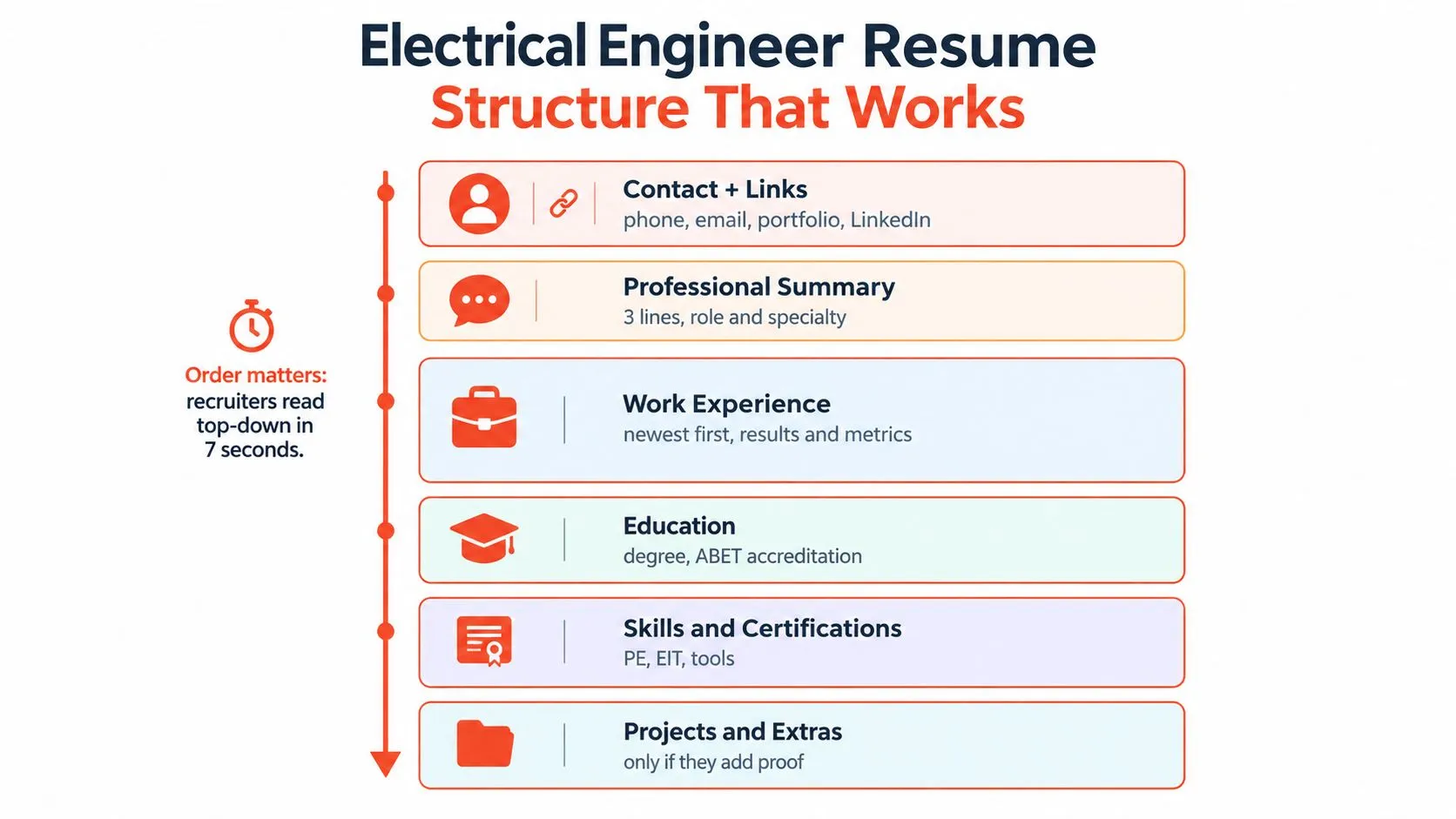
Use a structure that lets a technical reader find proof quickly:
- Contact and links: Include your name, location, email, phone, portfolio, and relevant professional profile.
- Professional summary: State your subfield, level of scope, and the problems you solve.
- Work experience: Lead with the newest relevant role and use outcome-focused bullets.
- Projects and lab experience: Add this when it proves a capability missing from your employment history.
- Skills and tools: Group technical terms so they're readable, not stuffed into one dense line.
- Education and certifications: Include your degree, relevant accreditation, PE or FE status, and meaningful standards exposure.
A standard structure typically includes a summary, reverse-chronological experience, education, and an ATS-focused skills list, according to this electrical engineer resume structure guide. Projects, lab work, and standards deserve more visibility when they supply stronger proof than an older job title.
Your summary shouldn't repeat the rest of the page. It should position you:
Electrical engineer specializing in industrial controls and machine safety, with experience taking PLC-based systems from design through commissioning. Skilled in Siemens TIA Portal, SCADA integration, electrical schematics, and IEC 61010 documentation.
That gives the reader a field, a delivery stage, and a technical direction. It's far more useful than “results-oriented electrical engineer with excellent communication skills.”
Two pages are acceptable for mid-career and senior engineers when the scope justifies them, but extra space isn't a promotion. Remove old tools, unrelated duties, and repeated achievements. For broader technical resume guidance, the Trackside Careers resume guide is useful because it focuses on making technical work easier to scan without flattening it into generic phrases.
Writing Electrical Engineer Resume Bullets That Prove Impact
A strong bullet answers four questions:
What system or scope did you own? What toolchain or method did you use? What action did you take? What changed afterward?
The result doesn't have to be dramatic. It has to be specific and defensible.
| Weak bullet | Better direction |
|---|---|
| Designed PCBs | Name the board, design constraints, tool, and production result |
| Troubleshot control systems | Identify the failure mode, diagnostic method, and operational improvement |
| Performed testing | State the test type, equipment, standard, and verification outcome |
| Worked with manufacturing | Explain the handoff, issue resolved, or yield improvement |
A bullet such as “designed PCBs” gives away almost everything a hiring manager needs to know. A stronger version might be:
Designed 4-layer industrial controller PCBs in Altium, resolved signal-integrity issues through schematic and layout reviews, and supported verification through production release.
Use actual measurements wherever you have them. Examples include reduced test time, improved yield, fewer field failures, lower defect rates, faster cycle times, reduced outages, greater test coverage, or completed compliance verification.
The metric should sit beside the work, not replace it. “Improved reliability” is vague. “Reduced repeat fault investigations by documenting failure modes and adding automated diagnostic checks” explains the mechanism, even if you can't disclose a precise figure.
A recruiting analysis cited by IMAST's engineering recruiting benchmarks describes noisy applicant pools, with roughly 191 applicants per hire in tech-adjacent engineering roles and only about 3 percent reaching interviews in some analyses. The practical lesson is simple: your first bullets must surface exact requirements and credible evidence quickly.
For more before-and-after transformations, use this guide to writing bullet points in a resume, then audit every bullet against the target posting.
Tailoring Your Electrical Engineer Resume for Power, Controls, Embedded, RF, and Test
One generic electrical engineer resume fails because each subfield asks a different question.
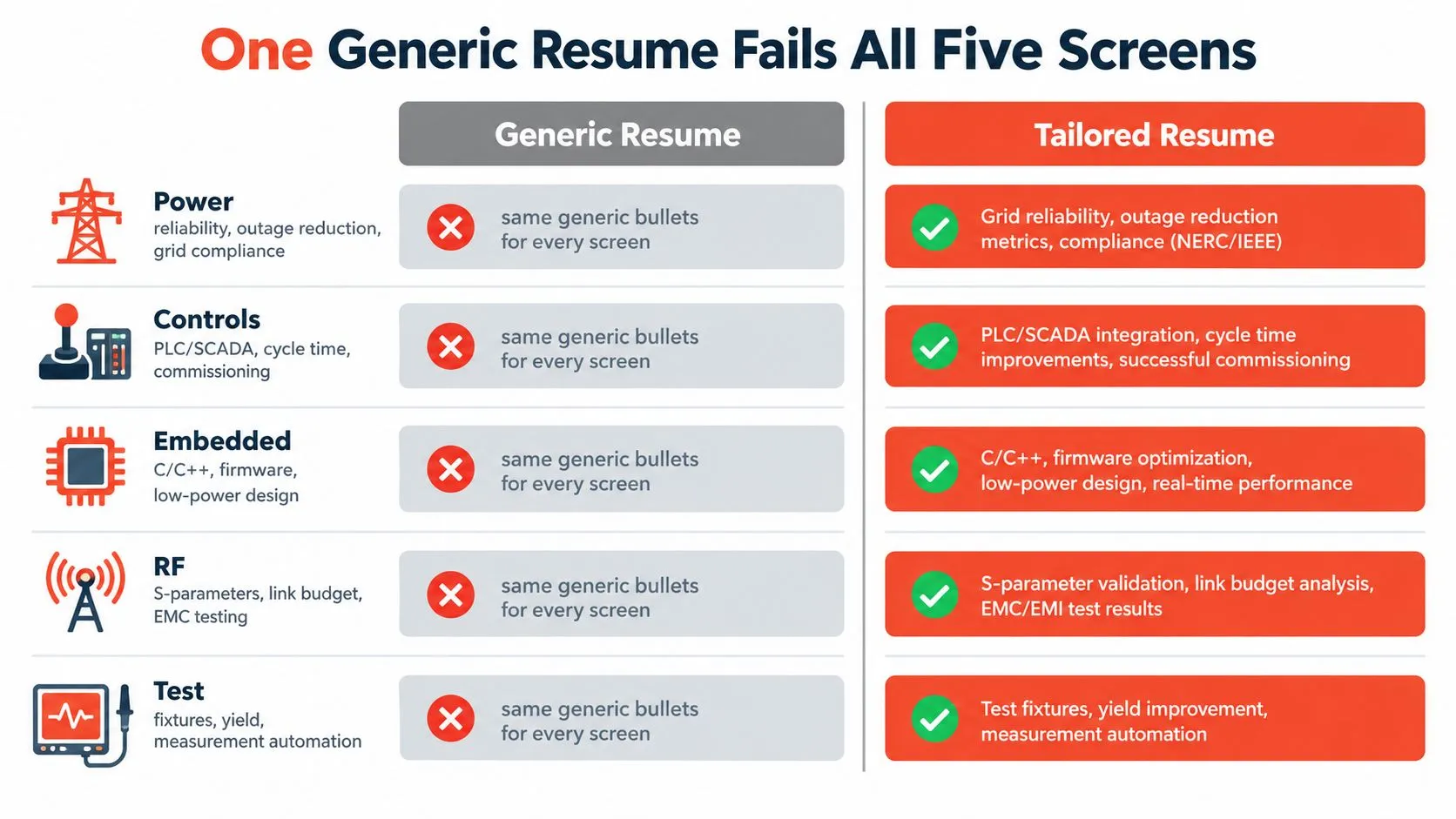
Power systems
Power hiring managers look for evidence around load studies, protection, reliability, safety, and code compliance. Mention ETAP, short-circuit analysis, arc-flash work, substations, switchgear, or grid interconnection when those terms describe your experience.
Completed load-flow and short-circuit studies in ETAP for an industrial distribution upgrade, documented protection changes, and supported NEC compliance review.
Controls and automation
Controls resumes should show commissioning, PLC and SCADA work, fault diagnosis, and production results. Name the platform, communication protocol, and machine or process.
Programmed Siemens PLC logic and HMI sequences for a packaging line, commissioning sensors, actuators, and safety interlocks before production handoff.
Embedded and firmware
Embedded teams care about the boundary between hardware and software. Show C or C++, microcontrollers, RTOS work, real-time constraints, power consumption, verification, and the path from prototype to production.
Developed firmware in C for a low-power microcontroller board, integrated SPI sensor interfaces, and supported hardware verification through production release.
RF and analog
RF and analog work needs measurement proof. Include S-parameters, link budgets, impedance matching, EMI or EMC testing, oscilloscopes, spectrum analyzers, and reproducible test methods where relevant.
Characterized RF front-end performance with a spectrum analyzer, documented measurement conditions, and investigated interference during EMC pre-compliance testing.
Test engineering
Test resumes should make verification tangible. Mention fixtures, automated measurement, defect isolation, coverage, compliance, and the handoff from test results to design changes.
Built an automated electrical test fixture for production boards, standardized measurement records, and routed recurring failures back to design review.
This role-specific approach reflects a gap in common guidance. Lists often mention ETAP, MATLAB, PLC, SCADA, AutoCAD Electrical, NEC, IEEE 1584, and Altium, but the electrical engineer resume examples from BeamJobs correctly point toward the harder question: what did you achieve with those tools?
A generic skills line says you've seen a technology. A targeted bullet shows where you used it and why it mattered.
Electrical Engineer Resume Skills, Tools, and ATS Keywords
Your skills section should help a recruiter confirm fit in seconds. It shouldn't become a warehouse of every program you've opened.
Use exact terminology from the posting, but only when you can support it elsewhere. A single-column, text-parsable layout is safer than graphics, tables, text boxes, or decorative skill bars. Guidance on electrical engineer resume skills and ATS terms consistently emphasizes role-specific CAD, EDA, simulation, specialization labels, and standards.
Group skills by the work they support:
- Design and analysis: MATLAB, Simulink, SPICE, circuit analysis, signal processing, load-flow analysis.
- CAD and PCB: Altium, AutoCAD Electrical, OrCAD, KiCad, schematic capture, multilayer layout.
- Embedded and controls: C, C++, PLC, SCADA, ladder logic, structured text, firmware verification.
- Measurement and testing: Oscilloscopes, logic analyzers, spectrum analyzers, LabVIEW, EMI and EMC testing.
- Standards and credentials: PE, FE, NEC, IEEE, UL, IPC-2221, IEC 61010, and other standards you've applied.
Standards are especially valuable because they connect design to accountability. IPC-2221 can signal PCB design exposure. UL 508A can point to industrial control panels. IEC 61010 can matter for measurement and laboratory equipment. NEC and IEEE 519 can support power-focused positioning.
Don't list PE, FE, NEC, IEEE, or UL as decoration. Put the relevant term in a project or experience bullet when possible, then explain what you designed, reviewed, tested, or documented against it. For a cleaner skills block, see this resume skills section guide.
Common Electrical Engineer Resume Mistakes and How to Fix Them
Most resume problems aren't writing problems. They're evidence problems.
-
Vague duty: “Managed electrical design.”
Fix: Name the system, design stage, stakeholders, and released outcome. -
Tool inventory: “MATLAB, PLC, Altium, AutoCAD, testing.”
Fix: Connect each important tool to a real engineering decision or deliverable. -
Missing standards: Listing “compliance” without naming the standard leaves the reader guessing.
Fix: Name the standard you used, such as IPC-2221, UL 508A, IEC 61010, NEC, or IEEE 519. -
Project as hobby: “Built a personal circuit.”
Fix: Describe the architecture, constraints, validation method, and what the project demonstrates. -
Formatting risk: Tables, columns, icons, and text embedded in images can make parsing unreliable.
Fix: Use a clean, single-column layout with normal section headings.
Career breaks need a different kind of correction. Don't disguise a gap with keyword stuffing or force every month into a chronology. Reframe relevant development, freelance engineering, caregiving, relocation, military transition, or certification progress as evidence of what you maintained or built.
A useful review also extends beyond the resume itself. Before applying, check this guide to protecting your online identity from employers, especially if your public profiles contain outdated technical information.
Then use this engineering resume mistakes checklist and ask three questions: What did I ship? How did I measure it? Why did it matter? If a bullet can't answer at least two of them, rewrite it.
StoryCV helps you turn real electrical engineering work into resume-ready bullets by asking about the system, constraints, tools, standards, and outcome instead of handing you another template. Visit StoryCV to talk through your experience and find the words for the work you've already done.