A marketing executive career isn't about running social media accounts. That’s marketing tactics. The executive role is the strategic brain behind the entire operation. You connect every dollar spent to a business goal.
What a Marketing Executive Actually Does
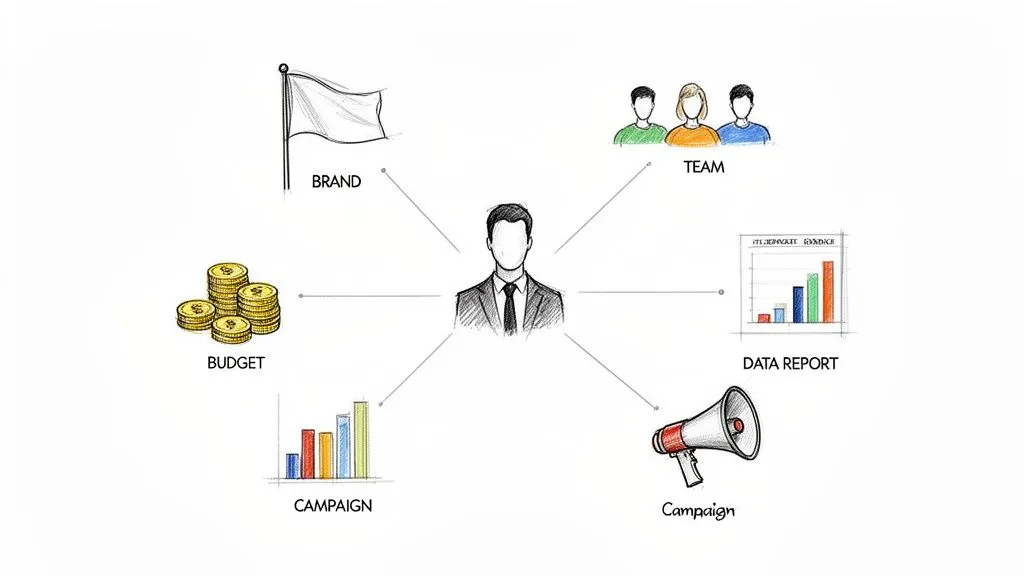
Forget vague job descriptions. Your job is to own the "why" before the team tackles the "how." You don't just approve campaigns. You build the engine that makes growth possible.
This means translating business objectives into a clear marketing strategy. It's a role of high accountability. You own the budget. You answer for the results. You steer the ship.
Core Responsibilities Unpacked
An executive's day isn't a checklist. It's a balancing act between strategy, leadership, and money.
You are responsible for:
- Strategic Planning: Defining target audiences, setting goals, and deciding which channels and messages will actually work.
- Budget Ownership: Allocating funds to maximize return on investment (ROI). This isn't just spending money; it's investing it.
- Team Leadership: Hiring, mentoring, and guiding a team of specialists to execute the strategy.
- Performance Analysis: Using data to measure what's working, report KPIs, and pivot when it's not.
- Brand Stewardship: Making sure every marketing effort reinforces the company's brand and market position.
This isn't a field for the faint of heart. But it's buzzing with opportunity. The US industry alone is valued at $410.66 billion and is projected to hit $1,189.5 billion by 2033. Job growth for marketing managers is set to rise 6% from 2024 to 2034, outpacing the average. You can dive deeper into marketing industry stats and trends.
What "Executive" Really Means
The term is confusing. A Manager, a Director, and a VP of Marketing are all executives. Their scope is vastly different. Think of it like a camera lens.
A Manager uses a macro lens, focusing on specific campaigns. A Director uses a standard lens, framing how campaigns fit together. A VP uses a wide-angle lens, capturing the entire market and plotting long-term strategy.
As you move up, your focus shifts from doing the work to directing the work. Less tactics, more impact.
Mapping Your Marketing Executive Career Path
There isn’t one straight ladder. Your career isn’t a checklist. It’s a map you draw yourself. You start executing tasks, then you orchestrate campaigns, and eventually, you define the entire strategy.
The journey is a shift in perspective. Early on, you’re rewarded for mastering a skill. Later, you’re valued for connecting those skills to business outcomes and leading others.
The Foundational Years: From Specialist to Generalist
Most marketing careers start with a specialism. SEO, paid ads, content. This is where you learn the craft and prove you can deliver results.
This stage is about depth. You become an expert. You have to understand how the engine works before you can lead the department.
But staying a specialist is a career-limiting move. The first jump is to generalist, often at the Marketing Manager level. Your focus must broaden from one channel to a multi-channel strategy.
A specialist is a world-class violinist. A manager is the conductor. They might not play every instrument perfectly, but they know how to make them play together.
This is where many people get stuck. It demands new skills. Not just managing projects, but managing people, budgets, and relationships.
The Leap: From Managing Projects to Leading People
The next pivot is from managing work to leading people. This is the real start of your executive path. Your success is no longer measured by your output, but by your team's.
This shift involves:
- Delegating Effectively: Trusting your team while you focus on the bigger picture. It’s harder than it sounds.
- Mentoring Talent: Actively developing your team. Turning good marketers into great ones.
- Setting Clear Goals: Translating company objectives into clear, measurable goals for your team.
- Taking Accountability: Owning your team's failures and giving them credit for their wins.
Many strong individual contributors fail here. They can't let go of the tactical work. They micromanage. A true executive learns to scale their impact through others.
Charting the Course to the C-Suite
In Director and VP roles, your focus becomes almost entirely strategic. You look 12-24 months into the future. You’re paid to anticipate market shifts, spot new opportunities, and align marketing with the company's vision.
It’s a big shift from worrying about next week’s campaign.
Marketing Career Progression From Specialist to Executive
This table maps the common journey. Notice the shift from doing to enabling to setting direction.
| Level | Typical Roles | Core Focus | Key Skills Developed |
|---|---|---|---|
| Individual Contributor | Marketing Coordinator, SEO Specialist, Content Writer | Tactical Execution & Skill Mastery | Channel-specific expertise, project management, data analysis. |
| Manager | Marketing Manager, Digital Marketing Manager | Campaign & Team Management | Budgeting, cross-functional collaboration, people management. |
| Director | Director of Marketing, Director of Growth | Functional Strategy & Leadership | P&L responsibility, long-term planning, team development. |
| Executive | VP of Marketing, Chief Marketing Officer (CMO) | Business Strategy & Vision | Market positioning, executive communication, brand stewardship. |
Each step requires you to let go of old responsibilities to make room for new ones. The skills that made you a great specialist won't make you a great VP.
What Does a Marketing Executive Get Paid?
Let's talk money. Your pay reflects the value you bring—your ability to drive growth and solve expensive problems.
Think of it less as a salary and more as a compensation package that grows with your responsibility. Pay swings based on location, industry, and the wins you've put on the board. This is a realistic map for your next negotiation.
Breaking Down the Numbers
Your total earnings are rarely just a base salary. As an executive, your pay is a mix of base pay, performance bonuses, and sometimes, equity.
The higher you climb, the more your compensation is tied to performance. Revenue growth, market share, profit. This is a big shift from junior roles where you're paid for tasks. As an executive, you get paid for outcomes. When the business wins, you win.
This progression is standard. Responsibilities and rewards scale together.
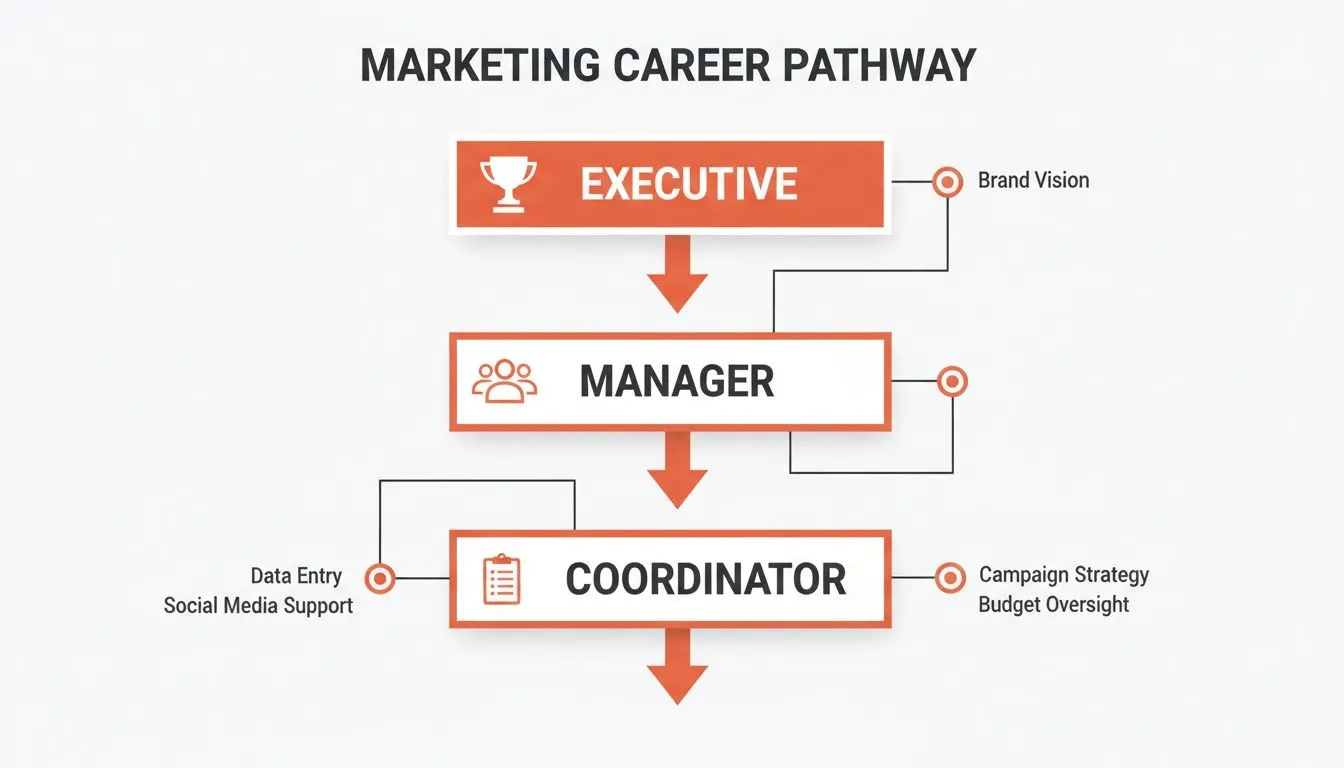
Each step up brings a jump in strategic oversight and financial reward.
Salary Benchmarks at Different Career Stages
The data is clear. According to PayScale.com, the average salary for a Global Marketing Manager is $101,615 a year. Early-career executives (1-4 years) pull in around $87,686, while mid-career pros (5-9 years) see that jump to $98,769.
But that's just the average. The ceiling is much higher, with top earners hitting $145,000. In major US markets, the numbers get better. The U.S. Bureau of Labor Statistics reports the median pay for marketing managers was $161,030. These roles can be lucrative.
The truth is simple: strategic career moves pay off. A promotion isn't just a new title; it's a major financial leap.
Your salary is the market's feedback on your ability to solve expensive problems. You're paid for your judgment, not your time.
What Pushes Your Paycheck Higher?
A few factors heavily influence your compensation. Knowing them is key.
- Industry: A marketing exec in SaaS or fintech will almost always earn more than one in non-profit.
- Company Size: Leading marketing for a Fortune 500 company pays more than a 50-person startup.
- Location: Salaries in hubs like San Francisco or New York are much higher. A similar role in a smaller city pays less.
- Specialized Skills: Deep expertise in analytics, data science, or AI-driven personalization commands a premium.
Your compensation tells a story. It reflects your influence, the problems you solve, and your impact on the bottom line. Plan your career to increase that impact.
The Skills That Define Top Marketing Executives

Your degree gets you in the door. Your skills get you promoted. Climbing the ladder isn’t about collecting certifications; it’s about mastering the right blend of abilities.
Many professionals obsess over technical stuff. Tools are important, but they're just the price of entry. True executive presence is where hard data meets human insight.
The Hard Skills You Cannot Ignore
Think of hard skills as the engine. They're the functional competencies you need to get anything done.
These are non-negotiable:
- Data Analysis and Interpretation: You don't have to be a data scientist, but you must see the story in the dashboard. Understand KPIs and attribution to make informed decisions.
- P&L Management: Executives speak the language of the CFO. You have to create, manage, and defend a budget, tying every dollar to revenue.
- SEO and SEM Strategy: You won't be in the weeds, but you need a deep strategic grasp of organic and paid search. You need to know what questions to ask.
- Marketing Automation and CRM: Understanding tools like HubSpot, Marketo, or Salesforce is crucial for scaling your efforts.
These skills are the bedrock of any operation. But they're only half the story. Learn more about the right balance in our guide on soft skills vs. hard skills.
The Soft Skills That Truly Set You Apart
As you climb higher, your success is less about what you can do and more about what you can inspire others to do. This is where soft skills become exponentially more valuable.
Your hard skills get you to the table. Your soft skills determine whether you'll be invited to lead it.
Top executives master crucial soft skills. For instance, learning effective time management strategies is key to handling immense responsibility without burnout.
Where Leadership and Strategy Collide
The most impactful soft skills are about influence and foresight. They're what allow you to navigate office politics and steer the company.
Focus on developing these:
- Strategic Thinking: The ability to see the bigger picture. It’s connecting market trends, competitor moves, and your team's capabilities to chart a course for the future.
- Leadership and Influence: Real leadership isn't authority; it's inspiration. Articulate a compelling vision that gets everyone rowing in the same direction.
- Negotiation and Communication: You are constantly negotiating. For budgets, for resources, with partners. Clear, persuasive communication is non-negotiable.
- Adaptability and Resilience: The market changes. Fast. A campaign will fail. A competitor will make a surprise move. Your ability to stay calm, learn, and pivot is what defines an executive.
The data backs this up. Job growth is projected at 6% for marketing managers, but 13% for analysts. With demand surging in some areas while senior roles face cuts, your ability to tell a compelling story about your impact makes you stand out. Your soft skills make your technical expertise valuable.
How to Accelerate Your Marketing Career
Waiting for a promotion is a slow way to build a career. It’s a passive strategy in a game that rewards action. To fast-track your career, stop waiting for permission.
Forget just doing your job well. That’s the baseline. Real momentum comes from proving your value in ways that show up on the company’s bottom line. Be proactive, not just productive.
Go Hunt for High-Impact Projects
Your day job keeps the lights on. High-impact projects get you promoted.
These are the initiatives that are visible to leadership, solve a painful problem, or open a new revenue stream. They’re often messy and risky. That's why nobody wants them, and why they're a huge opportunity.
Actively seek these out. Talk to leaders in other departments. Ask about their biggest headaches. Look for gaps in the strategy and pitch a pilot project.
Your career is a product. You are its manager. Create a roadmap of experiences to get to the next level. Waiting for assignments is like letting someone else build your product for you.
Instead of waiting for an opportunity, show up with a plan. Frame it in terms of business impact: "I have an idea that could cut our customer acquisition cost by 10% next quarter. Can I have two weeks to build a proof of concept?"
That kind of initiative gets you noticed. It shows you think like an owner, not an employee.
Stop Networking and Start Building Relationships
Let's be honest. "Networking" is transactional and fake. Stop doing it. Focus on building genuine relationships with people you respect.
This isn’t about collecting LinkedIn contacts. It's about finding peers you can learn from and mentors who have already walked the path. Buy them coffee. Ask smart questions. Offer to help them. Give value before you ask for anything.
Strong relationships are your career safety net and launchpad. The best opportunities come from a quiet recommendation from someone who trusts you. Our guide on networking events in Singapore has insights that apply anywhere.
Find Mentors Who Tell You the Hard Truth
A good mentor doesn’t just give advice; they challenge your thinking. They’ve already made the mistakes you’re about to make. Find someone a few steps ahead of you whose judgment you trust.
Don’t send an awkward "Will you be my mentor?" request. Start small. Reach out with a specific, thoughtful question. Keep it concise and respect their time. If the connection is right, a mentorship will grow naturally.
The right mentor gives you the unvarnished feedback you won't get from your boss. That kind of candid insight is priceless.
Crafting a Resume That Tells Your Story
You’ve done impressive work. But it doesn't matter if your resume's story is boring.
Most resumes are just lists of tasks. "Managed social media." "Oversaw campaign budgets." This tells a recruiter what you did, not why it mattered. It’s the difference between saying you played in a game and telling them you scored the winning goal.
A great marketing executive career is built on storytelling. That story starts with your resume.
From Tasks to Triumphs
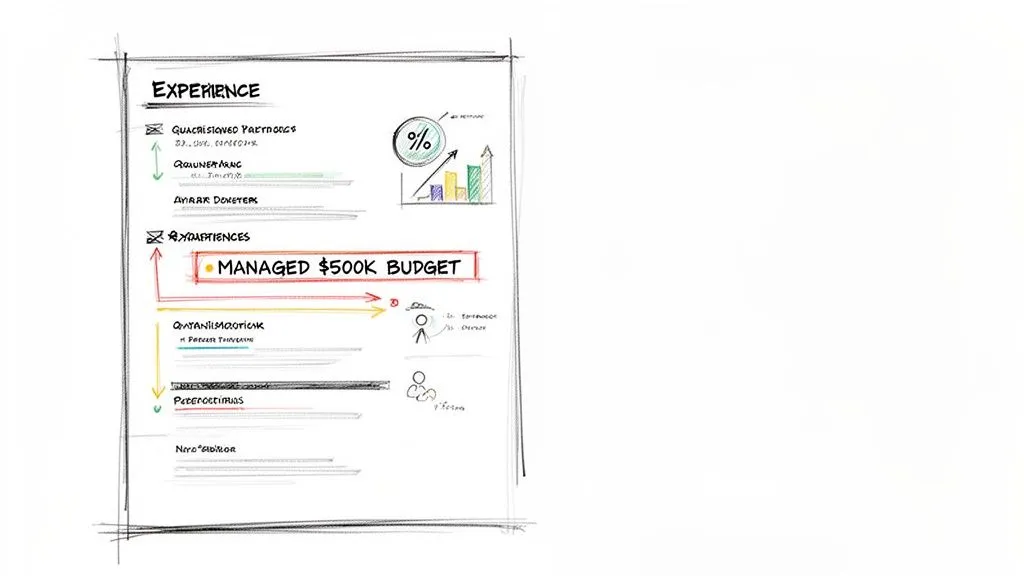
The biggest mistake professionals make is describing their job instead of demonstrating their impact. You have to translate responsibilities into quantifiable achievements.
Look at the difference:
- Before (The Task): "Managed a budget for paid ad campaigns."
- After (The Triumph): "Managed a $500k paid media budget, reallocating spend to reduce customer acquisition cost by 15% in six months."
The second version tells a story of strategic thinking and measurable results. It proves you don't just spend money—you invest it. This is the language of the C-suite.
Uncovering Your Impact Story
This is where most people get stuck. It’s hard to see your own wins in the day-to-day grind. Filling out a generic resume template is soul-crushing. You’re forcing your unique career into someone else’s boring boxes.
We built StoryCV to fix this. We're a Digital Resume Writer, not a template library. We interview you with smart questions to uncover those hidden metrics and connect your work to business goals.
Your resume isn't a historical document. It's a marketing document for your future, designed to sell one product: you. It should be focused, compelling, and built around a story of impact.
This narrative approach is what hiring managers want. They don't need another list of keywords. They need proof you can solve their problems. For more, check our deep dive on the perfect resume narrative.
Carry the Story Into the Interview
Your resume gets you the interview. Your storytelling gets you the job.
In the room, bring those impact statements to life. Use the STAR method (Situation, Task, Action, Result). Don't just recite what you did; talk about the why behind your decisions. Articulate your strategic thinking.
Finally, your digital presence tells a story, too. Optimize your LinkedIn profile for career growth. A recruiter will look you up. Your resume, interview, and online brand must all tell the same powerful story.
Common Questions About a Marketing Executive Career
Let's cut through the noise. Here are straight answers to common questions.
How Long Does It Take to Become a Marketing Executive?
There's no magic number. Most people land a director or VP role after 10-15 years of solid experience.
Your path depends on your performance, the chances you take, and how well you shift from doing to leading. A "squiggly" career with diverse experiences can sometimes get you there faster.
Is a Marketing Degree Necessary?
It helps, but it’s not a deal-breaker. Top executives have degrees in literature, finance, or psychology.
What matters is your track record. Can you drive growth? Do you understand customers? Can you lead a team? A portfolio of results beats a piece of paper.
What Is the Biggest Challenge in This Role?
Moving from doing to leading.
Talented marketers get stuck at the manager level because they can't let go of tactical work. An executive's job is to set the vision, empower their team, and own the results. Your success is measured by your team's output, not your own.
The real job of an executive is not to have all the answers, but to build a team that can find them.
How Is AI Changing the Marketing Executive Career?
AI is taking over routine tasks like basic copywriting and data analysis. This is great news. It frees you up for high-level strategy and creative thinking.
Your job won't be replaced by AI. But it will be taken by someone who knows how to use it. Getting good with AI for predictive analytics and personalization is a core skill for any modern leader.
You've done great work. The problem is articulating it. StoryCV is a Digital Resume Writer that interviews you to uncover your impact, turning your experience into a powerful story that gets you hired. Stop staring at a blank page.
Get started for free at story.cv