You're not choosing between two interchangeable resume apps. You're choosing between a template builder and a narrative writer, and that's a different problem disguised as the same search. MyPerfectResume helps when you already know what you did and just need it formatted cleanly. StoryCV helps when the hard part is figuring out what belongs on the page.
| Criterion | StoryCV | MyPerfectResume |
|---|---|---|
| Workflow | Interview first, then writes | Template first, then you fill it |
| Content depth | Pulls out context, impact, and story | Helps you format the content you already know |
| ATS handling | Structured text plus resume output | Clean, standard resume formatting |
| Pricing posture | One-time purchase model | Subscription-style posture |
| Privacy stance | Focused on selling the document, not your data | Builder model centered on uploaded content |
If you already know your career arc, the choice is easy. If you don't, a template just gives you a prettier version of the same confusion.
Two Tools That Solve Different Problems
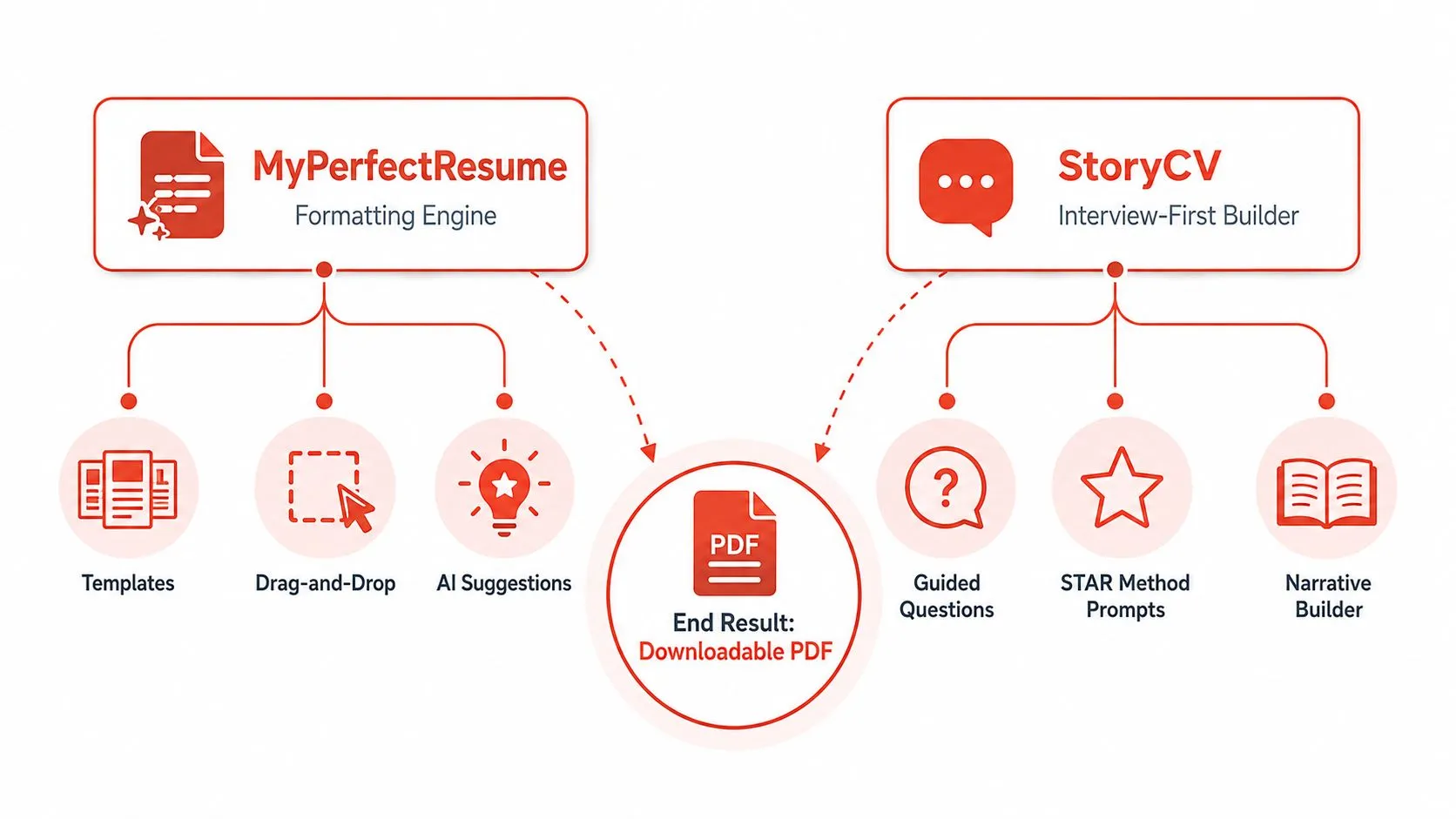
Calling StoryCV vs MyPerfectResume a fair fight misses the point. They aren't aiming at the same bottleneck. MyPerfectResume solves presentation. StoryCV solves articulation.
What each tool is actually doing
A MyPerfectResume session is basically, “Here's a structure, now drop your content into it.” That's useful if you've got a LinkedIn export, an old resume, or a clear sense of your accomplishments. You can make a document look professional without learning design, spacing, or section hierarchy. Its history also shows a long product evolution, from the company's beginnings in 2003 to its flagship U.S. launch in 2012, plus later ATS and AI additions in 2023 and 2025, and the company says its tools have helped over 56 million people make resumes and job search. MyPerfectResume's company story
StoryCV flips the order. It starts with the story, then turns that into a resume. That matters for people who know they've done good work but can't compress it into bullets without flattening the point. If your problem is “I have the experience, but I can't make it sound like anything,” a template won't rescue you.
Practical rule: if you already know the strongest three things on your resume, format them. If you're still hunting for the strongest three things, interview yourself first.
For a cleaner breakdown of why writing-first and building-first tools behave differently, the comparison in this AI resume writer vs human writer guide is closer to the core issue than most “best resume builder” lists.
The right decision criteria are simple. Look at content depth, workflow, ATS handling, pricing posture, and privacy. Ignore the shiny stuff. Template color is not the decision.
What MyPerfectResume Does Well
If you already have the substance, MyPerfectResume gets you to a presentable resume fast. It solves the template problem, not the writing problem. Pick a layout, drop in your sections, paste your bullets, and the tool handles the structure.
Clean structure without design homework
That is the value. You do not have to think about alignment, font hierarchy, or whether the page looks awkward. You also do not need to turn your resume into a personal brand exercise. A plain, professional format is enough for a lot of job seekers.

It also helps with basic ATS parsing. Standard headings and a controlled layout are easier for software to read than a messy design. That does not make the content strong on its own. It just lowers the odds of the document getting mangled on upload.
What it leaves to you
The gap is obvious. A template can make “managed a team of 5” look tidy, but it cannot tell you what changed because you managed that team. Did the project ship faster? Did turnover improve? Did handoffs stop breaking? You have to supply that answer.
If you already have the message, MyPerfectResume packages it well. If you do not, it packages silence.
That boundary is the point. MyPerfectResume is for people who want a fast, structured, submittable resume and do not want the tool doing the hard thinking for them. See our full MyPerfectResume review for a closer look at its templates and pricing. MyPerfectResume's resume summary guidance also makes the expectation clear. It wants concise, job-focused input, which is why it fits straightforward career histories better than messy ones.
What StoryCV Does Differently
StoryCV starts with the sentence most builders skip, “What happened because you were there?” That's the core difference. It doesn't ask you to decorate a blank template first. It asks you to explain the work until the value shows up.
Interview first, resume second
A good StoryCV session feels less like filling forms and more like being pressed for specifics by someone who cares about the outcome. If you say you led a migration, the next question should be about scope, constraint, decision, and result. If you say you managed a team, it should ask what changed because that team was under your lead.
That is the gap MyPerfectResume can't cross. A builder can organize content. It can't surface content that you never articulated. StoryCV is built for the part where the answer is still buried under memory, jargon, and habit.
For users with nonlinear careers, that matters a lot. A career changer, a returner, or a senior IC with a drawer full of buried wins doesn't need prettier bullets first. They need translation. The tool's job is to pull out the useful story before the sentence gets frozen into a template.
The bullet gets sharper
The concrete contrast is simple. A template may leave you with something like, “Led migration project for internal platform, improving system performance.” That's technically fine and completely forgettable.
A guided interview can push toward a stronger version because it asks for the missing details. Now the bullet has a reason to exist. It's not just about what you did. It's about what changed, what was at stake, and why the reader should care.
The company's own story page shows a product path that keeps leaning into structured help, from early career tests to later resume and AI features, which fits the broader idea that the product is about shaping the content, not just styling it. StoryCV's homepage frames that workflow around interview-led writing rather than template assembly.
Side by Side on the Five Things That Matter
The choice gets practical. Strip away the marketing, and the decision comes down to five things: workflow, content depth, ATS handling, pricing posture, and privacy stance. Everything else is noise.
| Criterion | StoryCV | MyPerfectResume |
|---|---|---|
| Workflow | Interview-first, then draft | Template-first, then fill |
| Content depth | Pulls out scope, stakes, and impact | Leaves most content decisions to you |
| ATS handling | Structured output aimed at readability | Standard formatting built for parsing |
| Pricing posture | One-time purchase model | Subscription-style model |
| Privacy stance | Focuses on your narrative as the product | Builder model centers on uploaded resume content |
Workflow and content depth
MyPerfectResume is the faster path if you already know your story. It gives you the shell and lets you move. StoryCV is slower up front, but that's the point. If you're unsure what to say, speed just gets you to a generic resume faster. That usually means more rewriting later.
Content depth is where the split gets obvious. One tool helps you arrange facts. The other helps you find the facts worth arranging. That's why people comparing resume builders should stop asking which one is “better” and ask which one matches the job they need done.
ATS handling, pricing, and privacy
On ATS handling, both can produce readable resumes, but they get there differently. MyPerfectResume prioritizes the familiar document structure ATS systems expect. StoryCV focuses on creating stronger narrative content that still exports into a usable resume. Those aren't the same advantage.
For pricing, the posture matters. MyPerfectResume sits in a subscription-shaped world, so the checkout number can be less straightforward than it looks. StoryCV's model is cleaner if you hate recurring software charges.
Privacy matters too, especially if you're past the early-career stage and don't want every draft sitting in a builder forever. When the product is your story, you should care who gets access to it.
If you want another neutral comparison frame, the Eztrackr compare page is a useful place to sanity-check how different resume products position themselves before you commit.
Which Reader Each Tool Is Built For
Pick the tool based on your actual bottleneck, not your ego. You already know the answer. You just want permission to stop overthinking it.
Use MyPerfectResume when the resume is already there
If you're a recent graduate with a straightforward internship trail, MyPerfectResume makes sense. So does it for a contractor who needs a clean PDF by tomorrow, or for anyone whose biggest problem is getting the page to look professional without fussing with layout. If the content is basically there, a builder is efficient.
That's also true if you've already done the hard reflection somewhere else, maybe in a prior resume, a performance review, or a long conversation with yourself. In that case, you don't need a coach. You need a formatter.
Use StoryCV when the story is still foggy
Career changers belong in StoryCV because titles rarely map cleanly across industries. Returners do too, because a gap doesn't explain itself. Senior professionals with solid results they can't quite articulate fit here as well, because the value is often buried under routine and repetition.
Decision rule: if your bottleneck is what to say, use StoryCV. If your bottleneck is how it looks, use MyPerfectResume.
That's the whole thing. A template can't invent context, and an interview can't fix messy formatting by itself. Match the tool to the problem and stop pretending one app should do both jobs equally well.
The Honest Verdict and What to Do Next
There isn't a universal winner in StoryCV vs MyPerfectResume because they don't solve the same upstream problem. If your resume is structurally fine but sounds generic, a builder won't fix it. Rearranging the same weak sentences just gives you a cleaner weak resume.
If your experience is rich but the page is a mess, an interview-led writer won't save you from poor structure. You still need a builder when the issue is layout, section order, or presentation. That's the cleanest way to think about it.
Most readers searching this comparison already know which side of that line they're on. Trust that instinct. If you're still unsure, take one role you want and answer five direct prompts about it. If the resulting bullet is sharper than what you currently have, the bottleneck was content. If it isn't, the bottleneck is format.
Neither tool is a full career system. They won't finish your cover letter, fix your LinkedIn, or magically package your portfolio. You'll still need to do that work yourself.
If your problem is that you've done real work but can't get the story out cleanly, StoryCV is built for that exact bottleneck. If you want to see whether interview-led writing beats your current template habit, visit StoryCV and test one role you care about.