
Most account executive resume advice tells you to add more keywords. That's backwards. A resume gets interviews when it proves you can create revenue, not when it repeats “relationship building” beside a long list of software.
A strong account executive resume is a revenue-impact document. It should make your target segment, sales motion, commercial scope, and results obvious before a hiring manager has to interpret anything. That standard matters in a market where account executive compensation varies widely. RepVue's 2026 account executive data reports a $100,000 median base salary, $190,000 median on-target earnings, and $469,312 top-performer earning potential, while reporting that only 42.7% of account executives attained quota. The figures explain why employers look for evidence of quota attainment, closed-won revenue, pipeline contribution, and deal quality.
Why Most Account Executive Resumes Read Like Job Descriptions
Most AEs write the resume they were told to write, not the resume a sales leader needs to read. They copy responsibilities from the job posting, add a few tools, and describe activities such as managing accounts, conducting demos, and collaborating with stakeholders. That document confirms you held a sales job. It doesn't prove you moved a number.
A hiring manager wants a faster answer:
What changed because you were there?
“Managed a full-cycle sales process” is a duty. “Closed new business across a defined segment while managing the sales process from discovery through negotiation” is still mostly a duty unless the bullet shows the commercial result. The useful evidence might be quota attainment, average contract value, pipeline created, sales-cycle movement, or expansion revenue.
The labor market makes this distinction more important. The U.S. Bureau of Labor Statistics data summarized in this account executive career guide reports a May 2025 median annual wage of $69,990 for sales representatives of services, with wages ranging from $37,980 at the 10th percentile to $148,840 at the 90th percentile. It also reports projected employment growth of 3.1% from 2024 to 2034 and about 123,000 openings per year. Employers can compare many similarly titled sales professionals, so your resume has to show why your performance belongs near the stronger end of that range.
Taking the easier route usually makes your resume weak
Responsibility statements feel safe because they don't force you to claim ownership. Numbers do. Candidates often remember the territory, the product, and the customer type, but not the exact result. That's a research problem, not a writing excuse.
Reconstruct the story from CRM records, forecast documents, compensation plans, deal reviews, and manager feedback. If you're evaluating roles, study the target segment and sales motion, then choose evidence that shows you can operate in that environment.
The rule is simple: every meaningful bullet should connect your action to a business outcome. If a line could appear unchanged on ten other AE resumes, it probably isn't doing enough work.
The Layout That Impresses Before Anyone Reads a Bullet
A good account executive resume has a clear visual hierarchy. The reader shouldn't have to search for your title, segment, or strongest result. Use reverse chronology, plain formatting, and enough space for evidence.
Start with a sharp header
Put your name first, followed by a one-line title specific to the target role. “Enterprise Account Executive, B2B SaaS” is more useful than “Sales Professional.” Add your city, remote or relocation status, phone number, email, and a LinkedIn URL that matches the resume.
Below that, write a three-sentence summary:
-
State your target segment and years of experience.
-
Name your sales motion or relevant commercial strength.
-
Lead with one signature metric.
For example: “Account executive with experience selling complex B2B solutions to enterprise buyers. Owns discovery, multi-stakeholder negotiation, forecasting, and close across new business and expansion motions. Known for exceeding quota and building durable pipeline in competitive territories.” Replace general language with your actual evidence wherever you have it.
Make experience easy to inspect
Each role should show the company, title, location if relevant, and dates in a consistent format. Add a short context line before the bullets. Explain the segment, product category, territory, or sales motion so the numbers have meaning.
Every experience entry should visibly contain:
-
Quota: State attainment and target context when available.
-
Segment: Identify SMB, mid-market, enterprise, vertical, or buyer type.
-
Deal size band: Use the commercial scale you can support.
-
Standout result: Put the most persuasive number first.
The sales resume guidance from ResumeBold recommends a metric-first hierarchy that includes quota percentage, ACV, win rate, pipeline coverage, ARR or MRR, and conversion rates. Use the measures that fit your role. Don't force SaaS language onto a business where it doesn't belong.
| Section | Purpose | Must Visibly Contain |
|---|---|---|
| Header | Identify you and your target | Name, target title, location, contact details |
| Summary | Position your commercial profile | Segment, experience, sales motion, signature metric |
| Experience | Prove performance | Scope, quota, deal size, outcomes |
| Skills | Support keyword matching | Relevant tools, methods, and sales capabilities |
| Education and certifications | Add context and credibility | Relevant degree, certifications, and training |
| Tools | Show operational fluency | CRM, engagement, forecasting, and sales systems |
For most candidates, one page is appropriate for 0 to 5 years of experience, while two pages can make sense at 6 or more years. Don't delete quantified achievements to force senior experience into one page.
The Five Numbers That Actually Move an Account Executive Resume
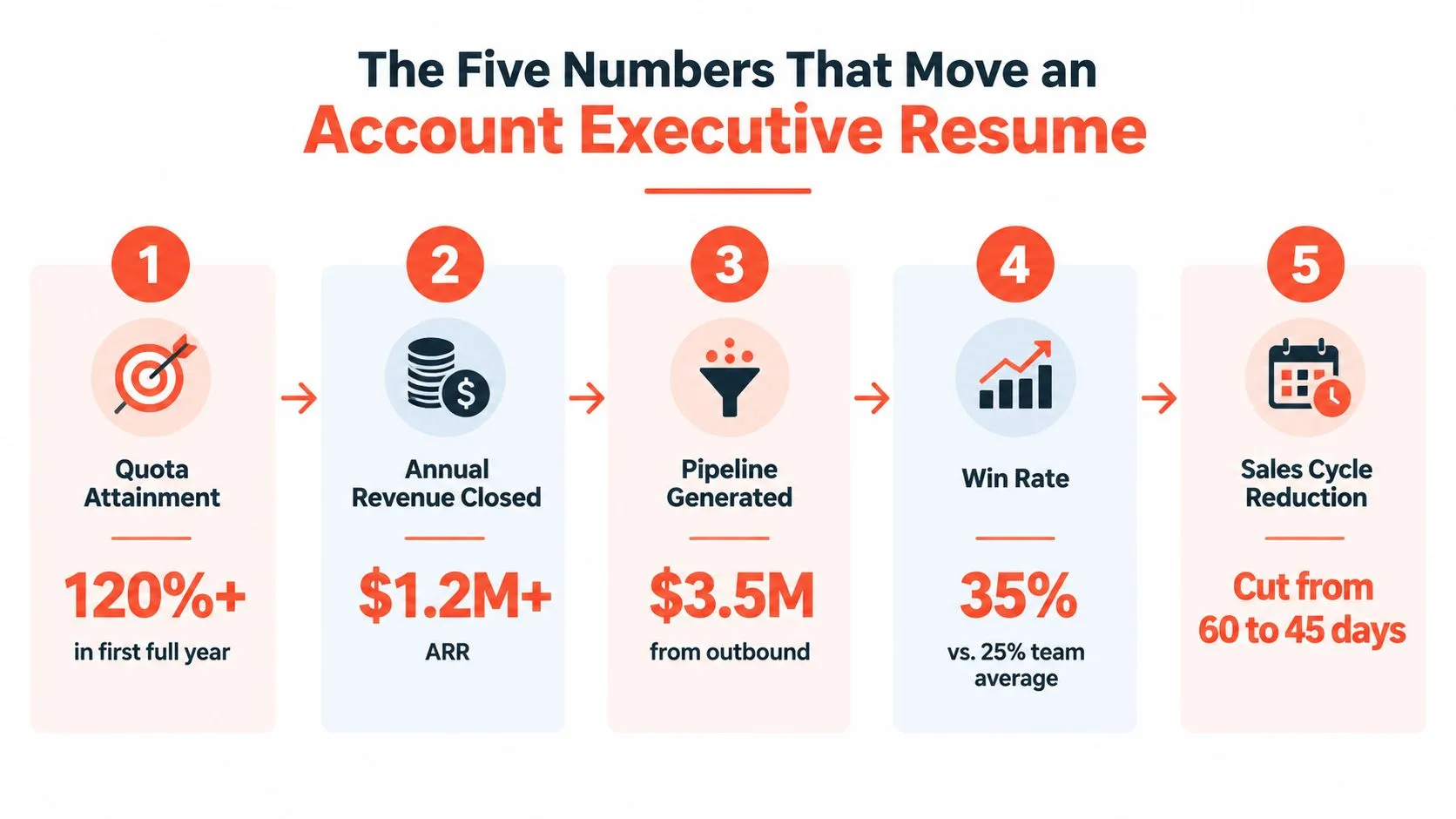
Metrics don't belong on a resume because numbers look impressive. They belong because they let a hiring manager compare your commercial scope with the role's expectations. Industry resume guidance consistently points toward quota attainment, ACV, win rate, pipeline, recurring revenue, and conversion evidence.
1. Quota attainment with context
Quota attainment is the cleanest signal of performance, but context matters. Show whether the result came during a ramp period, a full year, a new territory, or a mature book. “Exceeded quota” says little. “Exceeded annual quota while owning a mid-market territory” gives the reader a frame.
2. Annual revenue closed and deal-size band
Closed revenue establishes scale. Deal-size context shows whether you sold transactional business, strategic contracts, or a mix. If exact figures aren't available, use an honest range rather than a false precision.
3. Sales-cycle length
Cycle length signals operating rhythm. A shorter cycle can demonstrate process control in the right motion. A longer cycle can show patience, stakeholder management, and enterprise discipline. Don't present speed as automatically better. Present it as evidence of the sales environment you know.
4. Win rate against named competition
Win rate becomes more credible when you name the competitive context. “Improved win rate” is vague. “Won competitive evaluations against established vendors” explains the difficulty, then the percentage can carry the proof when you have it.
5. New logos versus expansion and renewal mix
New-logo selling and account growth require different muscles. Identify whether your results came from prospecting, net-new acquisition, renewal protection, upsell, cross-sell, or a combination. That distinction helps a hiring manager match your background to the open territory.
If your history is fragmented, recover the evidence methodically. Pull CRM exports, review forecast records, ask former managers for written confirmation, and separate your contribution from the team's result. On shared accounts, attribute deals proportionally and explain the role you owned. When exact figures remain unavailable, use ranges and label what the range represents.
For a practical framework on gathering and presenting metrics, use StoryCV's guide to metrics in a resume. The objective isn't to decorate the page. It's to create a defensible commercial record.
The supplied examples often used in sales-resume discussions, such as specific attainment, ARR, pipeline, win-rate, and cycle-time figures, are useful formats only when they reflect your own verified history. Never borrow someone else's numbers.
The sales market rewards evidence, but evidence has to be attributable. A smaller true result beats a larger number you can't explain in an interview.
Turning Past Duties Into Proof of Revenue
A strong bullet has four parts: action, scope, mechanic, and result. The action shows ownership. Scope identifies the territory, segment, or buyer. The mechanic explains how you sold. The result connects the work to revenue, pipeline, velocity, retention, or another business outcome.
Start with the verb, but don't stop there. “Managed,” “supported,” and “worked with” often hide the actual contribution. Replace team language with ownership language when the facts support it. You didn't merely participate in a deal if you owned discovery, built the business case, negotiated terms, and closed it.
| Role Archetype | Weak Bullet Before | Metrics-Driven Bullet After |
|---|---|---|
| SDR-promoted AE | Promoted to AE after performing well as an SDR and learning the sales process. | Earned promotion into a full-cycle AE role after building qualified pipeline, converting target accounts, and demonstrating ownership beyond prospecting. |
| Full-cycle SMB rep | Managed SMB accounts, ran demos, and closed new business. | Owned discovery, demonstration, negotiation, and close for SMB buyers, connecting sales activity to quota attainment and closed-won revenue. |
| Renewal and expansion rep | Maintained customer relationships and looked for upsell opportunities. | Protected renewals and identified expansion paths across existing accounts, separating retention performance from incremental revenue created. |
| Senior enterprise AE | Sold complex solutions to large companies and worked with executives. | Led enterprise evaluations involving executive sponsors, technical stakeholders, legal, and procurement, then connected deal complexity to ACV, sales-cycle length, and closed revenue. |
Rewrite the evidence you actually have
An SDR moving into an AE role may not have a long record of individual closed revenue. Don't invent one. Show the transition: sourced pipeline, qualified opportunities, promotion rationale, new-business ownership, and the point at which you took responsibility for closing.
A full-cycle SMB seller should emphasize repeatability. Name the segment, sales process, average contract value when available, and quota outcome. A renewal and expansion specialist shouldn't disguise farming work as hunting. Make the commercial motion clear, then show retention, expansion, or churn-related results where documented.
Senior enterprise sellers need scope, not chest beating. “Sold to executives” is weak because most enterprise sellers say it. Show the buying committee, procurement path, solution complexity, and commercial result. Account executive bullet points is recommended to have concrete measures such as revenue growth, deal size, win rate, renewal rate, upsell, cross-sell, ARR, and ACV.
Ownership test: If you couldn't explain exactly what you did in the deal review, don't claim the entire outcome.
Use the bullet-point framework from StoryCV to pressure-test each line. A bullet should answer what you owned, how you operated, and what changed. One defensible number can replace several lines of soft skills.
If you want to understand the difference between ordinary sales activity and professional closing craft, compare your language with how firms describe closers. The useful lesson isn't to copy the vocabulary. It's to make ownership and commercial consequence visible.
Passing the Scan Without Sounding Like a Robot
The ATS isn't judging your charisma. It is trying to identify fields, terms, and relationships in your document before a recruiter reads it. Recent resume-hiring data reports that about 97.8% of Fortune 500 companies use an ATS, recruiters spend roughly 5 to 11 seconds on an initial scan, and around 75% of resumes are rejected before human review. Those figures make parseability a practical requirement, not a design preference.
Use labels software recognizes
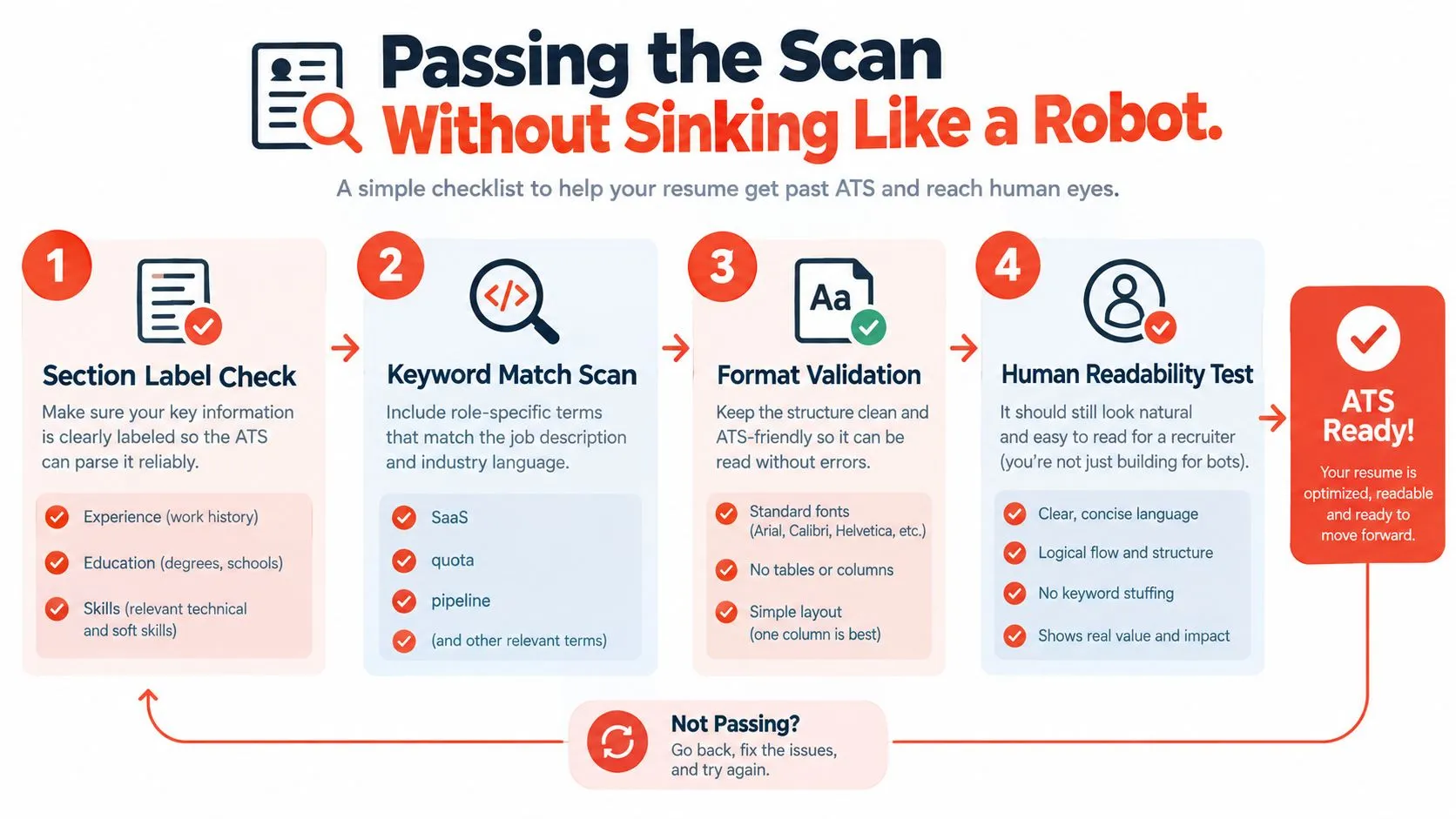
Use standard headings such as Summary, Experience, Education, Skills, and Certifications. Workday, Greenhouse, Lever, and iCIMS can map conventional labels more reliably than creative alternatives such as “Where I've Made an Impact.” A clever heading adds personality at the exact point where the parser wants a predictable field.
Mirror the job description's language naturally. If the posting asks for quota attainment, pipeline management, Salesforce, MEDDIC, forecasting, or enterprise sales, use the terms where they accurately describe your experience. Place the most relevant terms in the headline, summary, experience bullets, and a concise core competencies line. Keyword stuffing makes the document noisy and can expose gaps during the interview.
Protect the text layer
Use a clean, single-column layout with a standard font. Avoid tables, text boxes, headers and footers for essential information, multi-column layouts, decorative icons, and embedded images. These elements can disrupt extraction or place important text in the wrong reading order.
Choose the file format based on the portal. A text-based PDF usually preserves the intended layout when the application system handles PDFs well. Use a .docx when the portal specifically requests it or when its parsing behavior is more reliable with editable documents. Open the final file, select the text, and copy it into a plain-text document. If the order breaks, the ATS may struggle too.
For a fuller plain-text approach, see StoryCV's guide to optimizing a resume for ATS. The goal isn't to sound mechanical. It's to make your actual story easy for both systems and people to find.
Tailoring the Same Career for Different Seniority Tiers
Your career doesn't change when the target title changes. The evidence you promote should. A resume aimed at an individual contributor AE role should make personal production obvious. An enterprise role needs commercial scale and stakeholder complexity. A first-line manager role needs team outcomes and coaching impact.
Individual contributor AE
Lead with quota attainment, deal count, pipeline ownership, and the sales motion you personally ran. Promote bullets that show prospecting, discovery, negotiation, and close. Your summary should position you as a reliable producer who can own a territory, not as a general relationship manager.
Senior enterprise AE
Move ACV, strategic account scope, multi-stakeholder complexity, and forecast discipline higher on the page. Explain whether you managed legal, procurement, finance, security, or executive approval. Don't bury complex deal work under generic “managed key accounts” language.
First-line sales manager
Shift the center of gravity from your personal deals to team quota, ramp execution, coaching, forecast quality, and process improvement. If you still carried a number, include it, but don't let an individual win obscure the leadership evidence the role requires.
| Target Tier | Lead Metric | Promoted Bullets Focus | Summary Framing |
|---|---|---|---|
| Individual contributor AE | Attainment and deal production | Territory ownership, pipeline, discovery, close | Full-cycle seller for the target segment |
| Senior enterprise AE | ACV and deal complexity | Executive alignment, procurement, strategic accounts | Complex seller who builds consensus and protects forecast quality |
| First-line sales leader | Team quota, ramp, coaching | Rep development, inspection, process, team performance | Manager who turns sales process into consistent execution |
Tailoring is prioritization, not fabrication. De-emphasize wins that don't support the target role, but never rewrite the history. If your title is ambiguous, clarify the function in the headline or context line without changing the official title.
The same principle applies when you use tools outside the resume itself. A LinkedIn content intelligence platform may help you understand language used in a target market, but your resume still needs evidence from your own work. Borrow vocabulary carefully. Never borrow outcomes.
A Pre-Submit Check Worth Ten Minutes
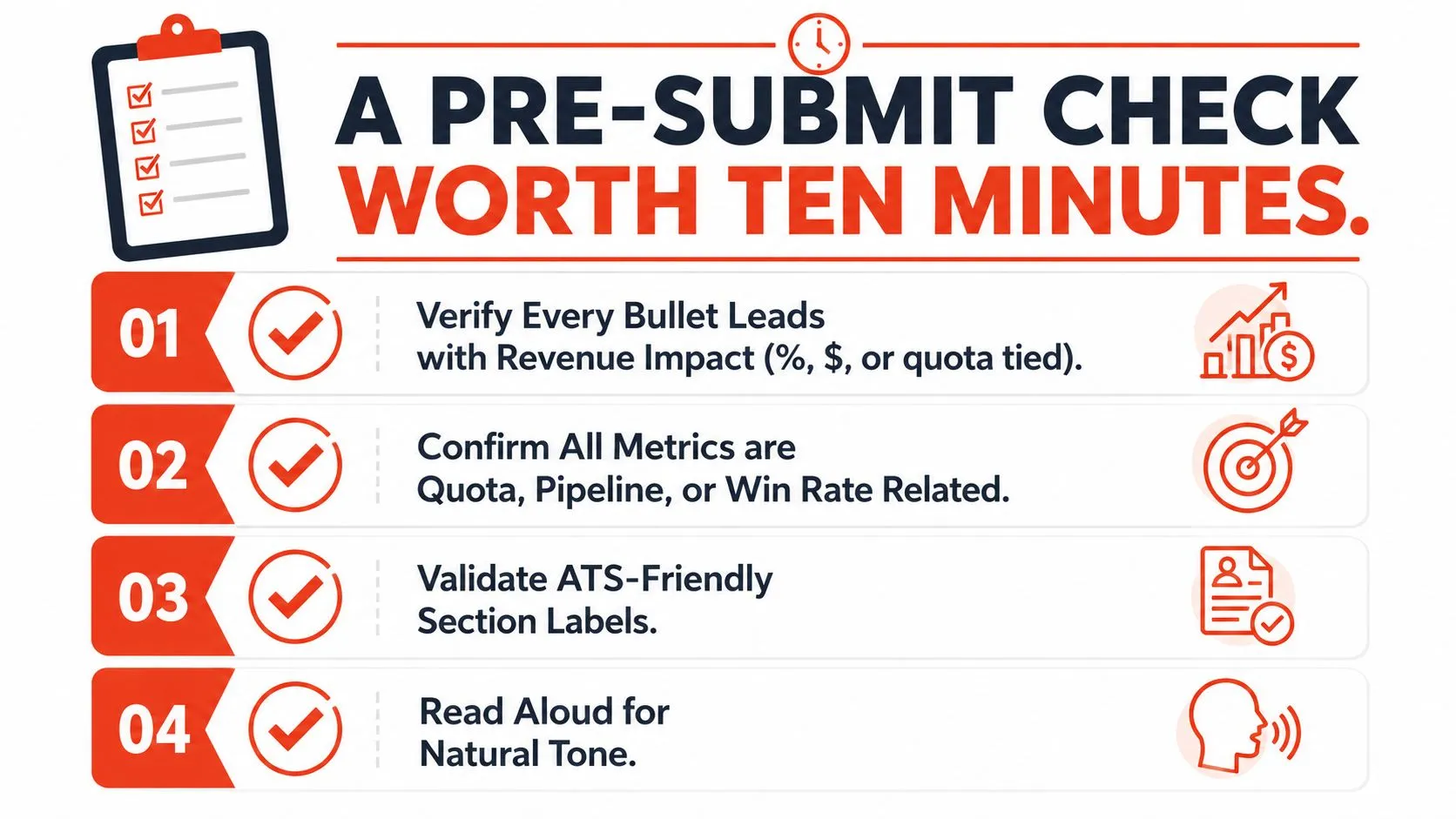
Run this check before every application. A polished account executive resume should survive both a parser and a skeptical sales leader.
-
Verify every bullet: Lead with revenue impact, a percentage, a dollar figure, quota, pipeline, retention, or another defensible commercial result.
-
Confirm metric relevance: Make sure the numbers connect to quota, pipeline, win rate, revenue, deal scope, sales cycle, renewal, or expansion.
-
Match the headline: Use the target role title and make the summary reflect the segment and sales motion in the posting.
-
Mirror relevant keywords: Include three to five accurate terms from the job description across the summary, experience, and skills sections.
-
Check structure: Keep roles in reverse-chronological order with consistent date formatting and conventional section labels.
-
Remove weak signals: Cut responsibility-only bullets, crowded skills lists, unexplained acronyms, and generic soft skills.
-
Confirm contact details: Make sure the LinkedIn URL, email, phone number, and location are current and consistent.
-
Name the file clearly: Include your full name and target role in the filename so the document remains identifiable outside the application portal.
SEO title guidance commonly recommends keeping a title between 50 and 60 characters, with a practical display limit of about 600 pixels, according to 2026 SEO title guidance from Wild and Free Tools. The same discipline helps resume writing too. Cut what doesn't clarify.
Ask one final question: Could a sales hiring manager defend this resume internally in under thirty seconds? If the answer is no, move the strongest proof upward.
StoryCV is an online resume writer, not a template library. Its guided interview turns your fragmented sales history into clear, compelling resume content, helping you surface quota, deal scope, pipeline, and ownership without stuffing the page with keywords. Start with StoryCV and build an account executive resume that explains the revenue you created.