"Interview prep is a waste of time" is mostly true.
If your prep means memorizing polished little speeches, you're sunk. Good interviewers have heard them all. They can smell a rehearsed answer in two minutes.
The better move is simpler. Use account management interview questions to find your strongest proof. The moment you grew an account. The time you saved a renewal. The client issue you untangled before it got ugly. Those stories do double duty. They help you in the interview, and they become the raw material for a resume that sounds real.
That matters because account manager interviews now lean hard on measurable impact, structured examples, and clear evidence of commercial ownership, not vague relationship talk, as noted in this account manager interview guide from AssessFirst. And the role itself has gotten more strategic. Interviewers increasingly ask about account planning, balancing multiple accounts, revenue growth inside existing customers, and the metrics behind your decisions, as discussed in this modern interview framework video.
So skip the script. Pull out the stories.
1. Tell me about a time you grew an existing account

This is the question people answer too loosely. They say they "built trust" or "understood client needs." Fine. But growth doesn't happen because you were pleasant on calls. It happens because you noticed a business gap, connected it to value, and moved the account forward.
Use a real scenario. Maybe a customer started with one product line, but during quarterly reviews you noticed another team had the same workflow problem. You mapped the stakeholders, showed how the current success could transfer, and built the case for expansion.
What to say instead of vague growth talk
Frame the answer in four beats:
- Starting point: What the client originally bought and what they were trying to achieve.
- Signal you noticed: A usage pattern, a team change, a new goal, or an adoption gap.
- Action you took: Meetings, stakeholder mapping, business case, pilot, or cross-functional plan.
- Business result: Revenue growth, broader adoption, stronger renewal position, or clearer expansion pipeline.
Practical rule: Growth answers should sound proactive, not lucky.
For your resume, this question usually turns into a bullet with action plus proof. Bad version: "Managed and grew client accounts." Better version: "Expanded a mature client relationship by identifying a second-team use case, aligning new stakeholders, and turning early product success into a broader commercial opportunity."
If your role wasn't quota-heavy, say that plainly. You can still show growth by proving you created expansion readiness, improved adoption, or reduced friction that made future upsell possible.
2. Describe a time a key client was at risk of churning

This one isn't about heroics. It's about control.
A lot of candidates tell a drama story. Angry client. Late-night calls. Fire drill. That's not enough. The interviewer wants to know if you found the actual reason the account was slipping.
Maybe the client said pricing was the issue, but the underlying problem was poor onboarding and weak adoption. Maybe they blamed support, but the underlying issue was that their executive sponsor had gone quiet and nobody rebuilt the relationship.
Show your diagnosis, not just your effort
A strong answer usually includes:
- The early warning sign: Lower engagement, missed meetings, product frustration, slower response, support-ticket pattern.
- Your diagnosis: What was really driving the churn risk.
- Your internal coordination: Who you pulled in and why.
- Your reset plan: Clear actions, owners, and follow-up cadence.
One modern framework recommends renewal forecasting far in advance, with health signals built from product usage, executive engagement, champion strength, and support-ticket trends, according to 4dayweek's account manager interview framework. That's the mindset to borrow in your answer. You don't need to say the framework out loud. Just think like that.
The best churn answers don't end with "they stayed." They end with "here's why the relationship became stable again."
On a resume, this often becomes one of your strongest bullets. Not because you "handled escalation." Because you identified root cause, aligned internal teams, and protected revenue or customer continuity.
3. What KPIs do you use to measure account health?
Weak candidates expose themselves fast.
If your answer is "relationship strength" and "customer happiness," you're giving feelings, not management. Good account managers track signals that help them act early. Great ones can explain why each metric matters.
Talk like someone who owns a book of business. Mention product usage, stakeholder engagement, renewal timing, support patterns, expansion readiness, and goal progress. Then tie each one to a decision. A metric isn't useful because it's available. It's useful because it changes what you do next.
A clean way to answer
Try a structure like this:
- Usage: Tells me whether the product is embedded or drifting.
- Stakeholder coverage: Tells me whether success depends on one person or is spread across the account.
- Executive engagement: Tells me whether the account still has strategic attention.
- Support trends: Tells me whether operational pain is building.
- Renewal and expansion signals: Tells me where to focus next.
If you want help translating those signals into resume bullets, StoryCV's guide on how to present metrics on a resume is worth reading.
A concrete example helps. Say you saw strong day-to-day usage but weak executive engagement. That means the account may look healthy on paper while still being exposed at renewal. That's a much stronger answer than rattling off dashboard terms.
4. Walk me through your strategic account planning process
Bad answers to this question sound like task management. Good answers sound like account ownership.
Your process should show that you can connect four things: the client's business goals, the people who matter, the risks that could block progress, and the actions that move the account forward. If your answer is just "I do quarterly business reviews and keep notes," you're describing admin work.
A stronger answer is specific. Start with the client's priorities for the year. Then show how you map stakeholders, confirm what value the client has seen, flag the biggest renewal or expansion risks, and turn all of that into a short plan for the next 90 days. Strategic planning is part commercial judgment, part relationship judgment, and part process discipline. If you want a simple way to frame that mix, StoryCV's guide to soft skills and hard skills at work is useful.
What a real account plan includes
A credible answer usually covers:
- Business goals: What the client is trying to achieve, in their terms.
- Value delivered: Results, wins, and proof that the account is getting a return.
- Stakeholder map: Who uses the product, who signs, who can block progress, and who could sponsor expansion.
- Account risk: Gaps in adoption, weak executive buy-in, unresolved issues, budget pressure, or competitor exposure.
- 90-day plan: The next few actions, owners, and what success looks like.
Use a real example. Say you inherited a mature account that looked healthy because it renewed every year, but most of the relationship sat with one mid-level champion. Your plan would focus on building wider stakeholder coverage, confirming current business goals, fixing any weak adoption areas, and identifying one realistic growth path instead of forcing a vague upsell story.
This question matters for your resume too. Plenty of candidates say they "managed strategic accounts." That says nothing. A better bullet shows how you planned: built account plans around client goals, stakeholder coverage, value proof, risk reduction, and 90-day execution. That's the angle that makes this article different from the usual list of interview questions. Your best interview answers are raw material for resume bullets that work.
5. How do you advocate for a client with internal teams?
This is one of the most revealing account management interview questions because it shows whether you're respected inside your company or just tolerated.
Clients don't care how your org chart works. They care whether you can get things done. But if your answer sounds like constant escalation, you're showing poor judgment. Strong advocacy isn't about making noise. It's about translating client pain into clear internal priorities.
Think of a real case. A client keeps hitting the same product limitation. Engineering sees it as one feature request among many. You reframe it. You show the business impact, the affected workflow, the account risk, and the broader relevance across similar customers. That's advocacy.
What interviewers want to hear
They want evidence that you can do three things:
- Translate: Turn vague frustration into a specific internal ask.
- Prioritize: Explain why this issue matters now.
- Collaborate: Push hard without wrecking trust with product, support, or engineering.
StoryCV's take on soft skills vs hard skills is useful here because this answer sits right in the middle. It takes relationship skill, but also judgment, process thinking, and commercial awareness.
You're not the client's messenger. You're the client's interpreter inside the business.
For your resume, don't write "served as liaison between clients and internal teams." Everyone writes that. Write what changed because you did it. Did a bug get prioritized? Did onboarding improve? Did internal teams finally understand the customer's use case? That's the good stuff.
6. Describe how you handle a tough renewal negotiation

This question isn't really about discounts. It's about whether you can keep your head when value gets challenged.
A weak answer sounds defensive. A worse one sounds submissive. "I gave them what they wanted to save the relationship" is not a strong account manager answer. Neither is "I held firm on price" with no nuance.
Start with the setup. Why was the renewal tough? Budget pressure? Low adoption? A competitor? Procurement pushback? Then show how you reset the conversation around outcomes, risk, usage, stakeholder support, and future value.
A better structure for negotiation answers
Use this sequence:
- Clarify the objection: Price is often the surface issue, not the underlying one.
- Re-ground in value: What has the client achieved, avoided, improved, or enabled?
- Create options: Scope, timing, packaging, rollout, or support model.
- Protect the relationship: Make sure the client feels heard, not cornered.
A good example is a customer asking for a discount after underusing part of the product. Instead of arguing price, you acknowledge the gap, rebuild the adoption plan, align on what success should look like, and then negotiate from a stronger position.
Renewal conversations go better when you walk in with evidence, not charm.
That sentence should shape your resume too. If you've handled renewals, don't hide behind generic client-care language. Say you managed renewal conversations, defended value, and balanced competing pressures without losing sight of customer outcomes.
7. Tell me about a time you had to say 'no' to a client
This is a boundary question. A lot of candidates miss that.
Some people think account management means always being accommodating. It doesn't. Good client work includes protecting the client from bad decisions, unrealistic requests, and expensive distractions. Sometimes "no" is the most useful answer you can give.
Use an example where the client wanted something that wasn't viable. Maybe they pushed for a custom workflow your team couldn't support. Maybe they wanted an aggressive timeline that would have wrecked implementation. Maybe they wanted your product used in a way that didn't match the original goals.
The key is how you said no
A strong answer has three parts:
- Acknowledge the request: Show you understood what they wanted.
- Explain the constraint: Be honest. Don't hide behind jargon.
- Offer a better path: Alternative process, phased rollout, workaround, or changed priority.
This is also where mid-to-senior candidates can show judgment. You weren't blocking the client. You were protecting the outcome.
For your resume, this kind of story often reveals executive presence. Not because you were forceful, but because you stayed credible under pressure. If you've ever redirected a client toward a smarter path, that's stronger than another "maintained strong relationships" bullet.
8. How do you prioritize requests from multiple clients?
If your answer is "I prioritize based on urgency," that's incomplete. Everything is urgent to someone.
Interviewers want to know whether you can manage a portfolio, not just react to noise. Recent account management interview guidance increasingly tests how candidates balance multiple key accounts, build account plans, and manage forecasting, with less emphasis placed on routine relationship maintenance, based on Indeed's overview of account manager interview questions.
That means your answer should sound like portfolio management. Not inbox management.
A simple prioritization framework
You can keep it clean:
- Business impact: Which request affects renewal, client risk, or strategic value?
- Time sensitivity: What has a hard deadline?
- Breadth of effect: Does solving this help one user, one account, or many customers?
- Effort and dependency: What can move now, and what needs other teams?
Use a scenario. One client has a loud but low-impact request. Another has a quieter issue tied to an upcoming renewal. A third needs routine support. A strong AM doesn't just answer fastest. They assign the right level of attention to each.
There's another nuance here. Not every account manager owns upsell. Some roles lean more toward retention, service quality, renewal stability, and operational excellence. If that's your background, say so. Then explain how you prioritized around client health, stakeholder alignment, issue prevention, and expansion readiness instead of pretending you ran a hard sales quota.
9. Tell me about a process you improved for your clients
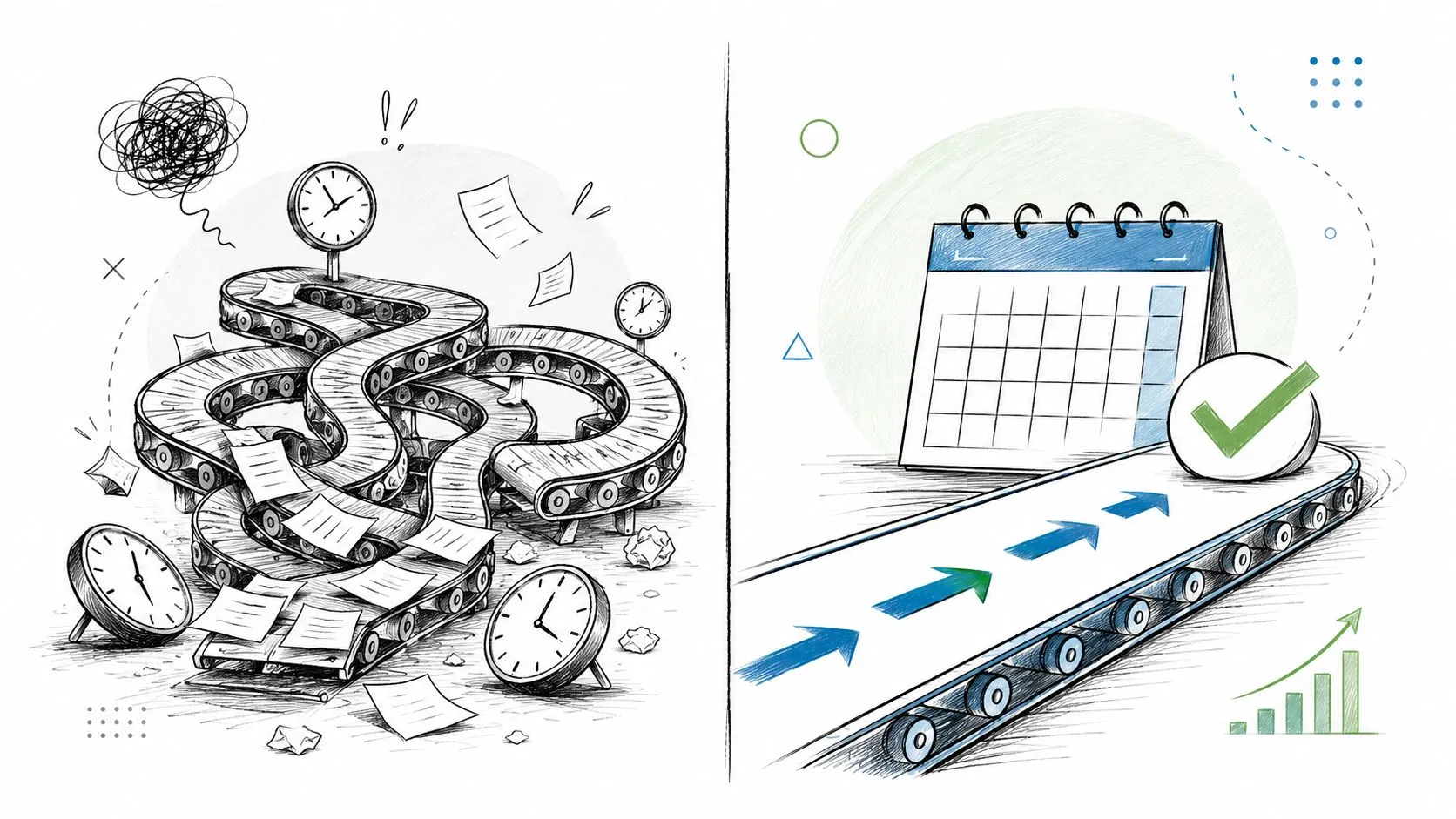
This is one of the best questions in the whole stack because it reveals whether you just worked inside the system or made it better.
Pick something repeatable. Onboarding. Escalation routing. QBR prep. Internal handoffs. Client reporting. Renewal prep. The best answers aren't about one-off heroics. They're about spotting friction, simplifying it, and making the client experience smoother.
Say you noticed new clients kept asking the same setup questions because implementation docs lived in too many places. You pulled the common blockers into one guide, aligned onboarding with support, and cut down confusion. That's strong.
Why this answer matters so much
It proves several things at once:
- Initiative: You didn't wait to be told.
- Pattern recognition: You saw a recurring issue.
- Scalability: The fix helped more than one customer.
- Commercial sense: Better process usually protects renewals and trust.
This kind of story is resume gold because it combines service, operations, and ownership. If you can show that your improvement made client work easier, faster, or more reliable, you've got a bullet that stands out from generic account management copy.
10. Describe a time you received difficult feedback from a client
A lot of candidates ruin this one by trying to look flawless.
Nobody believes you've never missed the mark. What matters is whether you get defensive, make excuses, or adjust fast. Account managers who can absorb blunt feedback without losing the relationship are rare. That's why interviewers ask.
Choose a story where the feedback stung a little. Maybe the client felt communication was too reactive. Maybe they felt handoffs were messy. Maybe they wanted more strategic guidance from you, not just answers to tickets.
The right shape for this answer
Keep it honest:
- What the feedback was
- How you responded in the moment
- What you changed after
- What happened next
Difficult feedback is useful when you can turn it into a new operating standard.
A solid example would be a client telling you your updates were too tactical. Instead of defending your work, you changed the meeting format, tied updates to business goals, and started surfacing risks and next steps earlier.
This is exactly the kind of story that belongs on a resume summary or in stronger experience bullets. It shows maturity. It shows you can improve. And it shows you treat client relationships as something you actively shape, not something you passively maintain.
Comparison of Top 10 Account Management Interview Questions
A flat list of questions is weak prep.
What you need is a pattern. These ten questions map to three things hiring managers care about in account management: client growth, crisis control, and strategic value. Use that pattern in the interview. Then use the same pattern to rewrite your resume with proof instead of vague duties.
| Interview Question | What it really tests | What a strong answer should prove | Best resume angle |
|---|---|---|---|
| 1. Tell me about a time you grew an existing account | Client Growth | You spotted expansion potential, built a case, and turned usage into revenue | Revenue growth, expansion strategy, adoption gains |
| 2. Describe a time a key client was at risk of churning | Crisis Management | You saw the risk early, took control fast, and kept the account | Retention, recovery plan, executive communication |
| 3. What KPIs do you use to measure account health? | Strategic Value | You track leading and lagging signals, not just renewal dates | Risk monitoring, portfolio ownership, proactive account coverage |
| 4. Walk me through your strategic account planning process | Strategic Value | You can connect client goals to a plan, stakeholders, and commercial outcomes | Account planning, stakeholder mapping, growth roadmap |
| 5. How do you advocate for a client with internal teams? | Strategic Value | You influence without formal authority and make a business case people act on | Cross-functional leadership, client advocacy, internal alignment |
| 6. Describe how you handle a tough renewal negotiation | Client Growth | You defend value, protect margin, and keep the relationship intact | Renewal ownership, commercial judgment, value-based negotiation |
| 7. Tell me about a time you had to say 'no' to a client | Crisis Management | You protected scope, product direction, or team capacity without damaging trust | Boundary setting, expectation management, alternative solutions |
| 8. How do you prioritize requests from multiple clients? | Strategic Value | You use a clear system instead of reacting to whoever shouts loudest | Portfolio prioritization, time management, client segmentation |
| 9. Tell me about a process you improved for your clients | Strategic Value | You fixed friction, improved consistency, and made the client experience better | Process improvement, onboarding, reporting, service delivery |
| 10. Describe a time you received difficult feedback from a client | Crisis Management | You absorbed criticism well, changed your approach, and improved the relationship | Coachability, client communication, continuous improvement |
Here is the practical takeaway.
If your answers cluster around growth, your resume should show expansion, renewals, and value realization. If your best stories are crisis stories, lead with retention, save plays, and trust repair. If you win on strategy, show planning, prioritization, and cross-functional influence.
That is how you turn interview prep into a resume that works.
Stop Answering. Start Storytelling.
You don't need ten polished monologues. You need a small set of real stories you can bend to fit different questions.
That's the part often overlooked. These account management interview questions aren't separate tests. They're different angles on the same few themes. Can you grow value? Can you protect trust when things get messy? Can you think beyond the ticket queue? Can you connect client work to business outcomes?
If you build three or four strong stories, you can reuse them everywhere. One story might cover growth, planning, stakeholder management, and negotiation. Another might cover churn risk, feedback, and internal advocacy. That's how experienced candidates answer with confidence. They aren't inventing new material on the spot. They're pulling from a short library of proof.
This also fixes your resume.
Most resumes fail for the same reason most interview answers fail. They're full of duties, not evidence. "Managed accounts." "Handled client relationships." "Worked cross-functionally." None of that tells a hiring manager what you did when something important was on the line.
Your best interview stories solve that. They give you the before, the problem, the action, and the result. They show how you think. They show what you own. They show whether you can be trusted with revenue, renewals, and real customer complexity.
So don't prep by memorizing. Prep by mining your past.
Write down the account you expanded. The renewal you saved. The angry client you stabilized. The internal fight you managed. The process you fixed. Then tighten each story until it can live in two places: spoken in an interview, written on a resume.
That's how you stop sounding generic.
That's how you make your experience usable.
If you've done strong work but can't turn it into sharp resume bullets, StoryCV helps you get there. It's a digital resume writer that pulls out your real examples through a guided interview, then turns them into clear, credible narrative. Less box-filling. Better storytelling.