“Looks fine. I just can't tell what you did.” That's the sentence that kills a lot of auto sales resumes. The candidate usually did real work, but the page reads like a duty log, not proof of performance.
What Hiring Managers Say About Auto Sales Resumes
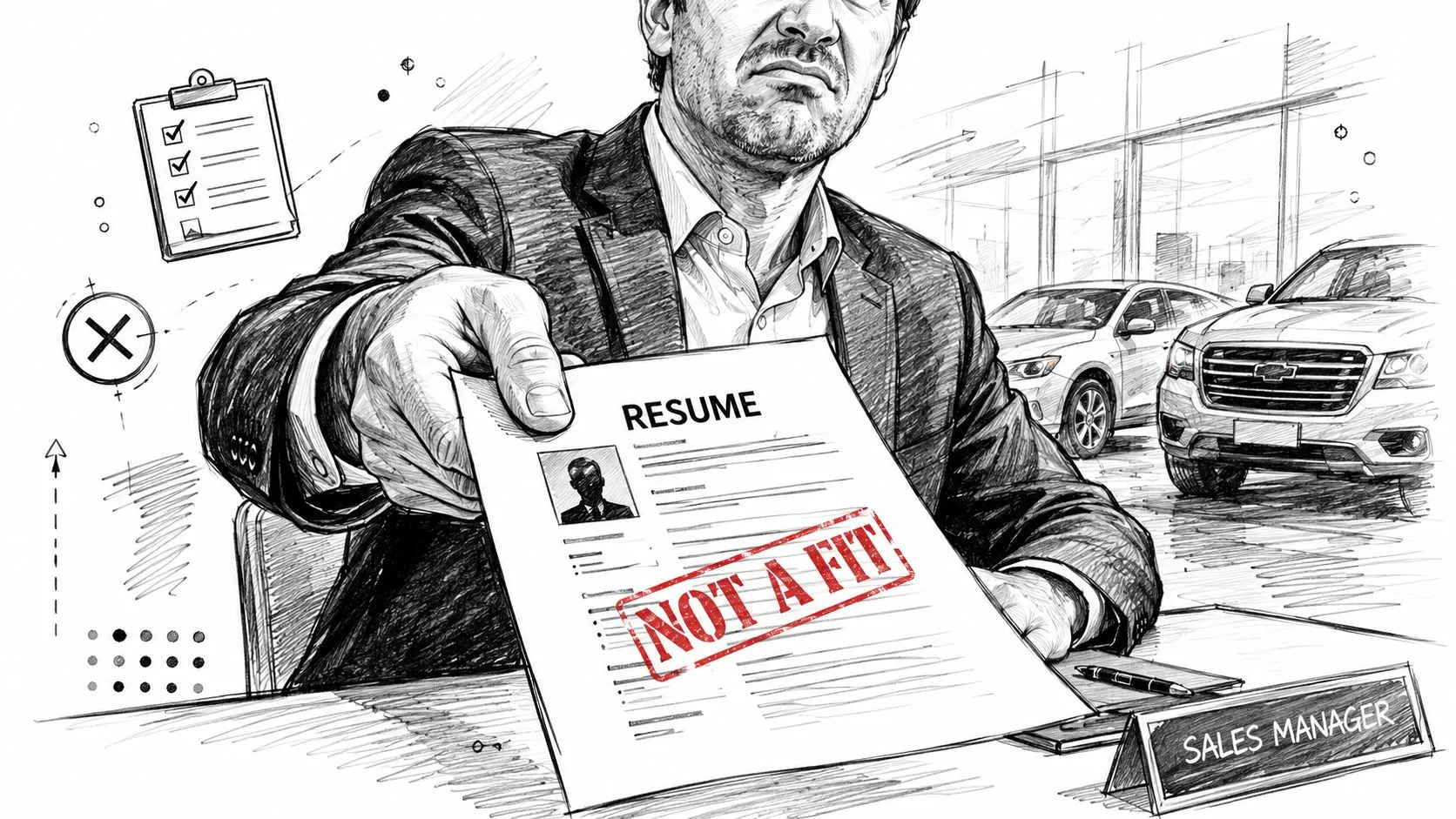
Dealership managers don't hire personality adjectives. They hire evidence. If your resume says you're a “hard worker” or a “team player,” it tells me nothing. If it says you handled CRM follow-up, moved digital leads, and kept repeat business flowing, now we're talking.
Practical rule: a resume bullet is a decision, not a description.
The best candidates usually lose because they write from memory in the wrong format. They list tasks. They forget outcomes. They bury the one number that matters. That's why a resume that looks “fine” still gets ignored.
If you want a clean way to pressure-test whether your bullets sound like real sales evidence, using Synopsix for sales assessments is one useful reference point. It's the same basic logic hiring managers use, proof first, noise later.
The fix is simple. Stop describing the job. Start showing the scoreboard. A solid auto sales resume sounds like someone who knows how a dealership makes money, then proves they've done it.
The Metrics That Move the Needle in Auto Sales
Dealership managers scan for numbers because numbers tell them whether you can produce. The usual proof points are units sold per month, revenue or gross, quota attainment, customer satisfaction, and repeat or referral business. That's the language that matters more than “motivated” or “goal-oriented.” For resume writers, that's not a style choice, it's the job.
Practical rule: if a bullet doesn't contain a number, it's probably too soft.
The market makes those metrics even more important. U.S. light-vehicle sales finished 2024 at about 15.8 million units, up roughly 2.5% from 2023, while the average selling price stayed near the mid-$48,000 range and incentives rose as inventory improved, according to the 2024 auto market review from Cars Commerce (2024 auto market year in review). That context matters because dealerships don't reward raw activity. They reward conversion, pricing discipline, and awareness of inventory conditions.
Here's how I'd frame it. A rep who says “sold cars” sounds generic. A rep who says “consistently sold in a market where pricing pressure and inventory changes affected close rate” sounds like someone who understands the floor, the desk, and the customer. That's the difference between a resume and a call-back.
| Key Auto Sales Resume Metrics | What to Include | Why It Matters |
|---|---|---|
| Units sold per month | Average monthly volume, peak months, rank if you know it | Shows production, not just effort |
| Gross or revenue | Front-end gross, total gross, or gross per unit if you track it | Tells managers you protect profit, not just volume |
| Quota attainment | Percent of target, pace against store goals, monthly consistency | Shows reliability under pressure |
| Customer satisfaction | CSI, survey results, delivery follow-through, review outcomes | Signals retention and process quality |
| Repeat or referral business | Referral share, repeat buyers, loyalty outcomes | Proves you can keep customers coming back |
If you're writing this from scratch, use this resume metrics guide as a sanity check for how to turn raw performance into readable proof. The point isn't to cram in every number you've ever seen. It's to pick the ones that tell the truth about how you sell.
Resume Sections by Career Stage
A strong auto sales resume doesn't use the same structure for everyone. A student, a mid-career rep, and a manager are not selling the same story, so don't force one layout on all three.
Students and recent grads
If you're new, lead with transferable proof. That means customer-facing jobs, leadership roles, part-time sales, service work, and any work where you had to handle pressure without melting down. You can also use coursework if it reinforces sales, business, or communication. If you need a portfolio-style presence for that stage, a student portfolio website guide can help you think about presenting evidence clearly.
Don't pretend you have dealership volume you don't have. That's amateur hour. Show that you can communicate, learn fast, and handle people without script-reading your way through a conversation.
Mid-level reps with real dealership experience
If you've got three or more years in the business, your resume should lead with proof, not biography. Put your summary at the top and make it useful. I want to see your average monthly unit volume, gross per unit, and quota pace before I read page one of your work history.
A decent summary might sound like this, in your own numbers and voice, “Automotive sales professional with experience in showroom sales, internet follow-up, and delivery coordination. Known for consistent production, clean CRM habits, and strong customer retention.” Then back it up immediately with bullets that prove it.
Managers and directors
If you're hiring up, your resume has to shift from individual output to team impact. Show what you did to improve process, protect gross, coach people, or clean up handoffs. Store performance, team consistency, and workflow improvements matter more than a list of every customer you personally closed.
Practical rule: the higher the title, the less the resume should sound like a personal brag sheet and the more it should sound like a business case.
Dealership scale matters here too. NADA reports that franchised light-vehicle dealers sold 16.2 million light-duty vehicles and generated more than $1.3 trillion in total dealership sales (NADA data). If you're applying into a business that large, your resume should look like it belongs in a serious sales channel, not a generic retail pile.
If you want help grouping roles by function, use these categories for resume structure to keep the document clean. The point is to make the reader understand your lane fast.
ATS Keywords That Dealership Managers Scan For
ATS doesn't hire anybody, but it does reject weak wording fast. In dealership recruiting, that means your resume needs to mirror the terms the store uses. The shift toward digital lead handling made this more important, because a lot of dealerships now screen for process words, not just personality words.
Use dealership language, not generic sales filler
Write with the same vocabulary managers use on the floor and in the tower. That usually means phrases like CRM follow-up, digital leads, appointment setting, lead conversion, sales process, inventory awareness, repeat business, referral business, and CSI. If you've done the work, say it plainly.
A lot of resumes fail because they use safe words instead of useful ones. “Customer service” is too broad. “Converted inbound internet leads into showroom appointments” is useful. “Negotiated pricing and financing” is better than “handled sales.” You get the idea.
Match keywords to proof
Don't just stack terms in a skills section. Put them where the work happened. If you worked a CRM every day, say so in a bullet. If you handled internet leads, say how. If you supported F&I handoff, say that too. Recruiters can smell keyword stuffing from a mile away.
These ATS bullet point tactics are worth using when you're tightening language. The trick is to write like a real person and let the keywords come along for the ride.
A practical list helps:
- CRM follow-up: Use this if you tracked tasks, set reminders, or worked a lead pipeline.
- Digital leads: Use this if you handled form fills, chat leads, or internet response.
- Appointment conversion: Use this if you turned inquiries into showroom visits.
- Gross profit: Use this if you protected margin, not just volume.
- CSI: Use this if customer satisfaction was part of your performance.
- Repeat and referral business: Use this if retention helped your number.
Keep it human. The hiring manager should read your resume and think, “This person speaks dealership,” not “This person stuffed keywords into a file.”
Tailoring Your Auto Sales Resume for Different Backgrounds
Most advice gets lazy. It tells everyone to quantify results, then leaves career changers and digitally native sellers to figure it out alone. Bad move. If your path isn't a straight showroom line, you need to translate, not apologize.
Career changers
If you came from retail, telecom, hospitality, banking, real estate, or another customer-heavy field, lead with transferability. A manager doesn't need you to prove you've memorized every trim package. They need to know you can build trust, follow up, and close.
Use language like customer acquisition, objection handling, appointment setting, and process accuracy. If you ran a pipeline in another sales role, say that. If you handled escalations well, say that. If you kept repeat customers coming back, say that too. Just don't dress it up in corporate wallpaper.
Returners and nontraditional candidates
If you've got fragmented experience, make the gaps irrelevant by framing the work that does connect. Part-time sales, family business work, service roles, remote sales, or operational support can all support an automotive narrative if you tie them to communication and consistency. Your resume should show that you can re-enter a fast-moving environment without drama.
Digital sellers and internet-focused applicants
The job is more channel-driven than the old lot-walk stereotype, so digital reps have real influence. Put internet response discipline, CRM follow-up, appointment setting, digital leads, and show rate style language front and center if that's where you've lived. A showroom-only résumé won't represent you well if your real strength is moving online prospects into the store.
Practical rule: don't rewrite your past to sound like a dealership. Translate it into dealership terms.
StoryCV handles this kind of translation well when it interviews you for context instead of just asking you to fill boxes. That matters because the same title can hide very different work.
The 10 Minute Auto Sales Resume Edit Checklist
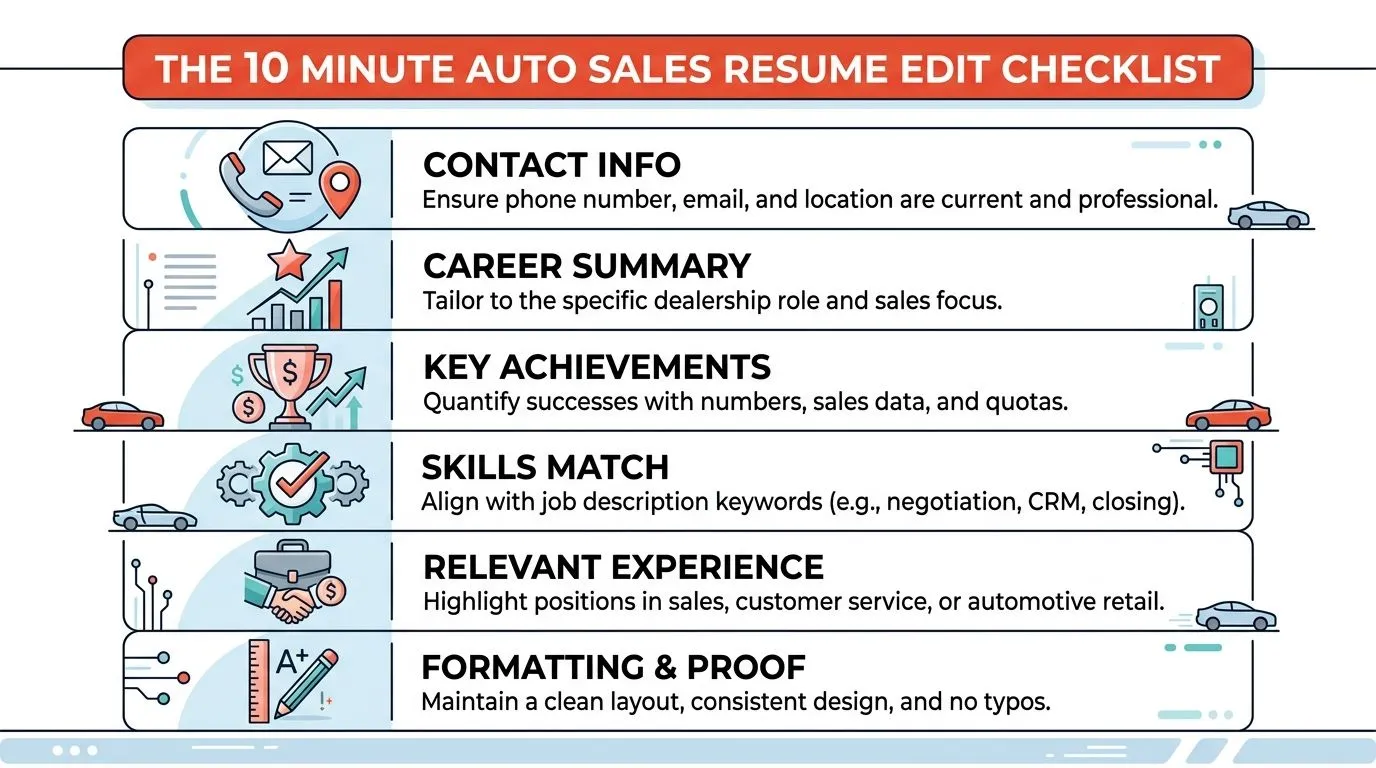
A manager can tell in seconds whether your resume was sharpened or slapped together. Use this checklist before you send anything out.
1. Put a number in every bullet
If the bullet has no metric, rewrite it. Use units sold, gross, CSI, quota percentage, appointment conversion, referral volume, or team ranking when they're true for your work.
Weak: “Worked with customers to close deals.”
Strong: “Closed showroom deals while maintaining strong follow-up discipline and supporting repeat business.”
2. Clean up your summary
Your summary should sound like a role, not a personality test. Put in CRM follow-up, digital lead conversion, F&I support, or inventory awareness if that's your lane. If it reads like a dating profile, cut it.
3. Remove vague adjectives
Delete words like strong, reliable, and detail-oriented unless you're proving them with a result. A hiring manager doesn't care what you call yourself. They care what you produced.
4. Move your best proof up
Your strongest numbers belong in the first third of the document. Don't hide them under a block of old jobs and soft skills. Lead with the stuff that makes a manager pause.
5. Make the format easy to scan
Keep it clean. No clutter. No gimmicks. No weird fonts. Your resume should hold up on paper, on a screen, and in a quick skim between deals.
6. Test the wording against the job ad
If the posting says internet sales, CRM, or appointment setting and your resume never says those words, you've got work to do. Mirror the job post where it fits.
Here's a quick before and after:
- Before: “Responsible for helping customers and meeting sales goals.”
-
After: “Managed showroom and digital leads through CRM follow-up, turning qualified opportunities into consistent monthly sales.”
-
Before: “Great at working with people.”
-
After: “Built repeat and referral business through delivery follow-up and proactive ownership check-ins.”
-
Before: “Assisted with financing and paperwork.”
- After: “Prepared clean deal information for F&I handoff and supported accurate financing conversations.”
If you want a second lens on executive-style framing, this guide to executive summaries for leaders shows the same basic principle. Lead with proof, then keep moving.
A good edit takes less time than a bad excuse. Tighten the bullets, move the best numbers up, and cut anything that sounds like filler.
Writing Your Auto Sales Resume with Confidence
The best resumes in this business sound like the person did the work. Not like they read about it. Not like they copied it. They sound lived-in, specific, and comfortable with numbers.
You already have the raw material. Use the metrics that matter, speak dealership language, and frame your background accurately. If you've got a useful starting point for leadership-style framing, a guide to executive summaries for leaders can reinforce the same discipline of leading with outcomes.
Don't bury your value under safe wording. A resume that says exactly what you did, where you did it, and what changed because of you will always beat a generic one. That's the one managers remember when the stack gets thin.
StoryCV turns your actual dealership wins into a resume that reads like a sales story, not a recycled template. If you want help turning real numbers, real follow-up habits, and real customer results into a sharper auto sales resume, visit StoryCV and start with a draft that sounds like you.