Most advice on the best AI resume writer is backward.
It tells you to chase templates, ATS scores, and keyword density. That's how you end up with a resume that technically exists and emotionally dies on contact. Clean formatting matters. Basic compatibility matters. But those are table stakes. The core problem is simpler: most good professionals struggle to explain what they did, why it mattered, and how to make that legible to a stranger in under a minute.
That's where the market splits. Some tools build resumes. A few generate them.
Most AI Resume Writers Sell You a Lie
Most AI resume tools solve the wrong problem.
They act like your issue is missing keywords or sloppy formatting. Usually it isn't.
Your issue is that your experience is dense, specific, and hard to compress. So you feed real work into an AI resume writing tool, and it spits back polished words. “Led cross-functional initiatives.” “Improved operational efficiency.” “Managed stakeholders.” Thanks. That could describe half the working population.
The annoying part is that AI help does work when it's good.
A randomized controlled trial of 480,948 jobseekers found that AI résumé-writing assistance increased hires by 7.8% overall, and the assisted group earned 8.4% higher wages on average, with $18.62/hour vs. $17.17/hour reported in the coverage at JobCannon's summary of AI resume statistics. So yes, AI can help.
But quality matters. The same reporting notes Stanford HAI analysis of more than 10,000 samples found false-positive rates can exceed 20% for non-native English writers and creative writing, which is exactly why generic language is a problem, not a feature.
Practical rule: Don't ask whether an AI resume writer can generate text. Ask whether it can help you say something specific and true.
What the lie sounds like
The sales pitch is usually some version of this:
-
It will optimize you for ATS. Fine. That gets you into the pile.
-
It will write faster. Also fine. Fast nonsense is still nonsense.
-
It will give you recruiter-friendly phrasing. Translation: it will make you sound like everyone else.
Hiring managers don't reject strong people because they lacked one more synonym for “managed.” They reject resumes that feel generic, inflated, or forgettable.
What actually matters
A useful AI powered resume writer should help you answer a few hard questions:
-
What problem were you dealing with
-
What did you change
-
Why was that work hard, useful, or risky
-
What should another employer infer from it
That's writing. Not filling boxes.
AI Builders vs AI Writers The Only Distinction That Matters
Forget giant feature grids. This market has two camps.
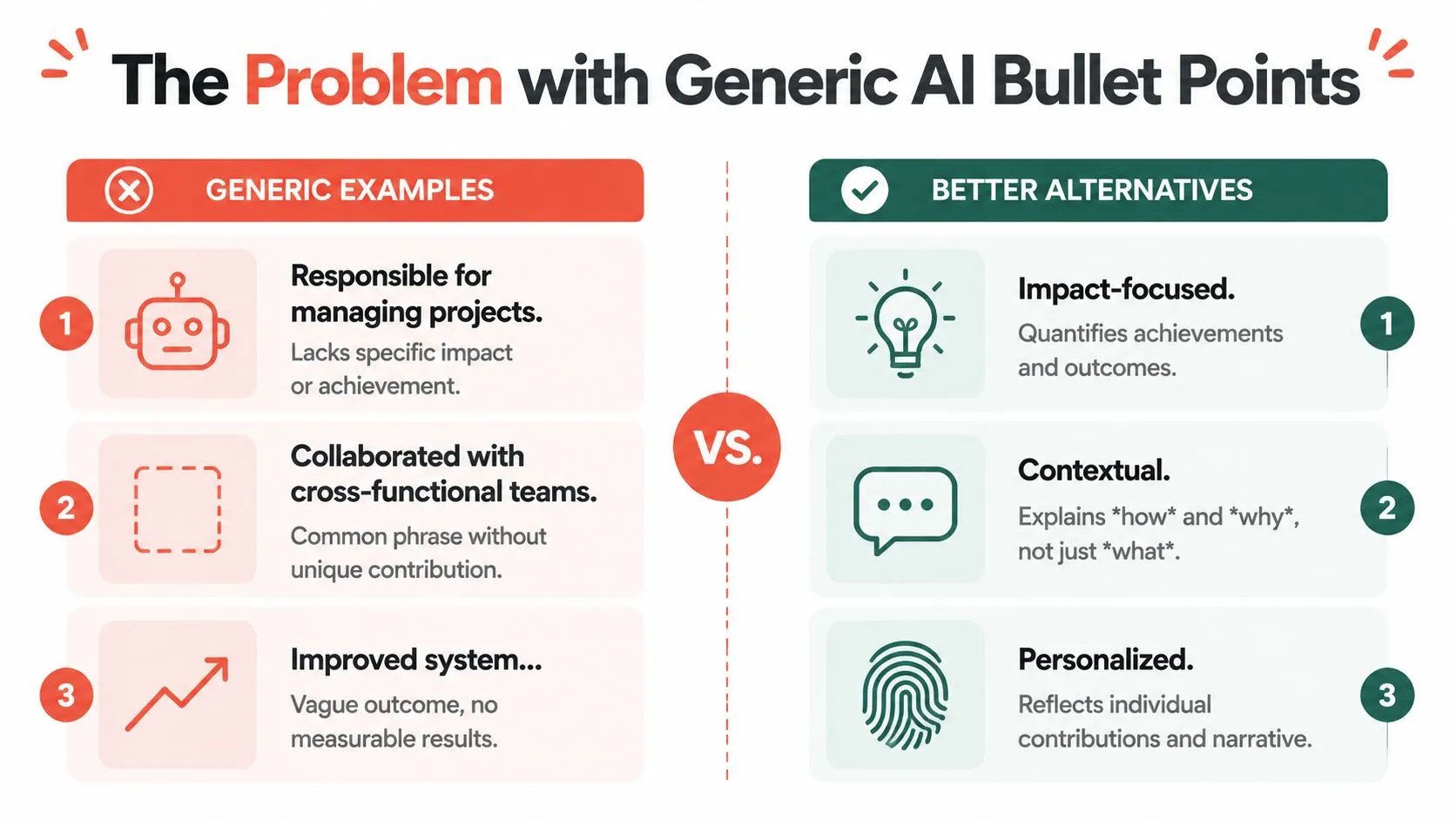
AI builders fill space
An AI resume builder is mostly a formatting machine with prompts attached. You pick a template. It asks for your title. It offers a menu of prewritten bullets. Maybe it gives you an ATS score and some missing keywords. Efficient, sure. But it usually writes from the outside in.
That means it starts with what a role should sound like, not what your work was.
Coverage of the category keeps circling the same weakness. Kickresume's comparison of AI resume builders points out that AI-generated wording is often vague, needs manual rewriting, and still depends on the user to add metrics and nuanced accomplishments. That's the whole problem with the average resume bullet generator. It can decorate. It can't really interpret.
AI writers pull signal from the mess
A real AI resume writer starts from context. It asks better questions. It treats your experience less like a form and more like an interview.
That distinction matters outside resumes too. In service businesses, the useful AI systems aren't the flashy ones. They're the ones that fit the actual workflow and help people make better decisions. The same idea shows up in this piece on integrating AI into hospitality. Good AI doesn't replace judgment. It supports it.
Generic builders optimize for completion. Writers optimize for clarity.
If you want the cleaner breakdown, StoryCV has a solid explanation of the difference between a guided writing system and a chatbot in this article on AI resume writer vs ChatGPT.
The decision is simpler than people make it
Use a builder if your background is straightforward and you mostly need speed.
Use a writer if any of these are true:
-
Your work was complex. You led ambiguous projects, cross-functional initiatives, or ugly operational fixes.
-
Your path isn't linear. You changed industries, came back after time away, or combined roles.
-
You hate your current bullets. They're accurate enough, but they sound dead.
-
You need framing, not just formatting. You're not short on experience. You're short on language.
That's the only distinction that matters.
Why Your AI Resume Bullet Points Sound Fake
You can spot bad AI resume bullet points in seconds.
They're smooth, empty, and weirdly interchangeable. Any AI resume bullet point generator can produce lines that look professional at first glance. Then you read them twice and realize they say almost nothing.
Three fake-sounding bullets and how to fix them
Here's the usual output from a resume bullet point writer that only knows titles and keywords.
| Generic AI output | Why it fails | Better rewrite |
|---|---|---|
| “Responsible for managing projects across multiple teams.” | Says duty, not contribution | “Coordinated engineering, ops, and vendor work to keep a fragile rollout moving when ownership was split across teams.” |
| “Collaborated with cross-functional stakeholders to improve processes.” | Nobody learns anything | “Worked with finance and operations to remove approval bottlenecks that were slowing routine purchasing and creating avoidable escalations.” |
| “Improved system efficiency and supported strategic initiatives.” | Sounds important, proves nothing | “Stabilized a recurring reporting mess by rewriting the handoff process and documenting edge cases the team had been patching manually.” |
Notice what changed. The better versions don't just add stronger verbs. They add context.
Use a simple writing frame
Most AI resume bullet points improve fast if you force them through a tighter structure.
Try this:
-
Problem
What was broken, messy, slow, risky, unclear, or stuck? -
Action
What did you specifically do, decide, build, untangle, or influence? -
Result
What changed afterward, even if the result is qualitative?
That's better than asking a resume bullet generator to “make this sound more professional.” Professional usually means bland.
Write bullets so a hiring manager can picture the work. If they can't picture it, they won't value it.
Before and after examples
Bad bullet
Managed customer onboarding and ensured client success.
Better bullet
Led onboarding for complex accounts, translating handoff chaos into a repeatable process clients could follow.
Bad bullet
Developed marketing strategies to support business growth.
Better bullet
Turned scattered campaign efforts into a focused launch plan, aligning content, sales enablement, and follow-up so the team stopped improvising every release.
Bad bullet
Worked with leadership on strategic planning.
Better bullet
Helped leadership turn broad planning discussions into executable priorities, clarifying ownership, sequence, and trade-offs across teams.
If you're trying to spot whether your draft already has that generic AI smell, this guide on how to tell if a resume is AI-generated is useful.
What a decent tool should ask before writing
Any resume writing AI tool worth using should ask things like:
-
What was difficult about the work
-
What changed because you were involved
-
What trade-offs did you handle
-
What would have happened if nobody fixed it
If it doesn't ask those questions, it's not writing. It's autofill.
A Look at Standard Online Resume Writer Tools
Most so-called online resume writer products are really analyzers.
They score. They scan. They compare your draft against ATS rules and keyword patterns. Useful in moderation. Misleading as a core strategy.
What these tools actually prioritize
A separate expert comparison reported that ResumeBuild.ai uses a 23-criteria scoring system, while Resume Optimizer Pro was the only tested tool to run a real ATS parser, flag missing keywords, and name formatting risks against systems such as Workday, Greenhouse, Lever, iCIMS, and Taleo in Monday.com's comparison of AI resume tools.
Another roundup says Wobo was evaluated on five technical criteria and claims a 24-metric ATS analysis with feedback on compatibility, readability, and optimization in Wobo's roundup of best AI resume builders.
That's not useless. It's just incomplete.
The problem with ATS obsession
A high score means your resume is machine-readable. Great. A PDF can also be machine-readable and still say absolutely nothing memorable.
Here's what these tools are good at:
-
Checking compatibility. They catch formatting issues and parser risks.
-
Flagging missing terms. Helpful when you've ignored obvious language from the role.
-
Speeding up cleanup. Fine for polishing a decent draft.
Here's what they're bad at:
-
Understanding judgment. They don't know which part of your experience deserves emphasis.
-
Translating messy careers. They struggle when your path isn't neat.
-
Writing convincing narrative. They score the document, not the story.
ATS optimization is hygiene. It isn't positioning.
If your draft already says something strong, these tools can help tidy it. If the draft is weak, they mostly help you produce a cleaner weak draft.
The StoryCV Method A Digital Resume Writer
The better model is simple. Stop treating resume writing like form completion. Treat it like guided extraction.

What a digital writer does differently
A digital resume writer works more like a thoughtful editor than a template engine. It asks about the messy parts people usually skip. What was at stake. What constraint mattered. Why the work wasn't trivial. How your role differed from the job description version.
That's why this approach works better for mid-career people. By year three or five or ten, your value usually isn't “used Agile” or “collaborated cross-functionally.” It's pattern recognition, judgment, and hard-earned credibility. A normal AI resume writing tool tends to flatten that. A writing-first system should surface it.
One option in this category is StoryCV, which positions itself as a Digital Resume Writer and uses a guided interview to turn context into drafted resume language rather than just handing you templates.
The useful workflow
A strong professional resume writer online experience should look something like this:
-
First, gather context. Not just title, company, and dates. Actual work.
-
Then, draft with editorial judgment. Choose what belongs in the summary, what belongs in bullets, and what should be cut.
-
Finally, adapt for use. Keep ATS compatibility, but don't sacrifice readability.
Here's a quick look at that kind of flow in action.
Why this beats pure prompt hacking
You can absolutely wrestle with a chatbot for an hour and eventually get decent copy. Plenty of people do.
But most professionals don't need another blank box and more prompt engineering homework. They need structure that helps them think clearly about their own work. That's the core job of an AI powered resume writer.
Resume Examples That Tell a Story
At this point, the difference becomes obvious.
Most comparison articles still ignore the hardest use case: people with non-standard paths. YesWriting's roundup of AI resume builders notes a major content gap around students, career changers, returners, and other candidates whose value doesn't fit a clean, linear story. That's exactly where generic tools fall apart.
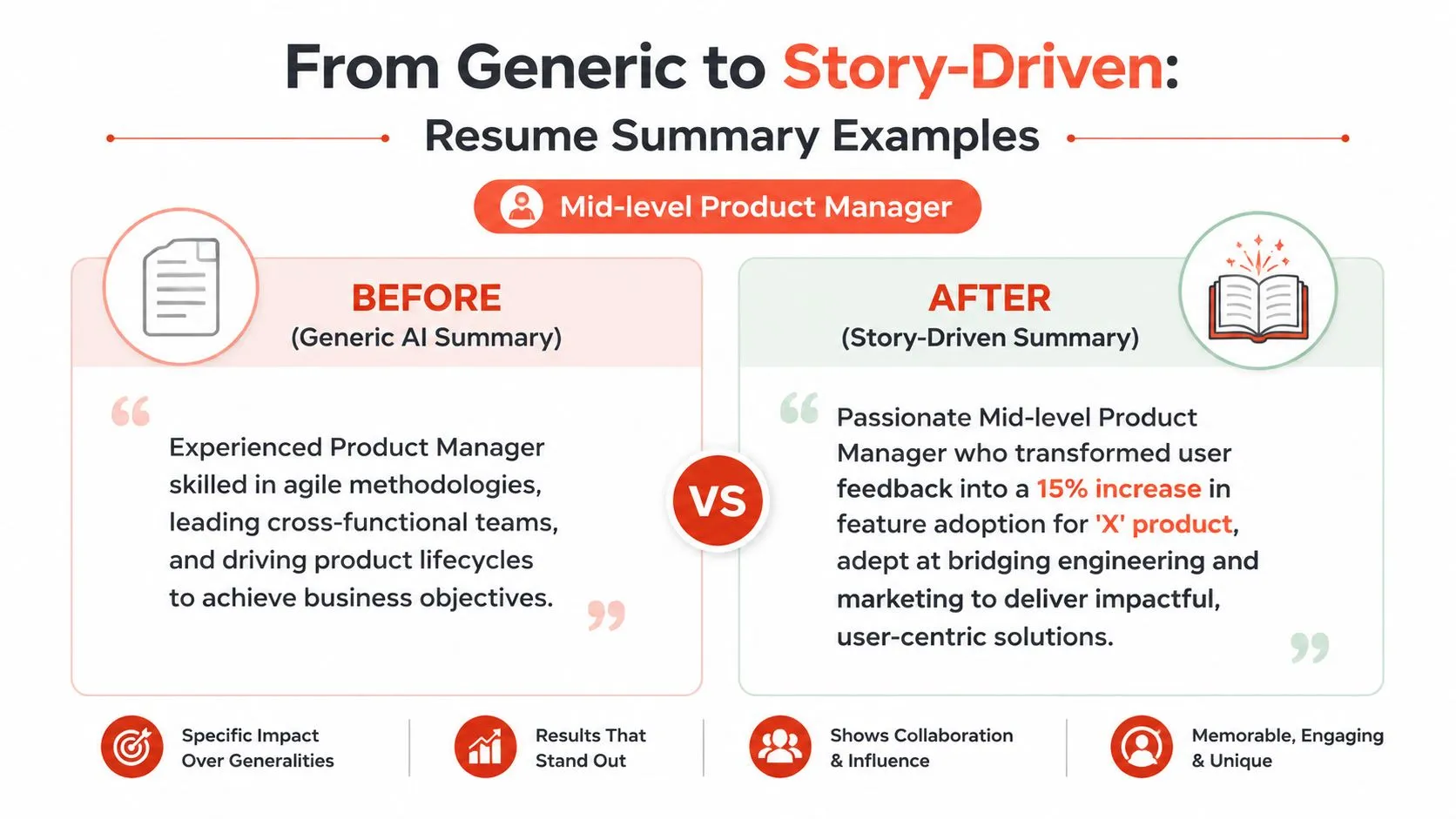
Mid-level product manager
Generic AI summary
Experienced Product Manager skilled in agile methodologies, cross-functional collaboration, and product lifecycle management. Proven ability to drive business objectives and deliver value-added solutions.
Why it fails: it sounds correct and forgettable. Every product manager on earth has apparently “driven business objectives.”
Story-driven summary
Product Manager with a track record of turning scattered user feedback and internal pressure into clearer product decisions. Strong at translating between engineering, commercial teams, and users so priorities stop competing and releases ship with a reason.
Why it works: it gives shape to the work. You can infer judgment, communication, and product sense.
Career changer from marketing to operations
Generic AI summary
Results-driven professional with experience in marketing, project management, and stakeholder communication, seeking to transition into operations.
That reads like a polite shrug.
Story-driven summary
Operator-minded marketer who spent years building the systems behind campaigns, not just the campaigns themselves. Brings experience coordinating deadlines, untangling handoffs, and turning ambiguous requests into repeatable workflows.
Why it works: it doesn't apologize for the transition. It explains the bridge.
If your career path is messy, your summary has to do translation work.
Senior software engineer
Generic AI summary
Senior Software Engineer with expertise in full-stack development, cloud technologies, and agile delivery. Passionate about building scalable solutions and mentoring teams.
Fine. Also lifeless.
Story-driven summary
Senior engineer known for taking ownership of brittle systems that others are tired of babysitting. Brings a calm, pragmatic approach to stabilizing production issues, simplifying handoffs, and helping teams ship without creating fresh chaos.
Why it works: there's texture. You can imagine the environments this person improves.
A niche example that proves the point
This matters even more in specialized fields. If you need to craft your physician resume, generic software language is obviously the wrong frame. The same logic applies across domains. The resume has to reflect the work, not just mimic a template.
So Which AI Resume Writer Is Best
Here's the blunt answer.
If you have a clean, linear background and you mostly need formatting, a builder is enough. Pick an AI resume writing tool with solid export options, basic ATS hygiene, and acceptable templates. Don't overthink it.
If your value is harder to explain, which is true for a lot of good mid-career people, you need a writer. Not an AI resume bullet point generator. Not a resume bullet generator with prettier buttons. A writer.
Choose the product that helps you articulate trade-offs, context, judgment, and actual impact. That is the test. If you want a shortlist built around that lens, this roundup of the top AI resume writer options is a good next step.
StoryCV is for people who don't need more templates. They need help saying what their work was worth. If that sounds familiar, try StoryCV and turn one real role into a clear, credible draft.