Keyword stuffing is not a business development strategy. A hiring manager wants evidence that you opened markets, built commercially useful partnerships, expanded accounts, or moved revenue. Your resume has to make that evidence obvious before the reader loses interest.
That matters because large-company hiring is filtered before a person reads many applications. One benchmark found that 97.8% of Fortune 500 companies use applicant tracking systems, while another reported keyword filtering at a 99.7% rate among recruiters using ATS platforms. Roughly 75% of resumes are filtered out before human review, according to the same resume statistics benchmark. Your document needs machine-readable language, but it also needs a commercial story a skeptical operator can trust.
Most Business Development Resume Advice Is Solving the Wrong Problem
Most business development resume advice treats the document like an SEO page. Add “pipeline generation,” “strategic partnerships,” “Salesforce,” “territory management,” and “revenue growth,” then hope the algorithm approves.
That's incomplete advice. The ATS may recognize the terms, but a sales leader still has to believe you can create opportunity and turn relationships into business. The evaluator is usually a hiring manager or commercial leader scanning for proof of revenue impact in under a minute. One benchmark reports an initial scan of about 11.2 seconds, with a median total review time of 1 minute 34 seconds after the first fit check. It also reports a 3% interview rate from applications. See the recruiter screening behavior benchmark.
The practical test: Could a sales leader explain your commercial value after reading only the top third of the page?
A strong business development resume answers three questions quickly:
- Can you create demand? Show pipeline, prospecting, market entry, or new-logo outcomes.
- Can you deepen relationships? Show strategic accounts, executive stakeholders, partner ecosystems, or expansion.
- Can you influence revenue? Show closed business, sourced pipeline, influenced revenue, activation, or another credible leading indicator.
The same logic applies whether you were a quota-carrying BDR, an alliances manager, or a cross-functional operator supporting go-to-market work. A BDR resume needs activity and conversion evidence. A partnership resume may need ecosystem scope and commercial influence instead.
Your goal isn't to satisfy a checklist. It's to earn the next interview.
Frame the Role Before You Write a Single Bullet
Don't format the resume first. Decide what you're selling.
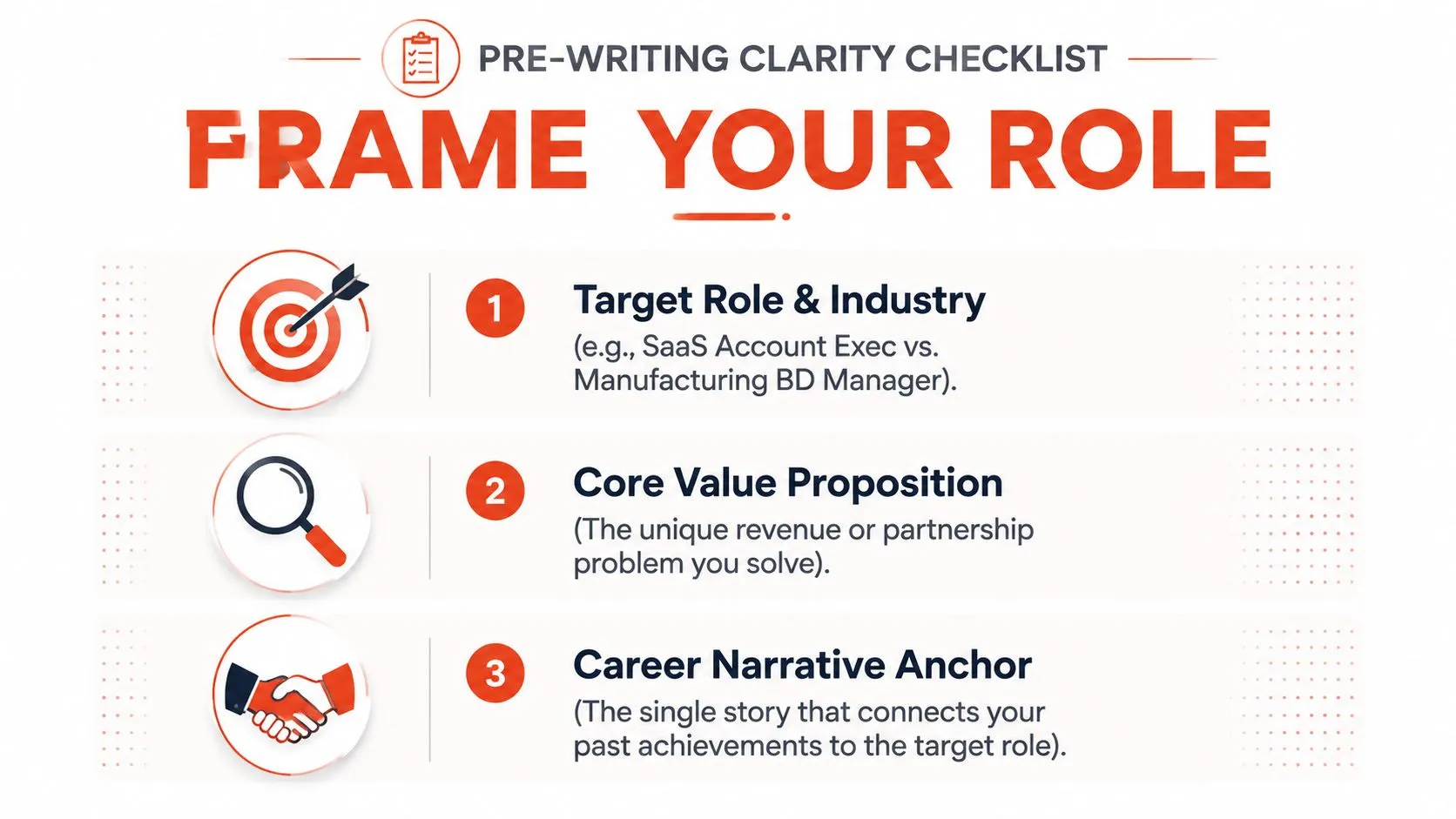
Start with three questions:
- Which business development role are you targeting? Name the function, seniority, industry, and commercial model. “Business development” is too broad. “Enterprise partnership development in SaaS” gives you a usable frame.
- What does success look like there? It might mean quota attainment, territory growth, partner-sourced pipeline, market expansion, account penetration, or sales-cycle improvement.
- Which two or three recent wins prove you can do it? Choose outcomes that match the target role, not the achievements you happen to remember first.
Your answers should produce one positioning line near the top of the resume:
Enterprise partnership leader expanding SaaS channels through strategic alliances, executive relationships, and partner-sourced pipeline.
That line gives every later bullet a job. If you're targeting fintech partnerships, don't lead with generic sales administration. If you're pursuing an enterprise account role, prioritize complex negotiations, expansion, and stakeholder management. A career changer should translate adjacent work into the same commercial language, using evidence rather than pretending the old title was identical.
This exercise also makes tailoring faster. You're not rewriting the entire document for every employer. You're adjusting the positioning line, summary, skills, and the most relevant accomplishments to reflect the employer's language and commercial priorities.
Without this frame, your resume becomes a record of tasks. With it, the reader sees a candidate built for a specific business problem.
The Structure a Recruiter Expects on a Business Development Resume
A recruiter shouldn't have to hunt for your commercial context. Put the most useful evidence where the reader expects it.
| Section Order | Content | What It Signals |
|---|---|---|
| 1 | Name, contact details, target positioning line | Immediate role fit |
| 2 | Focused professional summary | Relevant commercial identity |
| 3 | Experience and selected achievements | Revenue, pipeline, and partnership proof |
| 4 | Skills | Match with the job description |
| 5 | Certifications or notable partnerships | Supporting credibility |
| 6 | Education | Qualification and industry context |
Your header should be clean. Include your name, location, phone number, professional email, and a positioning line. Skip decorative graphics, dense sidebars, and icons that can confuse parsing software.
The summary should mirror the target role without sounding copied. Name your operating environment, strongest commercial lever, and most credible outcomes. “Business development professional with experience in partnerships and growth” says almost nothing. “Business development leader building partner channels for enterprise software, with experience aligning sales, product, and executive stakeholders” gives the reader a direction.
Lead the experience section with the strongest relevant evidence. Reverse chronology is usually easiest to follow, but experienced candidates can give selected achievements more prominence when their career includes adjacent functions or multiple commercial paths. Each role should answer the same question: what business outcome did this person help create?
Keep skills specific. Use terms such as pipeline generation, strategic accounts, contract negotiation, territory management, partner development, CRM, forecasting, and market expansion only when they reflect real work. You can use StoryCV's resume category guidance to decide which supporting sections deserve space.
Drop the objective, generic soft-skills list, and references. A hiring team assumes you can communicate and collaborate. Prove those capabilities through negotiations, stakeholder decisions, and outcomes instead.
Writing Bullets That Prove Revenue, Partnership, and Pipeline Impact
A duty tells the reader what occupied your calendar. An achievement shows why the company should care.
Use a simple pattern: action, scope, result. The scope matters because a metric without context is weak. “Generated pipeline” could mean a small experiment or a major regional channel. Name the territory, partner type, account segment, product, or stakeholder level when you can.
Here are three grounded rewrites:
| Role Type | Weak Bullet | Strong Bullet | Metric Shown |
|---|---|---|---|
| Quota-carrying representative | Managed enterprise accounts and closed deals | Negotiated enterprise software agreements across strategic accounts, converting qualified opportunities into closed-won revenue and supporting quota attainment | Closed-won revenue or attainment, if verified |
| Partner-led role | Built relationships with technology partners | Built joint plans with technology partners, aligned sales and marketing teams, and converted partner activity into sourced pipeline and shared revenue | Sourced pipeline or joint revenue |
| Non-quota BD function | Supported market expansion and sales enablement | Coordinated product, sales, and regional teams for market entry, improving partner activation and giving account teams a clearer path to qualified opportunities | Activation, cycle time, or pipeline indicator |
If you have exact figures, use them. If you don't own the revenue directly, don't imply that you did. Say influenced, enabled, supported, or sourced when those words accurately describe your contribution. A partnership leader may not close the contract, but can still explain how partner strategy created access, accelerated adoption, or generated qualified demand.
The same discipline applies to business development operations. CRM governance, territory design, enablement, and forecasting belong on the resume when they changed a commercial process. “Maintained Salesforce records” is administrative. “Improved opportunity data quality for regional forecasting” is business context. Add the verified result if you have one.
For more guidance on turning sales work into evidence, review these resume bullet points for sales.
Before keeping a bullet, ask:
What changed because I did this, and how do I know?
If the answer is unclear, the bullet isn't finished.
Make the Resume ATS-Friendly Without Sounding Like a Robot
ATS compatibility is mechanical. Good writing is contextual. You need both.
One 2026 summary citing Jobscan's State of the Job Search 2025 report says 99.7% of recruiters use keyword filters in ATS systems. The ATS filtering benchmark supports a simple rule: use the employer's language, but place it inside credible evidence.
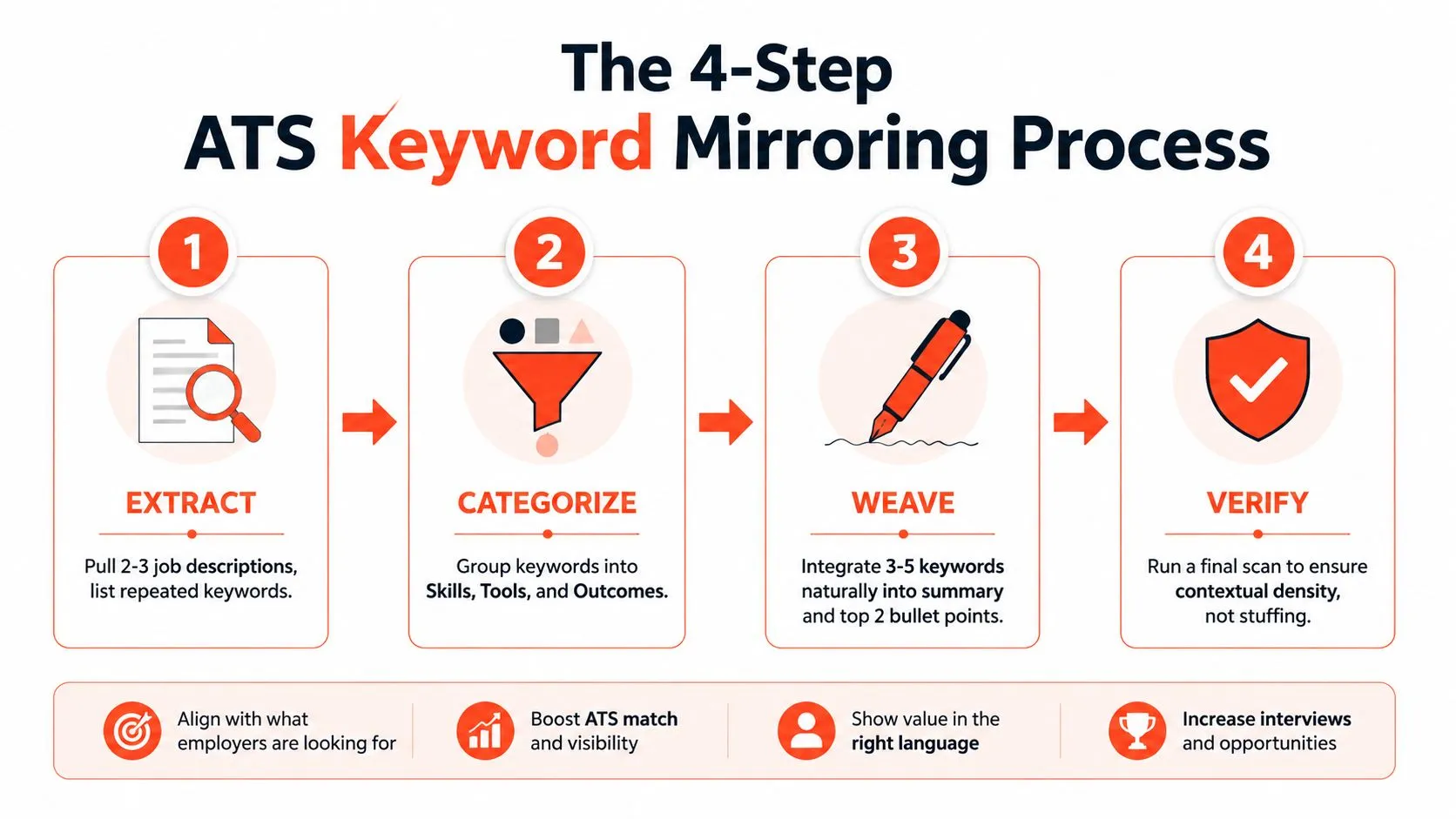
Use this four-step process:
- Extract. Review two or three target job descriptions. Collect repeated phrases connected to must-have skills, tools, and outcomes.
- Categorize. Sort them into skills, systems, and commercial results. “Salesforce” is a tool. “Strategic partnerships” is a capability. “Partner-sourced pipeline” is an outcome.
- Weave. Add the strongest terms to your summary and top bullets where they describe real work. Don't create a keyword paragraph.
- Verify. Read the resume aloud. If a sentence sounds like a search query, rewrite it.
Keep standard section names such as Summary, Experience, Skills, Education, and Certifications. Keep job titles close to conventional naming where possible. A parser may misread an unusual title, so clarify it without falsifying it, such as “Partnership Lead, Business Development.”
Use a conventional file format requested by the employer. A clean PDF often preserves layout, but follow the application's instructions. Avoid tables inside the main resume, text boxes, unusual headers, and graphics that separate content from the text layer.
For a useful complementary principle, see this guide to quantify impact on your resume. The important phrase is “impact,” not “more keywords.”
You can also compare your approach with this guide to ATS resume bullet points.
How Long Should a Business Development Resume Actually Be
The one-page rule is lazy advice. The better standard is relevance density.
One page suits students, recent graduates, career changers with limited directly relevant evidence, and professionals early in their commercial careers. Two pages suit mid-career and senior candidates when the additional space proves account growth, complex partnerships, territory ownership, or strategic influence. Resume-length guidance from NestCV's resume length guide supports one page for newer professionals and two pages when senior experience justifies it.
A senior individual contributor with extensive quota-carrying work may need two dense pages. A director can use two pages while compressing early-career roles into a short section. A career switcher should stay concise and use transferable skills to connect prior work to business development outcomes.
The test is simple:
- Keep the line if it helps the reader understand your commercial value.
- Cut the line if it only describes a routine.
- Compress the role if the work is old, irrelevant, or duplicated elsewhere.
Don't pad the document with three-line bullets, soft tools, or every certification you've ever completed. A second page isn't a weakness when it adds proof. It's a weakness when it adds biography.
Relevance beats chronology when experience is substantial.
Aim for a resume where most lines make a hiring manager more confident, not merely more informed. If the second page contains only repeated responsibilities, remove it. If it contains distinct evidence of revenue impact, partnership depth, or commercial scope, keep it.
Common Mistakes That Cost Business Development Candidates Interviews
Strong formatting will not rescue weak evidence. Hiring teams need proof that your work created commercial value, especially when your background centers on partnerships, cross-functional projects, or work without a formal quota.
The market is crowded. A 2026 resume statistics review reported 244 applications per job posting in 2025, compared with 115 in 2022. It also reported that applications per hire rose 157.7%, while the average job took 56.7 days to fill in 2025. A generic resume disappears quickly in that volume.
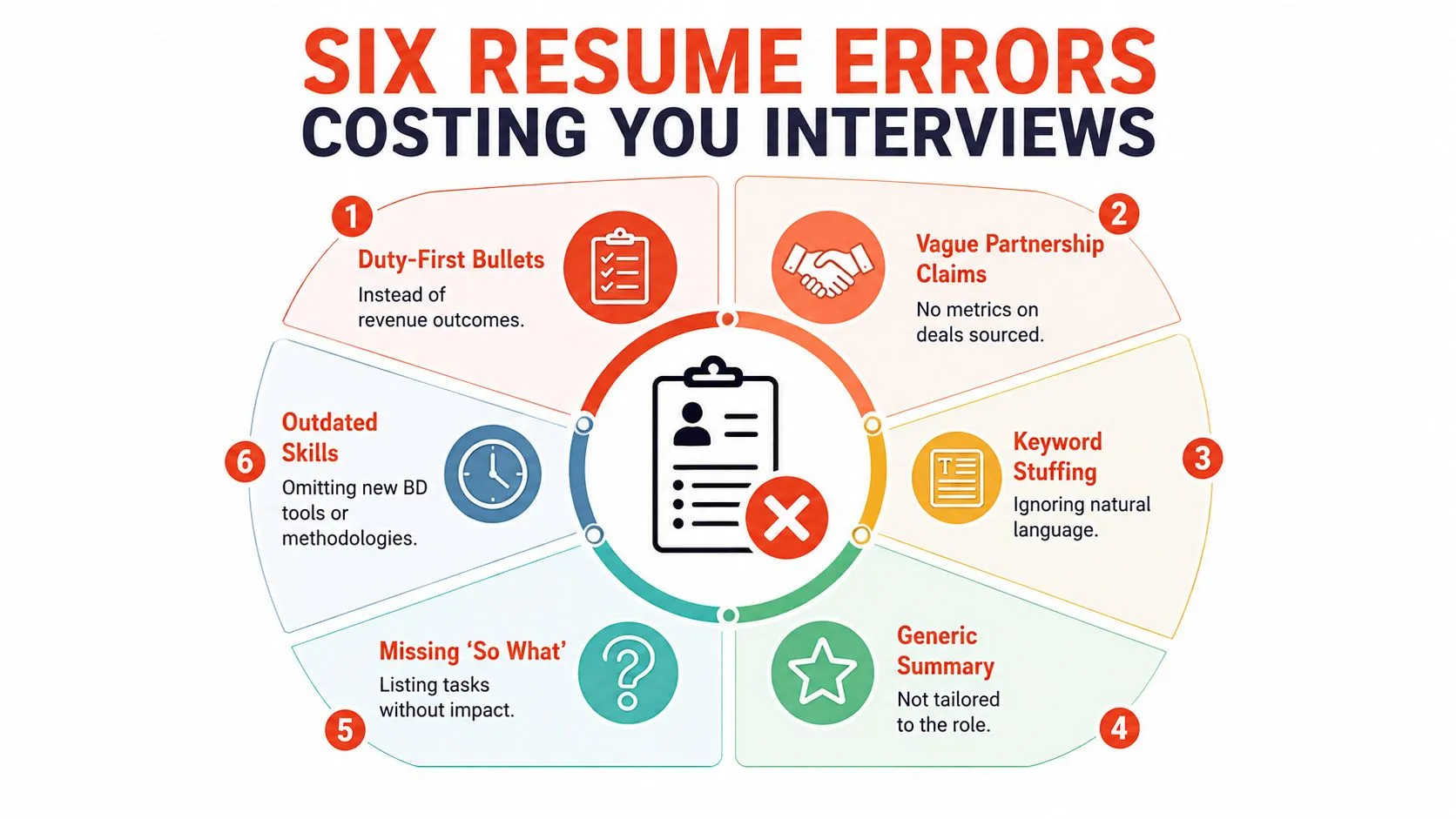
Correct these problems first:
- Duty-first bullets: Lead each relevant role with action, scope, and a verified result.
- Unclear partnership wins: Name the partner type, commercial motion, and value created. “Managed alliances” says nothing about the business outcome.
- Vague scope language: Specify the territory, segment, stakeholders, or process you handled.
- Soft-skill padding: Replace “excellent communicator” with evidence from negotiations, executive presentations, or cross-functional decisions.
- Expired or irrelevant content: Remove outdated certifications and early roles that do not support your target narrative.
- Generic submissions: Adjust the positioning line, summary, skills, and top accomplishments for each serious application.
Career changers must translate their experience with discipline. Stakeholder management, executive presentations, data analysis, budget ownership, and cross-functional collaboration matter only when tied to context and an outcome. ResumeVera's 2026 career-change guide and Resuma's transferable-skills guide recommend reviewing five to ten job postings and proving relevant skills with specific examples.
Make these edits before changing templates.
StoryCV is an online resume writer that uses a guided interview to turn your decisions, constraints, partnerships, and outcomes into business development resume language. Start with one fully written role for free, then visit StoryCV to build a sharper narrative for the role you want.