Reliable, dedicated, and hardworking are useful words when someone else uses them to vouch for you. When you write about yourself, replace each adjective with context, action, and an observable outcome, then choose from the wider vocabulary of 14 work-ethic adjectives with care.
The popular advice is to add more impressive words to your resume. That advice is backwards. A resume that calls its owner reliable or hardworking asks the reader to accept an opinion that can't be tested. A manager's recommendation is different. The manager is lending their credibility to the claim.
That's why the best adjectives for work ethic often belong in recommendations, appraisals, and peer feedback. Your resume and LinkedIn profile should show the evidence behind them. Common resume guidance includes words such as committed, conscientious, consistent, dedicated, dependable, diligent, disciplined, focused, honest, proactive, punctual, reliable, responsible, and self-directed. Monster's resume guidance presents this vocabulary as a practical set of observable traits, not a license to write vague praise.
The rule is simple:
Responsibility → context → action → outcome
“Managed network infrastructure” describes a responsibility. “Managed network infrastructure across multiple sites, resolved recurring failures, and maintained stable service during a major migration” shows what changed.
StoryCV helps with the part many find difficult. The problem usually isn't finding another synonym. It's remembering the details, deciding what mattered, and putting that experience into clear words. If you're tracking performance, start with tracking what truly matters, then turn the strongest evidence into a bullet.
1. Reliable
Reliable means people can count on you to deliver what you promised. That sounds valuable, and it is. The problem is that almost everyone can write the word in a summary, while almost nobody can prove the claim through the adjective alone.
Use reliable when a manager or colleague is describing you. A recommendation such as “Sarah is the most reliable engineer on our team” carries force because another person is taking responsibility for the judgment. On your own resume, replace the word with the pattern that earned it.
Practical rule: Reliability needs a record, not a declaration.
Look for evidence of consistency:
- Delivery pattern: Show the projects, releases, or commitments you completed on schedule.
- Timeframe: Make clear that the result lasted across a meaningful period rather than happening once.
- Operational trust: Explain what others trusted you to own and what happened as a result.
“Reliable project manager” says very little. “Delivered client projects on agreed dates, kept stakeholders informed when scope changed, and closed risks before handoff” gives the reader something to assess.
You can also express reliability through cadence. A finance professional might describe recurring reporting delivered without missed deadlines. An operations leader might show dependable service delivery across changing demand. A software engineer might focus on releases, incident follow-up, or maintenance work completed consistently.
The adjective still has a place in a recommendation, appraisal, or peer review. It can also appear in a job description, where the employer is describing the behavior they want. In your own bullets, let the frequency, timeframe, and outcome do the work. Guidance on top soft skills for job seekers follows the same principle, soft skills become more credible when connected to observable behavior.
2. Dedicated
Dedicated suggests commitment to a goal, project, customer, or standard. It's stronger than generic praise when someone else uses it to describe what they witnessed. Self-applied, it usually sounds like a warm opinion with no supporting record.
A colleague might write, “Marcus was dedicated to shipping that product. He stayed involved through every review and problem-solving session.” The useful part isn't the word. It's the behavior behind it, sustained ownership, participation, and follow-through.
Name the object of the commitment
Don't write “dedicated professional.” Say what you committed to and what your involvement changed.
“Led platform modernization from concept to launch despite team changes” shows dedication through ownership. “Owned roadmap delivery across several product areas, attended stakeholder reviews, and resolved blockers within the delivery cycle” gives the reader context and action.
The evidence can take several forms:
- Scope: What initiative, customer group, process, or product did you own?
- Persistence: What obstacle could have caused the work to stop?
- Participation: Which decisions, reviews, or delivery moments required your involvement?
- Result: What launched, improved, shipped, or became more stable?
Avoid turning activity into proof. Attending meetings doesn't automatically demonstrate dedication. It matters only when your participation led to decisions, progress, or a better result.
A mid-career professional often has better evidence than they realize. Revisit projects that survived changing priorities, reduced resources, difficult stakeholders, or unclear ownership. Those situations reveal commitment more clearly than a summary statement ever will.
Use dedicated in a recommendation when a third party can verify the pattern. On your resume, describe the thing you stayed with and the result you produced. That's more precise, more credible, and more useful to a hiring manager.
3. Hardworking
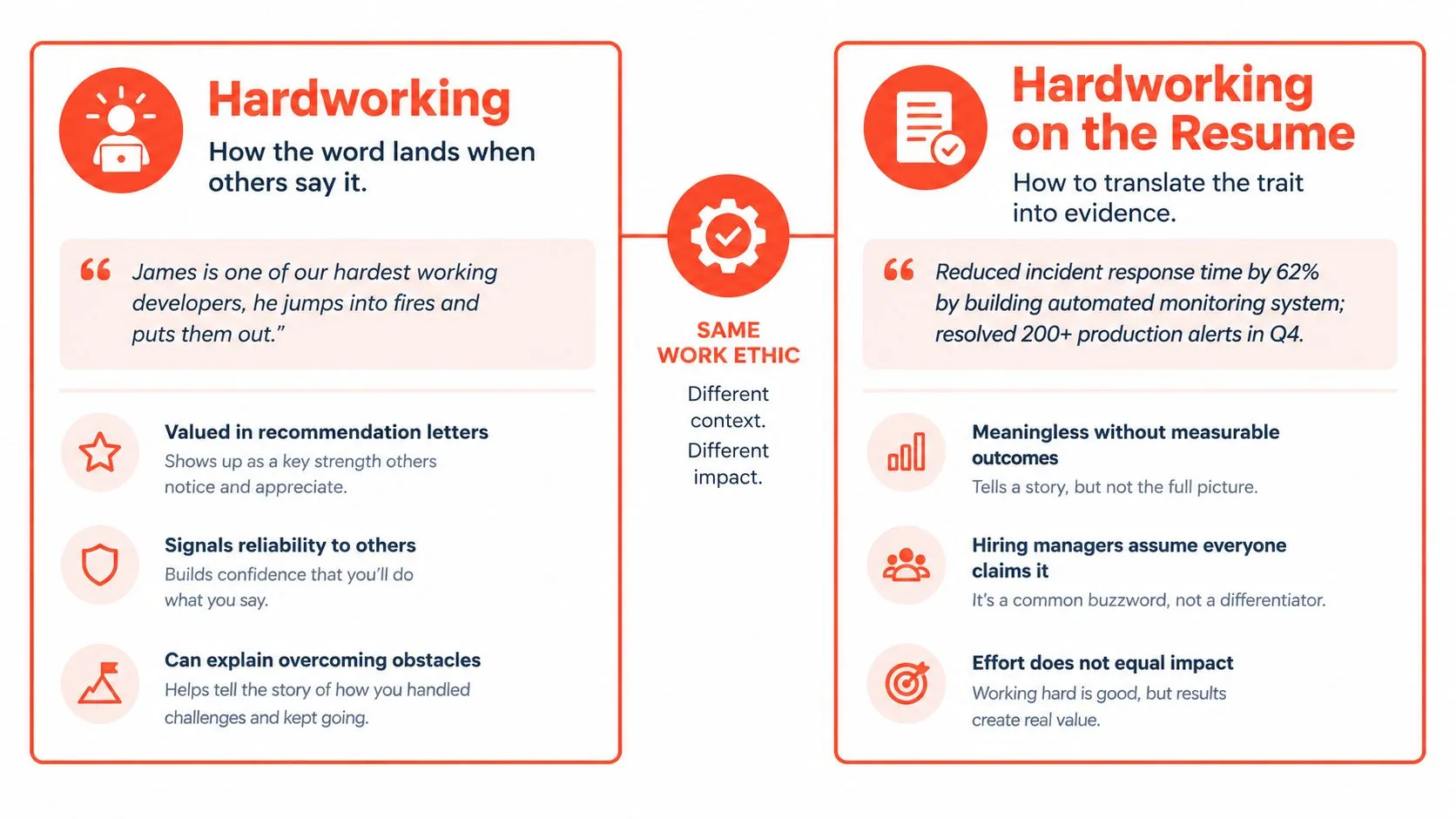
Hardworking is one of the weakest self-descriptions on a resume. It reports effort without showing value. A hiring manager can't see the hours you spent, and hours alone don't prove that the work mattered.
A manager's appraisal can reasonably say, “James is one of our hardest-working developers. He steps into difficult incidents and resolves them.” The manager has observed the effort and can connect it to a behavior. Your resume should skip the adjective and show what the effort produced.
“Work ethic” becomes persuasive when the reader can see the work, the difficulty, and the result.
Translate effort into output:
- Problems solved: What broke, stalled, or threatened delivery?
- Complexity handled: What made the work difficult?
- Volume managed: What level of workload, scope, or responsibility did you absorb?
- Improvement created: What became faster, safer, clearer, or more effective?
“Hardworking developer who handles pressure” is empty. “Built automated monitoring to shorten incident response and resolved a high volume of production alerts during a demanding release period” shows intensity through action and context.
You can use numbers when you have records. Verified resume guidance gives examples such as reducing processing time by 15%, improving on-time delivery to 98%, or managing 30+ priorities reliably. GoSkills' resume-adjective guidance makes the broader point clearly, work-ethic adjectives should be supported by achievements rather than left as character claims.
For a deeper treatment of self-description, see how to describe yourself in a resume. The useful question is not “How hard did I work?” It's “What did my work make possible?”
4. Proactive
Proactive describes action taken before someone asks. It's one of the more useful adjectives for work ethic because anticipation matters in almost every senior role. It still fails when it appears without a specific problem, decision, or outcome.
A peer might say, “Tanya is proactive. She spotted a scaling issue early and prepared a solution before it affected customers.” That sentence works because the peer identifies what Tanya noticed and why it mattered.
Your resume should tell the same story without relying on the label.
Show the moment before the problem
Start with the signal you noticed. Then show what you did and what changed.
“Identified a database bottleneck in forecasting, designed a caching solution, and improved response time before users experienced performance issues” demonstrates proactivity. The sentence contains a trigger, an action, and a consequence. The reader doesn't need to be told that you were proactive.
Useful verbs include identified, proposed, initiated, designed, prevented, and implemented. Choose the verb that matches your actual contribution. Don't claim that you solved a problem if you only raised it, and don't claim ownership where you only participated.
Ask one practical question: What would not have happened if I hadn't acted? The answer often contains the strongest part of the bullet.
Proactivity changes by role. An operations professional may prevent a capacity issue. A product manager may surface a customer need and move it into the roadmap. A compliance professional may identify a control weakness before an audit. The adjective stays the same, but the proof must match the work.
StoryCV's guidance on soft transferable skills supports this evidence-first approach. If you want a visual explanation of the distinction between effort and impact, use the accompanying video.
5. Meticulous
Meticulous means careful, thorough, and exacting. It can be valuable in engineering, finance, compliance, research, operations, and any role where small errors create real consequences. It's also one of the easiest adjectives to overclaim.
A manager can write, “Dev's code reviews are meticulous. They catch edge cases and security issues before release.” That statement identifies an observed habit and its consequence. Your resume should name the reviews, issues, standards, or risks involved.
Precision needs visible consequences
Look for proof in the quality of the work:
- Accuracy: What error rate, reconciliation result, or quality standard did you maintain?
- Scrutiny: What did you review, test, audit, or validate?
- Risk control: Which defect, security issue, compliance problem, or customer impact did you prevent?
- Scale: How much material passed through your process?
“Meticulous analyst” is a claim. “Reviewed complex financial submissions, reconciled discrepancies, and prepared audit documentation that passed external scrutiny” is evidence.
Use the strongest available measure, but don't force a number. An error avoided can be meaningful if the context explains what was at stake. “Caught a critical data issue before a regulatory submission” may be stronger than a percentage with no explanation.
Meticulous also needs intensity control. Don't use it for every task. Reserve it for work where precision was central to the outcome. A hiring manager will understand the word better when your example shows why detail mattered.
The same logic applies to alternatives such as methodical, precise, and disciplined. Choose one word that fits the evidence. Adding several synonyms doesn't create credibility. It creates repetition.

6. Driven
Driven implies ambition and forward movement, but it doesn't tell the reader what direction you chose. Were you pursuing growth, product delivery, operational stability, learning, promotion, or a difficult turnaround? Without that context, driven becomes narrative fog.
A manager's recommendation can give the word meaning: “Sarah is driven. She set an ambitious product goal and delivered it on schedule.” The manager has seen both the intention and the result.
Your resume should make the direction visible.
“Driven product leader” is weaker than “Launched new product lines, expanded the engineering team, and delivered the roadmap against agreed milestones.” The second version shows what you pursued, how far you moved, and what changed.
Think in three parts:
- Direction: What specific goal did you choose?
- Momentum: What did you move from idea to execution?
- Distance: What scale, reach, or stage did you achieve?
Driven professionals often leave evidence in decisions that required sustained momentum. They turn an unclear opportunity into a launched product. They take a stalled process and establish a working operating rhythm. They expand a service, team, or customer base with a defined outcome.
Don't use driven as a substitute for ambition. Ambition is internal. The resume needs the external result. Replace the adjective with verbs such as launched, scaled, expanded, delivered, advanced, or built, provided those verbs describe what you did.
The word can remain useful in a recommendation letter, especially when the writer can describe your direction and persistence. In your own profile, show the goal and the distance traveled. That's what makes momentum credible.
7. Conscientious
Conscientious describes responsibility, care, and respect for standards. It's a strong word in a manager's feedback because it suggests a pattern of judgment. On your resume, it can sound like private self-praise unless the reader can see the commitments you carried.
A peer might write, “You can trust Marcus with sensitive work. He takes accountability seriously and follows every detail through.” The value comes from trust demonstrated in a real setting.
Show conscientiousness through accountability. Describe the process you owned, the standard you had to meet, and the result that followed.
“Conscientious compliance professional” doesn't explain anything. “Owned compliance reviews for a department, maintained complete documentation, and prepared the team for successful audits” gives the claim a basis.
Accountability is the evidence
Strong proof often appears in work that receives scrutiny:
- Standards: Which policy, control, quality requirement, or professional standard governed your work?
- Ownership: What stayed with you from preparation through resolution?
- Judgment: What decision required care because the consequences were significant?
- Trust: Why did stakeholders rely on your review or recommendation?
Avoid unsupported absolutes. “Never makes mistakes” isn't credible. “Maintained accurate records through a complex transition and resolved discrepancies before approval” is specific without pretending perfection.
Role context matters. A compliance professional can foreground audit accuracy and control ownership. An engineer can show incidents prevented or risks addressed before release. An operations leader can demonstrate that a process remained stable during change.
When you need to describe strengths without drifting into vague praise, listing strengths on a resume is a useful reference point. The principle is straightforward. Keep conscientious in someone else's assessment. In your own writing, show the standard you upheld and the consequences you managed.
8. Dependable
Dependable is close to reliable, but it emphasizes trust in a specific situation. Reliability is a pattern of consistent delivery. Dependability is what people feel when an important responsibility lands with you.
That distinction makes dependable especially useful in recommendations. A manager might write, “When something critical needs to happen, we give it to James because he gets it done properly.” The manager is describing reliance, not just personal warmth.
Your resume should show the stakes.
“Dependable operations leader” is too broad. “Led critical client implementations, coordinated handoffs across teams, and stabilized delivery through launch” tells the reader why others trusted you.
Look for selection evidence:
- Chosen for: Were you selected for difficult, sensitive, or high-impact work?
- Trusted with: What responsibility could not be handled casually?
- Relied on by: Which customers, executives, teams, or partners depended on your judgment?
- Delivered through: What result proved that the trust was justified?
Dependability is not the same as availability. Being willing to work late doesn't automatically make you dependable. The evidence is the quality of the commitment you carried and the outcome others received.
This word also benefits from role-specific tailoring. A client-facing professional can show repeat responsibility for important accounts. A technical lead can describe production ownership and incident resolution. An operations manager can show delivery across vendors, sites, or shifting priorities.
Use dependable when another person is vouching for you. Use the situation, responsibility, action, and outcome when you're writing your own resume. That split keeps the word meaningful instead of turning it into another empty synonym.
8-Point Work Ethic Adjective Comparison
| Trait | 🔄 Implementation complexity | ⚡ Resource requirements | 📊 Expected outcomes | ⭐ Key advantages | 💡 Ideal use cases & tips |
|---|---|---|---|---|---|
| Reliable | Low, consistent processes over time | Low–Moderate, tracking metrics/time | Predictable delivery; low error/miss rates | Builds cross-role trust when verified | Use in recommendations; show streaks, percentages |
| Dedicated | Medium, sustained ownership and focus | Moderate–High, prolonged effort, stakeholder alignment | Long-term project completion; persistence through obstacles | Signals grit and leadership potential | In peer/manager testimonials; show what you owned and timeframe |
| Hardworking | Low, effort-focused, easy to claim | High, many hours or high output demands | High throughput; problems resolved under pressure | Shows resilience if outcomes documented | Convert hours to delivered results: tickets, fixes, scope |
| Proactive | Medium, requires anticipation and initiative | Low–Moderate, time to detect and propose fixes | Prevented issues; implemented improvements ahead of need | Differentiates contributors; demonstrates leadership thinking | Lead with problem identified, action taken, and impact (metrics) |
| Meticulous | Medium, systematic reviews and controls | Moderate, audits, reviews, QA cycles | Low defect rates; high quality and compliance | Strong correlation with quality in regulated contexts | Use defect counts, reviews conducted, audit/pass rates |
| Driven | Medium, goal-setting and momentum management | Moderate, project/scale resources | Rapid launches, scaling, measurable growth | Correlates with career advancement and impact | Replace with specific goals, timelines, scale achieved |
| Conscientious | Medium, principled processes and accountability | Moderate, governance, documentation efforts | Trusted outcomes; audits passed; zero-failure records | Valuable in risk-sensitive or regulated roles | Show accountability: audit results, ownership metrics, zero violations |
| Dependable | Low, reliable availability and follow-through | Low–Moderate, on-call or trusted ownership | Critical tasks completed; trusted for high-stakes work | Builds team credibility; easy for managers to confirm | Use selection stories: "hand‑selected," post-launch incident counts |
Let Other People Call You Reliable
Use this editing pass before you keep any work-ethic adjective.
First, choose the word that matches the proof you have:
- Consistency: reliable
- Commitment: dedicated
- Effort and output: hardworking
- Initiative: proactive
- Precision: meticulous
- Ambition and momentum: driven
- Accountability: conscientious
- Trust under responsibility: dependable
Don't choose the most flattering word. Choose the one your evidence can support.
Second, identify who is writing. If the document is a recommendation, appraisal, or peer review, the adjective can work because another person is making the judgment. Their credibility gives the word weight. If the document is your resume or LinkedIn profile, replace the adjective with responsibility, context, action, and outcome.
That doesn't mean adjectives are forbidden. They can strengthen a summary when the surrounding evidence supports them. Resume guidance commonly recommends using a focused set of work-ethic terms rather than repeating synonyms, and it emphasizes that measurable achievements should validate the language. Indeed's resume-adjective guidance also reflects the practical problem, these words often describe baseline expectations, so proof is what creates differentiation.
Third, tailor the vocabulary to the role. A compliance professional can foreground audit accuracy and standards maintained. An engineer can show incidents prevented, defects caught, or systems stabilized. An operations leader can show delivery at scale, process control, or dependable execution across teams.
Fourth, include relevant language from the job description naturally. Applicant tracking systems can recognize relevant terms, but keyword presence can't prove your character or impact. Use the role's vocabulary where it accurately describes your work, then attach the word to evidence. Resume guidance on good work ethic makes this evidence-first distinction central.
Finally, edit for brevity. SEO guidance often treats 50 to 60 characters as a practical title range, roughly corresponding to 580 to 600 pixels, though display width depends on the characters used. Moz's title-tag guidance explains why pixel width matters more than a strict character count. The same discipline helps resume writing. Short, clear sentences make evidence easier to find, and plain-writing guidance recommends one idea per sentence with an average length around 20 words, allowing roughly 20 to 25 words where needed. King County's plain-writing guidance supports that approach.
The best adjective may still be reliable. Just don't make the reader take your word for it. Show the record that made someone else use it.
StoryCV helps you talk through one real role, uncover the context and outcomes behind generic work-ethic claims, and turn that material into a stronger resume bullet. Visit StoryCV, then choose Tell my story and start with the work you already know best.