
“Add more keywords” is the most popular Java resume advice, and it's usually wrong. If you already know Java, Spring Boot, APIs, databases, and deployment, another skills list won't explain why a hiring team should trust your judgment.
A strong Java developer resume shows what you changed, why you changed it, and what happened afterward. It turns technical work into evidence. That's the difference between a resume that looks familiar and one that earns a closer read.
Why Your Java Resume Keeps Getting Filtered Out
Knowing Java, Spring Boot, and microservices does not guarantee a callback. If your resume still reads like a tool inventory, it gives recruiters no reason to believe you can make sound decisions under real constraints.
A weak bullet says, “Worked on Spring Boot services.” “Responsible for backend development” says even less. Both describe a job function, not your contribution. They could belong to almost any Java developer on the team.
The common failure pattern is clear:
- Duty language: “Responsible for,” “worked on,” and “involved in.”
- Copied responsibilities: Bullets that repeat the job description.
- Missing scale: No service scope, traffic context, data volume, team ownership, or operational constraint.
- Missing judgment: No reason for choosing Kafka over synchronous calls, Redis over another caching approach, or a staged migration over a rewrite.
- No avoided failure: No outage, bottleneck, deployment risk, or maintenance burden that your work reduced.
ATS systems can identify terms such as Java 17, Spring Boot, and Kubernetes, but a technology list cannot prove that you used them well. OneHour Digital's resume analysis reports that 97.8% of Fortune 500 companies use an ATS, 99.7% of recruiters use filters, and 75% of resumes are rejected before a human sees them. The same source reports that 43% of technically qualified candidates fail because of keyword and context misalignment.
Use exact terminology and simple formatting. A clean, single-column DOCX can parse more accurately than a two-column layout. Parsing only places your evidence in the system. It cannot create evidence that your bullets do not contain. For a deeper walkthrough, see pass ATS screeners and land interviews.
Practical rule: Every Java bullet should show a decision, a constraint, or an outcome within one pass.
Writing quality still matters after the filter. A study published in the International Journal of Social Applications found that applicants secured interviews for only 10% of jobs applied to on average, while a one-point improvement in resume and cover-letter writing quality was associated with 7% more interviews and placement almost 10 days faster. The findings appear in the International Journal of Social Applications study.
For a formatting check, learn how to optimize a resume for ATS. Then rewrite every duty as evidence of judgment, scale, and tradeoffs.
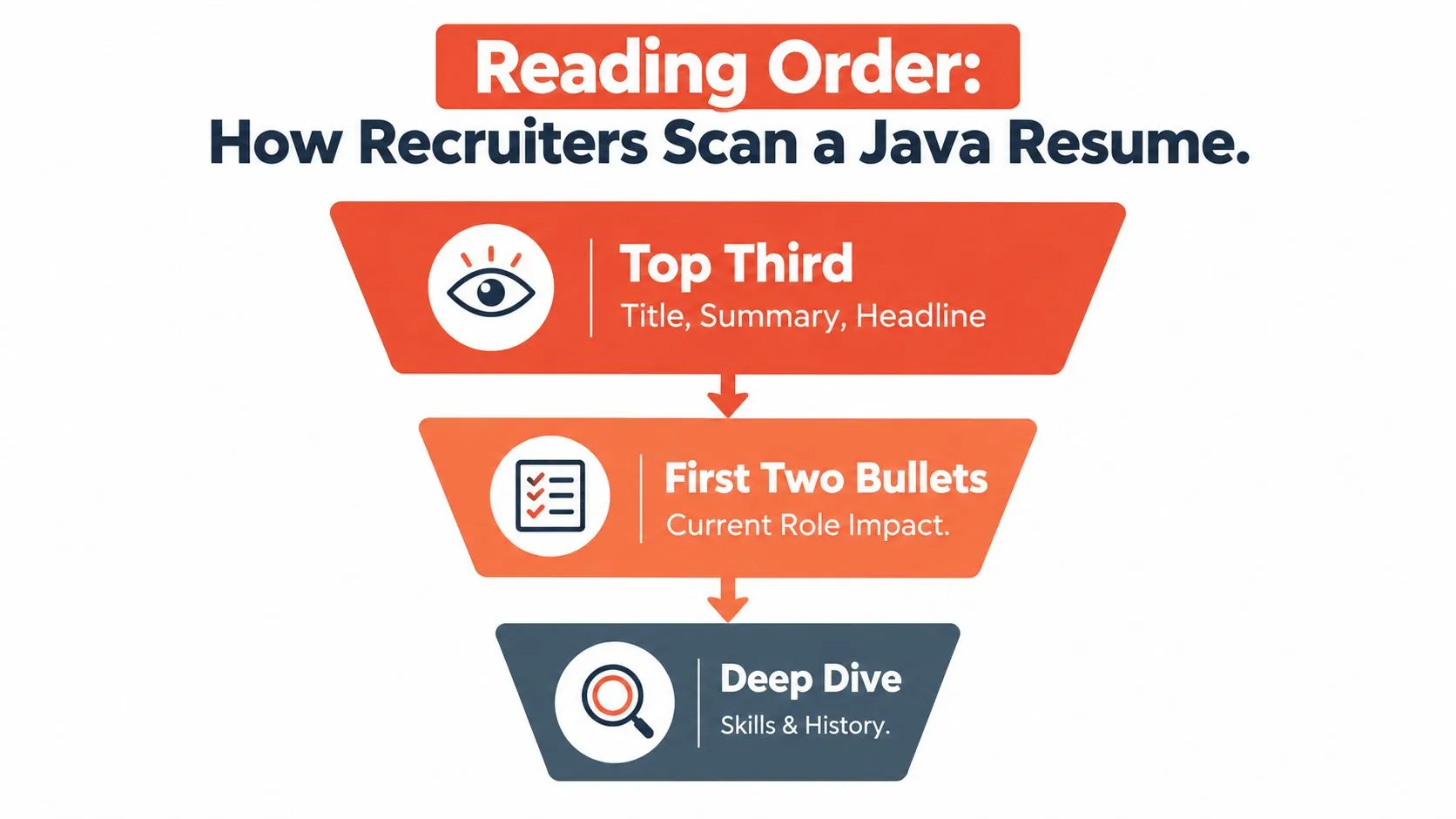
Reading Order How a Recruiter Actually Scans a Java Resume
A recruiter doesn't read your resume from top to bottom with equal attention. They make a sequence of fast decisions, and your layout should support those decisions.
First decision fit
The top third answers, “Is this person relevant?”
Put your target identity in the title line. Java Backend Engineer, Senior Java Developer, or Java Platform Engineer is clearer than “Software Professional.” Under it, write a short summary that names your strongest environment, not every tool you've ever opened.
A useful summary might mention Java 17, Spring Boot, REST APIs, Kafka, and cloud deployment if those technologies describe your recent work. It should also name the kind of problems you solve, such as service reliability, legacy modernization, or high-volume data processing.
The first two bullets under your current role carry disproportionate weight. Lead with the work that demonstrates judgment and current relevance. Don't use those positions for routine maintenance, ceremonies, or generic collaboration language.
Second decision depth
The reader then checks whether your experience has substance. Project names, architecture terms, and the stack help them decide whether to continue.
Put the strongest technical context directly into the bullets. “Order platform” is less useful than “Spring Boot order service” when the role asks for backend API ownership. “Cloud migration” is less useful than the specific migration decision, constraint, and result.
A reverse-chronological history still works, but attention decreases as the reader moves down. Earlier roles should support your story rather than compete with recent evidence.
Third decision proof
The skills section confirms terminology. It shouldn't be the first place where important technology appears.
Group skills into languages, frameworks, tools, databases, testing, and cloud. This makes scanning easier and gives each term a defensible context. For detailed guidance on making bullets easier to scan, use this bullet point formatting guide.
Java Resume Bullet Examples Before and After
Weak bullets aren't always false. They're incomplete. They name the activity and hide the reasoning.
Java Resume Bullets: Before and After
| Role Scenario | Weak Bullet | Strong Bullet |
|---|---|---|
| Backend services | Worked on Java backend development | Built and maintained Spring Boot services for order processing, isolating validation and persistence logic to make releases safer |
| API development | Developed REST APIs using Spring Boot | Designed REST endpoints for account workflows, adding validation and consistent error handling to reduce avoidable client failures |
| Microservices migration | Helped with a microservices migration | Split a tightly coupled billing module from a Java monolith, preserving the existing contract while giving the team independent deployment ownership |
| Performance work | Improved application performance | Profiled a slow Spring Boot endpoint, removed repeated database lookups, and reduced p99 latency based on production measurements |
| Team leadership | Led a team of Java developers | Led design reviews for a small Java team, resolved API ownership disputes, and established review criteria that made changes easier to approve |
The first rewrite demonstrates an important principle. You don't need an impressive scale claim to show value. A small team can still demonstrate ownership, technical reasoning, and a concrete change.
The performance example also avoids a common trap. Don't write a number unless you can defend how it was measured. “Reduced p99 latency” is useful when your monitoring system recorded it. A made-up percentage turns a plausible achievement into a credibility problem.
Use the same discipline for migration work. “Migrated to microservices” is now weak on its own. Explain what you moved, what you preserved, and what tradeoff you accepted. Perhaps you kept a shared database temporarily to reduce migration risk. Perhaps you introduced an event boundary only after stabilizing the existing API. Those details show architecture judgment.
For more transformation patterns, study these resume bullet point examples, but don't copy their wording. Copy the reasoning pattern instead.
Your bullet should answer three questions:
- What part of the system did you own?
- What technical decision did you make?
- What changed because of that decision?
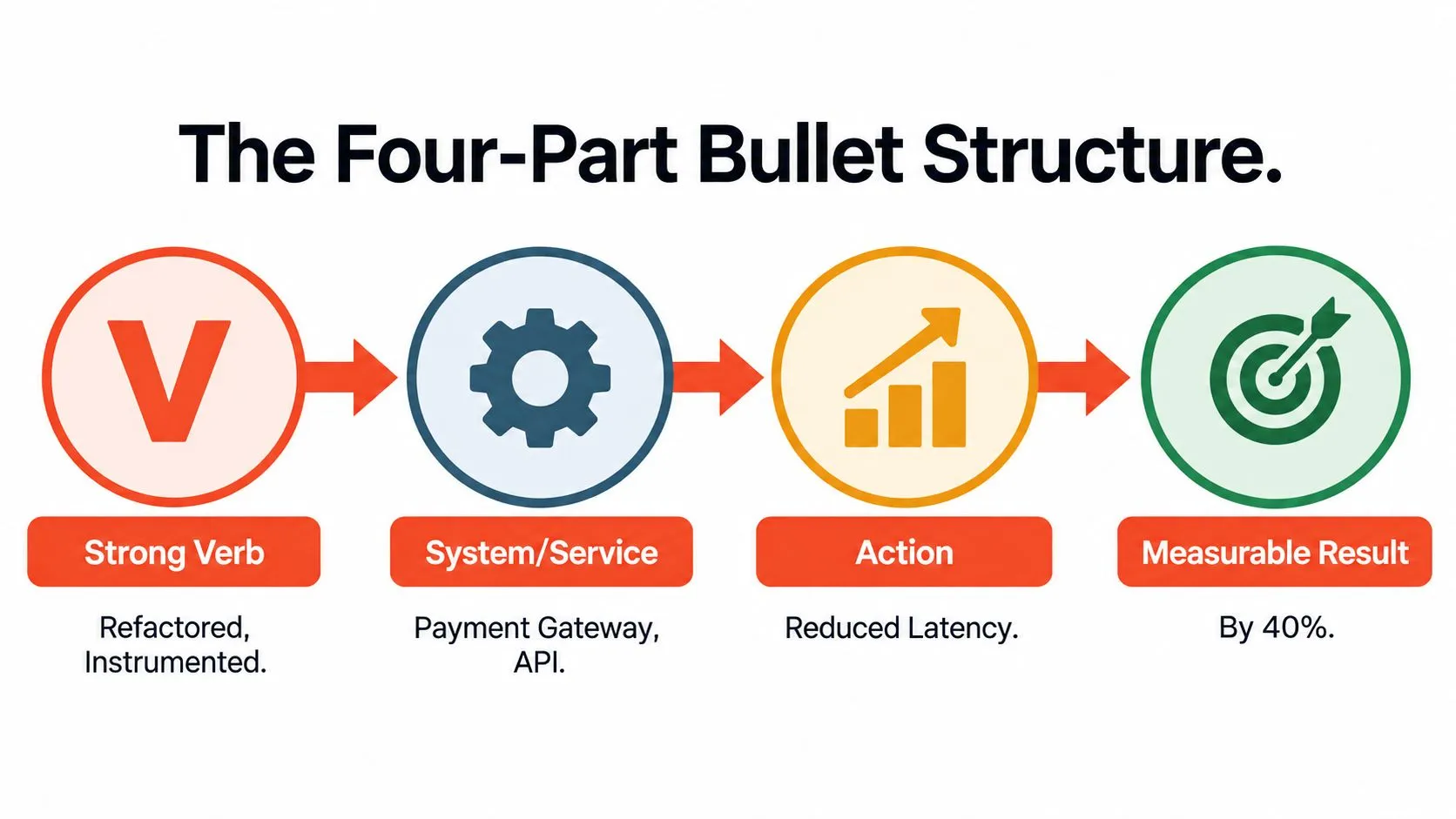
The Four-Part Bullet Structure for Java Roles
Use this order:
Strong verb → system or service → technical action → measurable result or scope
The order matters. Starting with “At Company X, I was responsible for...” buries your contribution before the reader reaches it.
Start with the decision
Choose a verb that describes your actual work. Refactored, instrumented, migrated, designed, tuned, introduced, and automated are useful because they imply action. “Used” rarely does.
Then name the system. A Spring Boot payment service, Kafka consumer, Maven build, JVM workload, or PostgreSQL-backed API gives the action a place to happen.
Name the technical move
“Improved performance” is an outcome without a method. Say that you added instrumentation, changed query access patterns, tuned garbage collection, introduced caching, or changed the deployment pipeline.
A strong bullet might say:
- Tuned a JVM-heavy Spring Boot service after profiling allocation pressure, reducing GC pause time according to production monitoring.
- Instrumented a REST endpoint with application metrics and tracing, isolating a downstream database bottleneck and guiding the remediation.
- Containerized a Maven build with Docker, making environment differences visible before deployment and simplifying the release process.
Don't add a metric because the formula appears to expect one. Use a measured result when you have one. If you don't, use a precise scope or operational consequence.
Finish with proof
Proof can be a measured result, a system boundary, a release improvement, or an ownership detail. It can also be a constraint you handled successfully.
Use this template in your notes:
[Strong verb] [system or service] by [technical action], resulting in [measured outcome, scope, or risk avoided].
Apply it to your last three roles. For backend work, the result may be service reliability or query behavior. For platform work, it may be deployment consistency or observability. For full-stack Java work, it may be a clearer contract between the API and the client.
A short demonstration helps:
- Backend: Refactored a Spring Boot checkout service, separating payment validation from persistence logic and reducing the risk of partial transactions.
- Platform: Instrumented Java services with distributed tracing, giving the team a way to isolate slow downstream calls during incident review.
- Full-stack: Designed a versioned REST contract for a Java service and its web client, allowing backend changes without breaking existing consumers.
Java Keywords That Matter in 2026 and the Ones to Drop
Keywords still matter. Keyword volume doesn't.
For a Java developer resume in 2026, use exact terms that describe your real experience. Java 17, Java 21, Spring Boot, Kafka, Kubernetes, and observability terms carry more information than a broad claim such as “modern technology stack.”
The Java platform has a long memory. Java was publicly launched on 23 May 1995 and first released as Java 1.0 in January 1996. Java 1.1 added JDBC, RMI, JavaBeans, and inner classes in February 1997, while Java 1.2 introduced the Collections Framework and Swing in December 1998, as outlined in this Java history overview. That history explains why strong candidates often need to present both legacy familiarity and current platform work.
| Tier | Examples | How to Use |
|---|---|---|
| Core stack | Java 17 or 21, Spring Boot, REST APIs, Kafka, PostgreSQL, Docker, Kubernetes, AWS, JUnit 5, CI/CD | Put them in the skills section and connect the most relevant terms to recent bullets |
| Seniority signals | Observability, distributed tracing, performance tuning, code review, mentorship, migration planning | Use them when you can describe the decision or responsibility behind the term |
| Low-signal noise | Rockstar, ninja, guru, references available, extensive experience, J2EE without context | Delete them and replace them with evidence |
“J2EE” isn't automatically wrong, but it needs context. Say what you maintained, migrated, or modernized. Java 8 or Java 11 experience can still matter, but older versions should sit beside a credible migration story when the target role emphasizes newer LTS releases.
Run a focused audit. Pull two recent Java job posts, circle the skills repeated three or more times, then mirror the employer's exact language in your skills section and in two to three bullets per role, when truthful. For a realistic view of current openings and their terminology, you can check out LatoJobs listings.
Don't stuff every keyword into every bullet. ATS alignment gets you considered. Relevance and evidence make the resume readable.
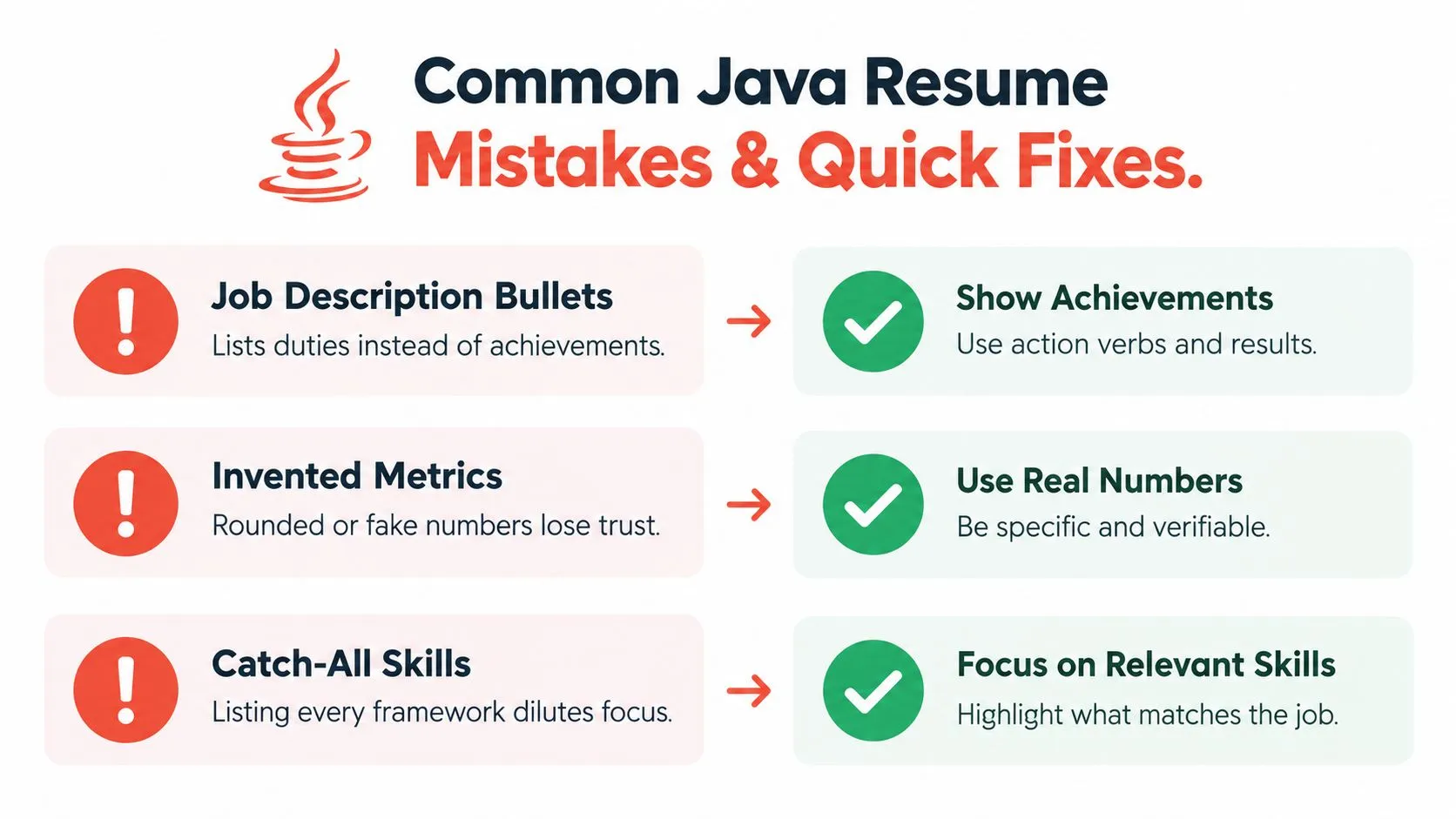
Common Java Resume Mistakes and Quick Fixes
Most Java resumes fail in predictable ways. The fixes are equally predictable, but candidates avoid them because vague writing feels safer than specific writing.
Job description bullets
“Responsible for developing and maintaining Java applications” repeats an employer's need. Replace it with the module, service, or workflow you owned and the change you made.
Invented metrics
Rounded metrics and dramatic claims invite questions you can't answer. Use actual measurements from dashboards, test reports, deployment records, query plans, or incident reviews. If the work had no recorded metric, describe the verified scope instead.
Catch-all skills
A list containing every library you touched during a career dilutes your strongest terms. Keep Java, frameworks, databases, testing tools, cloud services, and build systems you can defend in a technical screen. Separate current strengths from older exposure, or remove the exposure.
Unexplained GitHub links
A raw repository URL isn't proof by itself. Include a project only when the code is clean, documented, and shows production-style thinking such as authentication, error handling, testing, persistence, deployment, or clear architectural boundaries. Tutorial clones don't strengthen a senior Java developer resume.
Team hedging
“We worked on a team that built...” hides your contribution. Name the part you owned: the Kafka consumer, migration adapter, Spring Security configuration, database index strategy, or deployment workflow.
Run this 60-second audit before submitting:
- Top third: Does the title match the role you want?
- Current role: Do the first two bullets show decisions rather than duties?
- Evidence: Can you explain every metric and scope claim?
- Skills: Could you defend every listed framework in an interview?
- Parsing: Is the file single-column, clean, and free of decorative text boxes?
- Ownership: Does each bullet make your personal contribution clear?
A resume shouldn't claim that you built the whole platform when you owned one valuable boundary. Precision sounds more senior than exaggeration.
Turn Your Real Work Into Resume-Ready Bullets
The hardest part isn't learning the formula. It's remembering the work accurately.
Your strongest Java achievements are usually buried in artifacts you already have. Pull request history shows the code you changed. Ticket comments reveal the problem and constraints. Monitoring dashboards show what happened after release.
Use a focused memory-mining session:
- Choose one shipped pull request. Identify the decision you made, not just the files you edited.
- Read the ticket thread. Extract the constraint, such as backward compatibility, limited release time, data safety, or a dependency owned by another team.
- Check the dashboard or incident record. Capture the measurable outcome if one exists. If it doesn't, record the operational result you can verify.
- Write the bullet. Start with the verb, name the service, describe the action, and finish with the result or scope.
Paste this into a notes document:
What was failing, slow, risky, or unclear?
What part did I own?
What decision did I make?
What constraint shaped that decision?
What changed afterward, and where is the evidence?
Don't use this process to pad a resume. Use it to recover the details your memory has compressed into “worked on the payment service.” That phrase may represent a migration, a production incident, a difficult API decision, or a careful rollback strategy. Your resume needs the story.
Pick one shipped pull request from the last six months and write the bullet before closing the tab. Then repeat the process for the next two roles that matter most to the job you're targeting.
StoryCV is an online resume writer that asks about the work you did, then turns your answers into clear, resume-ready bullets. Visit StoryCV to talk through a Java role, recover the decisions and outcomes you remember only partially, and shape them into evidence a recruiter can read.